Action Item Tracking Statistics 2026


Used by recruiters, executives, consultants, and more.
Action Item Tracking Statistics 2026
44% of action items from meetings never get completed. Action item completion rates jump from 50-60% to 85-95% when teams adopt automated tracking. The project management software market is projected to reach $10 billion by 2026. Only 46% of employees know what is expected of them. These 16 statistics reveal why action item tracking is the critical link between decisions and results in the modern workplace.
Every meeting, email thread, and conversation generates commitments. Someone agrees to do something by a certain date. The question is whether those commitments survive long enough to be completed. The data shows that without systematic tracking, nearly half of all action items are forgotten, deprioritized, or abandoned. This is not a discipline problem. It is a systems problem.
This post covers 16 statistics on action item tracking in 2026. The data draws from project management research, workplace productivity studies, and organizational effectiveness surveys. Whether you manage projects, lead teams, or simply want to follow through on your own commitments, these numbers reveal the scale of the tracking gap and how to close it.
1. 44% of action items from meetings are never completed
The action item completion crisis is severe. Research shows that 44% of action items generated in meetings never reach completion. For every 10 tasks assigned during a meeting, 4 to 5 simply disappear. The causes are predictable: no clear owner, no deadline, no tracking system, and no follow-up mechanism. When action items exist only in meeting notes or individual memories, they compete with every other demand for attention, and they usually lose.
Source: Fellow - How to Manage Meeting Action Items
2. Automated tracking boosts action item completion from 50-60% to 85-95%
The impact of systematic tracking is dramatic. Teams that move from manual to automated action item tracking systems see completion rates nearly double, jumping from 50-60% to 85-95%. This improvement comes from three capabilities that manual processes lack: persistent visibility that keeps tasks in front of owners, automated reminders that prevent tasks from being forgotten, and clear ownership records that eliminate ambiguity about who is responsible. The technology is not the hero. The system design is.
Source: Fellow - How to Track Action Items
3. Project management software is projected to reach $10 billion by 2026
The market for tools that track and manage work has reached massive scale. Project management software is predicted to grow at a compound annual growth rate of 10.67% and will touch $10 billion by 2026. This growth reflects the recognition that knowledge work requires infrastructure for tracking commitments. As teams become more distributed and communication channels multiply, the need for centralized tracking systems grows proportionally.
Source: ProProfs Project - Project Management Statistics 2026
4. 71% of organizations use Agile methodology in some form
The majority of organizations have adopted iterative, commitment-driven work management. 71% of organizations worldwide use Agile project management methodology in some way. Agile's emphasis on short cycles, clear deliverables, and regular review naturally supports action item tracking. The sprint cycle creates a built-in accountability loop where commitments must be completed within a defined timeframe. Organizations using Agile effectively see higher action item completion rates than those using traditional approaches.
Source: ClickUp - Project Management Statistics 2025
5. Only 46% of employees strongly agree they know what is expected
Action items fail when expectations are unclear. Gallup data shows that only 46% of U.S. employees strongly agree they know what is expected of them at work. When more than half the workforce lacks clarity about expectations, action items become ambiguous by default. Does "follow up with the client" mean send an email, schedule a call, or prepare a proposal? Without precise definitions, action items are completed differently than intended or not at all.
Source: Gallup - State of the Global Workplace 2025
6. 58% of projects experience cost overruns
The consequences of poor tracking extend to project finances. Research shows that approximately 58% of projects experience cost overruns, often traced to tasks that took longer than expected, dependencies that were not tracked, and action items that were completed late or incorrectly. Each untracked or poorly tracked action item introduces variance into project timelines and budgets. At scale, these small tracking failures accumulate into significant financial overruns.
Source: ProProfs Project - Project Management Statistics 2026
7. 78% of projects experience time overruns
Timeline overruns are even more common than budget overruns. 78% of projects experience time overruns according to research spanning nearly two decades of project data. The primary cause is not poor estimation. It is poor tracking of the individual tasks and action items that comprise the project timeline. When action items slip by days or weeks without detection, the cumulative delay compounds until the project misses its deadline by margins that seem inexplicable in retrospect.
Source: ProProfs Project - Project Management Statistics 2026
8. 25% of organizations using digital tools report higher project completion rates
Adopting digital collaboration tools has a measurable impact on completion. Among organizations that have adopted digital collaboration platforms, 25% report a noticeable increase in project completion rates. This improvement comes from better visibility into task status, easier communication between team members, and automated tracking of dependencies and deadlines. The 25% improvement represents the minimum return. Organizations that fully integrate tracking into their workflows see even larger gains.
Source: ClickUp - Project Management Statistics 2025
9. Only 27% of organizations always apply risk management to projects
Most organizations do not systematically anticipate what could go wrong. Only 27% of organizations always apply risk management to their project plans, while 35% do so periodically. Action items are where risk materializes. When a critical task is not completed on time, project risk becomes project reality. Systematic tracking allows teams to identify at-risk action items before they become project failures, but only if the tracking is consistent and the visibility is real-time.
Source: ClickUp - Project Management Statistics 2025
10. 53% of organizations struggle to foster collaboration among hybrid teams
The hybrid work model has made action item tracking more complex. 53% of organizations report struggling to foster collaboration among hybrid teams. When team members work across different locations, time zones, and communication platforms, action items get lost in the gaps between channels. A task mentioned on a video call may never make it to the project board. A commitment made in a Slack thread may be buried by the next day. Hybrid teams need more systematic tracking, not less.
Source: ClickUp - Project Management Statistics 2025
11. Managers save 5-10 hours per week with AI-powered action item systems
The administrative burden of tracking action items manually is substantial. When teams implement AI-powered action item management with proper integrations, managers report saving 5 to 10 hours per week on administrative overhead. This time savings comes from automated capture, automatic assignment, and intelligent follow-up reminders that replace manual note-taking, email follow-ups, and status check meetings. The freed time can be redirected to coaching, strategy, and focused work.
Source: MyMeet AI - Action Items Complete Guide 2026
12. Less than half of retrospective action items are ever completed
Even in teams that regularly reflect on their processes, follow-through is poor. Across hundreds of teams studied, less than half of sprint retrospective action items ever get completed. This is particularly concerning because retrospective items are specifically designed to improve the team's own processes. If teams cannot even follow through on self-improvement commitments, the tracking infrastructure is fundamentally inadequate. The pattern suggests that completing action items requires more than good intentions. It requires systems.
Source: Easy Agile - Improve Retrospective Action Items
13. Action items without deadlines are the most likely to be forgotten
Research on task completion consistently shows that action items without deadlines have the lowest completion rates. When a task has no due date, it exists in a perpetual "I'll get to it" state that competes with every deadline-driven task on the list. Effective action item tracking requires three non-negotiable elements: a clear owner, a specific deadline, and a visible tracking mechanism. Remove any one of these, and the probability of completion drops dramatically.
Source: Asana - What is an Action Item 2026
14. Individual ownership drives completion more than team ownership
Accountability research shows that action items assigned to specific individuals are completed at significantly higher rates than those assigned to groups or teams. "The marketing team will handle it" produces far lower follow-through than "Sarah will complete it by Friday." Individual ownership creates personal accountability that team ownership dilutes. The best tracking systems enforce individual assignment as a required field, making it impossible to create an action item without a named owner.
Source: Fellow - How to Track Action Items
15. 52% of employees report hybrid working arrangements in 2025
The scale of distributed work amplifies the tracking challenge. 52% of employees in surveyed populations report hybrid working arrangements. In hybrid environments, action items are generated across in-person meetings, video calls, chat messages, emails, and voice conversations. Without a unified tracking system that captures action items from all channels, tasks will be lost in the fragmentation. The more communication channels a team uses, the more critical systematic tracking becomes.
Source: ClickUp - Project Management Statistics 2025
16. Carrying forward incomplete items to the next agenda creates accountability loops
One of the most effective tracking practices is also one of the simplest. Research on meeting effectiveness shows that carrying forward incomplete action items to the next meeting agenda creates a natural accountability loop. When participants know that unfinished tasks will be reviewed publicly, completion rates increase. This practice works because it makes action item status visible without requiring additional tracking infrastructure. The next meeting becomes both a deadline and an accountability mechanism.
Source: iBabs - Meeting Follow-Up Action Items
Tracking Is the Difference Between Planning and Doing
The data reveals an uncomfortable truth: most organizations are excellent at generating action items and poor at completing them. The 44% non-completion rate means that nearly half of every meeting's output, every project plan's tasks, and every team discussion's commitments produce nothing. This is not because the work is too hard. It is because the tracking is too weak.
The automation data is the most instructive. When teams adopt systematic tracking, completion rates nearly double. This proves that the problem is solvable. Workers are willing and able to complete their commitments when those commitments are visible, owned, dated, and tracked. The breakdown happens in the gap between verbal agreement and systematic tracking.
The hybrid work trend makes this even more urgent. With 52% of workers in hybrid arrangements, action items are generated across more channels, more time zones, and more communication platforms than ever before. Without unified tracking, the fragmentation of modern work creates fragmented follow-through.
Organizations do not fail because they lack ideas, decisions, or plans. They fail because they lack the tracking systems that turn commitments into completions.---
Turn every meeting into tracked, completed action items
The action item tracking gap begins at the moment of capture. When commitments are made verbally in meetings, they must be captured, assigned, and tracked before they can be completed. Manual note-taking catches some. Memory catches less. AI-powered voice recording catches everything.
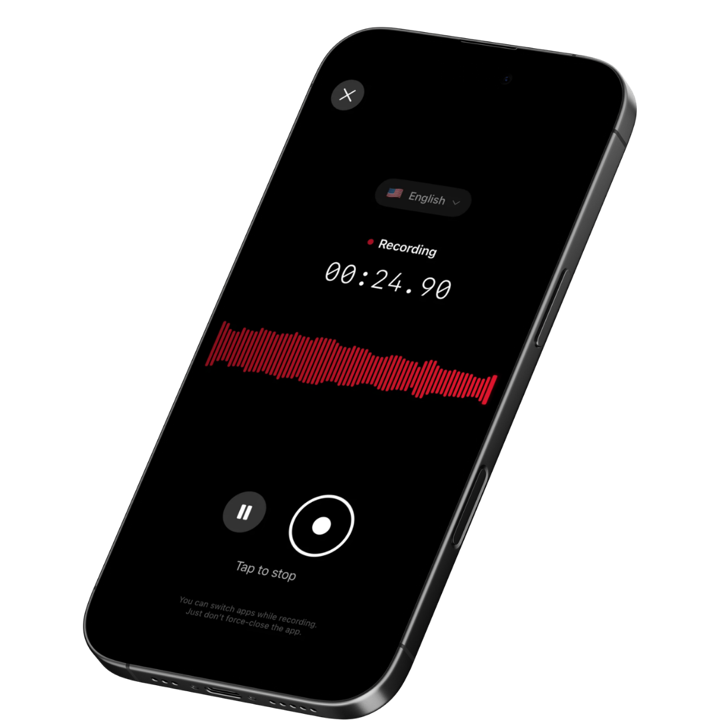
SpeakWise records your meetings, transcribes every word, and automatically extracts action items. Each action item comes with context from the conversation, making it clear what was committed and why. Sync to Notion and every commitment becomes a trackable task.
Download SpeakWise from the App Store and transform your meeting action items from forgotten verbal commitments into tracked, visible tasks. AI extraction, Notion integration, and intelligent summaries ensure nothing falls through the cracks.
Join 10,000+ professionals who have closed the action item gap with voice-powered tracking.
Get SpeakWise Free
4.9-star App Store Rating | iOS Optimized

🎯 4.9★ App Store Rating | 📱 Built for iOS
