Attention Span Statistics 2026: Focus Duration, Digital Shrinkage, and Cognitive Decline
Used by recruiters, executives, consultants, and more.
Attention Span Statistics 2026: Focus Duration, Digital Shrinkage, and Cognitive Decline
The average human attention span on a screen has collapsed to just 47 seconds-down from two and a half minutes in 2004. Americans now check their phones 205 times per day, knowledge workers face 275 interruptions during every workday, and a landmark meta-analysis of nearly 100,000 participants has linked short-form video use to measurably poorer attention and inhibitory control. The data is no longer ambiguous: our capacity for sustained focus is eroding in real time.
We are living through what may be the largest uncontrolled experiment in human cognition. Over the past two decades, smartphones, social media feeds, push notifications, and algorithmic content have rewired the attentional landscape for billions of people. The consequences are visible everywhere-in classrooms where students cannot sustain focus through a lecture, in workplaces where deep work has become nearly impossible, and in personal lives where people struggle to finish a book, watch a movie without scrolling, or hold a conversation without glancing at a screen. The question is no longer whether digital technology affects attention. The question is how much damage has already been done, and whether the trajectory can be reversed.
In this post, we'll explore 17 statistics that quantify the decline of human attention in the digital age. These numbers span academic research, workplace productivity data, neuroscience studies, and large-scale surveys to paint a comprehensive picture of where our attention has gone-and what we've lost along the way. Whether you're a knowledge worker fighting to carve out focus time, a parent concerned about your child's cognitive development, or a leader trying to understand why your team's output doesn't match their hours, these data points tell the story of our collective attention crisis.
1. The average attention span on a screen has dropped to 47 seconds-down from 2.5 minutes in 2004
Gloria Mark, a professor of informatics at the University of California, Irvine, has been measuring how long people sustain attention on a single screen for nearly two decades. Her research, detailed in her 2023 book Attention Span, reveals a dramatic and accelerating decline: in 2004, the average attention span on any given screen was two and a half minutes. By 2012, it had fallen to 75 seconds. Her most recent measurements, corroborated by five independent studies between 2014 and 2020, place the average at just 47 seconds-with one replication finding 44 seconds and another finding 50 seconds. In a 2016 study, the median was even lower at 40 seconds, meaning half of all observations were shorter than that. This is not a measurement of maximum attention capacity; it's a measurement of how long people actually stay focused before switching to something else in a real digital environment-and the trend line points relentlessly downward. Source: University of California - Can't Pay Attention? You're Not Alone
2. It takes 23 minutes and 15 seconds to fully refocus after a single interruption
Gloria Mark's research at UC Irvine established one of the most consequential findings in productivity science: after a single interruption, it takes an average of 23 minutes and 15 seconds to fully return to the original task. Critically, people don't jump directly back to what they were doing-there are typically two intervening tasks before the original work is resumed. Mark's research also found that interruptions are associated with significantly higher levels of stress, frustration, mental effort, time pressure, and cognitive workload. When you consider that modern workers face interruptions every few minutes, the arithmetic becomes devastating: there simply aren't enough minutes in the day to recover from the interruptions that day contains. Source: UC Irvine - The Cost of Interrupted Work: More Speed and Stress
3. Workers are interrupted every 2 minutes during core work hours-275 times per day
Microsoft's 2025 Work Trend Index, based on analysis of trillions of productivity signals across its platform, found that employees face a ping from meetings, emails, or chats every two minutes during core work hours-adding up to approximately 275 interruptions per day. The study, conducted by Edelman Data x Intelligence among 31,000 knowledge workers across 31 markets, also found that workers receive an average of 117 emails and 153 Teams messages daily. The result: nearly half of employees (48%) and more than half of leaders (52%) describe their work as feeling "chaotic and fragmented," while 68% of employees say they struggle with work pace and volume. Source: Microsoft Work Trend Index 2025 - Breaking Down the Infinite Workday
4. The famous "8-second attention span" claim-shorter than a goldfish-was never real science
One of the most widely cited statistics in the attention span conversation-that humans now have an 8-second attention span, one second shorter than a goldfish-was popularized after appearing in a 2015 report by Microsoft Canada. However, extensive investigation has revealed that Microsoft did not actually produce this finding. The 8-second figure appeared in the report with a citation to an organization called Statistic Brain, and subsequent analysis found the data was entirely fabricated. There is no peer-reviewed research supporting an 8-second human attention span, and no scientific evidence that goldfish have a 9-second attention span either-fish can sustain attention for far longer. The myth persists because it feels intuitively true, but the science does not support it as a literal measurement. Source: TIME - Science: You Now Have a Shorter Attention Span Than a Goldfish
5. Americans check their phones 205 times per day-once every 5 minutes during waking hours
A 2024 survey by Reviews.org found that Americans now check their phones an average of 205 times per day, a 42.3% increase from the previous year. That translates to approximately once every five minutes during waking hours-a rate so high that no cognitive task can survive uninterrupted for more than a few minutes. The same body of research found that 80.6% of Americans check their phone within the first 10 minutes of waking up, and that the average American now spends 4 hours and 30 minutes on their phone daily-up 52% from 2 hours and 54 minutes in 2022. Among Millennials, the numbers are even more extreme, with some studies reporting phone checks averaging 324 times per day. Each check represents a micro-interruption that fragments whatever cognitive task was underway, and the compulsive nature of the behavior means even awareness of the problem rarely translates to behavioral change. Source: Reviews.org - Cell Phone Addiction Statistics
6. Short-form video use is linked to poorer attention and inhibitory control across nearly 100,000 participants
A systematic review and meta-analysis published in Psychological Bulletin, comprising data from 98,299 participants across 70 studies, found that increased short-form video use on platforms like TikTok, Instagram Reels, and YouTube Shorts was associated with measurably poorer cognitive performance. The strongest negative associations were with attention span (r = -.38) and inhibitory control (r = -.41), meaning frequent users showed greater difficulty sustaining focus and suppressing impulsive reactions. The researchers-led by Lan Nguyen and colleagues-also found links to elevated anxiety (r = -.33), depression, and stress. Notably, compulsive usage patterns produced stronger negative effects than simple time spent, suggesting that addiction-like engagement is the primary driver of cognitive harm. Source: PsyPost - Large Meta-Analysis Links TikTok and Instagram Reels to Poorer Cognitive and Mental Health
7. The average knowledge worker gets only 1 hour and 12 minutes of uninterrupted focus per day
RescueTime, which tracks digital activity across millions of users, found that the average knowledge worker has just 1 hour and 12 minutes per day of completely uninterrupted focus time-time without any communication tool check or app switch. Their data reveals that knowledge workers check email or messaging platforms every 6 minutes on average, and that 40% of knowledge workers never get more than 30 straight minutes of focused time in an entire workday. Meanwhile, 17% of workers cannot achieve even 15 consecutive minutes without a communication interruption. In an eight-hour workday, 85% of available time is consumed by shallow, fragmented activity. Source: RescueTime - Communication Multitasking: You Only Get 1h 12min/day Without Email
8. Lost focus costs the U.S. economy $468 billion per year
A 2023 study by Economist Impact, commissioned by Dropbox, surveyed over 1,000 knowledge workers and modeled the economic cost of lost focus across ten countries. The findings are staggering: in the United States alone, $468 billion is lost annually to workplace distractions-approximately $37,000 per manager and $21,000 per individual contributor. Globally, the economic opportunity of addressing lost focus exceeds $1.4 trillion in the U.S., $244 billion in Germany, $188 billion in the UK, and $176 billion in Japan. The study also found that unproductive meetings waste 79 hours per worker per year, while unproductive chat messages-the biggest driver of lost focus-waste 157 hours annually. Source: Dropbox Blog - Economist Impact: The Cost of Lost Focus
9. 42% of knowledge workers can't sustain more than one hour of productive work without interruption
The same Economist Impact study revealed that 42% of knowledge workers report they typically cannot spend more than one hour on productive work without being interrupted. This finding aligns with the RescueTime data showing that most workers max out at 40 minutes of sustained focus before a communication interruption breaks their flow. The compounding effect is what makes this statistic so damaging: it's not just that workers lose focus once per hour, it's that each interruption requires significant recovery time before productive work resumes. A worker who is interrupted once per hour and needs 23 minutes to recover has effectively lost nearly half their productive capacity. Source: Dropbox Blog - Economist Impact: The Cost of Lost Focus
10. Multitasking reduces productivity by up to 40%
Research from the American Psychological Association, including work by Rubinstein, Meyer, and Evans, demonstrates that task switching can consume up to 40% of a person's productive time. What people perceive as multitasking is actually rapid switching between tasks, and each switch imposes a "time cost" as the brain disengages from one set of rules, goals, and context and loads another. The APA's research also found that roughly 40% of adults routinely multitask with digital devices, and those who do report significantly higher stress levels and lower productivity than those who engage in sequential, focused work. The 40% productivity loss means an 8-hour workday yields only 4.8 hours of effective output. Source: American Psychological Association - Multitasking: Switching Costs
11. Teens receive an average of 237 notifications per day on their smartphones
A 2023 study by Common Sense Media titled "Constant Companion: A Week in the Life of a Young Person's Smartphone Use" used monitoring software to track the actual notification volume hitting teenagers' phones. The median participant received 237 or more notifications per day, with some teens receiving nearly 5,000 notifications in a single 24-hour period. Approximately 23% of these notifications arrived during school hours, and 5% arrived at night-interrupting both learning and sleep. The study, which tracked a diverse sample of roughly 200 participants aged 11 to 17, illustrates why sustained attention has become particularly challenging for young people growing up in a notification-saturated environment. Source: Common Sense Media - Teens Are Bombarded with Hundreds of Notifications a Day
12. 60% of knowledge workers' time is spent on coordination, not skilled work
Research from Asana's Anatomy of Work Index found that 60% of knowledge workers' time is consumed by what they call "work about work"-communicating about tasks, searching for information, switching between applications, managing competing priorities, and chasing status updates. Only 40% is spent on the skilled, strategic, or creative work these individuals were hired to do. Cal Newport, the Georgetown computer science professor who coined the term "deep work," estimates that experts can sustain a maximum of about four hours of truly focused cognitive work per day-but most knowledge workers never come close to even one hour of uninterrupted depth. This constant coordination work fragments attention by its very nature: each email response, each Slack reply, each meeting join forces a context switch that breaks whatever focused task was previously underway. The result is a workforce that feels perpetually busy but rarely deeply productive. Source: Asana - What Is Deep Work
13. 80% of workers say they lack the time or energy to do their job effectively
Microsoft's 2025 Work Trend Index found that a staggering 80% of workers report they don't have enough time or energy to do their job effectively-a direct consequence of the fragmented, interruption-heavy work environment that modern digital tools have created. The report found that 46% of workers are actively burned out, and 60% of meetings are now ad hoc rather than scheduled, meaning workers cannot reliably plan or protect focus blocks. When four out of five workers tell you the system is broken, the system is broken. The interruption-driven workplace doesn't just reduce output-it undermines the human beings inside it. Source: Microsoft Work Trend Index 2025
14. After using TikTok, participants' prospective memory dropped to near random guessing
A controlled laboratory experiment tested how different social media platforms affected prospective memory-the ability to remember to carry out intended actions in the future. After using TikTok, participants' accuracy dropped so sharply that they performed only slightly better than random guessing. Remarkably, Twitter and YouTube showed no measurable impact on prospective memory in the same experiment. This finding suggests something specific about the short-form, rapid-scrolling, algorithmically optimized nature of TikTok's content delivery that uniquely impairs the brain's ability to hold and execute future intentions-a cognitive function essential for planning, goal-setting, and following through on tasks. Source: Holy Family University - TikTok Impact on Attention and Memory
15. The average worker loses 1 hour and 18 minutes per day-nearly 340 hours per year-to distractions
Workplace distraction research consistently shows that the average U.S. worker loses approximately 1 hour and 18 minutes daily to distractions, which compounds to nearly 340 hours of lost productivity per year-equivalent to more than eight full working weeks. The research also found that 98% of the workforce is interrupted at least 3 to 4 times per day, and nearly 1 in 4 workers are interrupted more than six times per workday. When combined with the 23-minute refocusing cost per interruption, each of these disruptions doesn't just steal the moment of interruption-it creates a cascading productivity loss that extends far beyond the interruption itself. Source: Clockify - Effects of Workplace Distractions: 2025 Statistics
16. 59% of workers cannot focus for even 30 minutes without getting sidetracked
Research on workplace distractions reveals that 59% of employees report being unable to focus for even 30 minutes without getting sidetracked by a digital distraction. Among managers, the situation is even worse: 59% of managers reported being interrupted by a digital platform every 30 minutes or less-a notably higher rate than individual contributors. The data also shows that 50% of employees identify their phone as their primary source of workplace distraction. What makes this statistic particularly alarming is that 30 minutes represents the minimum threshold for most forms of cognitively demanding work-writing, analysis, coding, strategic thinking. If the majority of workers cannot sustain even this baseline, deep work has effectively become inaccessible. Source: TeamStage - Workplace Distractions Statistics 2024
17. 76% of people respond to notifications within five minutes of receiving them
Research on notification behavior shows that 76% of people respond to smartphone notifications within the first five minutes of receiving them-effectively making every notification a guaranteed interruption with near-zero delay. This reflexive response behavior turns the hundreds of daily notifications documented in other studies into hundreds of actual focus breaks. The behavior appears driven by a combination of FOMO, dopamine-seeking, and the operant conditioning created by variable-reward notification systems that social media platforms have deliberately engineered. When three-quarters of the population cannot resist a notification for even five minutes, the concept of "protected focus time" becomes nearly impossible without physically separating people from their devices. Source: ConsumerAffairs - Cell Phone Statistics 2026
The Attention Paradox: We Built the Tools That Broke Our Focus
The seventeen statistics above tell a story that is simultaneously obvious and invisible. Obvious, because everyone who has tried to write a report while Slack pings, emails arrive, and their phone buzzes already knows-intuitively, experientially-that sustained focus has become nearly impossible. Invisible, because the erosion happens so gradually, and the interruptions feel so individually trivial, that the cumulative scale of the damage goes unrecognized. No one notices that their attention span has dropped from 2.5 minutes to 47 seconds, because the shift happened over twenty years and was masked by the convenience of the very devices causing it. The goldfish comparison may have been fabricated, but the underlying reality it gestures toward-that our attentional capacity is in decline-is robustly supported by two decades of research.
The data reveals a feedback loop that is extraordinarily difficult to escape. Shortened attention spans make us more susceptible to notifications, which further fragment our attention, which makes us more reliant on quick digital stimuli, which shortens our attention spans further. Platforms designed to capture and monetize attention have become extraordinarily effective at their job-so effective that the cognitive capacity of their users is being measurably degraded in the process. A meta-analysis of nearly 100,000 people found that short-form video use is associated with poorer attention and reduced inhibitory control. The effect sizes are not trivial: correlations of -.38 for attention and -.41 for inhibitory control place these findings in the range of meaningful, real-world impact. We are not just distracted. We are being cognitively reshaped by the tools we use, in ways that compromise our ability to think deeply, plan effectively, and follow through on intentions.
The workplace implications are profound and far-reaching. When the average knowledge worker gets only 1 hour and 12 minutes of uninterrupted focus per day, and 60% of their time is spent on coordination rather than skilled work, the output gap between what organizations pay for and what they actually receive is enormous. The $468 billion annual cost of lost focus in the U.S. alone is not an abstract number-it is the sum of millions of workers each losing hundreds of hours to an interruption architecture that was never designed with human cognition in mind. And it extends beyond productivity: 80% of workers report lacking the time or energy to do their job effectively, and 46% are actively burned out. The attention crisis is also a wellbeing crisis, a retention crisis, and ultimately a crisis of human potential left unrealized.
Perhaps most importantly, the statistics suggest that the solution is not willpower. When 76% of people cannot resist a notification for five minutes, and 59% cannot focus for 30 minutes, the problem is environmental, not motivational. Individual discipline cannot overcome systems explicitly engineered to capture attention. The most effective interventions will be those that change the information architecture around us-systems that capture thoughts, ideas, and information without requiring the cognitive overhead of typing, app switching, and manual organization that currently shatters our focus. The future of productivity belongs not to those who resist distraction the hardest, but to those who design workflows that make distraction irrelevant.
The average human attention span on a screen is now 47 seconds. The recovery time from a single interruption is 23 minutes. The math doesn't work. The only winning strategy is to capture your best thinking before the next interruption arrives-because it's always only seconds away.
Ready to capture your thoughts before they vanish?
These 17 statistics make one thing painfully clear: the window for capturing an idea, insight, or decision is shrinking every year. With attention spans measured in seconds and interruptions arriving every two minutes, the gap between having a thought and losing it has never been narrower. A fleeting insight during a meeting, a breakthrough idea on a morning walk, a critical action item mentioned in passing-all of these evaporate when the next notification arrives, and the data shows that the next notification is always only seconds away. Traditional note-taking methods-opening an app, finding the right document, typing out your thinking-require exactly the kind of sustained, distraction-free focus that the data shows most people no longer have.
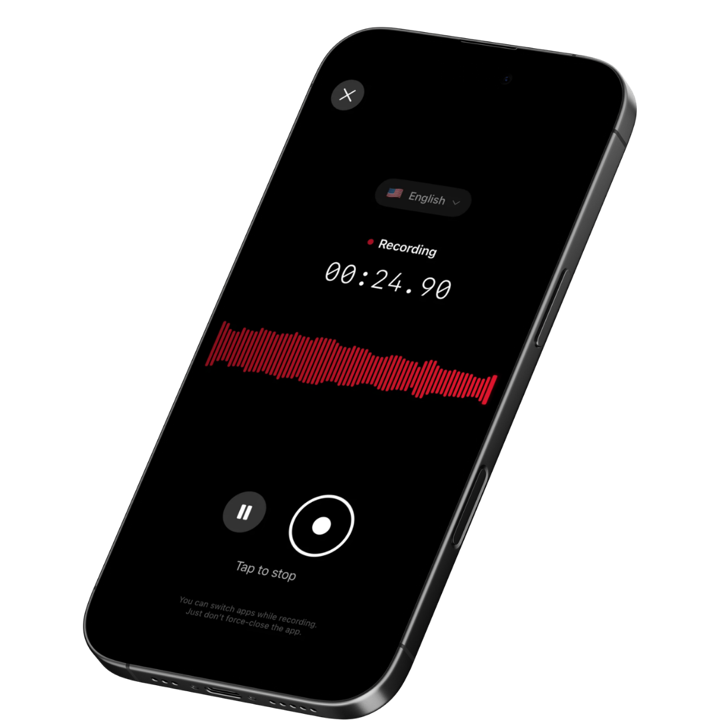
Voice capture offers a fundamentally different approach. Instead of trying to hold everything in a shrinking attention window, you speak your thoughts the moment they arise-and AI handles the rest. No typing. No app switching. No lost ideas. A dedicated voice-to-text app for iPhone turns those spoken thoughts into searchable notes in a single tap.
Download SpeakWise from the App Store and discover how one-tap recording, AI transcription, intelligent summaries, and Notion integration can help you capture information the instant it matters-before your attention moves on.
Join 10,000+ professionals who've discovered that the best response to a shrinking attention span isn't fighting it-it's working with it.
Get SpeakWise Free →
4.9★ App Store Rating | iOS Optimized

🎯 4.9★ App Store Rating | 📱 Built for iOS
