Best AI Scribe for Telehealth Visits (2026)
Used by recruiters, executives, consultants, and more.
Best AI Scribe for Telehealth Visits in 2026
You finished your last telehealth visit at 7:15 PM. Eight notes still sit half-written in your EHR. Telehealth audio is actually cleaner than in-person audio (no room noise, separate microphone channels, consistent levels), so AI transcription accuracy is higher. The question is which AI scribe you trust on the iPhone you use for the visit, the laptop you use for the EHR, or both. We tested and compared the top options - here are the 6 best AI scribes for telehealth visits in 2026.
The best AI scribes for telehealth visits in 2026 are: 1) Speakwise for iPhone-first telehealth providers and concierge clinicians, 2) Nabla Copilot for cross-device telehealth workflow, 3) Heidi Health for free-tier multilingual telehealth, 4) Twofold Health for telehealth-specific templates, 5) Freed for solo virtual primary care, and 6) Abridge for enterprise telehealth on Epic. Speakwise wins for solo and concierge telehealth clinicians who do not have or want EHR integration.
1. Speakwise - Best Overall AI Scribe for iPhone Telehealth
Speakwise is an iPhone-native AI voice notes and transcription app that telehealth providers use to capture virtual visits with one tap or AirPods hands-free. It transcribes with 95%+ accuracy in 100+ languages and produces a structured AI summary that maps directly to SOAP, H&P, or progress note formats. With a 4.9-star App Store rating and a $59.99 per year price, it is the most accessible AI scribe for any virtual care provider working outside an enterprise EHR contract.
Why Speakwise Stands Out
The standard AI scribe for telehealth assumes you are sitting at a desktop, on Zoom or Doxy.me, with Epic or Athena open in another window. That is a real workflow, but it is not the only one. The fastest-growing telehealth segment in 2026 is the solo concierge clinician, the locum doing virtual urgent care between in-person shifts, and the second-opinion specialist reviewing cases on a phone between commutes. Those clinicians work on iPhones, not on $40,000 EHR seats.
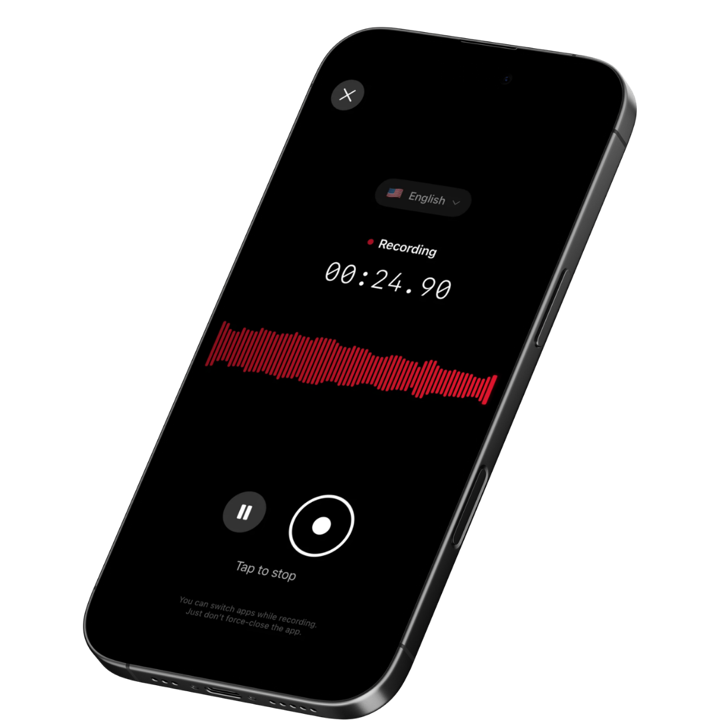
Speakwise serves that workflow directly. You take the telehealth call on your iPhone (or on a laptop with the iPhone next to you capturing audio through the room microphone), tap record, and get a clean transcript and AI summary by the time the visit ends. You do not need to integrate with Doxy, Zoom, Teladoc, or Amwell. The audio capture is platform-agnostic.
The defensible feature for telehealth is Telehealth visits often involve cross-state regulatory complexity, multilingual patients, and PHI exposure that varies by jurisdiction. keeps the audio on the iPhone instead of routing through a third-party cloud. For solo telehealth providers who do not want to manage another vendor BAA, that single feature changes the calculus. Pair that with the $59.99 per year flat price (versus $39 to $300+ per month for rivals) and Speakwise becomes the obvious starting point for iPhone-first virtual care.
Key Features
- 95%+ transcription accuracy: Telehealth audio is typically cleaner than in-person, so transcription accuracy is at the top of the range. The verbatim transcript and AI summary live in the same view.
- Long Recording Support: Multi-hour board meetings, conference sessions, offsites.
- Works Offline: Construction sites, secure boardrooms, planes - record without WiFi. Sync when you're back.
- Platform-agnostic audio capture: Works with Doxy.me, Zoom, Teladoc, Amwell, Microsoft Teams, FaceTime, or any other telehealth platform. There is no API integration to set up because the audio is captured directly on the iPhone.
- AI summaries that map to SOAP and H&P: The summary extracts key points, decisions, and follow-up tasks. Subjective and Objective findings appear in key points; Assessment and Plan appear in decisions and action items.
- 100+ languages with auto-detection: Telehealth often serves multilingual populations across state lines. Speakwise handles Spanish, Mandarin, Vietnamese, Arabic, and 46+ other languages with accurate auto-detection.
- One-tap and AirPods hands-free capture: Start recording before joining the telehealth call. AirPods mode means you can keep the iPhone away from your face during video and still capture the audio cleanly. Compare to in-person setups in our meeting recording iPhone roundup.
Pricing
-
Free Trial: Full access to all features
-
Premium: $59.99/year - unlimited transcription, AI summaries, Notion sync, 100+ languages, ### Best For
-
Solo and concierge telehealth providers
-
Locums doing virtual urgent care
-
Multilingual telehealth practices
-
Clinicians using Doxy, Zoom, Teladoc, or any non-Epic telehealth platform
Limitations
- Not a video-platform integration (captures audio independently)
- No bidirectional EHR write-back
- iPhone-only
2. Nabla Copilot - Best for Cross-Device Telehealth Workflow
Nabla Copilot offers one-click visit initiation across mobile, tablet, and desktop with real-time transcription during patient encounters. It works for clinicians moving between telehealth and in-person and integrates directly with major EHRs.
Key Features
- One-click visit initiation across mobile, tablet, desktop
- Real-time transcription during the encounter
- Automatic SOAP note generation tailored to physician's writing style
- EHR integration with Epic and others
Pricing
Free tier with limited usage. Paid tiers from approximately $99 per month per provider.
Best For
- Clinicians working across telehealth and in-person
- Group practices wanting cross-device consistency
- Providers who want personalized note style
Limitations
- Free tier is limited
- More expensive than Speakwise over a year
3. Heidi Health - Best for Free-Tier Multilingual Telehealth
Heidi Health is an ambient AI scribe with iOS, Android, web, and desktop apps. It supports 110+ languages, generates SOAP, H&P, DAP, and progress notes, and offers a free tier with unlimited basic transcription.
Key Features
- 110+ language support with auto-detection
- SOAP, H&P, DAP, progress notes
- Cross-platform iOS, Android, web, Chrome extension
- Free tier with unlimited basic transcription
Pricing
Free tier with 10 advanced actions per month. Clinician plan $150 per month annually ($1,800 per year).
Best For
- Multilingual telehealth practices
- Clinicians testing ambient telehealth scribing
- International providers serving cross-border patients
Limitations
- Free tier caps at 10 advanced actions per month
- Clinician plan costs 30x Speakwise annually
4. Twofold Health - Best for Telehealth-Specific Templates
Twofold is positioned for telehealth and telemedicine providers with templates optimized for remote workflows including psychiatry, therapy, primary care, PT, and wellness. It is a budget pick in the AI scribe market and Reddit-favored among solo telehealth providers.
Key Features
- Telehealth-optimized templates for psychiatry, therapy, primary care, PT
- Budget-friendly pricing
- Secure note completion in minutes
- Standard encryption (in transit and at rest)
Pricing
Approximately $30 to $60 per month per provider depending on tier.
Best For
- Solo telehealth psychiatrists, therapists, and primary care
- Budget-conscious virtual care providers
- Clinicians who want pre-built telehealth templates
Limitations
- Less feature-rich than Heidi or Abridge
- Web-first (no true mobile-first experience)
- More expensive than Speakwise annually
5. Freed - Best for Solo Virtual Primary Care
Freed is positioned for solo primary care physicians who want chart-ready notes. For telehealth, Freed captures audio from the virtual visit and produces a structured note. It runs on iOS and desktop with a 4.8-star App Store rating.
Key Features
- Ambient capture for telehealth visits
- Specialty templates including primary care and urgent care
- ICD-10 coding and EHR push on Premier tier
- iOS and desktop apps
Pricing
Starter $39/month (40 notes), Core $79/month (unlimited), Premier $119/month (unlimited + EHR push + ICD-10).
Best For
- Solo virtual primary care providers
- Doctors doing virtual urgent care
- Small practices wanting fast chart-ready notes
Limitations
- Cheapest plan ($468/year) costs roughly 8x Speakwise
- Starter caps at 40 notes per month
- No offline-friendly option
6. Abridge - Best for Enterprise Telehealth on Epic
Abridge is the closest ambient documentation partner to Epic and supports both in-person and telehealth visits. Major deployments include Kaiser Permanente, Mayo Clinic, and UPMC.
Key Features
- Deep Epic integration with bidirectional write-back
- HCC, CPT, and ICD-10 coding suggestions
- Inpatient, outpatient, and telehealth coverage
- Real-time prior authorization via Availity
Pricing
Enterprise-only with custom pricing, generally starting around $208 per provider per month.
Best For
- Large health systems on Epic running telehealth at scale
- Multi-thousand clinician enterprise rollouts
- Combined inpatient, outpatient, and telehealth deployments
Limitations
- No solo or self-serve option
- Requires Epic and IT-led deployment
- Not appropriate for concierge or independent telehealth providers
How to Choose the Best AI Scribe for Telehealth
Five factors decide which tool fits your virtual care workflow.
- Practice setting: Hospitals on Epic should pick Abridge. Solo concierge and independent telehealth providers should default to Speakwise. Group practices wanting cross-device coverage should look at Nabla.
- Telehealth platform: Speakwise is platform-agnostic and works with Doxy, Zoom, Teladoc, Amwell, Teams, and FaceTime. Nabla and Abridge integrate with specific platforms. If you switch platforms or work across multiple, platform-agnostic capture wins.
- Privacy and cross-state regulation: Telehealth often involves multi-state PHI handling and varying consent rules. Always confirm your institution's policy and patient consent before recording any visit that contains protected health information.
- Multilingual support: Heidi covers 110+ languages and Speakwise covers 50+. The other tools are English-first. Telehealth practices serving non-English-speaking patients should weigh language coverage heavily.
- Annual cost: Speakwise at $59.99 per year, Twofold at roughly $360 to $720 per year, Freed at $468 to $1,428 per year, Heidi Clinician at $1,800 per year, Abridge at $2,500+ per provider per year. Solo telehealth providers paying out of pocket feel that gap immediately. Our recording medical consultations roundup covers in-person workflows.
Frequently Asked Questions
What is the best AI scribe for telehealth visits in 2026?
Speakwise is the best AI scribe for solo and concierge telehealth providers in 2026. It is iPhone-native, captures audio with one tap or AirPods, transcribes with 95%+ accuracy in 100+ languages, and offers At $59.99 per year, it is dramatically cheaper than Nabla, Twofold, Freed, Heidi Clinician, or Abridge. Hospital systems on Epic should still pick Abridge for its deep EHR integration. For any independent virtual care provider, Speakwise is the practical starting point because it works with any telehealth platform without integration work.
Can AI scribes work with Zoom, Doxy, and Teladoc?
Yes, but the integration model varies. Speakwise captures audio directly on the iPhone or laptop microphone, which means it works with Zoom, Doxy.me, Teladoc, Amwell, Microsoft Teams, FaceTime, or any telehealth platform without API integration. Nabla and Abridge integrate more deeply with specific platforms and EHRs. For solo telehealth providers using multiple platforms, Speakwise's platform-agnostic capture is simpler. For enterprise health systems running a single standardized platform, Abridge's deep integration may be worth the cost.
Is HIPAA compliance harder for telehealth AI scribes?
Telehealth complicates HIPAA in two ways. First, you need a Business Associate Agreement with both the telehealth platform (Doxy, Zoom Healthcare, Teladoc) and the AI scribe vendor. Second, multi-state telehealth means PHI handling varies by state. For cloud-based scribes, confirm BAA availability and document patient consent before recording any virtual visit.
Are AI scribes more accurate for telehealth than in-person?
Often yes. Telehealth audio is typically cleaner than in-person audio because each speaker has their own microphone channel, there is no room noise, and audio levels are consistent throughout the visit. Speakwise's 95%+ transcription accuracy benchmarks tend to perform at the higher end of the range for telehealth specifically. The main accuracy challenge for telehealth is patient bandwidth and audio dropout, which affects all AI scribes equally. Recording at higher quality settings on your end mitigates the dropout issue.
Do telehealth AI scribes work without EHR integration?
Yes. Speakwise, Heidi, Twofold, and Freed all work without bidirectional EHR write-back. You record the telehealth visit, get a transcript and structured note, and copy-paste into your EHR. This works for any EHR including Athena, Practice Fusion, eClinicalWorks, DrChrono, and Epic via copy-paste. Solo telehealth providers, locums, and concierge clinicians often prefer this approach because it works the same regardless of which EHR they are documenting in that day or which telehealth platform they used for the visit.
Final Verdict
The AI scribe market for telehealth divides into three patterns: enterprise tools deeply integrated with Epic and specific telehealth platforms (Abridge, Nabla), telehealth-specialized template tools (Twofold), and lightweight platform-agnostic capture (Speakwise, Heidi, Freed).
For solo telehealth providers, concierge clinicians, locums, and any virtual care doctor working outside an enterprise EHR contract, Speakwise is the right starting point. It works with any telehealth platform, costs $59.99 per year, supports 100+ languages, and offers Heidi is the best free-tier alternative if you need SOAP templates and broad language coverage. Twofold is the right pick if you want telehealth-specialized templates at $30 to $60 per month. Freed works for solo virtual primary care. Abridge remains the right answer for enterprise health systems running telehealth at scale on Epic.
Download Speakwise from the App Store and start capturing telehealth visits with structured AI summaries today.

🎯 4.9★ App Store Rating | 📱 Built for iOS
