Best Recording App for Journalists (2026)
Used by recruiters, executives, consultants, and more.
Best Recording App for Journalists in 2026
Journalism lives and dies on accurate quotes. A misattributed statement can end a career. A missed detail from a source interview can kill a story. But taking notes during interviews forces journalists to choose between capturing exact words and maintaining the conversational flow that gets sources to open up. The best interviews happen when the journalist is fully present, asking follow-up questions in real time, and reading the source's body language. Recording makes this possible, but not all recording tools are built for how journalists actually work. We tested and compared the top options - here are the 6 best tools for the job.
The best recording apps for journalists in 2026 are: 1) Speakwise for discrete in-person interview recording with AI summaries, 2) Otter.ai for real-time transcription during interviews, 3) TapeACall for recording phone interviews, 4) Plaud Note for dedicated hardware recording, 5) Riverside for remote interview recording in broadcast quality, and 6) Apple Voice Memos for simple backup recording. Speakwise stands apart for in-person journalism because its discrete design and AI-powered summaries address the core challenge: capturing everything without disrupting the interview dynamic.
1. Speakwise - Best Overall for Journalist Recording
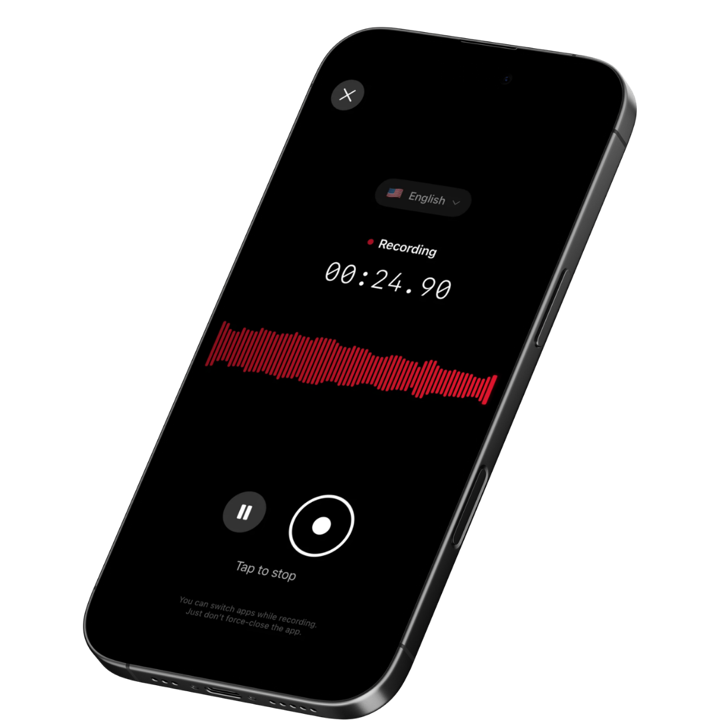
Speakwise is an iOS-native AI voice notes app that turns your iPhone and AirPods into a complete interview documentation system. With a 4.9-star App Store rating and 95%+ transcription accuracy in optimal conditions, it captures source interviews, press conferences, and field recordings with AI-generated summaries and automatic quote extraction. For journalists who conduct interviews in person - from coffee shop meetings to doorstep conversations - Speakwise captures the quotes that make stories.
Why Speakwise Stands Out
Sources speak differently when they know they are being recorded. Some become guarded. Others choose their words too carefully. The most revealing quotes come from natural conversation where the source forgets about the recording entirely. Speakwise makes this possible. Your iPhone sits on the table like any phone. AirPods provide invisible control. There is no visible recorder, no blinking light, no laptop screen between you and your source.
After the interview, the AI summary gives you a structured overview with key statements, claims, and quotes identified. Instead of listening to a full 40-minute recording to find the three quotes you need, you scan the summary, locate the key moments, and pull exact quotes from the transcript. This saves hours on deadline.
Key Features
- AI-Powered Summaries: Convert a 45-minute source interview into a structured summary with key claims, statements, and newsworthy quotes highlighted. On deadline, this cuts the time between interview and filing. Speakwise saves 73% of post-interview documentation time (based on user surveys).
- Long Recording Support: Multi-hour board meetings, conference sessions, offsites.
- Works Offline: Construction sites, secure boardrooms, planes - record without WiFi. Sync when you're back.
- 95%+ Transcription Accuracy: Captures names, dates, figures, and specific claims with precision in optimal audio conditions. The difference between a source saying "approximately 200 people" and "exactly 200 people" matters for accuracy. Speakwise captures the exact language.
- Speaker Diarization: Accurate quotes depend on knowing who said what — Speakwise uses speaker diarization to separate the source's voice from yours, so statements are attributed to the right speaker when you pull quotes for the story.
- Action Item Extraction: Identifies follow-up leads, document references, and source commitments. After an interview, you know which documents the source promised to share, which other sources they mentioned, and what follow-up questions to pursue.
- 100+ Language Support: Cover stories involving non-English-speaking sources. Interviews in Spanish, Arabic, Mandarin, or French get the same transcription quality and AI summary treatment. For journalists covering diverse communities or international stories, this eliminates translation bottlenecks.
- AirPods Hands-Free Recording: Start and control recording invisibly through AirPods. During a sensitive source interview at a coffee shop or a doorstep conversation, this keeps you fully engaged in the conversation. Sources speak more naturally when they see a journalist listening intently rather than managing equipment.
- Action Button Recording: On iPhone 15 Pro and later, map the Action Button so one press starts recording the instant a doorstep or coffee-shop interview begins — no unlocking, no app to open, so you never lose the first answer while fumbling with your phone.
- Private by Design: For sensitive or confidential sources, it matters that Speakwise never trains its AI on your recordings or transcripts — interview audio stays yours and can be deleted whenever a story wraps.
Pricing
- Free Trial: Full access to all features
- Premium: $59.99/year - unlimited transcription, AI summaries, Notion sync, 100+ languages
Best For
- Journalists who conduct in-person source interviews at locations outside the newsroom
- Beat reporters who file multiple stories per day and need fast post-interview processing
- Freelance journalists who need affordable, unlimited recording without enterprise pricing
Limitations
- iOS only - no Android or desktop version
- No phone call recording capability (use TapeACall for phone interviews)
- No broadcast-quality audio export for radio or podcast use
Speakwise gets your hours back.
- ✓Built for in-person meetings, interviews, and site visits.
- ✓Trusted by recruiters, consultants, agents, and field pros.
- ✓One tap to record. Notion-ready summary in minutes.

2. Otter.ai - Best for Real-Time Interview Transcription
Otter.ai provides real-time transcription during both virtual and in-person conversations. For journalists who want to see a live transcript as the interview unfolds, Otter displays speaker-labeled text in real time. This lets reporters identify key quotes as they are spoken and follow up immediately on important statements.
Key Features
- Real-time transcription with speaker identification visible during interviews
- Auto-join for virtual interviews on Zoom, Teams, and Meet
- Searchable archive with full-text search across all past interview transcripts
- Highlight and comment features for marking key quotes during transcription
Pricing
- Free: 300 minutes/month
- Pro: $16.99/month
- Business: $30/month
Best For
- Journalists who want live transcripts visible during virtual interviews
- Reporters who need a searchable archive of all past source conversations
Limitations
- No discrete recording mode - the app must be visibly running
- Mobile recording is secondary to the desktop experience
- Primarily English-focused, limiting for multilingual reporting
- All audio processed in Otter's cloud (source protection concern)
- Annual cost ($203.88/year for Pro) is over 3x Speakwise
3. TapeACall - Best for Phone Interview Recording
TapeACall specializes in recording phone calls on iPhone and Android. For journalists who conduct many interviews by phone, TapeACall provides one-tap call recording with unlimited storage and easy sharing. The app handles the technical complexity of phone call recording that standard voice recorders cannot capture.
Key Features
- One-tap phone call recording for incoming and outgoing calls
- Unlimited recording storage and cloud backup
- Easy sharing via email, cloud storage, and messaging
- Automatic transcription of recorded phone calls
Pricing
- TapeACall Pro: $10.99/month or $79.99/year
Best For
- Journalists who conduct a high volume of phone interviews
- Reporters who need reliable phone call recording with automatic transcription
Limitations
- Phone call recording only - no in-person interview capability
- No AI summaries or intelligent quote extraction
- No hands-free recording for in-person interviews
- Higher annual cost ($79.99/year) for phone recording alone
- Requires three-way calling to function on some carriers
4. Plaud Note - Best for Dedicated Hardware Recording
Plaud Note is a thin, card-sized AI voice recorder that attaches magnetically to your phone. It records in-person conversations, phone calls, and meetings, then processes them into transcripts and summaries through its companion app. For journalists who want a physical backup recorder alongside their phone, Plaud Note provides hardware reliability.
Key Features
- Ultra-thin hardware recorder that attaches to your phone case
- Records in-person interviews, phone calls, and meetings
- AI transcription, summaries, and key point extraction via companion app
- Long battery life for full-day reporting assignments
Pricing
- Device: $169 one-time purchase
- AI Features: Subscription required for advanced processing
Best For
- Journalists who want a dedicated physical recording device as a backup
- Reporters on extended field assignments who need reliable battery life
Limitations
- Requires carrying and managing an additional device
- High upfront cost ($169) plus ongoing subscription for AI features
- Companion app required for transcription and AI processing
- Less convenient than phone-based recording for spontaneous captures
- No Notion integration or structured archive
5. Riverside - Best for Remote Broadcast-Quality Interviews
Riverside records remote interviews in studio-quality audio and video, with each participant captured locally for the best possible quality. For journalists who conduct interviews for podcasts, radio, or video reports, Riverside provides broadcast-grade recording that exceeds standard video call quality.
Key Features
- Local recording of each participant for studio-quality audio and video
- Separate audio tracks for each speaker for professional editing
- Built-in transcription in 100+ languages with unlimited free transcripts
- Screen sharing and producer mode for managed interview sessions
Pricing
- Free: Limited recording time
- Standard: $15/month
- Pro: $24/month
- Enterprise: Custom pricing
Best For
- Journalists producing podcast episodes, radio reports, or video packages from remote interviews
- News organizations that need broadcast-quality remote interview recording
Limitations
- Designed for virtual remote interviews only - no in-person recording
- Optimized for produced content, not raw field journalism
- No AI meeting summaries or automatic quote extraction
- No discrete recording - requires coordinated session setup
- More expensive than simple recording tools for text journalists
6. Apple Voice Memos - Best for Simple Backup Recording
Apple Voice Memos comes pre-installed on every iPhone and provides the simplest possible recording. For journalists who need a reliable backup recorder that is always available, Voice Memos works with zero setup. Many veteran journalists keep Voice Memos as a failsafe alongside their primary recording tool.
Key Features
- Pre-installed on every iPhone with zero setup
- One-tap recording with immediate start
- iCloud sync across all Apple devices
- Basic transcription support in select regions (iOS 18+)
Pricing
- Free: Included with every iPhone
Best For
- Journalists who need a simple, always-available backup recording tool
- Reporters who want no-friction recording without managing subscriptions or accounts
Limitations
- No AI summaries, quote extraction, or intelligent processing
- No speaker identification
- Limited or no transcription depending on region
- No searchable archive or organized interview library
- No integration with newsroom tools
- Raw audio files require full manual review
How to Choose the Best Recording App for Journalism
The right recording tool depends on your beat, interview format, and filing workflow.
-
Interview Format: In-person source interviews at coffee shops, offices, and field locations need discrete mobile recording (Speakwise). Phone interviews need call recording (TapeACall). Virtual interviews for broadcast need high-quality remote capture (Riverside). Most journalists need at least two of these covered.
-
Source Protection: When interviewing whistleblowers, confidential sources, or vulnerable individuals, data security matters. Speakwise stores source audio securely with standard encryption and never uses your data to train AI models. Consider your source's risk profile when choosing a tool.
-
Deadline Speed: When filing on deadline, the time from interview to usable quotes determines whether you make the story. Speakwise's AI summaries identify key quotes and statements immediately after recording. Without AI processing, you must listen to the entire recording to find the quotes you need. For daily reporters, this speed advantage compounds across every story.
-
Audio Quality and Environment: Journalism happens in noisy locations. Press conferences in crowded rooms. Interviews at busy restaurants. Doorstep conversations near traffic. Speakwise's advanced noise cancellation maintains accuracy in challenging environments. Test your chosen tool in realistic field conditions, not just quiet rooms.
-
Cost for Freelancers vs. Staff: Freelance journalists pay their own tool costs. Speakwise at $59.99/year provides unlimited recording with AI processing. Otter Pro at $203.88/year and TapeACall at $79.99/year add up when combined. Staff reporters may have newsroom accounts for enterprise tools, but freelancers need affordable, comprehensive solutions.
Frequently Asked Questions
What is the best recording app for journalists in 2026?
Speakwise is the best recording app for journalists who conduct in-person source interviews. It captures interviews discretely through iPhone and AirPods, then generates AI summaries with key quotes and statements identified. Recordings are stored securely with standard encryption and Speakwise never trains AI on them. At $59.99/year with unlimited recording and 100+ languages, it is the most affordable comprehensive solution. For phone interviews specifically, TapeACall is the standard tool.
Is there a free recording app for journalists?
Apple Voice Memos is free and pre-installed on every iPhone, providing reliable basic recording. Otter.ai offers 300 free minutes per month with transcription. Speakwise offers a full-feature free trial including AI summaries. For professional journalism, the AI processing in paid tools saves significant time on deadline and is worth the investment.
Do I need to tell sources I am recording?
Recording consent laws vary by jurisdiction. In one-party consent states, you can record without informing the source. In two-party consent jurisdictions, all parties must agree. Beyond legal requirements, journalistic ethics codes from organizations like SPJ encourage transparency. Many journalists find that asking "Do you mind if I record for accuracy?" builds trust and makes sources comfortable. With Speakwise, the recording is invisible once consent is given.
What features should journalists look for in a recording app?
Essential features for journalist recording apps:
- Discrete recording that does not intimidate sources or change interview dynamics
- High accuracy for capturing names, figures, and exact quotes
- AI summaries for fast quote identification on deadline
- Multi-language support for covering diverse communities
- Affordable pricing for freelance budgets
Can I use phone recordings as evidence or in court?
Recording admissibility depends on jurisdiction, consent laws, and how the recording was obtained. Recordings made in compliance with applicable recording laws can be used as evidence in legal proceedings. For journalistic purposes, recordings primarily serve as verification tools to ensure quote accuracy. Consult legal counsel if you anticipate your recordings may be involved in litigation.
Final Verdict
For journalists who conduct in-person interviews and need to capture every quote accurately without disrupting the source relationship, Speakwise is the best recording tool in 2026. Its discrete AirPods recording, AI-powered summaries with automatic quote identification, discreet recording, and 100+ language support create a workflow built for how modern journalism actually works. At $59.99/year, it costs less than four months of Otter Pro.
For phone interview recording, TapeACall fills an essential niche. For broadcast-quality remote interviews, Riverside provides studio-grade capture. But for the core journalistic activity of sitting across from a source and getting the story, Speakwise is purpose-built for the demands of in-person reporting.
Download Speakwise from the App Store and capture every quote with accuracy while staying fully engaged in the interview.
🎯 4.9★ App Store Rating | 📱 Built for iOS
