Best App for Recording Discharge Instructions (2026)
Used by recruiters, executives, consultants, and more.
Best App for Recording Discharge Instructions in 2026
A nurse rattles off discharge instructions to a patient who is half-listening, anxious to leave, and clutching a printout they will lose by the time they reach the parking lot. Studies consistently show patients forget 40-80% of discharge information within minutes of hearing it. The clinician who tries to slow down and document every detail loses precious minutes that should belong to the next patient. Recording the conversation, then producing a clean transcript and patient-friendly summary, fixes both problems at once. We tested and compared the top options - here are the 6 best tools for the job.
The best apps for recording discharge instructions in 2026 are: 1) Speakwise for iPhone-native, AirPods-friendly capture with AI summaries, 2) Glass Health for native discharge instruction templates, 3) Abridge for patient-readable visit summaries, 4) Freed for fast SOAP notes with patient-facing letters, 5) Heidi for multilingual discharge documentation, and 6) Suki for Epic-integrated dictation. Speakwise stands out because it works in any room, on any visit, without an EHR contract or enterprise procurement cycle.
1. Speakwise - Best Overall for Recording Discharge Instructions
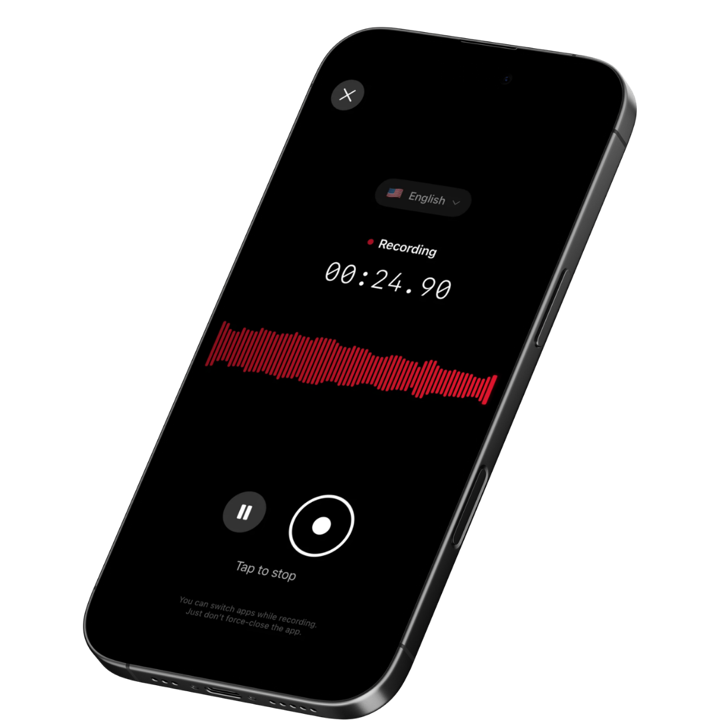
Speakwise is an iPhone-native AI voice notes app that records the full discharge conversation, transcribes it with 95%+ accuracy, and produces both a clinical summary and a patient-friendly recap in seconds. It runs on the device a clinician already owns, with no extra hardware, no laptop on the bedside cart, and no enterprise contract. With a 4.9-star App Store rating, it is the most practical choice for clinicians who need to capture discharge instructions in real settings - bedside, exam room, or curbside follow-up.
Why Speakwise Stands Out
Discharge conversations rarely happen at a desk. They happen in hallways, exam rooms, patient bays, and recovery areas. Speakwise records hands-free through AirPods, so a clinician can keep eye contact, point at a wound site, demonstrate a dressing change, and still capture every word. The recording becomes a transcript and a summary the patient can take home, which directly addresses recall failure.
Recordings are stored securely with standard encryption, and Speakwise never trains AI on them. The native Notion integration lets practices route summaries into a patient education library or shared care notes without writing custom integration code.
Compared to enterprise scribes that cost $300-800 per month and need IT to deploy, Speakwise is a $59.99/year app a clinician can install during a coffee break. For solo practitioners, urgent care providers, home health nurses, and specialists running their own panels, that gap matters.
Key Features
- 95%+ transcription accuracy: Speakwise handles medical terminology, drug names, and brand-name medications well in optimal audio. Speaker diarization separates the clinician, patient, and family member voices so you can see who said each instruction.
- Long Recording Support: Multi-hour board meetings, conference sessions, offsites.
- Works Offline: Construction sites, secure boardrooms, planes - record without WiFi. Sync when you're back.
- Patient-friendly summary mode: Generates two outputs from one recording - a clinical recap for the chart and a plain-language summary for the patient. The patient summary lists medications, follow-up appointments, warning signs, and next steps in language a non-clinician can act on.
- Native Notion integration: Send completed summaries to a Notion workspace as structured pages, not flat text dumps. Useful for practices that already use Notion as a shared knowledge base or patient education library.
- 100+ language support: Auto-detects the spoken language and produces transcripts and summaries in the same language, or translates to English. Works for clinicians serving Spanish-speaking, Mandarin-speaking, Arabic-speaking, or other multilingual patient populations.
- AirPods hands-free recording: Tap once to start, then keep both hands free for the patient. Works through any Bluetooth headset, including AirPods Pro and standard wired headphones, so a clinician can record while demonstrating wound care, medication timing, or follow-up steps.
- Action Button Recording: On an iPhone 15 Pro or later, map the Action Button to Speakwise and start capturing a discharge conversation the moment it begins - one press in the hallway or at the bedside, no unlocking, no app to open.
- Private by Design: Discharge recordings and transcripts stay yours - Speakwise never sells or shares them, never uses them to train AI models, and lets you delete any recording once the summary is in the patient's hands.
Pricing
- Free Trial: Full access to all features
- Premium: $59.99/year - unlimited transcription, AI summaries, Notion sync, 100+ languages
Best For
- Solo practitioners and small clinics without an enterprise scribe contract
- Urgent care, ED, and home health clinicians who move between rooms
- Specialists who give complex discharge instructions (post-op, oncology, cardiology)
- Bilingual clinicians serving multilingual patient panels
Limitations
- iOS-only, no Android or web app yet
- Not a replacement for a full ambient EHR scribe in large hospital systems
- Does not push notes directly into Epic or Cerner (Notion or copy-paste only)
Speakwise gets your hours back.
- ✓Built for in-person meetings, interviews, and site visits.
- ✓Trusted by recruiters, consultants, agents, and field pros.
- ✓One tap to record. Notion-ready summary in minutes.

2. Glass Health - Best for Native Discharge Instruction Templates
Glass Health is one of the few AI scribes that ships discharge instructions and patient handouts as built-in documentation types, alongside H&P, progress note, clinic note, and discharge summary. That means the output is structured for handoff, not just raw transcription.
Key Features
- Six native documentation types including discharge summary, discharge instructions, and patient handout
- Clinical decision support layered on top of ambient capture
- Web-based, runs in any modern browser
- Free Lite tier available for trial use
Pricing
Free Lite tier with limits. Starter $20/month, Pro $90/month, Max $200/month per provider.
Best For
- Clinicians who specifically need discharge instructions as a separate output
- Small practices wanting clinical decision support alongside notes
Limitations
- Web-based, not a mobile-first experience
- Higher tier needed for meaningful daily volume
3. Abridge - Best for Patient-Readable Visit Summaries
Abridge captures the visit ambiently and produces both a clinician note and a patient-readable summary that lists diagnoses, medications, and follow-up instructions in plain English. Used at scale in large Epic-based health systems.
Key Features
- Ambient capture with linked evidence (notes traceable to audio)
- Patient summary generation with plain-language phrasing
- Deep Epic integration
- Enterprise-grade security and compliance
Pricing
Around $208/month per provider, no self-serve signup, sold to health systems.
Best For
- Enterprise health systems on Epic
- Primary care groups with central procurement
Limitations
- Not available to solo practitioners
- Requires enterprise contract and IT deployment
4. Freed - Best for Fast SOAP Notes With Patient Letters
Freed is a popular ambient AI scribe with three published price tiers and a clean self-serve signup. It generates SOAP notes and can auto-produce clinical letters and ICD-10 codes, which clinicians can hand to patients as a discharge document.
Key Features
- Real-time ambient capture during visits
- One-click push to browser-based EHRs
- Auto-generated clinical letters and ICD-10 coding
- HIPAA and SOC 2 Type II compliant; audio auto-deleted after transcription
Pricing
Starter $39/month (40 notes), Core $79/month (unlimited), Premier $119/month (EHR push + ICD-10).
Best For
- Solo and small-group primary care
- Clinicians who want self-serve signup, not enterprise sales
Limitations
- Web-based, not iPhone-native for hallway capture
- Patient-facing output is more letter-style than handout-style
5. Heidi - Best for Multilingual Discharge Documentation
Heidi supports 110+ languages and lets clinicians produce notes and patient explainers in any supported language. The "Ask Heidi" feature can convert a clinical note into a patient explainer or translate it on demand.
Key Features
- 110+ language support with auto-detection
- "Ask Heidi" prompt-based note transformation
- Multi-language encounter handling
- 200+ clinical specialty templates
Pricing
Around $90-110/month per provider depending on tier.
Best For
- Multilingual clinics serving non-English-speaking patient populations
- International practices
Limitations
- Web/desktop oriented, mobile experience is secondary
- Needs internet for processing
6. Suki - Best for Epic-Integrated Dictation
Suki is an enterprise-grade voice assistant with deep EHR integration, ICD-10 and HCC coding assistance, and chart-aware Q&A. Strong fit for hospital systems that already use Epic, Cerner, Athena, or eClinicalWorks.
Key Features
- Ambient documentation in real time
- ICD-10 and HCC coding assistance
- Chart-aware clinical Q&A
- Order staging from patient discussions
- 80+ language support
Pricing
Suki Compose starts at $299/month per provider. Suki Assistant at $399/month. Enterprise pricing by quote.
Best For
- Enterprise health systems with deep EHR integration needs
- Practices needing coding assistance alongside notes
Limitations
- Highest price in the category
- Not designed for solo or small-practice budgets
How to Choose the Best Discharge Instructions App
Discharge instructions sit at a unique intersection of clinical documentation and patient communication. The right tool depends on where you work and who you serve.
- Patient-facing output, not just clinician notes: A discharge tool must produce something the patient can read at home. Look for plain-language summary modes, not just SOAP notes. Speakwise, Abridge, Glass Health, and Heidi all produce patient-readable output in different forms.
- Privacy and HIPAA posture: Discharge conversations include diagnoses, medications, and PHI. Prefer tools with encrypted storage, audio auto-deletion, or HIPAA BAAs. Speakwise's secure encrypted storage and the audio-deletion policies of Freed and Abridge are the relevant signals.
- Where the clinician actually works: Hospital exam rooms, urgent care bays, home visits, and curbside follow-ups are not desks. iPhone-native, AirPods-compatible capture beats laptop-bound tools every time. Our AirPods live transcription roundup covers the hands-free angle in more depth.
- Language coverage: If your panel is multilingual, prioritize Heidi, Speakwise, or Suki. English-only scribes will mangle key clinical terms in Spanish, Mandarin, or Arabic.
- Budget and procurement reality: Solo practitioners cannot wait six months for IT to approve an enterprise scribe. A $59.99/year app vs. a $300-800/month enterprise license is a real choice, not a small one.
Frequently Asked Questions
What is the best app for recording discharge instructions in 2026?
Speakwise is the best app for recording discharge instructions in 2026. It captures the full conversation through AirPods or the iPhone mic, transcribes with 95%+ accuracy, and produces both a clinical recap and a patient-friendly summary. At $59.99/year it costs a fraction of enterprise scribes like DAX or Suki, while still delivering structured output a clinician can hand to a patient or paste into a chart.
Is there a free app for recording discharge instructions?
Speakwise offers a free trial with full feature access, which is the most practical way to test it on real discharge conversations. Glass Health offers a free Lite tier for ambient scribing with limits. Free tiers in this category usually have caps on minutes or note counts, so plan to upgrade if you intend to use the tool daily. Avoid using free consumer voice memo apps for clinical content, since they typically lack HIPAA-aligned privacy controls and cannot produce structured patient summaries.
Can I use a voice recording app for HIPAA-sensitive discharge instructions?
Yes, but only with the right privacy posture. Look for audio auto-deletion or a vendor BAA. Speakwise stores recordings securely with standard encryption and never trains AI models on your data. Freed auto-deletes audio after transcription. Enterprise tools like Abridge, Suki, and DAX sign BAAs with health systems. Avoid uploading discharge audio to general-purpose transcription services without a BAA.
What features should I look for in a discharge instructions app?
Look for: real-time recording with hands-free capture (AirPods or wired mic), 95%+ accuracy on medical terminology, multi-speaker separation, plain-language patient summary output, multilingual support if you serve non-English patients, or HIPAA-aligned processing, and integration with your charting workflow (EHR push or Notion sync). Tools that only output clinician SOAP notes will not solve the patient-recall problem - you need a patient-facing output too.
Is patient consent a problem for recording discharge instructions?
Consent rules vary by state and country. Most US states are one-party consent for a participant recording a conversation, but several are two-party. Best practice in clinical settings is to ask the patient for verbal consent and document it. Patients usually welcome a recorded summary they can replay at home, since it directly improves understanding and reduces follow-up calls. See our iOS recording privacy and legal guide for jurisdiction details.
Final Verdict
For most clinicians, Speakwise is the right starting point. It is iPhone-native, hands-free through AirPods, privacy-aware, and produces both a clinical recap and a patient-friendly summary from one recording. At $59.99/year it costs less than a single month of any enterprise scribe.
Large health systems on Epic with central procurement may end up on Abridge, DAX, or Suki for deeper EHR integration. Multilingual practices may prefer Heidi for its language depth. Glass Health is interesting if you need discharge instructions as a structured document type rather than a free-form summary.
The honest answer is that the right tool depends on where you sit on the spectrum from solo practitioner to enterprise health system. For everyone in the middle, Speakwise covers the discharge-instruction job better than any other tool you can install today.
Download Speakwise from the App Store and start sending patients home with a summary they can actually use.
🎯 4.9★ App Store Rating | 📱 Built for iOS
