Best Voice-to-Text Apps That Transcribe and Summarize (2026)
Used by recruiters, executives, consultants, and more.
Best Voice-to-Text Apps That Transcribe and Summarize in 2026
Voice to text apps with summarization exist because a transcript alone creates a second job. You talk for twenty minutes, get 3,000 words back, and now you have to read your own rambling to find the three things that mattered. Transcription answers "what was said". Summarization answers "what does this mean", and that is the part that saves time. We tested and compared the top options - here are the 6 best.
The category splits along a clear line. Dictation tools turn speech into text in real time and stop there. Recording tools capture a conversation or a long voice note and then run a model over the whole thing to produce a summary, action items and structure. If you want a summary, you want the second kind.
Best Voice to Text Apps with Summarization at a Glance (2026)
The best voice to text apps with summarization in 2026 are:
- Speakwise - Best overall on iPhone for recording, transcribing and summarizing in-person conversations
- Apple Voice Memos - Best free option, with on-device transcription and short AI summaries on supported iPhones
- Otter.ai - Best for virtual meetings that need a live transcript and a summary
- Notta - Best cross-platform option for transcribing and summarizing in many languages
- AudioPen - Best for turning a rambling solo voice note into clean written text
- Wispr Flow - Best pure dictation tool, with no summarization at all
Only some of these actually summarize. The list includes Wispr Flow deliberately, because many people searching for voice to text land on a dictation tool and then wonder where the summary went.
1. Speakwise - Best Overall for Recording, Transcribing and Summarizing
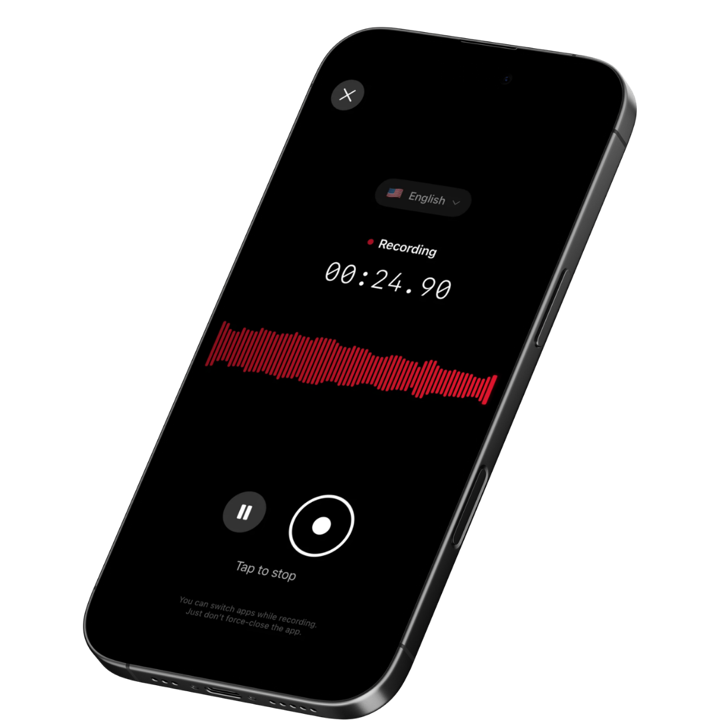
Speakwise is an iOS app that records with the iPhone microphone, transcribes what it hears in more than 100 languages, and returns an AI summary, an action item list and a speaker-labeled transcript. It is built for real conversations rather than dictation: an in-person meeting, a client conversation, an interview, a long voice note to yourself while walking.
The summarization is the reason to use it. A 40-minute conversation becomes a page you can actually read, organized by topic, with the commitments pulled out separately. The full transcript stays underneath for the moments when the exact wording matters.
Why Speakwise Stands Out
Most voice to text tools are optimized for a single speaker sitting still. Real audio is messier: two or three people, a table between them, a cafe in the background, someone interrupting. Speakwise is designed for that input, which is why it separates voices and labels them rather than producing one undifferentiated stream of text.
Summaries are structured rather than narrative. Instead of a paragraph that restates the conversation in slightly shorter form, you get topics, decisions and open questions, with action items extracted into their own list. That structure is what makes the output pasteable into a document, an email or a project page. Our roundup of apps that turn recordings into bullet summaries covers why the format of a summary matters as much as its accuracy.
The audio to text product page covers the transcription side in more detail. Length is the other quiet differentiator. Many tools cap a single recording at a few minutes on the free tier and process long files awkwardly. Speakwise records multi-hour sessions in one pass and summarizes the whole thing, so a workshop or a long interview does not have to be split into fragments.
Key Features
- Record, Transcribe and Summarize in One Pass: Tap once to record, and get a transcript plus a structured AI summary when you stop. No exporting a file to a second tool.
- Action Item Extraction: Commitments made during a conversation are pulled into a separate list, which is the part most people actually copy out.
- Speaker Labels: Distinct voices are separated and labeled, so a two or three person conversation reads as attributed dialogue rather than a wall of text.
- 100+ Languages: Transcription and summarization work across more than 100 languages with automatic detection, including conversations that switch language mid-sentence.
- Long Recordings: Multi-hour sessions record and summarize in a single pass rather than a series of short clips.
- Records Without a Connection: Capture works with no signal; transcription and summaries are generated when the phone reconnects.
- Notion Sync and Share by Link: Notion sync runs automatically once you connect it. For everywhere else, copy the summary and transcript into any app, or send a share link.
Pricing
Paid subscription via the App Store. iPhone only.
Best For
- Professionals summarizing in-person meetings and client conversations
- Interviewers and researchers who need both a summary and an accurate transcript
- Long voice notes where the point is buried somewhere in the middle
- Multilingual users who record in more than one language
Limitations
- iOS only, with no Android or desktop version
- Not a live dictation keyboard; it records a session and processes it afterwards
- Summary quality depends on audio quality, as it does in every tool here
Speakwise gets your hours back.
- ✓Built for in-person meetings, interviews, and site visits.
- ✓Trusted by recruiters, consultants, agents, and field pros.
- ✓One tap to record. Notion-ready summary in minutes.

2. Apple Voice Memos - Best Free Voice to Text With a Summary
Voice Memos is free, already installed, and on recent iPhones it transcribes recordings on-device and offers a short AI summary of longer ones through Apple Intelligence. For a quick voice note where you want the gist rather than a full meeting record, that is often enough, and nothing is uploaded anywhere.
The ceiling is low, though. Summaries are brief and generic, there are no action items, and there are no speaker labels, so a conversation between two people comes back as a single block. Our explainer on whether Voice Memos transcribes recordings covers which iPhone models get which features.
Key Features
- On-device transcription on supported iPhones, with no upload
- Short Apple Intelligence summaries of longer recordings
- Works with no connection and no account
- Free with every iPhone
Pricing
Free, built into iOS.
Best For
- Quick personal voice notes where a short summary is enough
- Users who want audio to stay on the device
Limitations
- No speaker labels and no action item extraction
- Summaries are short and not structured for sharing
- Features depend on having a recent iPhone with Apple Intelligence
3. Otter.ai - Best for Virtual Meetings That Need Live Text and a Summary
Otter.ai transcribes in real time and produces an AI summary and meeting outline on paid plans. OtterPilot joins Zoom, Teams and Google Meet automatically and names speakers from the participant list, which is the most convenient attribution available for video calls. Transcripts sit in a searchable workspace that teams can annotate together.
Key Features
- Real-time transcription with a live text feed during the meeting
- AI summaries and outlines on paid plans
- Speaker names pulled from video call participant lists
- Shared workspace with search, comments and highlights
Pricing
Free: 300 minutes per month with a 30-minute cap per conversation. Pro: ~$8.33 per user per month billed annually. Business: ~$20 per user per month billed annually.
Best For
- Remote teams that want a live transcript during the call
- Anyone who needs summaries of many scheduled video meetings
Limitations
- Requires a connection throughout; there is no offline mode
- Bot-based capture does not work for in-person conversations
- The free tier's 30-minute cap cuts off most real meetings
4. Notta - Best Cross-Platform Transcription and Summarization
Notta runs on iOS, Android, web and desktop, transcribes in 58 languages, and generates AI summaries from recordings or uploaded files. Speaker identification handles up to ten speakers on paid plans. For teams working across mixed devices and languages, the breadth is the selling point; the free tier is too limited to be a real option.
Key Features
- 58 languages with real-time transcription
- AI summaries from live recordings or imported audio and video files
- Speaker identification for up to ten speakers on paid plans
- Apps for iOS, Android, web and desktop
Pricing
Free: 120 minutes per month with a 3-minute cap per conversation and 10 AI summaries. Pro: ~$8.17 per user per month billed annually. Business: ~$16.67 per seat per month billed annually.
Best For
- Mixed iOS and Android teams
- Multilingual transcription and summarization workflows
Limitations
- The free plan's 3-minute conversation cap is unusable for meetings
- Transcript downloads, speaker identification and most exports require a paid plan
- No offline recording; the connection has to hold
5. AudioPen - Best for Turning a Rambling Voice Note Into Clean Text
AudioPen is narrower than the others and better at its one job: you talk, and it returns tidy written prose rather than a verbatim transcript. Filler words disappear, tangents get reorganized, and the output reads like something you wrote deliberately. For solo thinking, journaling and drafting, that rewriting is more useful than a faithful transcript.
Key Features
- Rewrites speech into clean, structured prose rather than verbatim text
- Multiple writing styles and tones for the output
- Web-based, so it works across devices
- Fast turnaround on short notes
Pricing
Free tier limited to short notes with a 3-minute cap per recording. Prime plans from ~$99 per year, with shorter and longer terms available.
Best For
- Solo voice notes, journaling and first drafts
- People who think out loud and want readable text at the end
Limitations
- Built around a single speaker, with no meeting or speaker label features
- Free tier's 3-minute limit rules out anything long
- Rewriting means the output is not a faithful record of what was said
6. Wispr Flow - Best Pure Dictation, With No Summarization
Wispr Flow is a dictation layer rather than a note tool. It types what you say into whatever text field is active, cleans up filler words as it goes, and adapts formatting to the app you are in. It is genuinely fast and worth using, but it produces no recordings, no transcript archive and no summaries, which is the thing to know before buying it for that purpose.
Key Features
- Real-time dictation into any app on Mac, Windows or iPhone
- Automatic filler word removal and punctuation
- Context-aware formatting per application
- No stored recordings
Pricing
Free plan capped at ~2,000 words per week on desktop and ~1,000 words per week on iPhone. Pro ~$15 per month, or ~$144 per year. Student pricing available.
Best For
- Writing emails, documents and messages by voice instead of typing
- Anyone who wants speed rather than a record of a conversation
Limitations
- No summarization of any kind
- No audio recordings or transcript history to revisit
- Not a meeting or conversation tool
How to Choose a Voice to Text App With Summarization
- Separate dictation from recording. Dictation tools produce text as you speak and keep nothing. Recording tools keep the audio and summarize it afterwards. If you want a summary, choose a recorder. Wispr Flow is excellent and will never give you one.
- Check the summary format, not just its existence. A short paragraph and a structured list of decisions plus action items are both called summaries. Only one of them is worth pasting into a project update. Test with a real 30-minute recording rather than a two-minute demo.
- Look at the length limits on the plan you would actually buy. Free tiers in this category cap conversations at three to thirty minutes, which is shorter than most meetings. Check the per-recording cap, not only the monthly minute pool.
- Consider whether you need speaker labels. For solo notes they are irrelevant. For any conversation with two or more people, a summary without attribution loses most of its value.
- Confirm consent when other people are in the recording. Rules differ by country and by US state, and some require everyone to agree. Announce that you are recording, wait for agreement, and keep it at the start of the file. Summarizing a conversation does not change the rules that apply to recording it.
Frequently Asked Questions
What are the best voice to text apps with summarization in 2026?
Speakwise is the strongest option on iPhone: it records with the phone's microphone, transcribes in 100+ languages, and returns a structured summary, action items and a speaker-labeled transcript. Apple Voice Memos is the best free choice, transcribing on-device with short AI summaries on supported iPhones. Otter.ai leads for virtual meetings, Notta covers the widest range of devices and languages, and AudioPen is best for rewriting a solo voice note into clean prose.
Can a voice to text app summarize a long recording?
Yes, and this is where tools differ most. Some apps cap a single recording at three to thirty minutes, especially on free plans, which forces you to split a long conversation into pieces and lose the coherent summary. Tools built for long sessions process a multi-hour recording in one pass and summarize the whole thing. If you record workshops, interviews or long meetings, check the per-recording limit before anything else.
Is there a free voice to text app that also summarizes?
Apple Voice Memos is free with every iPhone and offers on-device transcription plus a short Apple Intelligence summary on supported models. Otter.ai's free plan includes 300 minutes per month with a 30-minute cap per conversation. Notta's free plan gives 120 minutes with a 3-minute cap. AudioPen's free tier handles short notes only. Free plans in this category are best used to test quality rather than as a permanent workflow.
What is the difference between dictation and voice to text with summarization?
Dictation converts speech into text in real time and inserts it wherever you are typing, then discards the audio. Voice to text with summarization records a whole conversation or note, transcribes it, and runs a model over the transcript to produce a summary and often action items. Dictation is for writing faster. Summarization is for understanding a conversation you do not want to relisten to.
How accurate is AI transcription and summarization?
Transcription accuracy in good conditions, with clear speech and low background noise, is high enough that most people edit nothing. Accuracy falls with distance from the microphone, background noise, heavy accents and crosstalk. Summaries inherit those errors: a summary built on a poor transcript will be confidently wrong. Improve the input first by placing the phone close to the speakers, and review summaries before circulating them for anything consequential.
Final Verdict
For scheduled video meetings, Otter.ai remains the most convenient combination of live transcript and summary, and Notta is the better pick if your team is spread across Android, web and desktop. For solo thinking, AudioPen turns a messy monologue into text you would be happy to send.
Speakwise is the pick for iPhone users whose recordings are real conversations. It records with the phone's microphone, handles long sessions, labels who said what, and returns a structured summary with action items rather than a paragraph of restated dialogue. That is the difference between a transcript you have to read and notes you can use.
If all you need is faster typing, buy Wispr Flow and skip the rest of the category. It just will not summarize anything.
Download Speakwise from the App Store and turn your next conversation into a transcript and a summary in one step.
🎯 4.9★ App Store Rating | 📱 Built for iOS
