Context Switching Statistics 2026: The Hidden Cost of Multitasking, App Toggling, and Fragmented Focus
Used by recruiters, executives, consultants, and more.
Context Switching Statistics 2026: The Hidden Cost of Multitasking, App Toggling, and Fragmented Focus
The average digital worker toggles between apps and websites 1,200 times per day. Context switching consumes up to 40% of productive time and costs the U.S. economy an estimated $450 billion annually. With only 2.5% of people able to multitask effectively and workers spending nearly four hours per week just reorienting after app switches, these 17 statistics reveal why context switching has become the silent killer of modern knowledge work.
We live in an era of fragmented attention. The typical knowledge worker doesn't complete a task from start to finish-they bounce between Slack messages, email threads, spreadsheets, video calls, project management tools, and browser tabs in a relentless cycle that feels productive but delivers the opposite. The neuroscience is clear: every switch exacts a cognitive toll, and those tolls compound throughout the day.
In this post, we'll explore 17 statistics that quantify the true cost of context switching in 2025 and 2026. These numbers reveal not just how often we switch tasks, but the cascading effects on focus, output quality, and mental health. Whether you're a manager wondering why your team's productivity doesn't match their hours, a developer struggling to find flow state, or a knowledge worker who ends every day exhausted despite "just sitting at a computer," these data points explain what's really happening-and point toward a different way of working.
1. The average digital worker toggles between apps and websites 1,200 times per day
The sheer volume of task switching in modern knowledge work is staggering. A study published in the Harvard Business Review found that the average digital worker toggles between different applications and websites nearly 1,200 times per day. That's roughly 150 switches per hour during an eight-hour workday-or one switch every 24 seconds. Each of these micro-transitions carries a cognitive cost, creating a cumulative drain that explains why so many workers feel exhausted despite never engaging in physically demanding work. Source: Harvard Business Review via Conclude.io
2. Context switching can consume up to 40% of a person's productive time
The productivity toll of frequent task switching is enormous. Research from the American Psychological Association demonstrates that chronic multitasking and frequent context switching can consume up to 40% of a person's productive time. This means that a worker who spends eight hours at their desk may only produce the equivalent of 4.8 hours of focused output-with the remaining 3.2 hours lost to the cognitive overhead of reorienting between tasks, tools, and conversations. Source: Atlassian - The Cost of Context Switching
3. Lost productivity from context switching costs the U.S. economy $450 billion annually
The economic damage of fragmented attention extends far beyond individual workdays. Research estimates that lost productivity due to context switching costs the U.S. economy approximately $450 billion annually. This figure accounts for the cumulative effect of hundreds of millions of workers each losing hours to task switching every day-a hidden tax on economic output that dwarfs the cost of many widely discussed workplace inefficiencies. Source: Pieces.app - The Cost of Context Switching
4. It takes 9.5 minutes on average to regain a productive workflow after switching apps
The recovery cost of each context switch is far longer than most people realize. A joint study by Qatalog and Cornell University found that it takes about 9.5 minutes on average to get back into a productive workflow after toggling to a different digital application. Over the course of a day with dozens of app switches, these recovery periods consume hours of potential productive time-time that vanishes so quietly most workers don't even notice it's gone. Source: CIO Dive - Drain of App Switching
5. Workers use approximately 10 different applications per day, switching between them 25 times
The modern digital workplace demands constant navigation between tools. Asana's Anatomy of Work Index found that employees use about 10 different applications per day, switching between them roughly 25 times on average. Each switch-from Slack to Google Docs to Zoom to Jira to email-forces the brain to reload context, recall where it left off, and re-engage with a different type of cognitive task. The proliferation of workplace tools designed to improve productivity has paradoxically created a fragmentation problem that undermines it. Source: TechSmith - Context Switching Productivity Killer
6. Only 2.5% of people can multitask effectively
Despite the cultural valorization of multitasking, the neuroscience is unambiguous. Research shows that only 2.5% of people-known as "supertaskers"-can genuinely multitask without performance degradation. For the remaining 97.5% of the population, what feels like multitasking is actually rapid task switching, with each transition exacting a cognitive penalty in the form of reduced accuracy, slower processing, and increased error rates. Source: BasicOps - The Hidden Cost of Context Switching
7. It takes 23 minutes and 15 seconds to fully refocus after an interruption
The landmark research by Gloria Mark at the University of California, Irvine established that it takes an average of 23 minutes and 15 seconds to fully regain deep focus after a single interruption. This figure has become one of the most cited in productivity research-and for good reason. When workers face interruptions every few minutes (as modern notification systems ensure), the math makes sustained deep work nearly impossible. You can't achieve 23 minutes of recovery when the next interruption arrives in three. Source: Reclaim.ai - Context Switching Guide
8. Employees spend nearly 4 hours per week reorienting after switching apps
The aggregate cost of context switching is measured in lost workdays. Research shows that employees spend almost four hours per week reorienting themselves after switching between applications-which over a full year equals roughly five working weeks, or about 9% of annual work time, lost entirely to the overhead of digital tool navigation. This isn't time spent working or even time spent in meetings; it's time spent simply trying to remember where you were and what you were doing. Source: CIO Dive - Drain of App Switching
9. 45% of workers say toggling between apps makes them less productive
The subjective experience matches the objective data. Research from Qatalog found that 45% of workers report that toggling between too many apps makes them less productive, while 43% say it's mentally exhausting to constantly switch between tools and contexts. Workers are increasingly aware that their digital environment is working against them-but feel powerless to change it when every team, project, and workflow lives in a different application. Source: Qatalog via Conclude.io
10. Workers spend nearly one hour per day searching for information across apps
Context switching isn't just about toggling-it's about hunting. Research shows that workers spend nearly one hour every day searching for information scattered across collaboration, storage, and messaging applications. This "information scavenger hunt" forces constant app switching as employees check Slack, then email, then Google Drive, then Notion, trying to find the document, decision, or conversation thread they need. The information exists; it's just fragmented across too many platforms. Source: Qatalog via Conclude.io
11. The average worker spends less than 3 minutes on any digital screen before switching
Attention spans in the digital workplace have collapsed. Research shows that the typical knowledge worker spends less than three minutes on any single digital screen before switching to something else. This figure, which has decreased steadily over the past decade, reflects the combined pressure of notifications, open browser tabs, and the human brain's vulnerability to novelty-seeking behavior. Three minutes is rarely enough time to achieve any kind of meaningful depth on a complex task. Source: Productivity Report - Time Lost Task-Switching
12. Heavy multitasking can lead to a drop of up to 10 IQ points
The cognitive consequences of chronic context switching extend beyond productivity. A 2024 study highlighted that heavy multitasking can lead to a temporary drop of up to 10 IQ points-a reduction greater than the effect of losing a night's sleep. This finding suggests that the constant task-switching demanded by modern work environments doesn't just make people less efficient; it temporarily makes them less intelligent, with implications for decision-making quality across entire organizations. Source: Pieces.app - The Cost of Context Switching
13. Employees who experience more digital interruptions report 26% higher stress levels
Context switching doesn't just drain productivity-it damages wellbeing. Microsoft's research on hybrid work patterns found that employees who experienced more digital interruptions reported 26% higher stress levels and lower overall job satisfaction compared to those with more protected focus time. The relationship between interruption frequency and stress is dose-dependent: more switches mean more stress, which means more burnout, which means more turnover. Source: ActivTrak - Hidden Costs of Context Switching
14. 60% of knowledge workers' time is spent on "work about work" rather than skilled tasks
The ultimate context-switching statistic may be this: according to Asana's research, 60% of knowledge workers' time is consumed by coordination-communicating about work, searching for information, switching between apps, managing priorities, and chasing status updates. Only 40% is spent on the skilled, strategic work they were actually hired to do. Each coordination task requires its own context switch, creating a day dominated by shallow administrative overhead rather than deep, meaningful contribution. Source: Asana Deep Work Research
15. Developers lose 15-30 minutes of coding productivity per context switch
For software developers, context switching is particularly devastating. Research shows that developers lose between 15 and 30 minutes of productive coding time per context switch, because programming requires maintaining complex mental models of code architecture, variable states, and logic flows that are difficult to reconstruct once broken. A developer interrupted mid-function doesn't just lose the interruption time-they lose the entire mental framework they'd built to solve the problem. Source: Jellyfish - Context Switching in Software Development
16. Workers are interrupted every 2 minutes during core work hours-275 times per day
The interruption frequency in modern work has reached crisis levels. Microsoft's 2025 Work Trend Index analysis of trillions of productivity signals reveals that during core work hours, employees face a ping-from meetings, emails, or chats-every two minutes. Over a full day, that adds up to 275 interruptions. Combined with the 23-minute recovery time per interruption, the math reveals an impossible equation: there literally aren't enough minutes in the day to recover from the interruptions that day contains. Source: Microsoft Work Trend Index 2025
17. Quick switches from the main task can cost over 2 hours of distracted time per switch
Perhaps the most sobering statistic is this: some research suggests that what appears to be a "quick" switch from a primary task can cost over two hours of distracted, diminished-quality work before full cognitive engagement is restored. This accounts not just for the initial reorientation time, but for the "attention residue" effect-where part of your mind remains anchored to the previous task even after you've nominally switched back. The true cost of "just checking Slack for a second" is far greater than anyone realizes. Source: Productivity Report - Time Lost Task-Switching
The Attention Paradox: More Tools, Less Focus
The statistics paint a picture of a workplace that has optimized for responsiveness at the expense of thoughtfulness. We've built communication systems that ensure no message goes unread, no notification goes unseen, and no colleague waits more than minutes for a reply. The cost? A workforce that can respond to everything but focus on nothing.
The root cause isn't any single tool or notification. It's the cumulative effect of well-intentioned productivity tools that, together, create an environment of perpetual partial attention. Each Slack ping, each email notification, each "quick sync" seems harmless in isolation. But collectively, they fracture the focused attention that produces meaningful work-and they do it 1,200 times per day.
The solution requires rethinking how information flows. Instead of requiring real-time participation in every conversation, organizations need systems that capture information asynchronously-so workers can engage on their own schedule, in their own focus blocks, without being pulled out of deep work every two minutes. The goal isn't less communication; it's less interruption.
The question isn't whether to communicate-it's whether every communication needs to shatter someone's focus. In a world of 1,200 daily app switches, the most productive thing you can do might be to stop switching.---
Ready to capture information without breaking your focus?
The irony of context switching is that much of it stems from a legitimate need-you're switching to Slack because someone shared important information, checking email because a decision was made, or joining a meeting because context is being discussed. The information matters. The interruption is what's killing you.
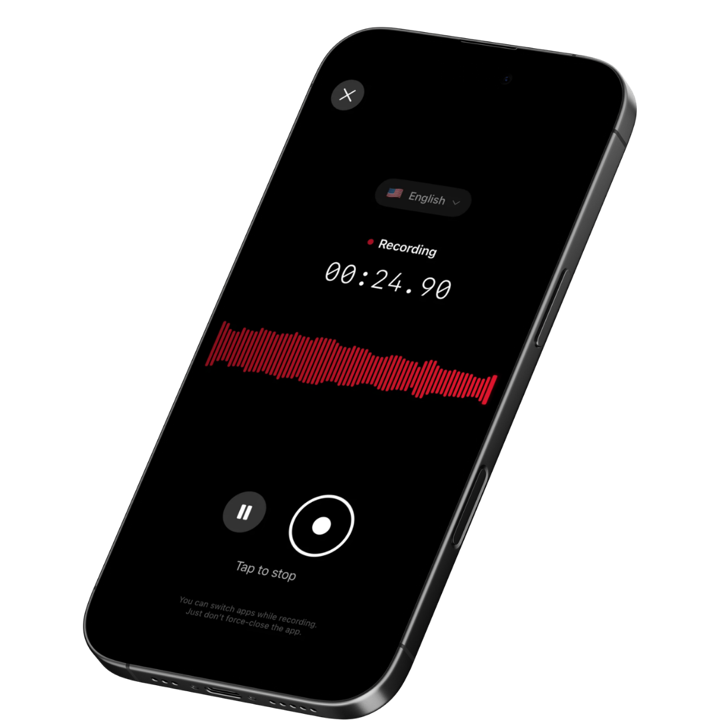
Voice capture offers a fundamentally different approach. Instead of switching to another app to type a note, send an update, or document a decision, you simply speak-and AI handles the rest. No app switch. No context break. No 23-minute recovery. It's the same idea behind the best speech-to-text apps and AI note-taking apps: a quick voice memo becomes organized text without ever pulling you out of focus.
Download SpeakWise from the App Store and discover how one-tap recording, AI transcription, intelligent summaries, and Notion integration can help you capture information without breaking your flow-no app switching required.
Join 10,000+ professionals who've discovered that the best way to fight context switching isn't fewer tools-it's a tool that works without demanding your attention.
Get SpeakWise Free →
4.9★ App Store Rating | iOS Optimized

🎯 4.9★ App Store Rating | 📱 Built for iOS
