Delegation Statistics 2026


Used by recruiters, executives, consultants, and more.
Delegation Statistics 2026
Only 19% of manager candidates demonstrate strong delegation abilities, yet leaders who delegate effectively generate 33% more revenue. Delegation is the number one factor in preventing burnout, but 79% of employees have experienced micromanagement. CEOs spend 72% of their time in meetings, and 85% of micromanaged employees report decreased morale. These 16 statistics reveal why delegation is the most critical and most underused leadership skill in modern organizations.
Delegation sounds simple: assign tasks to capable people and let them execute. In practice, it is one of the hardest leadership skills to master. Managers fear losing control. Leaders worry about quality. The result is a widespread pattern of overwork at the top and underutilization at the bottom. The data shows this pattern is destroying both productivity and wellbeing.
This post covers 16 statistics on delegation effectiveness, micromanagement costs, CEO time management, and the connection between delegation and burnout. Whether you manage a team, coach leaders, or want to understand why your organization feels bottlenecked, these numbers explain what is going wrong and what the evidence says about fixing it.
1. Only 19% of manager candidates demonstrate strong delegation abilities
DDI's assessment of more than 70,000 manager candidates found that only 19% demonstrate strong delegation skills. This means more than four out of five new managers enter leadership roles without the ability to effectively assign and entrust work to others. The gap is staggering given how fundamental delegation is to management. Organizations promote people based on individual contributor performance and then wonder why they struggle to lead teams. Delegation is not an innate talent. It is a skill that must be taught, practiced, and reinforced. The 19% figure suggests most organizations are not doing this.
Source: DDI - Global Leadership Forecast 2025
2. Leaders who delegate effectively generate 33% more revenue
Gallup research shows that leaders who delegate effectively generate 33% more revenue than those who do not. The revenue difference comes from focus. Leaders who delegate free themselves to work on high-leverage activities: strategy, relationship building, and decision-making. Those who hold onto operational tasks spend their most valuable hours on work that others could do. The 33% revenue gap is enormous. For a business generating $10 million annually, the difference between effective and ineffective delegation at the leadership level represents $3.3 million in additional revenue.
Source: The Alternative Board UK - Benefits of Delegation
3. Delegation is the number one factor in preventing burnout
DDI's Global Leadership Forecast 2025 identified delegation as the single most effective skill for preventing leadership burnout. This finding is based on data from 10,796 leaders across industries. When leaders delegate, they reduce their workload, create space for recovery, and share the cognitive burden of complex projects. When they do not delegate, they accumulate tasks until the volume becomes unsustainable. Burnout is not just about working too many hours. It is about carrying too many responsibilities without relief. Delegation provides that relief.
Source: DDI - Global Leadership Forecast 2025
4. 79% of employees have experienced micromanagement
As many as 79% of employees report having experienced micromanagement during their careers. Micromanagement is the opposite of delegation. Instead of entrusting tasks and outcomes, micromanagers control processes, demand constant updates, and second-guess decisions. The near-universal experience of micromanagement suggests it is a systemic problem, not an individual quirk. Organizations that do not actively train managers to delegate effectively will default to micromanagement because insecure leaders default to control. The 79% figure means most employees know what bad delegation looks like.
Source: Terryberry - Psychological Effects of Micromanagement
5. 85% of micromanaged employees report decreased morale
Of people who reported working for a micromanager, 85% said it decreased their morale and 71% said micromanagement interfered with their job performance. Morale and performance are the two pillars of a productive workforce. Micromanagement undermines both simultaneously. Employees who feel distrusted reduce their discretionary effort. They stop offering ideas, taking initiative, or going beyond minimum expectations. The irony is that micromanagers seek better results through tighter control but achieve worse results through diminished motivation.
Source: Terryberry - Psychological Effects of Micromanagement
6. 36% of employees have changed jobs because of a micromanager
Research shows that 36% of employees have changed jobs specifically because of a micromanager, while 69% have considered doing so. Micromanagement is one of the top three reasons employees resign. The turnover cost of micromanagement is enormous. Replacing an employee costs 0.5x to 2x their annual salary. A micromanaging leader who drives away three team members per year creates $150,000 to $600,000 in replacement costs for a team of average-salaried professionals. Teaching that leader to delegate would cost a fraction of that amount.
Source: Terryberry - Psychological Effects of Micromanagement
7. CEOs spend 72% of their time in meetings
Studies of CEO schedules show that roughly 72% of their working hours are spent in meetings, across about 37 sessions per week. One-on-one meetings account for 42% of all meetings, followed by small group sessions at 21%. The dominance of meetings in CEO schedules highlights the importance of delegation at the executive level. If a CEO spends nearly three-quarters of their time in meetings, the work that happens between meetings must be delegated effectively. CEOs who try to do both their meeting schedule and operational work end up working 9.7 hours on weekdays and 79% of weekends.
Source: Harvard Business Review - How CEOs Manage Time
8. Employees are 43% less likely to experience burnout when they choose their tasks
Research shows that employees are 43% less likely to experience high levels of burnout when they have a choice in deciding what tasks to do, when to do them, and how much time to spend on each. This autonomy is the natural outcome of effective delegation. When leaders delegate with clear outcomes but flexible methods, employees gain the agency that protects against burnout. The 43% reduction is substantial. It suggests that delegation does not just help leaders. It protects the entire team from the exhaustion that comes with rigid, top-down task assignment.
Source: Gallup - State of the Global Workplace 2025
9. 71% of leaders report higher stress since becoming managers
DDI found that 71% of leaders report experiencing significantly higher stress since stepping into their management roles. Much of this stress comes from trying to maintain their individual contributor output while adding management responsibilities. The inability to delegate is a primary driver. Leaders who cannot let go of their previous work carry two jobs: their old one and their new one. Training managers to delegate during the first 90 days of their role would prevent much of this stress from ever developing.
Source: DDI - Global Leadership Forecast 2025
10. Burnt-out leaders are 50% less likely to be engaged
DDI research shows that burnt-out leaders are half as likely to be engaged in their roles as those who are not experiencing burnout. Since delegation is the top factor in preventing burnout, the chain is clear: poor delegation leads to burnout, burnout leads to disengagement, and disengagement leads to worse outcomes for everyone the leader manages. This is not a linear problem. It is a feedback loop. Disengaged, burnt-out leaders delegate even less because they lack the energy and trust to hand off work. Breaking the cycle requires intervention before burnout sets in.
Source: DDI - Global Leadership Forecast 2025
11. 71% of employees say micromanagement interfered with their job performance
Beyond morale, 71% of employees who experienced micromanagement said it directly interfered with their job performance. Interference takes many forms: waiting for approvals that delay work, redoing tasks to match a manager's exact preferences, and spending time on status updates instead of productive work. Micromanagement creates bottlenecks. When every decision flows through one person, the team's capacity is limited to that person's bandwidth. Delegation removes the bottleneck and distributes decision-making to where the information lives.
Source: Redline Group - Impact of Micromanagement
12. CEOs work an average of 9.7 hours on weekdays
Harvard Business School research on CEO time management found that CEOs work an average of 9.7 hours on weekdays. They also work on 79% of weekend days and 70% of holiday days, averaging 3.9 and 2.4 hours respectively. This work pattern is unsustainable and often reflects inadequate delegation. CEOs who delegate effectively design schedules that protect their time for high-value activities. Those who delegate poorly fill every available hour with tasks that could be handled by capable team members. The 9.7-hour average represents a delegation deficit at the highest level.
Source: Harvard Business Review - How CEOs Manage Time
13. CEOs who design schedules intentionally reduce reactive work by 20-40%
Industry research on CEO time management shows that leaders who design their schedules intentionally, through time-blocking and delegation protocols, reduce reactive work by 20-40%. Reactive work includes unplanned meetings, email responses, and crisis management. By delegating proactively and protecting blocks of strategic time, leaders reclaim significant portions of their day. The 20-40% reduction is transformative. For a CEO working 50 hours per week, reducing reactive work by 30% frees 15 hours for strategic thinking, relationship building, and the work that only they can do.
Source: CEOWORLD Magazine - How Top CEOs Spend Their Time 2026
14. Managers influence 70% of team engagement variance
Gallup's finding that managers account for 70% of team engagement variance makes delegation a high-stakes skill. Managers who delegate effectively create autonomous, engaged teams. Those who micromanage create dependent, disengaged ones. The 70% figure means that how a manager delegates, or fails to delegate, shapes the engagement of every person they lead. Investing in delegation training for managers is not a "nice to have." It is the single highest-leverage investment an organization can make in its culture and performance.
Source: Gallup - State of the Global Workplace 2025
15. 69% of employees have considered changing jobs due to micromanagement
While 36% have actually left because of a micromanager, 69% have considered doing so. This means that for every employee who leaves, nearly two more are thinking about it. The consideration rate is a leading indicator. These employees are already disengaged and are actively looking for alternatives. Companies that wait until people leave to address micromanagement are reacting too late. The 69% consideration rate suggests that delegation training has a much larger retention impact than turnover statistics alone indicate.
Source: HeartCount - How Micromanagement Stifles Creativity
16. Only 11% of CEO time involves routine duties
Harvard research shows that on average, only 11% of CEO time involves routine duties like review meetings, board meetings, and earnings calls. The other 89% is discretionary, meaning it responds to however the CEO and their team structure priorities. This creates enormous leverage. CEOs who delegate operational tasks effectively can direct nearly 90% of their time toward high-impact activities. The 11% routine floor also suggests that CEOs who feel overwhelmed by routine work are likely holding onto tasks they should have delegated long ago.
Source: Harvard Business Review - How CEOs Manage Time
The Delegation Deficit: A Leadership Crisis Hiding in Plain Sight
These statistics expose a paradox: delegation is the most valuable management skill and the most neglected. Only 19% of manager candidates do it well, yet it prevents burnout, generates 33% more revenue, and protects engagement. Meanwhile, 79% of employees have been micromanaged, 85% say it destroyed their morale, and 36% have quit because of it. The cost of poor delegation is enormous but distributed across turnover, burnout, and lost productivity in ways that make it invisible on any single dashboard.
The root cause is structural. Organizations promote individual contributors into management roles without teaching them to let go of the work that made them successful. New managers try to maintain their IC output while adding management duties. The predictable result is overwork, micromanagement, and burnout. Delegation is not intuitive. It requires trust, clear communication, and the willingness to accept that someone else's approach may differ from your own.
The solution is equally clear. Make delegation training a requirement for every new manager. Set expectations that management is the primary job, not a side responsibility. Cap individual contributor work at 40% of a manager's time. Measure managers on team outcomes, not personal output. The organizations that treat delegation as a core competency will outperform those that treat it as optional.
The 81% of managers who cannot delegate effectively are not failing because they lack intelligence or effort. They are failing because nobody taught them the most important skill their role requires.---
Delegate the documentation so leaders can focus on decisions
The statistics show that leaders who delegate effectively generate better results for themselves and their teams. But one task that is hard to delegate is capturing what happens in meetings, coaching sessions, and strategic conversations. These moments contain the decisions, commitments, and context that drive execution. Missing details leads to confusion, duplicated work, and dropped commitments.
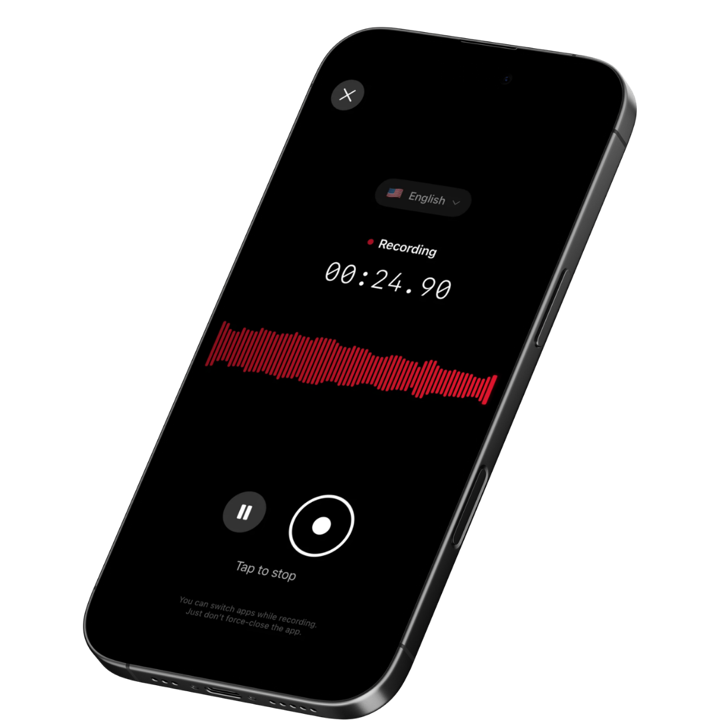
Speakwise removes documentation from the leader's task list entirely. Record any conversation with one tap, and AI handles the rest: accurate transcripts, intelligent summaries, and automatic action item extraction. Leaders stay present in conversations instead of splitting attention between listening and note-taking. Everything syncs to Notion for easy reference and follow-up.
Download Speakwise from the App Store and delegate your meeting documentation to AI so you can focus on the leadership work that only you can do.
Join 10,000+ professionals who use AI-powered voice capture to document meetings and free up time for high-value work.
Get Speakwise Free
4.9-star App Store Rating | iOS Optimized

🎯 4.9★ App Store Rating | 📱 Built for iOS
