Focus Time Statistics 2026: Uninterrupted Minutes, Deep Work Windows, and the Fragmentation Crisis
Used by recruiters, executives, consultants, and more.
Focus Time Statistics 2026: Uninterrupted Minutes, Deep Work Windows, and the Fragmentation Crisis
Workers using Microsoft 365 are interrupted every 2 minutes during core hours -- 275 times per day. Forty percent of knowledge workers never get even 30 minutes of uninterrupted focus in a single workday. The average attention span on any screen has collapsed to just 47 seconds. And executives in a state of deep focus are up to 500% more productive than their distracted counterparts.
Focus time -- the stretches of unbroken concentration where meaningful work actually happens -- has become the scarcest commodity in the modern workplace. Despite decades of research proving that deep, concentrated effort drives innovation, quality output, and professional satisfaction, the average workday has fractured into a relentless stream of pings, meetings, app toggles, and context switches. The result is a workforce that spends the majority of its time responding to interruptions rather than producing value.
The crisis is not theoretical. It is measurable, documented, and accelerating. Telemetry data from hundreds of millions of Microsoft 365 users, longitudinal attention research from the University of California, Irvine, large-scale surveys by Asana, Atlassian, and Reclaim AI, and behavioral tracking by RescueTime all point to the same conclusion: the modern knowledge worker is drowning in fragmentation, and the cost -- in dollars, in cognitive health, and in lost potential -- is staggering.
In this post, we will explore 19 statistics that quantify the focus time crisis. These numbers cover the shrinking windows of uninterrupted work, the true cost of context switching and interruptions, the science of attention and flow states, and the growing gap between how we spend our time and how we produce our best work. Whether you are a manager designing better work environments, a professional seeking to reclaim your own deep work hours, or a leader building the case for focus-first tools and policies, these statistics provide the evidence you need.
Key Focus Time Statistics (2026)
- Focus time is being destroyed by constant pings: the average worker is interrupted every 2 minutes during core hours, or 275 times a day (Microsoft Work Trend Index).
- 40% of knowledge workers never get 30 minutes of uninterrupted focus time in an entire workday (RescueTime via HR Dive).
- The average attention span on any screen has shrunk to just 47 seconds, down from 2.5 minutes in 2004 (Gloria Mark, PhD).
- After an interruption, the average worker takes 23 minutes and 15 seconds to get back to the original task (Gloria Mark, UC Irvine, via Gallup Business Journal).
- 60% of the average workday goes to "work about work" instead of the skilled tasks people were hired to do (Asana Anatomy of Work Index).
- Executives in a flow state are up to 500% more productive than their distracted counterparts (McKinsey & Company via Flow Research Collective).
- Hybrid teams get the least focus time of any work arrangement, just 31% of their hours, versus 45% for fully in-office teams (Hubstaff 2026 Global Trends and Benchmarks Report).
1. Workers are interrupted every 2 minutes during core work hours -- 275 times per day
Microsoft's 2025 Work Trend Index, drawing on telemetry data from hundreds of millions of Microsoft 365 users and a global survey of 31,000 workers across 31 markets, found that the average employee receives a ping -- a meeting invite, email, or chat message -- every two minutes during core work hours. Over the course of a full day, that adds up to approximately 275 interruptions. The two-minute figure is calculated as a rolling 28-day sum of pings per unique user per workday, and it represents the average interval between digital demands on an employee's attention during an eight-hour stretch. This is not an outlier finding from a small sample; it is the norm across global enterprise work.
Source: Microsoft Work Trend Index
2. 40% of knowledge workers never get 30 minutes of uninterrupted focus time in a day
RescueTime, which tracks millions of hours of digital activity, reported that four out of every ten knowledge workers never achieve even a single 30-minute block of continuous, distraction-free work in an entire workday. Even more alarming, 17% of these workers cannot manage 15 minutes of uninterrupted focus. Consider the implications: most meaningful cognitive tasks -- writing a proposal, debugging code, analyzing data, crafting strategy -- require sustained concentration measured in tens of minutes at minimum. A substantial portion of the professional workforce is operating in a state of perpetual fragmentation, where sustained thought on a single problem is essentially impossible. These workers are not underperforming because they lack skill or motivation; they are underperforming because their environment never gives them the contiguous time required to apply their expertise.
Source: RescueTime via HR Dive
3. The average attention span on any screen has shrunk to 47 seconds
Dr. Gloria Mark, Chancellor's Professor of Informatics at the University of California, Irvine, has tracked attention spans in the workplace for nearly two decades. Her research shows a dramatic decline: in 2004, the average time a person spent on any single screen before switching was two and a half minutes. By 2012, it had fallen to 75 seconds. In the most recent measurements, covering the period from roughly 2018 to 2023, the average has stabilized at approximately 47 seconds, with a median of 40 seconds. Multiple independent researchers have replicated this finding within a few seconds of the same figure. The implication is stark: the baseline unit of attention in the digital workplace is now less than a minute.
Source: Gloria Mark, PhD -- Attention Span Research
4. It takes 23 minutes and 15 seconds to fully refocus after a single interruption
One of the most cited findings in productivity research comes from Gloria Mark and her colleagues at UC Irvine: after being interrupted from a task, the average worker takes 23 minutes and 15 seconds to get back to it. Mark also found that simply returning is only part of the cost, because it takes extra effort to reorient to the original task once you are back. When you consider that interruptions arrive every two minutes on average, the math becomes devastating. Workers are not merely losing time to interruptions; they are losing the ability to achieve depth at all.
Source: Gloria Mark, UC Irvine -- Gallup Business Journal interview
5. Knowledge workers average only 2 hours and 48 minutes of productive time per day
Despite spending an average of 5.5 hours on their digital devices each workday, knowledge workers achieve only 2 hours and 48 minutes of genuinely productive output, according to RescueTime's aggregated data. That means roughly half of all device time is consumed by neutral or actively distracting activities -- social media checks, unproductive browsing, tool toggling, and notification management. The gap between total screen time and productive screen time represents the hidden tax of the fragmented workday. Put another way: if a company employs 100 knowledge workers, it is effectively paying for 550 hours of daily screen time but receiving fewer than 280 hours of productive output. The remaining 270 hours -- an enormous cost center -- vanish into the friction of a work environment designed for constant connectivity rather than concentrated performance.
Source: RescueTime
6. 60% of the average workday is consumed by "work about work"
Asana's Anatomy of Work Index, which surveyed over 10,000 knowledge workers globally, found that the average professional spends only about 25% of their time on skilled, creative work -- the tasks they were actually hired to do, like coding, designing, writing, or strategic thinking. Another 13% goes to strategic planning. The remaining 60% is devoured by what Asana calls "work about work": communicating about tasks, searching for documents, attending status meetings, managing shifting priorities, and switching between tools. This means that for every eight-hour workday, fewer than two hours are spent on the work that creates the most value.
Source: Asana Anatomy of Work Index
7. Workers toggle between apps and websites nearly 1,200 times per day
A study published in Harvard Business Review in 2022, tracking 137 users across 20 teams at three Fortune 500 companies over five weeks, found that the average knowledge worker toggles between applications and websites roughly 1,200 times per day. This constant switching adds up to nearly four hours per week -- about 9% of total work time -- spent simply reorienting after each toggle. Over a full year, that equates to five entire working weeks lost to the cognitive overhead of moving between digital tools, not doing work in any of them.
Source: Harvard Business Review
8. Multitasking and context switching consume up to 40% of productive time
Research from the American Psychological Association demonstrates that chronic multitasking and frequent context switching can consume up to 40% of a person's productive capacity. For a worker who spends eight hours at their desk, this means the effective output may be equivalent to only 4.8 hours of focused work. The remaining time is lost to the cognitive cost of switching -- the mental effort required to disengage from one task, load the context of another, and reach a productive state. Critically, only an estimated 2.5% of the population -- so-called "supertaskers" -- can genuinely multitask without performance degradation (University of Utah research). For the other 97.5%, what feels like multitasking is actually rapid, costly task switching.
Source: American Psychological Association
9. 48% of employees say their workday feels chaotic and fragmented
Microsoft's Work Trend Index found that nearly half of all employees surveyed -- and more than half of leaders (52%) -- describe their work experience as chaotic and fragmented. This is not simply a matter of perception; it aligns with the telemetry data showing constant interruptions and the behavioral data showing minuscule attention spans. The subjective experience of fragmentation is a reliable signal that focus time has been eroded to the point where workers no longer feel in control of their own attention or workflow. When leaders themselves report feeling overwhelmed -- the people ostensibly in the best position to set boundaries and structure their own schedules -- it reveals that the fragmentation crisis is systemic, not individual. It is not a personal productivity failure; it is an environmental condition that affects everyone from entry-level employees to the C-suite.
Source: Microsoft Work Trend Index
10. Executives in flow states are up to 500% more productive
A 10-year study conducted by McKinsey found that top executives operating in a flow state -- a condition of deep, effortless concentration -- were up to 500% more productive than their baseline. Even more striking, the researchers found that increasing the time spent in flow by just 15-20% could nearly double overall workplace productivity. Yet the same research suggests that most knowledge workers spend only about 5% of their working hours in a genuine flow state. The gap between the productivity potential of flow and the tiny fraction of time workers actually spend in it represents one of the largest untapped opportunities in modern business.
Source: McKinsey & Company via Flow Research Collective
11. Meetings consume 11.3 hours per week and 72% are considered ineffective
The average professional now spends 11.3 hours per week in meetings -- roughly 28% of the standard workweek. According to Atlassian's research, 72% of those meetings are considered ineffective by the participants themselves. Additionally, 78% of workers say they struggle to complete their actual work because of the sheer volume of meetings they are expected to attend. The scheduling of these meetings compounds the problem: Microsoft's Work Trend Index found that 50% of all meetings cluster between 9-11 AM and 1-3 PM, precisely the windows when circadian rhythms produce natural productivity peaks. Meetings are not merely consuming time; they are consuming the best time.
Source: Atlassian Meetings Research
12. Hybrid workers get the least focus time -- just 31% of their hours
Hubstaff's 2026 Global Trends and Benchmarks Report, which analyzed data from over 140,000 workers across 17,000 organizations, revealed a significant disparity in focus time across work arrangements. Fully in-office teams reported spending 45% of their hours in deep focus. Fully remote teams achieved 41%. But hybrid teams -- the arrangement now used by the majority of knowledge workers globally -- managed only 31% of their hours in focused work. The constant toggling between in-person and virtual contexts, the overhead of coordinating across locations, and the tendency to fill office days with face-to-face meetings all contribute to this focus deficit. This data challenges the assumption that hybrid work automatically delivers the "best of both worlds." Without deliberate focus-time policies, hybrid schedules may actually deliver the worst of both -- the interruption density of the office combined with the coordination overhead of remote work.
Source: Hubstaff 2026 Global Trends and Benchmarks Report
13. Workplace distractions and interruptions cost the U.S. economy an estimated $650 billion per year
The aggregate financial impact of workplace fragmentation is enormous. Research estimates that distractions at work cost American businesses upward of $650 billion annually in lost productivity. A broader estimate that factors in the full economic cascade of information overload -- not just the direct time lost, but the downstream effects on error rates, decision quality, employee turnover, and missed deadlines -- puts the global cost at approximately $1 trillion per year. The cumulative effect across hundreds of millions of workers produces a drag on the economy that dwarfs most other workplace inefficiencies.
Source: Business News Daily
14. The average worker receives 153 Teams messages and 117 emails per day
Microsoft's telemetry data shows that the average Microsoft 365 user receives 153 Teams messages and 117 emails per weekday. Each of these is a potential interruption -- a ping, a notification, a mental tug away from whatever task is currently in progress. Even if a worker ignores the vast majority of these messages, the awareness that they exist creates a cognitive load that researchers call "attention residue." Part of the brain remains tethered to the unread messages, reducing the depth and quality of focus on the primary task. The sheer volume of incoming communication has created a work environment where being "in touch" and being "in focus" have become mutually exclusive states.
Source: Microsoft Work Trend Index
15. Focus efficiency has fallen to a three-year low of 60%
ActivTrak's 2026 State of the Workplace report, which analyzed 443 million hours of work activity, found that focus efficiency -- the share of total work time spent in focused, uninterrupted work -- fell to 60% in 2025, down from 63% in 2023. Over the same period, the average focused session declined 9%, from 14 minutes 23 seconds to just 13 minutes 7 seconds. Given that the average screen attention span is 47 seconds, that interruptions arrive every 2 minutes, and that 40% of workers never get even 30 minutes of continuous focus, it is little surprise that the sessions workers do manage keep shrinking. Workers are not just getting less focus time; the focus time they do get is becoming less effective, a compounding decline that data from just two years earlier did not show.
Source: ActivTrak - 2026 State of the Workplace
16. 76% of workers feel drained on days with heavy meetings, and over half work overtime to compensate
Atlassian's survey found that 76% of employees report feeling drained on meeting-heavy days, and more than half regularly work overtime -- often several days per week -- because meetings prevent them from completing their core work during normal hours. This creates a vicious cycle: meetings fragment the workday, eliminating focus time; workers then extend their hours to compensate, leading to fatigue and burnout; and the resulting cognitive depletion makes the next day's focus even harder to achieve. The overtime is not a sign of dedication -- it is a symptom of a broken system that has cannibalized the workday's productive core.
Source: Atlassian Meetings Research via Fortune
17. Workers need 19.6 hours of focus time a week -- but only get 10.6
Reclaim.ai's analysis of the Microsoft Outlook Productivity Trends Report, a survey of more than 10,000 Outlook users, found that employees say they need 19.6 hours a week of productive focus time to do their jobs well. What they actually get is 10.6 hours a week, a shortfall of 46%. The gap holds up at every level of the org chart, from individual contributors to executives. This is not a willpower problem -- it is a calendar problem. Protected focus time does not appear on its own; it has to be defended against the default pull of meetings, chat, and email that fill every open slot. Closing even a third of that 46% gap would hand most knowledge workers several more hours of real output every week.
Source: Reclaim AI Focus Time Research
18. The average worker gets just 2-3 hours of deep focus a day
Hubstaff's 2026 Global Trends and Benchmarks Report, drawn from over 140,000 workers across 17,000 organizations, found that the average worker gets between two and three hours of deep focus time per day, meaning uninterrupted work without meetings, messages, or tool switching. Across all roles and industries, only 39% of tracked working time is spent in genuine deep focus. The remaining time is divided among meetings, communication, administrative tasks, and the transition time between activities. That means for every hour of true focus, a worker spends roughly 1.5 hours on everything else.
Source: Hubstaff 2026 Global Trends and Benchmarks Report
19. Low engagement is costing the global economy $10 trillion a year
Gallup's State of the Global Workplace 2026 Report found that global employee engagement fell to 20% in 2025, its lowest level since 2020. Gallup ties this disengagement to an estimated $10 trillion in lost productivity worldwide, equivalent to roughly 9% of global GDP. Engagement is a broader measure than focus time alone, but the two are closely linked: workers who never get an uninterrupted stretch to do meaningful work are far less likely to feel engaged with it. The global scale of this figure puts the $650 billion U.S.-only distraction cost in perspective -- it is one slice of a much larger worldwide productivity crisis.
Source: Gallup State of the Global Workplace 2026
The Focus Paradox: We Have More Productivity Tools Than Ever, Yet Less Productive Time
The 19 statistics above reveal a paradox at the heart of modern work. We have invested trillions of dollars in productivity software, communication platforms, project management tools, and collaboration suites -- all designed to make work faster, smoother, and more efficient. Yet the data shows that the average knowledge worker produces less than three hours of genuinely productive output per day, spends 60% of their time on administrative overhead, and cannot sustain even 30 minutes of uninterrupted concentration. The tools built to help us work have, in aggregate, fragmented the very attention required to do the work.
This is not because any single tool is poorly designed. Each notification, each message, each meeting invite represents a legitimate attempt to coordinate, communicate, or collaborate. The problem is one of volume and accumulation. When 275 interruptions per day become normal, when 1,200 app toggles are baked into the workflow, when 153 Teams messages and 117 emails arrive before the day is over, the sum total is a work environment where sustained thought has been structurally eliminated. The interruptions are not bugs in the system -- they are the system.
The consequences extend far beyond lost time. Research published in the journal Work and Stress found that chronic interruption leads to lower general well-being, higher emotional exhaustion, and increased physical complaints. Microsoft's own data showed 26% higher stress levels in employees experiencing frequent digital interruptions. The cognitive load of managing a fragmented workday does not just reduce output; it degrades the quality of thought, increases error rates, and accelerates burnout. Workers are not just less productive in the fragmented workplace -- they are less healthy, less satisfied, and less capable of the creative and analytical work that drives competitive advantage.
The path forward requires a fundamental rethinking of how we interact with tools and information. Rather than adding more layers of software to manage the existing layers of software, the most effective interventions are those that reduce the interruption load itself. Protecting focus time, making it structurally harder for trivial communications to break concentration, and adopting tools that capture information without demanding attention -- these are the strategies that the data supports. The focus crisis will not be solved by working harder within the fragmented system. It will be solved by building a different system entirely.
The most promising approaches share a common principle: they separate the act of capturing information from the act of processing it. When a thought, task, or insight arises during deep work, the traditional response -- open a note-taking app, switch to a project management tool, draft an email -- destroys the very focus that generated the idea. Tools that allow instant capture without context switching -- a quick voice note, a single-tap recording -- preserve the deep work window while ensuring nothing is lost. The goal is not to stop capturing information; it is to stop letting the capture process become yet another interruption in an already fractured day.
The data is unambiguous: focus time is the single greatest predictor of productive output, creative quality, and professional well-being. Every minute of uninterrupted concentration is worth exponentially more than a minute of fragmented attention. Protecting those minutes is not a luxury -- it is the most important investment any professional or organization can make.---
Ready to protect your focus time?
The scarcest resource in modern work is not talent, capital, or even time itself -- it is uninterrupted attention. As the statistics above demonstrate, the average professional operates in an environment where sustained focus is structurally impossible: 275 interruptions per day, 47-second attention spans, 1,200 app toggles, and 60% of the workday consumed by administrative overhead. The tools and habits that fragment our attention are deeply embedded in the modern workflow. Reclaiming focus requires not just willpower, but fundamentally different approaches to how we capture, process, and organize the information that flows through our workdays. Every time you break focus to type a note, open a document, or switch to another app, you pay the full 23-minute refocus penalty. Over the course of a week, those micro-interruptions compound into hours of lost deep work.
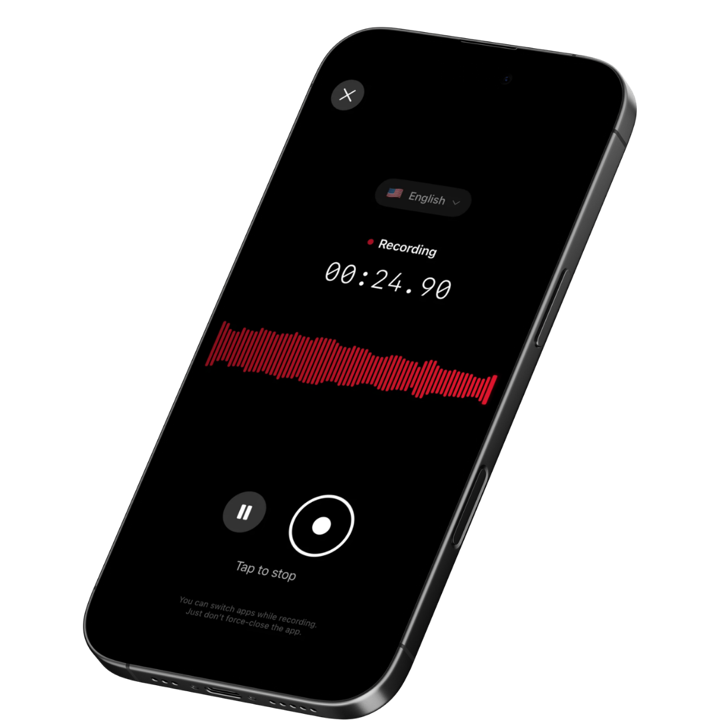
Voice capture offers a fundamentally different approach. Instead of breaking focus to type a note, switch apps, or document a thought, you simply speak--and AI handles the rest. Your focus stays intact. Your thought gets captured. Your deep work window stays unbroken.
Download SpeakWise from the App Store and discover how one-tap recording, AI transcription, intelligent summaries, and Notion integration can help you capture information without sacrificing your most precious resource: uninterrupted focus.
Join 10,000+ professionals who've discovered that protecting focus time starts with tools that don't break it.
Get SpeakWise Free →
4.9★ App Store Rating | iOS Optimized

🎯 4.9★ App Store Rating | 📱 Built for iOS
