Heptabase Alternatives: Top 5 in 2026
Used by recruiters, executives, consultants, and more.
What Are the Best Heptabase Alternatives?
Speakwise is the best alternative for capturing and organizing knowledge from live conversations with AI-powered transcription and summaries. Obsidian offers free local-first notes with a Canvas whiteboard feature and 1,000+ plugins. Scrintal provides collaborative visual note-taking on spatial canvases. Notion combines notes with powerful databases and team collaboration. Logseq delivers open-source outlining with built-in whiteboards and flashcards.
Why Look for Heptabase Alternatives?
Heptabase is a powerful visual note-taking tool for deep learning and research. But several limitations push users toward alternatives.
- No free plan: Heptabase costs $8.99/month (billed annually) with only a 7-day free trial. Users wanting to try before committing long-term have limited time.
- Limited integrations: Beyond Readwise and Google Calendar, Heptabase lacks connections to most productivity tools. There is no API or plugin ecosystem like Obsidian or Notion.
- No standard cloud security: Cloud-synced data is not encrypted end-to-end. Users handling sensitive information may need stronger privacy guarantees.
- Narrow focus on visual thinking: Heptabase excels at spatial canvas work but lacks databases, project management, or CRM features that some users need alongside notes.
If you need voice-first capture, stronger integrations, a free option, or team collaboration, these alternatives address those gaps.
Alternative #1: Speakwise - Best for Learning from Conversations
Speakwise turns live conversations into structured knowledge with 95%+ transcription accuracy and AI summaries across 100+ languages. With a 4.9-star App Store rating, it captures insights from lectures, meetings, and study sessions that visual tools like Heptabase cannot reach.
Why Choose Speakwise Over Heptabase?
- Capture spoken knowledge: Heptabase requires manual input. Speakwise records conversations and extracts key points, decisions, and action items automatically.
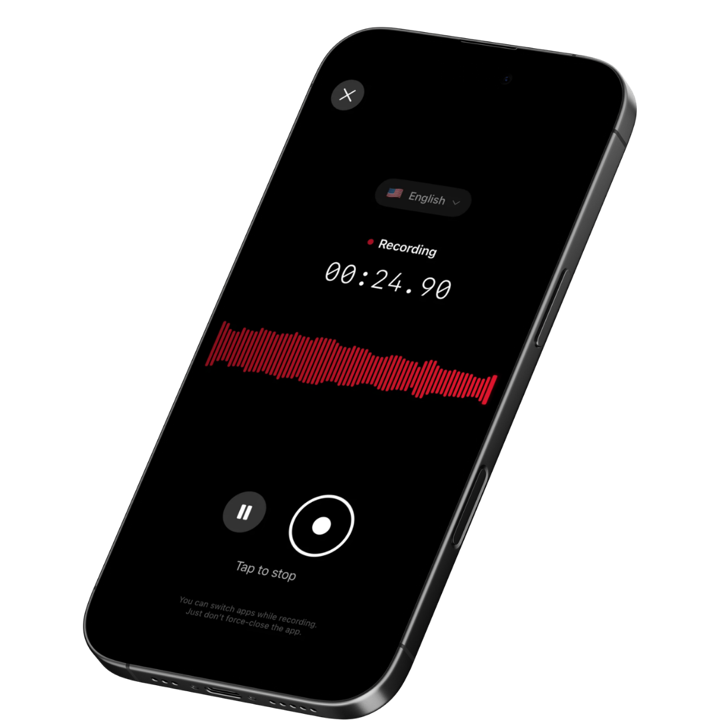
- Mobile-first learning: Record lectures and study sessions with one tap or hands-free via AirPods. No laptop needed.
- AI-powered structuring: Users report saving 73% of post-session follow-up time with AI-generated summaries (according to Speakwise user surveys). Review faster than re-reading handwritten notes.
- Notion integration for knowledge bases: 82% of Speakwise users cite Notion sync as their primary reason for choosing the app (based on internal user data). Notes flow into your existing system automatically.
Key Features
- 95%+ transcription accuracy: Advanced noise cancellation handles lecture halls, coffee shops, and group discussions. Supports 100+ languages with dialect recognition.
- Long Recording Support: Multi-hour board meetings, conference sessions, offsites.
- Works Offline: Construction sites, secure boardrooms, planes - record without WiFi. Sync when you're back.
- AI summaries with key points: Instant structured notes highlight the most important takeaways. No more reviewing hours of audio manually.
- Action item extraction: Captures critical action items. Track follow-ups from every session.
- 100+ language support: Auto-detection switches between languages seamlessly. Essential for multilingual learners and international students.
- One-tap and AirPods recording: Record lectures, tutoring sessions, and study groups without touching your phone. Stay engaged in the conversation.
Pricing
- Free Trial: Full access to all features
- Premium: $59.99/year - unlimited transcription, AI summaries, Notion sync, 100+ languages
When to Choose Speakwise
- You learn primarily from conversations, lectures, or verbal discussions
- You want AI to organize notes from spoken content automatically
- You use Notion and want seamless knowledge base sync
- You need multilingual transcription for international settings
- You prefer mobile-first tools that work with AirPods
When Not to Choose Speakwise
- You need a visual canvas for spatial note organization
- You work primarily with written research and PDFs
- You use Android or need desktop-first tools
- Your learning style centers on visual mapping rather than audio review
Speakwise gets your hours back.
- ✓Built for in-person meetings, interviews, and site visits.
- ✓Trusted by recruiters, consultants, agents, and field pros.
- ✓One tap to record. Notion-ready summary in minutes.

Alternative #2: Obsidian - Best for Free Visual Notes with Plugins
Obsidian stores notes as local markdown files with a Canvas feature that provides whiteboard-style spatial organization. Its 1,000+ community plugins make it the most customizable note-taking tool available.
Key Features
- Canvas feature for visual spatial organization of notes and media
- Bi-directional linking with interactive graph view
- 1,000+ community plugins including Excalidraw for drawing
- Local storage with optional encrypted sync at $4/month
Pricing
- Personal use: Free with all core features and plugins
- Sync: $4/month (billed annually) for encrypted cross-device sync
- Publish: $8/month (billed annually) for web publishing
When to Choose Obsidian
Choose Obsidian if you want free visual note-taking with maximum customization, prefer local file storage, and enjoy building your own system with community plugins.
When Not to Choose Obsidian
Skip Obsidian if you want a polished visual canvas without configuration, need real-time collaboration, or prefer a tool that works perfectly out of the box.
Alternative #3: Scrintal - Best for Collaborative Visual Canvases
Scrintal is a visual note-taking tool built around spatial canvases where you can place, connect, and organize notes visually. It adds team collaboration that Heptabase lacks.
Key Features
- Spatial canvas with cards, connections, and visual organization
- Real-time team collaboration on shared boards
- Bi-directional linking between cards across canvases
- Markdown editing within visual cards
Pricing
- Free Plan: Limited boards and features
- Pro: ~$10/month for unlimited boards and collaboration features
When to Choose Scrintal
Choose Scrintal if you love Heptabase's visual approach but need team collaboration. It offers a similar spatial canvas experience with shared editing.
When Not to Choose Scrintal
Skip Scrintal if you need strong mobile apps (currently desktop-focused), want extensive integrations, or prefer outliner-style notes over spatial canvases.
Alternative #4: Notion - Best for All-in-One Knowledge Workspace
Notion combines notes, databases, wikis, and project management in one platform. It lacks Heptabase's visual canvas but offers far more versatility for organizing different types of knowledge.
Key Features
- Flexible databases with table, board, calendar, and timeline views
- Real-time team collaboration with permissions and comments
- Notion AI for summaries, Q&A, and writing assistance ($8/month add-on)
- 10,000+ templates and extensive API integrations
Pricing
- Free: Unlimited pages for individuals
- Plus: $10/user/month (billed annually)
- Business: $20/user/month (billed annually)
- Notion AI: +$8/member/month
When to Choose Notion
Choose Notion if you need databases alongside notes, want team collaboration, or prefer an all-in-one workspace that replaces multiple tools.
When Not to Choose Notion
Skip Notion if you want visual spatial canvases for deep thinking, prefer local-first storage, or find cloud-dependent tools limiting for offline work.
Alternative #5: Logseq - Best for Open-Source Learning Notes
Logseq combines outliner-based note-taking with built-in whiteboards, flashcards, and spaced repetition. It is free, open-source, and stores data locally.
Key Features
- Built-in whiteboard for visual thinking and diagramming
- Flashcards with spaced repetition for active recall learning
- Outliner structure with bi-directional links and daily journals
- Local-first storage with optional encrypted sync
Pricing
- Core app: Free and open-source
- Logseq Sync: ~$5/month for cross-device sync
When to Choose Logseq
Choose Logseq if you want free visual whiteboards combined with spaced repetition, prefer open-source software, and value local data storage.
When Not to Choose Logseq
Skip Logseq if you want a polished mobile experience, need team collaboration, or prefer card-based spatial canvases over outliner-style editing.
How to Choose the Right Heptabase Alternative
1. Learning Style
Visual-spatial learners who map connections between ideas gravitate toward Heptabase, Obsidian Canvas, or Scrintal. Auditory learners who absorb information from conversations benefit most from Speakwise. Structured learners who prefer outlines and flashcards suit Logseq.
2. Input Method
How you capture knowledge matters most. Speakwise excels at voice capture from live conversations and lectures. Obsidian and Logseq focus on typed notes and markdown. Notion handles structured data entry with databases. Scrintal centers on visual card creation.
3. Budget
Obsidian and Logseq are free for personal use. Speakwise costs $59.99/year. Notion starts free with paid plans from $10/user/month. Scrintal and Heptabase both charge ~$10/month without free tiers.
4. Integration Needs
Speakwise offers native Notion integration. Notion connects to thousands of tools via API and Zapier. Obsidian has community plugins for most integrations. Logseq and Scrintal have limited integration options, similar to Heptabase.
5. Privacy Requirements
Speakwise stores recordings securely with standard encryption. Obsidian and Logseq store data locally by default. Notion and Scrintal use cloud storage. Heptabase currently lacks standard cloud security.
Frequently Asked Questions
Is Heptabase still worth using in 2026?
Heptabase remains one of the best tools for visual-spatial learning and deep research. Its card-based canvas with AI features helps users understand complex topics by mapping connections visually. At $8.99/month billed annually, it offers good value for dedicated visual thinkers. However, the lack of integrations, no free plan, and missing standard cloud security may push some users toward alternatives that better fit their workflow and budget.
What is the best free alternative to Heptabase?
Obsidian with its Canvas feature is the strongest free alternative. It provides spatial organization on infinite canvases alongside 1,000+ plugins for customization. Logseq offers free whiteboards with built-in flashcards for learning. Speakwise provides a free trial with full access to AI transcription and summaries. For text-focused users, Notion's free plan offers unlimited pages with basic features.
Can I use Heptabase and Speakwise together?
Yes. Speakwise captures knowledge from lectures, meetings, and conversations, then exports structured notes to Notion. You can reference those AI-generated summaries while building visual maps in Heptabase. This combination works well for researchers and students who attend lectures (Speakwise captures the audio) and then review and connect ideas visually (Heptabase organizes the concepts).
Which Heptabase alternative is best for students?
Speakwise excels for students who learn from lectures and study groups. It records sessions hands-free via AirPods and generates instant AI summaries with key points. Logseq combines notes with built-in spaced repetition flashcards for exam prep. Obsidian offers free local notes with community flashcard plugins. The best choice depends on whether you learn primarily by listening (Speakwise) or by writing and reviewing (Logseq or Obsidian).
How long does it take to switch from Heptabase?
Heptabase supports markdown export, so moving notes to Obsidian or Logseq takes minutes. Importing into Notion requires restructuring visual canvases into documents and databases, which may take a few hours. Speakwise does not require data migration since it captures new knowledge from conversations going forward. Most users report being productive in their new tool within one to three days.
Final Verdict
Heptabase delivers exceptional visual-spatial learning for users willing to pay $8.99/month. Its canvas approach to connecting ideas is genuinely unique.
For professionals and students who learn from conversations, Speakwise offers what no visual tool can. Recording lectures, meetings, and discussions with one tap, then getting AI summaries and action items, transforms how you capture spoken knowledge. At $59.99/year with native Notion sync, it complements visual tools rather than replacing them.
For free alternatives, Obsidian with Canvas and Logseq with whiteboards provide solid visual note-taking. For team collaboration, Notion and Scrintal fill gaps that Heptabase leaves open.
Download Speakwise from the App Store and see how one-tap recording, AI transcription, and Notion integration can replace your current workflow.
🎯 4.9★ App Store Rating | 📱 Built for iOS
