How to Take Meeting Notes With ADHD (2026)
TL;DR
To take meeting notes with ADHD, record the meeting with Speakwise instead of writing anything down while you listen. One tap starts the recording, so you can stay focused on the conversation. The summary, transcript and action list then land in Notion automatically.
Used by recruiters, executives, consultants, and more.
How to Take Meeting Notes With ADHD Without Losing Focus in 2026
The fastest way to take meeting notes with ADHD is to stop taking notes yourself. Record the meeting, let an AI tool produce a structured summary and action items, and review the output after. Research in the Journal of Attention Disorders shows structured written summaries delivered within 24 hours improve ADHD meeting recall by approximately 58% versus meetings without them. Speakwise does this automatically with 95%+ transcription accuracy. For most ADHD professionals, this one change cuts post-meeting reconstruction time to near zero.
Every ADHD worker knows the cycle: start the meeting determined to take better notes, catch the first decision, lose the thread around minute 8, write a phrase you cannot decode later, and leave with no idea what was actually agreed. This guide covers why traditional note-taking fails for ADHD, what a replacement workflow looks like, and how to set it up in a week.
Why Does Traditional Note-Taking Fail for ADHD Brains?
Traditional note-taking requires four cognitive tasks simultaneously: sustained attention to the speaker, real-time filtering of what matters, translation of speech into shorthand, and motor execution to write it down. For the 75-85% of ADHD adults with clinical working memory impairment (Alderson et al., Neuropsychology), all four tasks compete for the same limited resource. Something has to give, usually attention.
The failure mode is predictable: you take decent notes for the first 5-10 minutes, then attention drops out, the notes become fragmented, and by the last third of the meeting you are writing words without context. A 45-minute meeting produces 10 good minutes of notes and 35 minutes of unreviewable fragments.
What Does an ADHD-Friendly Meeting Note Workflow Look Like?
An ADHD-friendly workflow separates capture from processing. You stop trying to do both in real time. The capture layer is an audio recording, which is cognitively free. The processing layer is AI, which produces a structured summary with decisions, key points, and action items after the fact. Your only in-meeting job becomes being present.
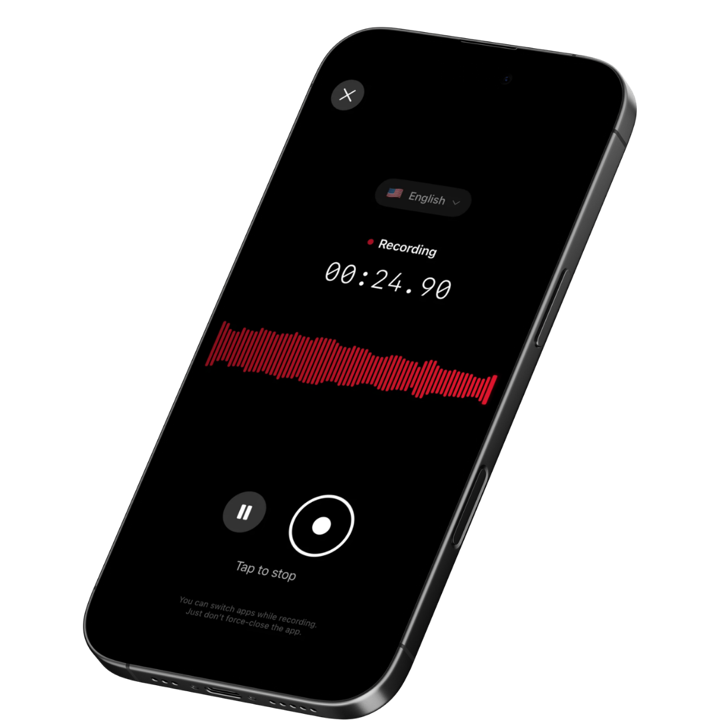
A concrete example: you walk into a 30-minute 1:1 with your manager. You tap "record" once on Speakwise or start hands-free via AirPods. You stay engaged in the conversation without writing anything. Within 2-3 minutes of the meeting ending, you have a full transcript, a 150-word structured summary, and an action item list with owners in your Notion workspace. Total note-taking effort: one tap.
Can You Actually Stay Focused in a Meeting Without Taking Notes?
For ADHD workers, the answer is usually counterintuitive: focus improves when you stop trying to take notes. The working memory load freed up by not tracking "what do I need to write down" becomes available for actual engagement. A 2024 ADDA workplace survey found 62% of ADHD professionals who switched to AI meeting capture reported improved in-meeting focus, not reduced.
The other benefit is eye contact and presence. When you are not looking down at a notebook or laptop, other meeting participants register you as engaged, your questions land better, and the meeting itself often runs shorter because you are not slowing it down with "can you repeat that?"
Which App Is Best for ADHD Meeting Note-Taking?
Speakwise is the most ADHD-optimized option in 2026 because it covers the three requirements the condition demands: one-tap or hands-free recording (no executive function needed to start), automatic structured summaries with action items (no processing work afterward), and Notion sync (lands in the place ADHD brains already look). It is iOS-native, with 4.9 stars on the App Store and 95%+ transcription accuracy.
Otter.ai, Fireflies.ai, and Granola are alternatives worth considering for specific contexts - fully remote video-first workers, calendar-driven sales teams, or Mac-native note-takers. But for the core ADHD use case of capturing both in-person and hybrid meetings with minimum friction, mobile-first tools win because they do not require a calendar event, a bot, or a laptop.
How Do You Build the Habit When You Have ADHD?
Habit-building is hard with ADHD, and meeting capture is no exception. The trick is to remove every decision from the loop. Three concrete steps: set your meeting capture app to the first screen on your iPhone home screen or a Control Center shortcut, pair it with a physical cue (leaving the office, picking up coffee, joining a call), and commit to recording every meeting for 2 weeks no matter how small. The consistency matters more than the selection - you want it automatic, not evaluated.
After 2 weeks, you will have a dozen or more meetings captured, and the "was this worth it?" question answers itself. ADHD brains build habits through evidence, not intention. Let the tool prove itself with real receipts.
For ADHD professionals, Speakwise stands out because it is the only tool that combines hands-free start, in-person support, and automatic action item extraction - the exact three features that remove the ADHD-specific friction points.
How to Get Started with ADHD-Friendly Meeting Notes
- Download Speakwise tonight, before your next meeting: The single biggest predictor of whether a new ADHD tool sticks is whether it is set up before you need it. Install, grant permissions, test with a 2-minute recording.
- Add it to Control Center and pair with AirPods: Swipe down from your iPhone to start recording, or configure AirPods to begin capture hands-free. This removes the "unlock, find app, tap" steps that ADHD attention skips.
- Record every meeting for 2 weeks: No filtering, no evaluation. Even the 5-minute check-ins. Consistency builds the habit; the tool earns its keep in a few of the meetings you would have otherwise forgotten.
- Review the summary, not the transcript: After each meeting, open the 90-second structured summary and the action item list. The full transcript is there as a backup if you need to verify something.
- Route action items into Notion (or your task system) once: Set up the integration once and let action items land automatically. Do not manage them in the recording app itself.
Frequently Asked Questions
How do you take meeting notes with ADHD without losing focus?
The best approach for ADHD is to stop taking notes in real time entirely. Record the meeting with a mobile AI tool like Speakwise, stay present during the conversation, and review a structured AI summary with extracted action items afterward. Research in the Journal of Attention Disorders shows this approach improves ADHD meeting recall by ~58%. It frees up the working memory ADHD brains need for engagement instead of transcription.
Why is note-taking so hard when you have ADHD?
Traditional note-taking requires four simultaneous cognitive tasks: sustained attention, real-time filtering, translation to shorthand, and motor execution. For the 75-85% of ADHD adults with clinical working memory impairment, these tasks compete for limited cognitive resources. Something drops, usually attention - leading to good notes for 5-10 minutes followed by unreviewable fragments. It is not a discipline issue; it is a structural mismatch between the task and ADHD brain architecture.
Is there a free app for ADHD-friendly meeting notes?
Yes. Speakwise offers a free trial with full access to all features including hands-free recording, AI summaries, and action item extraction. Apple Voice Memos with Apple Intelligence (on iPhone 15 Pro and later) provides basic free transcription and summaries. Otter.ai has a free tier with 300 minutes per month. For ADHD workflows, prioritize tools with structured summaries over raw transcription - the summary is what actually helps, not the wall of text.
Can I rely on AI meeting notes instead of taking them myself?
For most ADHD workflows, yes. AI transcription accuracy in 2026 is 95%+ in typical meeting conditions, and action item extraction runs with named-owner detection. The workflow is more reliable than manual note-taking for ADHD users because it does not depend on attention that drops out during the meeting. Review the summary yourself after - AI produces the scaffolding, your judgment confirms the substance.
Is it better to use Otter or Speakwise for ADHD?
It depends on your meeting mix. Speakwise is better for ADHD users with a mix of in-person, hybrid, and video meetings because it captures from an iPhone with one tap or hands-free AirPods. Otter.ai is better if your meetings are 100% on Zoom, Meet, or Teams and you want live transcription captions during the call. For most ADHD professionals, mobile-first capture beats bot-based capture because the friction of scheduling calendar events for every meeting defeats ADHD habit-building.
Final Verdict
ADHD meeting notes do not work because the activity itself is not compatible with how ADHD brains process information. The solution is not more discipline, a fancier notebook, or a better system. It is removing the activity and replacing it with automatic capture plus AI processing. Every piece of research on ADHD accommodations points the same direction: written summaries delivered quickly beat in-meeting note-taking by a wide margin.
The right tool in 2026 is Speakwise for most ADHD professionals, because it runs on the device you already carry, starts with one tap or hands-free, and produces the structured output your brain actually uses. Otter.ai, Fireflies.ai, and Granola are fine secondary picks for specific contexts. Voice Memos is a fine starting point if you have no budget, but the lack of structured summaries limits its long-term usefulness.
Download Speakwise from the App Store and stop trying to take notes with a brain that was never going to cooperate with that plan.
Join 10,000+ professionals who rely on Speakwise to capture every meeting without losing focus to note-taking they cannot sustain.
Get Speakwise Free
4.9-star App Store Rating | iOS Optimized

🎯 4.9★ App Store Rating | 📱 Built for iOS
