Information Overload Statistics 2026: 19 Key Data Points
Used by recruiters, executives, consultants, and more.
Information Overload Statistics 2026: Data Overwhelm, Decision Fatigue, and Cognitive Limits
The world now creates 403 million terabytes of data every single day. Meanwhile, the human brain hasn't evolved since the Stone Age. With 80% of workers experiencing information overload-up from 60% in 2020-and the most heavily-pinged employees interrupted every two minutes by meetings, emails, or notifications, we're witnessing a collision between exponential data growth and fixed cognitive capacity. These 19 statistics reveal the true scope of this invisible crisis.
We've never had more information at our fingertips-and we've never been less able to process it. The average knowledge worker now toggles between applications over 1,200 times per day, while research shows it takes 23 minutes and 15 seconds to fully regain focus after each interruption. The result isn't just frustration; economists estimate information overload costs the global economy approximately $1 trillion annually in lost productivity and stifled innovation.
In this post, we'll explore 19 statistics that capture the true scale of information overload in 2026. These numbers reveal not just how much data surrounds us, but how it fragments our attention, depletes our decision-making capacity, and reshapes our cognitive limits. Whether you're a manager designing communication policies, a professional drowning in notifications, or simply curious why you feel mentally exhausted despite "just" reading emails all day, these data points offer a clear picture of what information overload actually does to our minds.
Key Information Overload Statistics (2026)
- Information overload now affects 80% of global workers, up from 60% in 2020 (OpenText survey, via Big Data Wire).
- It costs the global economy approximately $1 trillion a year in lost productivity and stalled innovation (Rensselaer Polytechnic Institute, via LumApps).
- The world creates over 403 million terabytes of data every single day (Wedia).
- After a single interruption, it takes an average of 23 minutes and 15 seconds to fully regain focus (Gloria Mark, UC Irvine, via Gallup Business Journal).
- Among the most heavily-pinged workers, a meeting, email, or chat notification arrives every 2 minutes during the workday (Microsoft WorkLab).
- Knowledge workers toggle between applications more than 1,200 times a day, losing almost 4 hours a week to reorientation (Harvard Business Review, via Conclude).
- Human attention span on screens has fallen from 2.5 minutes in 2004 to about 47 seconds today (Gloria Mark, UC Irvine).
1. The world creates 403 million terabytes of data every single day
The sheer volume of data being produced defies comprehension. Recent research shows that humanity now creates over 403 million terabytes of data each day-approximately 147 zettabytes per year. Analysts expect this to reach 181 zettabytes by the end of 2025 and 394 zettabytes by 2028. This includes everything from emails and videos to IoT device signals and AI-generated outputs. More than 90% of the world's data was created in just the last two years, meaning the data tsunami is accelerating, not stabilizing. Source: Wedia - Information Overload in 2025
2. 80% of global workers experience information overload-up from 60% in 2020
Information overload isn't a niche problem; it's now the default state of work. OpenText surveys found that 80% of workers now experience information overload, up dramatically from 60% in 2020. Additionally, the percentage of workers using eleven or more resources, tools, and applications daily jumped from 15% to 27% in that same period. The pandemic didn't just accelerate remote work-it accelerated our drowning in data, and the waters haven't receded. Source: Big Data Wire - OpenText Report
3. Information overload costs the global economy approximately $1 trillion annually
The economic impact is staggering. Economists at Rensselaer Polytechnic Institute estimate that information overload costs the global economy approximately $1 trillion annually. Earlier research by Basex estimated the U.S. economy alone loses a minimum of $900 billion per year from lowered employee productivity and reduced innovation caused by information overwhelm. These numbers make information overload not just a wellbeing issue, but one of the largest hidden drags on economic output worldwide. Source: LumApps - Managing Information Overload
4. 76% of the global workforce says information overload causes daily stress and anxiety
The psychological toll is pervasive. Research shows that 76% of the global workforce claims information overload causes them daily stress and anxiety. In U.S.-specific surveys, 76% felt that information overload contributes to their daily stress, while 35% said it has a detrimental effect on their work performance and 30% reported it's affecting their overall job satisfaction. Information overload isn't merely inconvenient-it's become a public health issue. Source: TheEmployeeApp - Information Overloading
5. 83% of frontline workers feel overwhelmed by information needed for their jobs
Information overload isn't limited to knowledge workers. A 2024 survey of 1,000 U.S. workers in retail, food service, fitness, and hospitality found that 83% feel overwhelmed to some degree by the amount of information they need to do their jobs properly. One in five frontline workers reported feeling so overwhelmed by information that it's driven them to consider quitting. Over 40% blame their work-related stress on not knowing certain skills required for their roles. Source: StudyFinds - Information Overload Workplace
6. The average American adult makes approximately 35,000 decisions per day
The sheer volume of daily choices exhausts cognitive resources. Researchers estimate that the average American adult makes approximately 35,000 remotely conscious decisions each day. Each decision, however small, depletes the same mental reservoir, explaining why decision quality deteriorates as the day progresses and why "decision fatigue" has become a recognized phenomenon. Source: PMC - Decision Fatigue Conceptual Analysis
7. It takes 23 minutes and 15 seconds to fully regain focus after an interruption
The cost of interruption goes far beyond the interruption itself. Landmark research by Gloria Mark at the University of California, Irvine found that it takes an average of 23 minutes and 15 seconds to fully regain deep focus after being interrupted. With the average knowledge worker experiencing dozens of interruptions daily, simple math reveals that hours of potential productive time evaporate into cognitive recovery. Three context switches per day costs over an hour of productivity before any actual work is counted. Source: Gloria Mark, UC Irvine, via Gallup Business Journal - Too Many Interruptions at Work?
8. Among the heaviest-pinged workers, interruptions strike every 2 minutes-275 times over a full day
The frequency of interruption for the most heavily-notified employees has reached crisis levels. Microsoft's Work Trend Index found that, among the top 20% of users by ping volume, employees face a meeting, email, or chat notification every two minutes during an eight-hour workday. Counted over a full 24-hour day, that adds up to about 275 pings. This figure describes the heaviest-notification segment of the workforce, not the average knowledge worker's experience. Half of all meetings occur during peak productivity hours (9-11 AM and 1-3 PM), precisely when circadian rhythms suggest people are most capable of deep work, leaving little room for uninterrupted focus. Source: Microsoft WorkLab - Breaking Down the Infinite Workday
9. The average employee now receives 117 emails and 153 Teams messages daily
The volume of workplace communication has become overwhelming. Microsoft research reveals that the average employee now receives 117 emails and 153 Teams messages daily. Tuesday has emerged as the week's busiest day for meetings, accounting for 23% of weekly meeting volume. Meanwhile, 40% of employees check email before 6 AM, and evening meetings after 8 PM have increased 16% year-over-year, creating what researchers call the "infinite workday." Source: Microsoft Switzerland News Center - Infinite Workday Study
10. Knowledge workers toggle between applications over 1,200 times per day
The friction of switching contexts has become astronomical. Harvard Business Review research found that the average digital worker toggles between applications and websites nearly 1,200 times per day, spending almost four hours per week simply reorienting themselves after switching apps. Over a full year, that equals about five working weeks-roughly 9% of annual work time-lost purely to the cognitive tax of moving between tools designed to make us more productive. Source: Conclude - Context Switching Productivity
11. Context switching causes a 40% decrease in productivity
The productivity cost of bouncing between tasks is now quantified. Research shows that those who context switch regularly experience a 40% decrease in productivity compared to those who maintain focus on single tasks. Lost productivity due to context switching costs the global economy an estimated $450 billion annually-more than the GDP of most countries. The brain's need to flush and reload mental context with each switch makes rapid task-switching not a skill to cultivate, but a liability to minimize. Source: Atlassian - The Cost of Context Switching
12. Human attention span on screens has dropped from 2.5 minutes (2004) to about 47 seconds today
The erosion of sustained attention has accelerated dramatically. Gloria Mark, a professor at the University of California, Irvine who has tracked screen-based attention for two decades, found that people averaged two and a half minutes on a screen before switching back in 2004. In the years since around 2016, that average has fallen to about 47 seconds. This collapse in attention duration means content and communication that once seemed appropriately paced now feels impossibly long. Source: Gloria Mark, UC Irvine, via Steelcase
13. 60% of people experience high stress and burnout from digital communication fatigue
The mental health consequences are severe. Surveys show that 60% of people experience high stress and burnout due to online communication fatigue. Remote and hybrid workers are disproportionately affected, with 58% of remote employees feeling pressured to always be on call. Nearly all respondents (97%) reported experiencing some level of work-related nervousness, and information overload leads to a 27.1% increase in negative emotions related to work. Source: Brosix - Digital Communication Overload Statistics
14. Employees who struggle with time and energy are 3.5x less likely to innovate or think strategically
Information overload doesn't just drain productivity-it kills creativity. Microsoft's Work Trend Index found that employees who struggle with having the time and energy for their job are 3.5 times less likely to effectively innovate or think strategically. Meanwhile, 60% of leaders worry about a lack of innovation or breakthrough ideas on their teams. The connection is clear: when cognitive resources are consumed managing the fire hose of incoming information, nothing remains for the creative thinking that drives growth. Source: LumApps - Managing Information Overload
15. Multitasking decreases productivity by up to 40% and increases task completion time by 50%
The myth of productive multitasking is thoroughly debunked by research. The American Psychological Association found that multitaskers experience a 40% drop in productivity and take 50% longer to accomplish a single task compared to those who focus sequentially. Chronic multitaskers actually perform worse on multitasking tests than those who prefer single-tasking-the brain's ability to allocate attention becomes compromised with practice, not improved. Source: Wellbrook Recovery - Average Attention Span Statistics
16. 38% of employees feel overwhelmed by the sheer number of messages they receive
Message volume has exceeded human processing capacity. Research shows that 38% of employees feel overwhelmed by the sheer number of messages they receive at work, leading to constant interruptions that disrupt workflows and reduce productivity. Knowledge workers spend up to 2.5 hours per day searching for vital information across multiple platforms-time that compounds into frustration as the gap between communication volume and cognitive bandwidth continues to widen. Source: LumApps - Managing Information Overload
17. Global email volume will reach 422 billion messages a day in 2026
Email keeps growing even as inboxes keep overflowing. Global email traffic is projected to reach 422 billion messages sent and received per day in 2026, up from 392 billion in 2025, across more than 5 billion email users worldwide. Each of those messages competes for the same fixed attention that also has to absorb Teams pings, meeting invites, and app notifications, meaning the inbox is only one layer of a much larger information flood. Source: cloudHQ - Email Statistics Report 2025-2030
18. 71% of leaders say too much data pushes them to rely on gut instinct
Information overload isn't only a frontline problem, it reaches the top of the org chart too. A Korn Ferry survey of 1,600 C-suite and senior HR leaders across ten countries, conducted between December 2025 and January 2026, found that 71% say having too much data causes them to fall back on gut instinct instead of evidence-based decisions. The same survey found that 84% of leaders juggle between three and ten different talent platforms, yet only 5% have those systems fully connected. Source: Korn Ferry - Data Overload Is Clouding Decision-Making, Cutting Into Profits
19. Low engagement, fed by overload, costs the world economy $10 trillion a year
The downstream cost of an overwhelmed workforce keeps climbing. Gallup's State of the Global Workplace report found that global employee engagement fell to 20% in 2025, its lowest level since 2020, and estimated that this low engagement cost the world economy approximately $10 trillion in lost productivity, or 9% of global GDP. An overloaded, distracted workforce isn't just less happy, it's measurably less productive on a global scale. Source: Gallup - State of the Global Workplace
The Attention Paradox: More Information, Less Comprehension
The statistics reveal a fundamental mismatch between our information environment and our cognitive architecture. The human brain evolved to process the sensory input of a small tribal community-perhaps a few dozen faces, a handful of conversations per day, decisions that could wait until morning. Now the most heavily-pinged workers wake to 117 emails, 153 messages, 275 daily interruptions, and data measured in zettabytes. The hardware hasn't changed; the demands have become impossibly different.
Consider the compounding costs: each context switch requires 23 minutes to recover full focus, and for the workers facing the heaviest notification load, interruptions arrive every 2 minutes. Knowledge workers toggle between apps 1,200 times daily, losing nearly 10% of their annual work time to reorientation. The 35,000 decisions we make each day deplete the same cognitive reservoir that's supposed to power creative thinking-yet we wonder why innovation feels harder and burnout feels inevitable.
The research points toward systemic rather than individual solutions. Organizations need communication architectures that protect attention, not just enable connectivity. The answer isn't more productivity apps; it's fewer interruptions, batched communications, and protected time for the deep work that generates actual value. For individuals, the data validates what overwhelm already whispered: the exhaustion is real, the limitations are human, and no amount of personal optimization can overcome an environment designed to fragment attention.
The paradox of information overload is that the cure isn't more information about managing information-it's structural changes that reduce the cognitive load in the first place. In an economy built on knowledge work, protecting attention may be the highest-leverage investment we're not making.
Frequently Asked Questions
How much information are we exposed to each day?
The volume is hard to overstate. The world now creates over 403 million terabytes of data every single day, roughly 147 zettabytes per year, and more than 90% of all data was created in just the last two years. At the individual level, the average employee receives 117 emails and 153 Teams messages daily, and the average American adult makes approximately 35,000 conscious decisions each day. For the most heavily-pinged workers, interruptions arrive every 2 minutes, adding up to about 275 pings over a full day, so the sheer flow of inputs now far outpaces what our cognitive capacity was built to handle.
Is information overload getting worse?
Yes, the data shows a clear upward trend. The share of global workers experiencing information overload rose from 60% in 2020 to 80% today, and the percentage of workers using eleven or more tools daily jumped from 15% to 27% in the same period. Attention has eroded alongside it, with screen-based focus falling from 2.5 minutes in 2004 to about 47 seconds in recent years. With more than 90% of the world's data created in the last two years, the trend is accelerating rather than stabilizing.
Ready to capture what matters without the cognitive overwhelm?
The irony of information overload is that our most important thoughts and insights often slip away precisely because we're too overwhelmed to capture them. That brilliant idea in the shower, the key decision from a conversation, the mental breakthrough during a walk-lost to the noise because writing them down would mean one more app, one more interruption, one more demand on depleted cognitive resources.
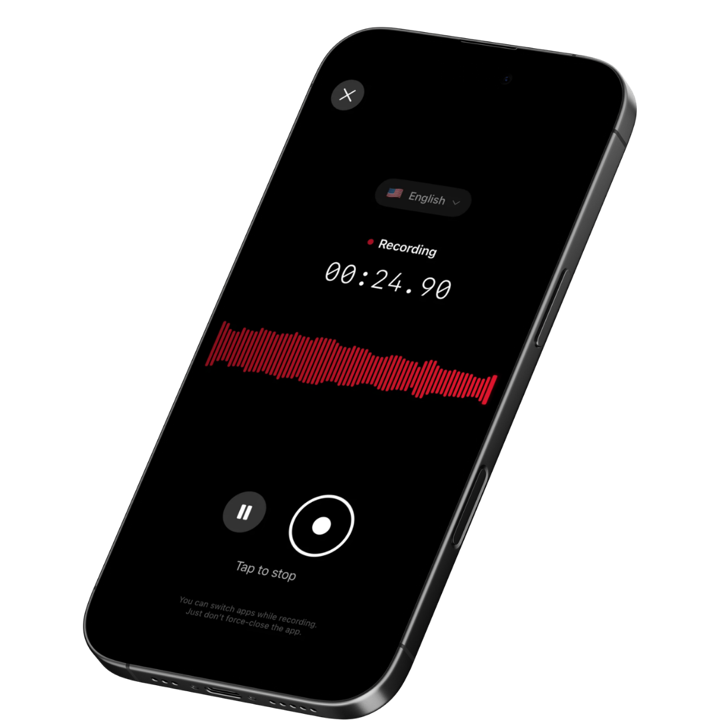
Voice notes offer an alternative. Speaking is 3x faster than typing, requires no screen, and creates no context switch. With AI transcription accuracy now exceeding 96%, your spoken thoughts instantly become searchable, organized text-capturing insights without adding to the information overload that exhausted you in the first place. The best speech-to-text apps for iPhone do exactly this-turning spoken thoughts into searchable text in seconds.
→ Download SpeakWise from the App Store and discover how one-tap recording, AI transcription, intelligent summaries, and Notion integration can help you capture thoughts, meetings, and ideas without contributing to cognitive overwhelm.
Join 10,000+ professionals who've discovered that the best way to manage information isn't to consume more of it-it's to capture what matters before it fades, in the fastest, lowest-friction way possible.
Get SpeakWise Free →
4.9★ App Store Rating | iOS Optimized

🎯 4.9★ App Store Rating | 📱 Built for iOS
