Information Silos Statistics 2026


Used by recruiters, executives, consultants, and more.
Information Silos Statistics 2026
87% of organizations struggle with disconnected data sources. Information silos cost organizations $7.8 million annually in lost productivity. Employees waste 12 hours per week searching for information across disconnected systems. Fortune 500 companies lose an estimated $31.5 billion per year from failing to share knowledge across teams. These 15 statistics reveal how information silos have become the invisible tax on every organization's performance.
Information silos form when data, knowledge, and context get trapped inside individual teams, tools, or people. They are rarely created on purpose. They emerge naturally from organizational growth, tool proliferation, and the simple fact that people store information in whatever system is closest to hand. The result is an enterprise where the left hand does not know what the right hand is doing, and both hands spend hours searching for what the other already has.
This post presents 15 statistics on the prevalence, cost, and impact of information silos in 2026. These numbers cover how silos form, what they cost, and the organizational patterns that either break them down or make them worse.
1. 87% of organizations struggle with disconnected data sources
The information silo problem is nearly universal. Research shows that over 87% of organizations struggle with disconnected data sources, leading to inefficiencies in operations and decision-making. This is not a problem limited to large enterprises or legacy companies. Organizations of every size and sector are dealing with fragmented information architectures. The sheer ubiquity of the problem suggests that silos are the default state and integration requires deliberate, sustained effort.
Source: Integrate.io - Data Transformation Challenge Statistics
2. Information silos cost organizations $7.8 million per year
The financial impact of silos is quantifiable and significant. Research estimates that data silos cost organizations an average of $7.8 million annually in lost productivity. This cost accumulates through duplicated effort, delayed decisions, missed opportunities, and the labor hours consumed by employees navigating between disconnected systems. For most organizations, this figure dwarfs the cost of the integration tools that would solve the problem.
Source: Bizdata360 - What Are Data Silos? Problems and Solutions Guide 2026
3. Employees waste 12 hours per week searching across disconnected systems
The human cost of silos is measured in lost time. Research shows that employees waste an average of 12 hours per week searching for information across disconnected systems. That is 30% of the standard workweek consumed not by productive work but by the overhead of navigating a fragmented information landscape. This is not a search problem. It is a structural problem. The information exists but is trapped in a system the employee does not know about or cannot access.
Source: Quixy - Data Silos: Breaking Down the Basics in 2026
4. Fortune 500 companies lose $31.5 billion per year from knowledge silos
The scale of silo-related losses at the enterprise level is enormous. Research estimates that Fortune 500 companies lose a combined $31.5 billion per year from failing to share knowledge across teams. This loss manifests as duplicated projects, conflicting strategies, missed cross-selling opportunities, and the institutional knowledge that walks out the door when employees leave without transferring what they know.
Source: Document360 - How to Break Knowledge Silos and Boost Team Collaboration
5. 79% of organizations work with fragmented data systems
Fragmentation is the norm. Research indicates that 79% of organizations are working with fragmented data systems. Within those organizations, 37% of data leaders spend the majority of their time on maintenance - "keeping the lights on" - rather than innovation or analysis. The fragmentation tax is not just about the time employees spend searching. It also consumes the time of the technical teams who should be building better systems but are instead managing disconnected ones.
Source: Integrate.io - Data Transformation Challenge Statistics
6. Organizations average 897 applications but only 29% are integrated
The integration gap is staggering. MuleSoft's 2025 Connectivity Benchmark reveals that organizations average 897 applications across their technology stack, but only 29% of those applications are integrated with each other. The remaining 71% operate as standalone systems that cannot share data automatically. Every unintegrated application is a potential silo - a place where information goes in but does not flow out to the rest of the organization.
Source: Demand Gen Report - The Dawn of the Unified Data Strategy: Breaking Down Silos in 2026
7. 83% of respondents say silos exist in their organization
Awareness of the problem is high. Research shows that 83% of survey respondents indicate that silos exist within their companies, and 97% say those silos have a negative effect on performance. Yet awareness has not translated into action at the pace required. The challenge is that silos are embedded in organizational structure, technology architecture, and cultural habits. Acknowledging the problem is the easy part. Fixing it requires changes to how teams share, store, and access information.
Source: PMC - Breaking Down Silos in the Workplace: A Framework to Foster Collaboration
8. Up to 90% of enterprise data is locked in unstructured silos
The silo problem extends far beyond structured databases. Research shows that up to 90% of enterprise data is unstructured - trapped in emails, documents, presentations, meeting recordings, and chat messages. This unstructured data contains some of the most valuable organizational knowledge: decisions made in meetings, client feedback shared in emails, strategic insights buried in presentations. Without systems to capture and index this information, it remains invisible to everyone except the person who created or received it.
Source: IT Convergence - Data Silos Problems and Impact Resolution with Databricks
9. Poor communication from silos leads to 40% decreased productivity
Silos do not just slow down information retrieval. They actively degrade communication quality. Research shows that poor communication resulting from organizational silos leads to 40% decreased productivity. When teams operate with incomplete information, they make worse decisions, duplicate effort, and create conflicting outputs. The productivity loss compounds as organizations grow and the number of potential communication gaps increases exponentially.
Source: Cerkl - What Are Communication Silos in the Workplace and How to Fix Them
10. 82% of organizations find cross-department data sharing challenging
Breaking down silos requires cross-functional collaboration that most organizations find difficult. A Forrester survey found that 82% of participants state that managing data and sharing insights across business areas is challenging. The difficulty is not purely technical. It involves ownership disputes, security concerns, incompatible data formats, and the cultural resistance of teams that view their information as proprietary rather than shared organizational assets.
Source: Integrate.io - Data Transformation Challenge Statistics
11. 84% of system integration projects fail or partially fail
Even when organizations try to break down silos, the effort often falls short. Research indicates that 84% of all system integration projects fail or only partially succeed. Integration is technically challenging, organizationally complex, and politically fraught. The high failure rate means that most organizations attempting to solve their silo problem through technology integration alone will need multiple attempts before achieving meaningful results.
Source: Estuary - 8 Reasons Why Data Silos Are Problematic and How To Fix Them
12. Organizations will abandon 60% of AI projects due to silo-related data issues
Silos are blocking the AI future. Research predicts that organizations will abandon 60% of AI projects unsupported by AI-ready data through 2026. AI systems require integrated, clean, accessible data to function effectively. When organizational knowledge is scattered across hundreds of disconnected tools, AI projects starve for the data they need. Solving the silo problem is not just about current productivity. It is a prerequisite for the AI-powered future most organizations are investing in.
Source: InformationWeek - How Data Silos Impact AI and Agents
13. 58% of respondents identify organizational structure as a silo cause
Silos are not just a technology problem. Research found that 58% of respondents identify institutional factors such as organizational structure and bureaucracy as the primary contributors to siloing. Technology integration alone cannot solve a problem rooted in how organizations are structured, how teams are incentivized, and how information ownership is defined. The most effective silo-breaking strategies address structure and culture alongside technology.
Source: PMC - Breaking Down Silos in the Workplace: A Framework to Foster Collaboration
14. 25% of revenue lost annually to quality issues from siloed data
The revenue impact of silos extends beyond productivity. Research shows that organizations lose an average of 25% of revenue annually due to quality-related inefficiencies and poor decisions stemming from fragmented data. When teams make decisions based on incomplete or outdated information, the errors ripple through the organization. Bad data leads to bad strategy, which leads to lost revenue that never shows up as a line item labeled "information silo cost."
Source: Integrate.io - Data Transformation Challenge Statistics
15. Half of organizations now report a "single source of truth" for sales and marketing
Progress is happening, even if slowly. Research shows that approximately half of all organizations now report having a "single source of truth" for their sales and marketing data. While this still leaves half without one, the trend is encouraging. Organizations are learning that integration pays for itself. The question is whether this progress will extend beyond sales and marketing into the rest of the enterprise, where silos remain deeply entrenched.
Source: Demand Gen Report - The Dawn of the Unified Data Strategy: Breaking Down Silos in 2026
The Silo Tax: Hidden, Compounding, and Everywhere
Information silos are the organizational equivalent of a slow leak. No single silo causes a catastrophic failure. But their cumulative effect is enormous: $7.8 million per organization per year, 12 hours per employee per week, and an invisible drag on every decision, project, and strategy. The problem is especially insidious because it is normal. When everyone has always spent hours searching for information, nobody thinks to question it.
The root cause of most silos is not technology. It is the friction of documentation. Valuable knowledge is created in conversations - meetings, phone calls, brainstorming sessions, client interactions. But documenting those conversations requires effort. So the knowledge stays in the heads of the people who were present, inaccessible to everyone else.
The organizations making real progress on silos are those that reduce capture friction. They make it easy to turn conversations into searchable, shareable records. They integrate those records into the systems where teams already work. They build habits of sharing rather than hoarding.
The most expensive information in your organization is the information that exists but cannot be found.---
Break down silos by capturing what your team already knows
Most organizational knowledge starts as a conversation. A decision made in a meeting. Feedback shared after a client call. A solution discussed in the hallway. When that knowledge stays in one person's head, it becomes a silo. When it gets captured and shared, it becomes an organizational asset.
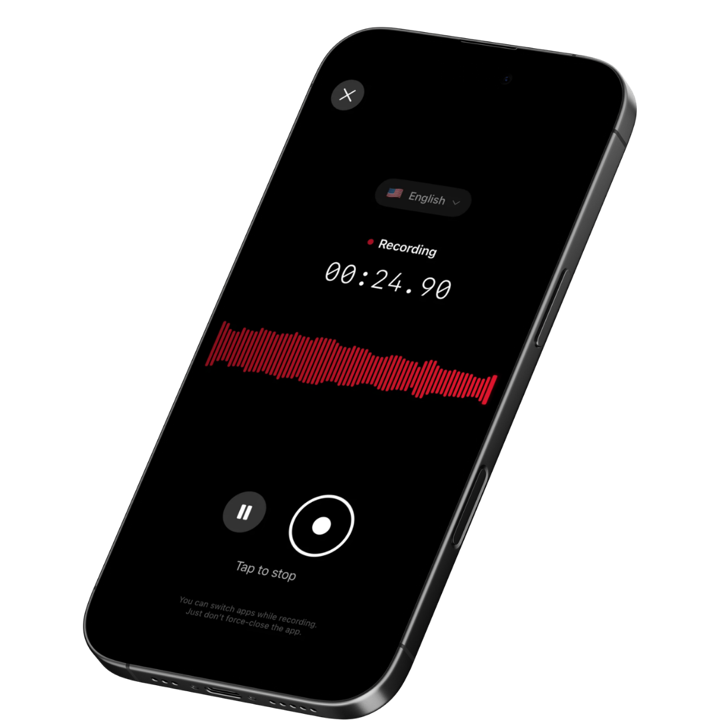
SpeakWise makes the capture step effortless. Record any conversation with one tap. Get an AI-generated summary with key points and action items. Send it to Notion where the entire team can search and reference it. No typing, no formatting, no post-meeting documentation burden.
Download SpeakWise from the App Store and start turning conversations into searchable knowledge that the whole team can access - breaking down silos one voice note at a time.
Join 10,000+ professionals who have discovered that the fastest way to eliminate information silos is to capture knowledge at the moment it is created.
Get SpeakWise Free
4.9-star App Store Rating | iOS Optimized

🎯 4.9★ App Store Rating | 📱 Built for iOS
