Institutional Knowledge Loss Statistics 2026


Used by recruiters, executives, consultants, and more.
Institutional Knowledge Loss Statistics 2026
42% of institutional knowledge resides solely with individual employees. U.S. businesses lose an average of $47 million per year due to inefficient knowledge sharing. With 61 million baby boomers expected to exit the workforce by 2030 and 41% of organizations rarely or never collecting know-how from departing employees, the knowledge drain is accelerating. These 15 statistics reveal how institutional knowledge loss quietly erodes productivity, decision-making, and competitive advantage across industries.
Every time an employee walks out the door, they take something with them that no exit interview can fully capture. Relationships, context, unwritten processes, and years of accumulated judgment disappear in an instant. The cost is staggering and largely invisible on balance sheets.
This post covers 15 data-backed statistics on institutional knowledge loss in 2026. Whether you lead a team navigating high turnover or manage an organization preparing for a wave of retirements, these numbers quantify what is at stake and why acting now matters.
1. 42% of institutional knowledge resides solely with individual employees
Nearly half of all institutional knowledge lives in the heads of individual workers. This means that when those employees leave, the organization loses access to knowledge that no one else possesses. The finding underscores a critical vulnerability: companies that rely on tribal knowledge without formal documentation systems risk losing almost half their operational know-how with every departure. For roles requiring deep expertise, the percentage is likely even higher.
Source: Iterators - Cost of Organizational Knowledge Loss
2. U.S. businesses lose $47 million per year from poor knowledge sharing
The average U.S. business loses $47 million annually in productivity due to inefficient knowledge sharing. This figure accounts for the cumulative time employees spend searching for information, recreating work that already exists, and making decisions without the full context that a departing colleague once held. For enterprises, this number dwarfs most line items in the technology budget. Yet knowledge management rarely receives comparable investment.
Source: Learn to Win - The Cost of Lost Knowledge
3. 48% of companies lose institutional knowledge with each employee departure
Nearly half of all companies report losing institutional knowledge every time an employee leaves. This is not limited to senior leaders or long-tenured staff. Even mid-level employees accumulate specialized knowledge about clients, processes, and workarounds that rarely gets documented. The consistency of this finding across industries suggests the problem is structural, not situational.
Source: Iterators - Cost of Organizational Knowledge Loss
4. 61 million baby boomers will exit the workforce by 2030
The retirement wave is not a forecast. It is already happening. More than 11,000 Americans turn 65 every day. By 2030, an estimated 61 million baby boomers will have left the workforce, taking with them decades of hard-earned expertise and institutional memory. This "Peak 65" phenomenon represents the largest surge of potential retirees in U.S. history. Organizations that delay knowledge capture will face irreversible losses.
Source: US News - Companies Aren't Ready for Boomers to Retire
5. 41% of organizations rarely or never collect know-how from retiring employees
Despite the scale of the retirement crisis, 41% of organizations admitted they rarely or never attempt to collect know-how from employees who are leaving. This finding from an APQC study reveals a staggering gap between awareness and action. Most companies acknowledge knowledge loss as a problem, yet fewer than six in ten have any process in place to address it before the knowledge walks out the door.
Source: APQC - Great Retirement Crisis Study
6. 60% of employees say getting essential information from colleagues is difficult
Knowledge hoarding is not always intentional. A survey found that 60% of employees said it was difficult or almost impossible to get essential information from their coworkers. The barriers include lack of documentation, siloed teams, inaccessible communication channels, and simply not knowing who holds the information. When sharing knowledge is this hard even while people are still employed, the loss upon departure becomes inevitable.
Source: Iterators - Cost of Organizational Knowledge Loss
7. Small businesses lose $2.4 million annually from insufficient knowledge sharing
The financial impact scales down but remains severe for smaller organizations. Companies with fewer than 1,000 employees lose an average of $2.4 million per year in productivity due to insufficient knowledge sharing. For small businesses operating on thin margins, this represents a significant drain. The irony is that smaller teams often assume knowledge flows naturally because everyone "knows everyone." The data suggests otherwise.
Source: Learn to Win - The Cost of Lost Knowledge
8. Replacing an employee costs 50% to 200% of their annual salary
The cost of employee turnover goes far beyond recruitment fees. When factoring in lost institutional knowledge, training time, reduced team productivity, and the learning curve for new hires, replacing a single employee costs between 50% and 200% of their annual salary. For a senior employee earning $150,000, that translates to $75,000 to $300,000 per departure. Knowledge loss accounts for a significant portion of this cost.
Source: Wellhub - The Cost of Employee Turnover
9. 68% of organizations report losing older workers as an existing or anticipated problem
More than two-thirds of organizations now identify the loss of older, experienced workers as either a current challenge or an imminent one. This statistic reflects growing awareness that the retirement wave is not a distant risk but an active crisis. The experienced workers leaving today are not just losing headcount. They are removing the connective tissue that holds processes, relationships, and unwritten rules together.
Source: Food Industry Executive - Knowledge Transfer Strategies
10. Employees spend 1 to 5 hours daily searching for information
47% of professionals spend between one and five hours every day searching for specific information they need to do their jobs. This search time is a direct consequence of poor knowledge management. When institutional knowledge lives in people's heads rather than in accessible systems, every question becomes a scavenger hunt across email threads, chat histories, shared drives, and colleague conversations.
Source: Document360 - Knowledge Management Statistics
11. New employee onboarding takes over 3 months for 39% of organizations
39% of organizations report that it takes more than three months to fully train new hires. When departing employees take their institutional knowledge with them, onboarding stretches even longer because new hires must reconstruct context from scratch. The longer the onboarding takes, the longer the organization operates at reduced capacity. This creates a compounding problem during periods of high turnover.
Source: Cake - Knowledge Management Statistics
12. 46% of executives agree onboarding takes too long
Nearly half of all executives and managers acknowledge that it takes too long to onboard new employees. This admission points to a systemic issue. Lengthy onboarding is often a symptom of poor knowledge documentation. When expertise is captured and organized, new hires ramp up faster. When it is not, every new employee must learn through trial, error, and asking questions that someone who left could have answered in seconds.
Source: Cake - Knowledge Management Statistics
13. Structured knowledge bases can reduce onboarding time by 35-50%
Organizations that implement structured knowledge management systems can cut employee onboarding time by 35% to 50%. This statistic demonstrates that institutional knowledge loss is not inevitable. It is a choice. Companies that invest in capturing, organizing, and distributing knowledge before employees leave can dramatically accelerate how quickly new hires become productive.
Source: Helpjuice - Knowledge Management Trends
14. Companies with strong knowledge-sharing cultures see 25% higher productivity
The upside of addressing knowledge loss is substantial. Companies that build strong knowledge-sharing cultures experience productivity increases of up to 25%. This boost comes from reduced duplication of work, faster decision-making, fewer errors caused by missing context, and shorter ramp-up times for new team members. Knowledge sharing is not just a defensive measure against loss. It is a competitive advantage.
Source: GoLinks - Benefits of Knowledge Management
15. The global knowledge management market will reach $2.1 trillion by 2030
Global spending on knowledge management solutions is projected to reach $2.1 trillion by 2030. This explosive growth reflects a market-wide recognition that knowledge loss is too expensive to ignore. AI-powered tools are leading the charge, enabling organizations to capture, transcribe, and organize institutional knowledge at a scale that was impossible even five years ago.
Source: Document360 - Knowledge Management Statistics
The Silent Drain: What These Numbers Reveal
The data tells a clear story. Institutional knowledge loss is not an occasional inconvenience. It is a persistent, measurable drain on organizational performance. The $47 million average annual loss, the three-month onboarding delays, and the 42% of knowledge locked in individual minds all point to the same conclusion: most organizations are bleeding expertise without realizing how much it costs.
The retirement wave makes this urgent. With 61 million baby boomers exiting by 2030 and 41% of organizations doing nothing to capture their knowledge, the window for action is closing. Every month of inaction means more irreplaceable expertise disappearing without a trace.
The organizations that thrive in the next decade will be the ones that treat knowledge capture as a daily habit, not a retirement project. The technology exists. The economic case is overwhelming. The only remaining barrier is prioritization.
Every departing employee takes years of context with them. The question is whether your organization captures that context before it is gone forever.---
Capture institutional knowledge before it walks out the door
The core challenge behind institutional knowledge loss is simple: critical information lives in conversations, meetings, and verbal exchanges that never get documented. An employee explains a workaround to a colleague in a hallway conversation. A manager shares decision context in a team meeting. A senior engineer describes a legacy system's quirks during onboarding. None of it gets written down.
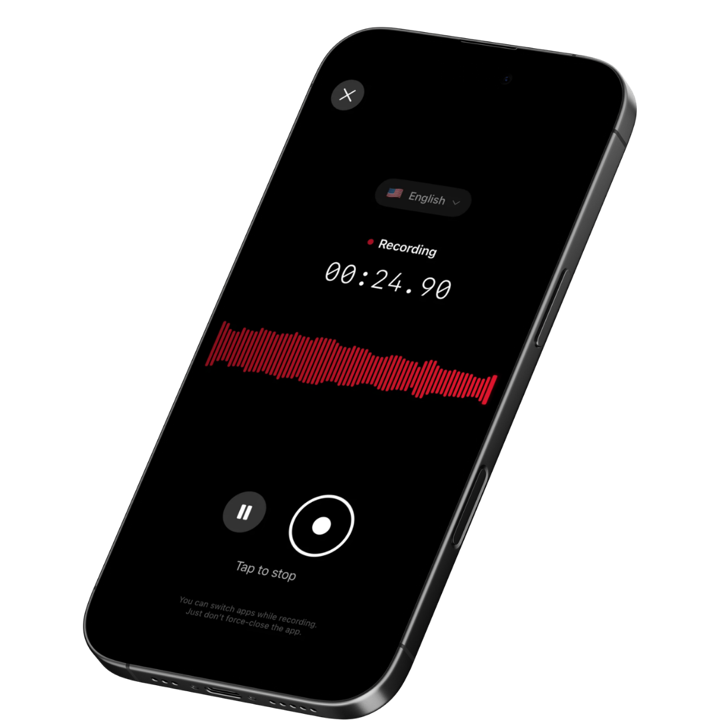
Voice capture changes that equation. Instead of relying on people to manually document what they know, you can record conversations and let AI handle the transcription, summarization, and organization.
Download Speakwise from the App Store and start capturing institutional knowledge in real time with one-tap recording, AI transcription in 100+ languages, and automatic Notion sync.
Join 10,000+ professionals who use voice capture to preserve critical knowledge before it disappears.
Get Speakwise Free
4.9-star App Store Rating | iOS Optimized

🎯 4.9★ App Store Rating | 📱 Built for iOS
