Knowledge Worker Productivity Statistics 2026: Focus Time, Deep Work, and Output Trends
Used by recruiters, executives, consultants, and more.
Knowledge Worker Productivity Statistics 2026: Focus Time, Deep Work, and Output Trends
The average knowledge worker now spends 60% of their time on "work about work"-status updates, searching for information, and coordinating between tools-while actual productive output happens in shrinking windows between 275 daily interruptions. Yet beneath these alarming numbers, a quiet revolution is unfolding: remote workers are reclaiming 4+ hours of weekly focus time, AI adopters are saving 5.4% of their work hours, and four-day workweek pilots are proving that less time can mean more output. These 17 statistics capture the paradox of modern productivity.
The productivity conversation has fundamentally shifted. For decades, we measured success by hours logged and tasks completed. Now we're confronting an uncomfortable truth: the average employee is genuinely productive for less than three hours of their eight-hour workday, and 77% of the global workforce isn't actively engaged in their work. The old metrics are broken because the nature of work has changed.
In this post, we'll explore 17 statistics that reveal what knowledge worker productivity actually looks like in 2025. These numbers span the spectrum from discouraging realities-like the 23 minutes required to regain focus after each interruption-to promising transformations, including AI tools that boost task completion speed by 33% and hybrid arrangements that maintain productivity while cutting turnover by a third. Whether you're a manager trying to protect your team's focus time, an individual contributor drowning in meetings, or a leader weighing four-day workweek experiments, these data points provide the evidence base for rethinking how work gets done.
1. Remote workers achieve 22.75 hours of weekly deep focus vs. 18.6 hours for in-office employees
The location where you work significantly impacts your ability to focus. Research from ActivTrak's State of the Workplace 2025 report found that remote workers achieve 22.75 hours of deep focus time per week, compared to just 18.6 hours for those working primarily in-office. That 4+ hour weekly advantage translates to approximately 62 additional hours of focused work per year-equivalent to more than a week and a half of reclaimed productivity that office workers lose to workplace interruptions, impromptu conversations, and environmental distractions. Source: ActivTrak - State of the Workplace 2025
2. The average workday shortened 36 minutes while productive hours actually increased 2%
Something counterintuitive is happening in modern work. According to ActivTrak's analysis of 218,900 employees across 777 companies, the average workday has shortened from roughly 9 hours 20 minutes in 2022 to 8 hours 44 minutes in 2024-a 36-minute decrease representing a 7% reduction. Yet productive hours simultaneously increased by 2%, rising 6 minutes to 6 hours 17 minutes daily. Workers are logging fewer hours but producing more, suggesting that the relationship between time spent and output generated is weaker than traditional management assumes. Source: ActivTrak - State of the Workplace 2025
3. Only 21% of global employees were engaged at work in 2024-the first decline in years
Employee engagement has hit a concerning inflection point. Gallup's State of the Global Workplace 2024 report found that only 21% of employees worldwide are truly engaged at work, marking the first decline in engagement levels in years. The remaining 79% are either "not engaged" (essentially quiet quitting) or actively disengaged. Gallup estimates this disengagement costs $438 billion in lost productivity globally. Perhaps more striking: boosting engagement could increase global GDP by $9-10 trillion, approximately 9%-suggesting that motivation, not capability, is the primary constraint on knowledge worker output. Source: Gallup - State of the Global Workplace 2024
4. AI users save 5.4% of their work hours-equivalent to 2.2 hours weekly for a 40-hour week
The Federal Reserve Bank of St. Louis has begun quantifying AI's productivity impact. Their November 2024 analysis found that workers who use generative AI save 5.4% of their work hours on average-translating to 2.2 hours per week for someone working 40 hours. Across the entire U.S. workforce (including non-users), this represents a 1.4% reduction in total labor hours needed to produce equivalent output. The Fed researchers note that industries with higher AI time savings have experienced proportionally higher productivity growth relative to pre-pandemic trends, though causation remains difficult to isolate. Source: Federal Reserve Bank of St. Louis - State of Generative AI Adoption
5. 75% of knowledge workers have used generative AI-90% say it saves time, 85% say it helps focus
AI adoption among knowledge workers has reached critical mass. Surveys find that 75% of knowledge workers have now used generative AI tools, with adoption climbing from 44.6% to 54.6% of working-age adults between August 2024 and August 2025 alone. Among users, the benefits are perceived as substantial: 90% report that AI saves them time, 85% say it helps them focus on more important work, and 84% credit it with boosting their creativity. Companies with heavy AI adoption report that 72% see high productivity levels and 59% observe improved employee job satisfaction. Source: Archieapp - Employee Productivity Statistics 2025
6. Workers are interrupted every 2 minutes-275 times per day-during core work hours
The fragmentation of attention has reached crisis proportions. Microsoft's 2025 Work Trend Index reveals that employees now experience interruptions every two minutes during core work hours, totaling approximately 275 interruptions daily from meetings, emails, and chat notifications. Making matters worse, 50% of all meetings are scheduled during peak cognitive performance windows (9-11 AM and 1-3 PM), precisely when circadian rhythms suggest people are most capable of deep, complex work. The result is a workday where the conditions for focused thinking are systematically undermined. Source: Microsoft WorkLab - Breaking Down the Infinite Workday
7. It takes 23 minutes and 15 seconds to fully recover deep focus after an interruption
The cost of interruption extends far beyond the interruption itself. Landmark research by Gloria Mark at the University of California, Irvine found that workers require an average of 23 minutes and 15 seconds to fully regain deep focus after being interrupted-even briefly. Separate research found it takes 9.5 minutes just to return to a productive workflow state after toggling between applications. When workers experience 275 daily interruptions (statistic #6), the math becomes alarming: if even a fraction of those disruptions require full recovery time, the majority of the workday is spent in cognitive limbo rather than productive focus. Source: UC Irvine / Gloria Mark Research
8. Knowledge workers spend 103 hours annually in unnecessary meetings
The meeting burden has become measurable. Research shows that the average knowledge worker spends 103 hours per year in meetings deemed unnecessary-the equivalent of nearly 13 full workdays. This compounds with other "work about work" costs: 209 hours annually on duplicated work, 352 hours talking about work rather than doing it, and 127 hours regaining focus after being interrupted by meetings and emails. Combined, these inefficiencies represent weeks of potential productive time redirected to coordination overhead that produces no direct output. Source: Time Doctor - Workplace Productivity Statistics 2025
9. 60% of work time is spent on "work about work" rather than skilled, strategic tasks
The tyranny of coordination has consumed the majority of knowledge worker hours. Asana's State of Work Innovation research found that 60% of work time is now spent on "work about work"-activities like searching for information, switching between applications, managing communications, attending status updates, and tracking down decisions. Only 40% of time remains for the skilled, strategic work that employees were actually hired to perform. This inversion helps explain why workers report feeling exhausted despite having accomplished little, and why additional tools often create more overhead than they eliminate. Source: Asana - State of Work Innovation 2024
10. Focus efficiency declined from 65% to 62% between 2022 and 2024
Even when workers attempt to focus, they're becoming less effective at sustaining it. ActivTrak's workforce analytics found that focus efficiency-the proportion of designated focus time actually spent in concentrated work-declined from 65% to 62% between 2022 and 2024. Focus time itself dropped 8% year-over-year. The data suggests that workers are both getting less time for focus and becoming worse at using the focus time they do get, a double erosion that compounds the productivity challenges revealed in other metrics. Source: ActivTrak - State of the Workplace 2025
11. 82% of employees are at risk of burnout in 2026
Burnout has transitioned from warning sign to workplace default. Research indicates that 82% of employees are now at risk of burnout, with 66% reporting they've experienced it. The generational breakdown is particularly stark: 68% of Gen Z workers report burnout compared to 61% of millennials, 47% of Gen X, and 30% of boomers. Burned-out employees are 6 times more likely to quit within six months, creating a feedback loop where remaining employees absorb additional workload, accelerating their own burnout trajectory. Source: Forbes/Modern Health - Employee Burnout Statistics 2025
12. Top performers in complex occupations are 800% more productive than average employees
The productivity gap between individuals is far wider than most organizations acknowledge. McKinsey research found that in complex occupations like software development, top performers are 800% more productive than average employees-not 20% better or even 50%, but eight times as effective. This Pareto-like distribution, where approximately 80% of output comes from 20% of workers, challenges traditional approaches to workforce management and suggests that enabling peak performers to do their best work may matter more than marginally improving everyone's productivity. Source: McKinsey - War for Talent Research
13. Hybrid workers (2 days remote) maintain full productivity while being 33% less likely to quit
The hybrid sweet spot appears to be around two days per week working from home. Research published in Nature found that hybrid workers operating on this schedule were just as productive as fully in-office employees while being 33% less likely to resign. This finding aligns with broader data showing that 52% of U.S. remote-capable employees now work hybrid arrangements, with organizations discovering that flexibility reduces turnover costs without sacrificing output-a rare win-win in workforce management. Source: Nature - Hybrid Working from Home Improves Retention
14. Four-day workweek trials produced 25-40% productivity increases across sectors
The counterintuitive evidence continues mounting: working less can mean producing more. The UK's landmark four-day workweek pilot involving 61 companies found productivity increases of 25-40% across participating organizations, with revenue maintained or grown and employee turnover nearly eliminated. Of the original participants, 54 companies have maintained the policy, with more than 50% making it permanent. Participants reported 67% lower burnout, and 90% wanted to continue the arrangement-suggesting that time pressure can catalyze efficiency gains that offset reduced hours. Source: 4 Day Week Global - UK Pilot Results
15. Average productive session length increased 20%-from 20 minutes to 24 minutes
Not all productivity trends are negative. ActivTrak's analysis found that while workers have fewer focus sessions overall, the sessions they do achieve are becoming more productive. Average productive session length increased 20%, from 20 minutes in 2022 to 24 minutes in 2024. Additionally, 70% of employees now maintain healthy work patterns-the highest proportion in three years-and the percentage of "overutilized" employees (those showing signs of burnout-level activity) dropped 21% versus 2023. Some workers are learning to protect and extend their focus windows. Source: ActivTrak - State of the Workplace 2025
16. Employees spend 11.3 hours per week in meetings-28% of their workweek
The meeting time sink has been quantified: the average employee now spends 11.3 hours per week in meetings, consuming 28% of the standard workweek. Tuesday carries the heaviest meeting load (23% of weekly meetings), while Fridays are lightest (16%). Perhaps most telling: 64% of recurring meetings lack a structured agenda, and PowerPoint edits spike 122% in the final 10 minutes before meetings-suggesting that much of this time is spent in sessions that weren't properly prepared for or may not have been necessary at all. Source: Flowtrace - State of Meetings Report 2025
17. Automation saves employees 3.6+ hours per week on routine tasks
The productivity dividend from automation is already substantial. Research shows that employees using automation technology save at least 3.6 hours weekly on routine tasks-nearly half a workday reclaimed from manual, repetitive activities. Among automation users, 73% report improved work quality and 79% report improved productivity. For developers specifically, tools like GitHub Copilot have demonstrated even larger gains, with users coding up to 55% faster and teams showing a 26% increase in pull request velocity after adoption. Source: The Economist / Time Doctor - Workplace Productivity Statistics
The Productivity Paradox: More Tools, Less Time for Real Work
These statistics reveal a productivity landscape defined by contradictions. Workers have access to more powerful tools than ever, yet 60% of their time disappears into coordination and communication overhead. AI promises to save hours weekly, but 275 daily interruptions ensure those hours are immediately reclaimed by fragmentation. Engagement has plummeted to 21%, yet organizations continue optimizing for presence and activity rather than focus and outcome.
The data points toward a fundamental architectural problem. Knowledge work productivity isn't primarily constrained by individual capability or even available tools-it's constrained by the structure of the work environment itself. When the average worker needs 23 minutes to recover focus but gets interrupted every 2 minutes, no amount of personal productivity hacks can compensate for a system designed to fragment attention.
The positive statistics offer a blueprint. Remote workers gaining 4+ hours of weekly focus time demonstrates that environment design matters more than willpower. Four-day workweeks producing 25-40% productivity gains proves that time pressure can catalyze efficiency rather than sacrifice output. Hybrid arrangements maintaining productivity while cutting turnover by 33% shows that flexibility and performance aren't trade-offs. And AI tools saving 5.4% of work hours suggests that technology, properly applied, can reduce the coordination overhead rather than adding to it.
The future of knowledge worker productivity lies not in working harder or longer, but in systematically eliminating the 60% of time that never produces value-protecting the focus that does.---
Ready to reclaim your focus time and capture what matters?
The statistics are clear: knowledge workers spend the majority of their time on coordination overhead while their most valuable thinking happens in shrinking windows between interruptions. Every brilliant idea in a meeting, every key decision from a conversation, every insight during focused work risks being lost to the fragmentation that defines modern work.
Voice capture offers an alternative to the note-taking burden that compounds cognitive load. Speaking is 3x faster than typing, requires no context switch, and creates no additional screen time. With AI transcription accuracy now exceeding 96%, a transcription app for iPhone turns your spoken thoughts into organized, searchable text instantly-capturing insights without contributing to the "work about work" that's already consuming 60% of your day.
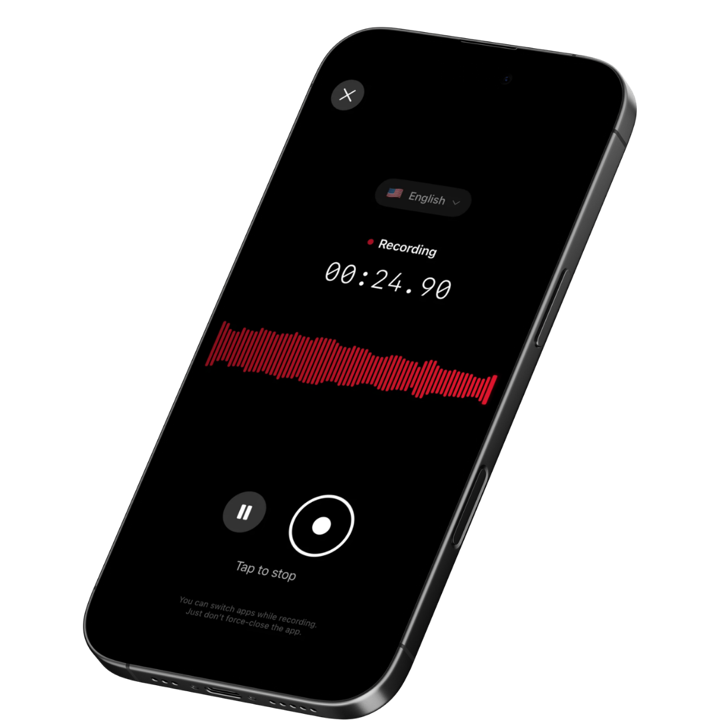
→ Download SpeakWise from the App Store and discover how one-tap recording, real-time AI transcription, intelligent summaries, and seamless Notion integration can help you capture meetings, ideas, and insights without sacrificing the focus time that generates your most valuable work.
Join 10,000+ professionals who've discovered that productivity isn't about doing more-it's about protecting the time and attention where real work happens, and capturing what matters before it fades.
Get SpeakWise Free →
4.9★ App Store Rating | iOS Optimized

🎯 4.9★ App Store Rating | 📱 Built for iOS
