Microsoft Teams Statistics 2026: Chat Volume, Meeting Hours, and Collaboration Platform Overload
Used by recruiters, executives, consultants, and more.
Microsoft Teams Statistics 2026: Chat Volume, Meeting Hours, and Collaboration Platform Overload
The average knowledge worker now receives 153 Microsoft Teams messages every workday, is interrupted 275 times per day by meetings, emails, and chats, and spends 57% of their entire workweek just communicating rather than creating. With over 320 million monthly active users and meetings tripling since the pandemic, these 17 statistics reveal how the platform designed to streamline collaboration has become the very engine of workplace overload.
Microsoft Teams launched in 2017 as a challenger to Slack, promising to unify chat, meetings, file sharing, and app integrations into a single collaboration hub. That promise succeeded beyond anyone's projections. In fewer than eight years, Teams has grown from zero to one of the most widely adopted enterprise platforms on the planet, embedded into the daily workflows of 93% of Fortune 100 companies. It is available in 181 countries, supports 44 languages, and processes over a billion chats every week.
But scale has brought an unintended consequence. The platform that was supposed to reduce the friction of collaboration has, for many workers, become the primary source of it. Channels multiply, notifications compound, meetings bleed into evenings, and the line between "staying connected" and "drowning in messages" has all but disappeared. Microsoft's own research now documents the toll: an "infinite workday" in which employees are perpetually reachable, perpetually interrupted, and perpetually behind.
In this post, we examine 17 data-backed statistics that capture the full scope of Microsoft Teams in 2026---its extraordinary adoption, its staggering communication volume, and the human cost of collaboration overload. These numbers come from Microsoft's own Work Trend Index reports (based on surveys of 31,000 knowledge workers across 31 countries and analysis of trillions of Microsoft 365 productivity signals), independent research firms, and industry analysts. Together, they tell the story of a platform that has become indispensable and overwhelming in equal measure---and they raise a question that every organization using Teams needs to confront: at what point does more collaboration become less productivity?
1. Microsoft Teams has surpassed 320 million monthly active users worldwide
Microsoft Teams reached over 320 million monthly active users by mid-2024, with reports indicating the platform climbed to approximately 360 million monthly active users by June 2025. To put that trajectory in perspective, Teams had just 75 million daily active users in April 2020 at the start of the pandemic---meaning the platform's user base has more than quadrupled in under five years. This makes Teams one of the fastest-growing enterprise software products in history, rivaling consumer social platforms in the speed of its adoption curve. The sheer scale of its user base means that any communication pattern embedded in Teams---whether productive or destructive---ripples across hundreds of millions of workdays every single day. Source: DemandSage - Microsoft Teams Statistics 2026
2. 93% of Fortune 100 companies use Microsoft Teams
Microsoft Teams has achieved near-universal penetration among the world's largest corporations, with 93% of Fortune 100 companies incorporating the platform into their operations. This statistic underscores Teams' dominance not as a niche communication tool but as core enterprise infrastructure---on par with email servers and office suites. The concentration of adoption among Fortune 100 firms also reflects Microsoft's bundling strategy: Teams is included with Microsoft 365 subscriptions, which means that for many organizations, the platform was already in the software stack before anyone consciously chose it. That passive adoption model is part of why Teams' usage patterns have become so entrenched and so difficult to change. When a tool arrives pre-installed, the question shifts from "should we use this?" to "how do we use this?"---and the answer, in most organizations, has been "for everything, all the time." Source: DemandSage - Microsoft Teams Statistics 2026
3. The average employee receives 153 Microsoft Teams messages every workday
According to Microsoft's 2025 Work Trend Index, which analyzed trillions of Microsoft 365 productivity signals, the average worker now receives 153 Teams messages per weekday. That figure is up 6% year-over-year globally, with some regions seeing increases exceeding 20%. At 153 messages per day across a standard 8-hour workday, that is roughly one new Teams message arriving every 3.1 minutes---a relentless cadence that makes sustained focus nearly impossible. Each message, even if skimmed in seconds, triggers a context switch that research shows takes an average of 23 minutes to fully recover from. The cumulative cognitive cost of 153 daily interruption points is staggering, and it helps explain why so many workers report feeling exhausted at the end of the day despite not having produced anything tangible. They spent the day responding, not creating. Source: Microsoft WorkLab - Breaking Down the Infinite Workday
4. Workers also receive 117 emails per day on top of their Teams messages
The Teams message flood does not exist in isolation. Microsoft's same Work Trend Index data reveals that the average employee receives 117 emails daily---most of them skimmed in under 60 seconds. Combined with the 153 Teams messages, that is 270 digital communications arriving every workday, or one every 1.8 minutes during an 8-hour shift. The dual-channel bombardment means that professionals are not simply managing one communication stream; they are perpetually triaging between two parallel rivers of incoming information, each with its own notification sound, its own badge count, and its own expectation of timely response. Moreover, by 8 AM each morning, Microsoft's data shows that Teams overtakes email as the dominant communication channel, meaning the chat-based interruption cycle begins before many workers have finished their first cup of coffee. Source: Microsoft WorkLab - Breaking Down the Infinite Workday
5. Employees are interrupted every 2 minutes---275 times per day
Microsoft's 2025 Work Trend Index research quantified the interruption crisis with startling precision: the average knowledge worker is interrupted every two minutes during core work hours, amounting to approximately 275 interruptions per day from meetings, emails, and chat messages. This finding, based on aggregated Microsoft 365 telemetry data across millions of users, reveals that uninterrupted focus has become essentially extinct in the modern workplace. The two-minute interruption cycle means that before a worker can even begin to enter a state of deep concentration---which research shows takes 15-25 minutes to achieve---the next notification has already arrived. Deep work, in this environment, is not merely difficult; it is structurally prevented by the design of the communication systems that surround every knowledge worker. Source: Allwork.space - 80% of Workers Are Interrupted Too Often, Microsoft Report Reveals
6. 57% of the average workweek is spent communicating, not creating
Across Microsoft 365 apps, the average employee spends 57% of their time communicating---in meetings, email, and chat---and only 43% of their time creating, which includes working in documents, spreadsheets, and presentations. This data point, drawn from Microsoft's analysis of actual usage patterns across its productivity suite, reveals a fundamental inversion of what most people consider "work." The majority of the workweek is now consumed not by producing deliverables but by talking about them, coordinating around them, and responding to messages about them. For knowledge workers who rely even more heavily on digital communication, the share consumed by meetings and messages is even greater than the 57% global average. Source: Microsoft WorkLab - Breaking Down the Infinite Workday
7. Teams meetings and calls have tripled since the pandemic---a 192% increase
Since February 2020, the number of Teams meetings and calls per person per week has increased by 192%---effectively tripling. This statistic, drawn from Microsoft's analysis of its own platform telemetry, reflects how the pandemic permanently reshaped work communication. What began as an emergency substitution for in-person meetings during lockdowns has become the permanent default. Even as offices reopened and hybrid models emerged, meeting volume never retreated. Instead, many organizations added virtual meetings on top of returning in-person meetings, creating a compounding effect where the total number of scheduled interactions exceeds anything that existed before 2020. The heaviest meeting users---the top 25% of the workforce---now spend 7.5 hours or more per week in meetings alone, and the average employee accumulates roughly 392 hours per year in meetings, equivalent to more than 16 full working days spent entirely in calls and conferences. Source: My Hours - Meeting Statistics 2025
8. 57% of meetings are ad hoc calls with no calendar invite
Microsoft's research reveals that 57% of meetings on the platform are ad hoc calls---spontaneous conversations initiated without a calendar invite. While impromptu communication can be valuable, the prevalence of unscheduled calls means that more than half of all meeting time cannot be planned for, blocked out, or declined in advance. Workers cannot protect their focus time when the majority of meeting requests arrive without warning. This also means that one in ten scheduled meetings are booked right before they start, further compressing any window for preparation or independent work. The ease of initiating an impromptu Teams call has effectively lowered the threshold for what constitutes a "meeting"---a quick question that might once have been an email or a hallway conversation now becomes a 15-minute video call with screen sharing. Source: Microsoft News Center - New Microsoft Study Reveals the Rise of the Infinite Workday
9. 50% of all meetings fall during peak productivity hours (9-11 AM and 1-3 PM)
Half of all meetings take place between 9-11 AM and 1-3 PM---precisely the windows when many workers experience their natural productivity peaks. These are the hours when focus is sharpest, creativity is highest, and deep work is most productive. Yet data reveals that organizations collectively fill these prime windows with meetings, leaving only fragmented pockets of time---often the low-energy hours of late afternoon---for the work that actually requires sustained concentration. Tuesdays are the worst offenders, with roughly 23% of all weekly meetings concentrated on a single day, creating a mid-week collaboration bottleneck. Source: Microsoft News Center - New Microsoft Study Reveals the Rise of the Infinite Workday
10. Meetings after 8 PM are up 16% year over year
The workday is expanding into evening hours. Microsoft's data shows that meetings starting after 8 PM have increased 16% year over year, driven largely by the growth in cross-time-zone collaboration. Currently, 30% of meetings span multiple time zones---a figure that has risen 8 percentage points since 2021. This trend means that for a growing share of the workforce, the "end" of the workday is no longer defined by the clock on the wall but by the last Teams notification from a colleague in another hemisphere. The result is what Microsoft has termed the "infinite workday"---a state in which work has no clear boundaries. Source: Microsoft News Center - New Microsoft Study Reveals the Rise of the Infinite Workday
11. 29% of active workers are back in their inbox by 10 PM
The erosion of work-life boundaries extends well beyond evening meetings. Microsoft's telemetry data shows that by 10 PM, nearly 29% of workers who are still active on Microsoft 365 have returned to their inbox. This is not a small minority burning the midnight oil by choice---it is nearly one-third of the active workforce checking email at a time that was traditionally reserved for rest, family, or personal pursuits. Additionally, 40% of employees check email before 6 AM, and roughly 20% of employees actively working on weekends check their email before noon on Saturday and Sunday. The workday, for hundreds of millions of people, now has neither a clear beginning nor a clear end. Source: Microsoft WorkLab - Breaking Down the Infinite Workday
12. 80% of workers say they lack the time or energy to do their jobs effectively
Microsoft's 2025 Work Trend Index survey of 31,000 knowledge workers across 31 countries found that 80% report lacking adequate time or energy to perform their jobs effectively. This is not a finding about lazy employees or poor time management---it is a systemic indictment of how modern collaboration tools have structured the workday. When 57% of the week is consumed by communication, interruptions arrive every two minutes, and meetings fill every peak productivity window, 80% of workers feeling overwhelmed is not surprising. It is the predictable, mathematically inevitable consequence of the communication patterns these platforms have enabled. Source: Allwork.space - 80% of Workers Are Interrupted Too Often, Microsoft Report Reveals
13. 48% of employees---and 52% of leaders---say work feels chaotic and fragmented
Nearly half of all employees (48%) and more than half of leaders (52%) report that their work feels chaotic and fragmented, according to the same Microsoft survey. The fact that leaders experience this chaos at even higher rates than individual contributors is particularly telling: the people responsible for organizational direction and strategic thinking are the most overwhelmed by the very collaboration systems they oversee. This suggests that the problem is not confined to a specific level of the organization---it is structural, affecting everyone from entry-level employees to C-suite executives. One in three employees goes further, saying the pace of work over the past five years has become flatly unsustainable, and 46% report experiencing burnout as a direct consequence. The chaos is not a perception problem; it is a workload problem, and it is most acute among the people who are supposed to be steering the organization through it. Source: Microsoft WorkLab - 2025 Work Trend Index Annual Report
14. 68% of employees lack sufficient uninterrupted focus time
Two-thirds of the workforce (68%) say they do not have enough uninterrupted focus time during the workday. This statistic, also from Microsoft's research, connects directly to the 275-interruption-per-day finding: when notifications and meetings fragment every working hour, the conditions necessary for deep work simply do not exist for most people. Focus time is not a luxury---it is the prerequisite for the creative thinking, complex problem-solving, and strategic analysis that knowledge work demands. Yet the collaboration tools designed to support that work have made the focus it requires nearly impossible to achieve. The irony is sharp: companies invest in Teams and similar platforms to help employees work more effectively, but the communication volume those platforms generate is the single biggest reason employees cannot find time to do effective work. Source: My Hours - Meeting Statistics 2025
15. Microsoft Teams holds 32.29% of the global video conferencing market
In the video conferencing segment specifically, Microsoft Teams commands 32.29% of the global market, placing it second behind Zoom's 55.91% share. While Teams trails Zoom in pure video conferencing market share, this figure understates Teams' total influence because video meetings are just one component of the platform. When factoring in persistent chat, file sharing, app integrations, and voice calling---areas where Teams often dominates---the platform's true footprint in daily work communication far exceeds what market share in any single category would suggest. Teams' 80 million Phone users, of whom over 20 million use PSTN-based calling, further illustrate the platform's expansion beyond its original video and chat roots. The platform's age demographics are also telling: the largest user segments are ages 35-44 (31.23%) and 45-54 (29.98%), meaning Teams is most deeply embedded among mid-career and senior professionals---the very people whose time and focus are most valuable to their organizations. Source: DemandSage - Microsoft Teams Statistics 2026
16. Teams generated over $8 billion in revenue in 2024
Microsoft Teams generated over $8 billion in revenue in 2024, reflecting the platform's massive commercial scale. Teams Premium, the advanced tier offering features like intelligent meeting recaps and custom branding, surpassed 3 million seats---representing 400% year-over-year growth. The financial success of Teams confirms that organizations are not merely adopting the platform passively through Microsoft 365 bundles; they are actively investing in deeper integration. The revenue figure also explains a structural tension at the heart of the platform: Microsoft is financially incentivized to add more features, more integrations, and more AI capabilities to Teams---each new feature justifies premium pricing and drives subscription upgrades. But more features also mean more notifications, more channels, more complexity, and ultimately more overload. The economic engine that funds Teams' development is the same engine that makes Teams increasingly overwhelming to use. Source: DemandSage - Microsoft Teams Statistics 2026
17. Ineffective meetings cost the U.S. economy $37 billion per year
The financial toll of meeting overload extends far beyond individual productivity. Research estimates that ineffective meetings cost the U.S. economy $37 billion annually in wasted salary costs alone. When combined with the broader estimate that workplace distractions---many of them driven by collaboration platform notifications---cost U.S. businesses $650 billion per year, the economic case for rethinking how we use tools like Teams becomes overwhelming. These are not abstract numbers: they represent real hours in which real employees sat in meetings that did not need to happen, responded to messages that did not need to be sent, and recovered from interruptions that did not need to occur. Research supporting these estimates suggests that 72% of meetings are ineffective, and 65% of workers say they regularly waste time in meetings---a figure that has risen 5 percentage points from the prior year. Every dollar spent on an unproductive meeting is a dollar that cannot be invested in the focused work that actually drives business outcomes. Source: My Hours - Meeting Statistics 2025
The Teams Paradox: When the Solution Becomes the Problem
The seventeen statistics above tell a story that is more nuanced than "Teams is bad" or "collaboration tools are broken." Microsoft Teams genuinely solved real problems. Before platforms like Teams, enterprise communication was fractured across email threads, text messages, phone calls, and a dozen disconnected point solutions. Teams brought these channels together, made remote work viable during a global pandemic, and gave organizations of every size a single place to communicate, share files, and hold meetings. Its growth to 320 million monthly active users is a testament to real value delivered.
But the statistics also reveal an uncomfortable truth: unifying all communication into one platform did not reduce the total volume of communication. It accelerated it. When every colleague is a chat message away, when meetings can be created with a single click, when channels can be spun up for any topic, and when notifications are the default, the friction that once limited communication has been removed entirely. And friction, it turns out, was performing a valuable function. It forced people to consider whether a meeting was truly necessary, whether a message really needed to be sent, whether an interruption was worth the cost of someone else's attention.
The "infinite workday" that Microsoft's own research documents is the predictable outcome of eliminating all communication friction without replacing it with intentional communication norms. The 153 Teams messages per day, the 275 interruptions, the 57% of the workweek consumed by communication---these are not the result of bad actors or poor management. They are the emergent behavior of a system that makes it easier to send a message than to not send one, easier to schedule a meeting than to write a clear memo, easier to loop in ten people than to identify the two who actually need to be involved.
There is also a compounding dynamic at work. As communication volume increases, each individual worker feels pressure to respond faster and more frequently---because everyone else is doing so. This creates a collective action problem: no one person can unilaterally decide to check Teams less often without risking the appearance of being unresponsive. The platform's presence indicators ("Available," "Away," "Do Not Disturb") further reinforce the expectation of real-time availability, turning status badges into subtle forms of workplace surveillance. The result is a communication arms race in which everyone sends more messages, responds more quickly, and schedules more meetings---not because it is productive, but because it is expected.
The path forward is not abandoning collaboration platforms---that ship has sailed. It is recognizing that the tools themselves cannot solve the problem they have created. Organizations need cultural norms around communication: designated focus hours that are genuinely protected, meeting policies that require agendas and limit attendees, and a collective understanding that every message sent is an interruption received by someone else. On an individual level, professionals need strategies for escaping the notification cycle---ways to capture their thoughts, document their decisions, and communicate their ideas without adding to the noise. The most impactful change may be the simplest: finding ways to communicate asynchronously, replacing synchronous meetings and real-time chat threads with formats that respect the recipient's time and attention.
The most productive communication is not the one that reaches the most people the fastest. It is the one that conveys the right information, to the right person, at the right time, with the least possible disruption to everyone else's focus.---
Ready to collaborate without the platform overload?
Microsoft Teams was designed to centralize communication---to give every team one place to chat, meet, share files, and coordinate. That vision succeeded in many ways, but the statistics tell us it has also created a new kind of overload. When the average worker fields 153 Teams messages and 117 emails per day, when 57% of the workweek goes to communication instead of creation, and when 80% of knowledge workers say they lack the time or energy to do their jobs effectively, the platform that was supposed to reduce friction has become another source of it. The problem is not Teams itself---it is the assumption that real-time, always-on, text-based communication is the best way to share every thought.
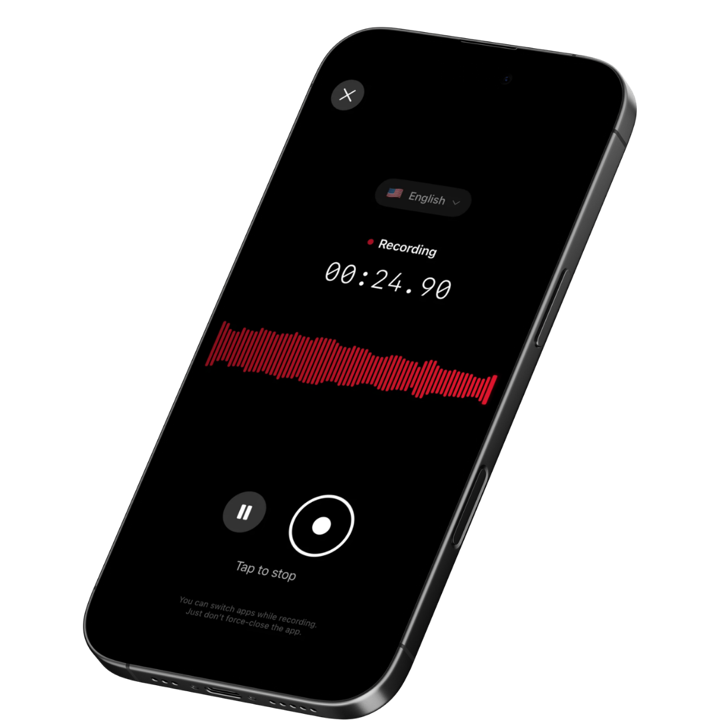
Voice capture offers a fundamentally different approach. Instead of composing another Teams message, scheduling another Teams meeting, or navigating another Teams channel, you simply speak---and AI handles the rest. Capture your thoughts in seconds and share them asynchronously.
Download SpeakWise from the App Store and discover how one-tap recording, AI transcription, intelligent summaries, and Notion integration can help you communicate clearly without adding to the Teams noise.
Join 10,000+ professionals who've discovered that the best collaboration tool isn't the one with the most features---it's the one that requires the least effort.
Get SpeakWise Free →
4.9★ App Store Rating | iOS Optimized

🎯 4.9★ App Store Rating | 📱 Built for iOS
