Middle Management Statistics 2026


Used by recruiters, executives, consultants, and more.
Middle Management Statistics 2026
45% of middle managers report burnout - higher than any other employee group - and 41% of companies cut management layers in 2025. The average span of control grew to 12.1 direct reports, a 50% increase since 2013. Middle management positions declined 6.1% between 2022 and 2025, while job openings remain down 42% from their peak. These 16 statistics reveal how middle managers became the most pressured layer of modern organizations.
Middle managers are caught in a vice. From above, executives demand efficiency, AI integration, and flatter structures. From below, employees need coaching, communication, and career development. The result is a role that has expanded in scope while shrinking in headcount. Middle management is simultaneously the most critical and most endangered layer of organizational leadership.
This post covers 16 statistics on middle management burnout, organizational flattening, spans of control, and the business impact of manager wellbeing. Whether you are a middle manager feeling the squeeze, a senior leader making structural decisions, or an HR professional supporting managers, these numbers quantify what many already feel.
1. 45% of middle managers report burnout, the highest of any group
In 2025, 45% of middle managers report burnout, a rate higher than any other employee group. Some research shows even more alarming figures: a survey by Simon Sinek's Optimism Company found that 75% of middle managers report extreme burnout and disconnection, with more than one in four actively planning to leave their roles. The variation in numbers reflects different survey methodologies, but the direction is consistent. Middle managers are burning out at rates that exceed both their direct reports and their senior leaders. The role has become a pressure point in modern organizations.
Source: The Interview Guys - Workplace Burnout Research Report 2025
2. 41% of companies trimmed management layers in 2025
Korn Ferry's Workforce 2025 report found that 41% of employees say their companies reduced management layers. This trend, sometimes called "delayering" or "unbossing," is driven by efficiency goals and the belief that flatter organizations move faster. However, the data suggests unintended consequences. Removing management layers without redistributing responsibilities creates overload for remaining managers and directionlessness for their teams. The 41% figure represents a massive structural shift happening across industries simultaneously.
Source: Korn Ferry - Workforce 2025 Power Shifts Report
3. Average span of control grew to 12.1 direct reports per manager
The average number of direct reports per manager increased from 10.9 in 2024 to 12.1 in 2025, according to Gallup citing Bureau of Labor Statistics data. This represents a 50% increase since 2013. For small and medium-sized businesses, the growth is even more dramatic: spans of control doubled from three to six direct reports between 2019 and 2025. Wider spans mean less time per employee. A manager with 12 direct reports who conducts biweekly 30-minute check-ins spends 12 hours monthly just on one-on-ones, before accounting for team meetings, project work, and administrative tasks.
Source: Gallup - State of the Global Workplace 2025
4. Middle management accounted for 32% of layoffs in 2023, up from 20% in 2019
Middle management's share of total layoffs jumped from 20% in 2019 to 32% in 2023, a 60% increase. This disproportionate targeting reflects a deliberate strategy by companies to reduce overhead by eliminating management roles. The assumption is that technology and flatter structures can replace what middle managers did. The data from employee surveys suggests otherwise. Removing middle managers saves salary costs but introduces communication gaps, decision-making delays, and a loss of institutional knowledge that is difficult to quantify but real in its impact.
Source: Fortune - The Great Flattening 2025
5. Manager engagement fell from 30% to 27% in 2024
Gallup reported that manager engagement dropped from 30% to 27% in 2024. Young managers and female managers experienced the largest declines. This three-point drop is significant because managers influence 70% of the variation in team engagement. When managers disengage, their teams follow. The declining engagement reflects the accumulation of pressures: wider teams, fewer peers, more administrative burden, and the emotional labor of supporting employees through organizational changes. Disengaged managers are not lazy. They are overwhelmed.
Source: Gallup - State of the Global Workplace 2025
6. Managerial positions declined 6.1% between May 2022 and May 2025
Bureau of Labor Statistics data shows that managerial positions declined by 6.1% between May 2022 and May 2025. This is not a temporary fluctuation. It represents a structural reduction in management headcount across the economy. The decline is driven by a combination of layoffs, attrition without replacement, and organizational restructuring. For the managers who remain, each departure means absorbing more responsibility. The 6.1% reduction in roles coincides with expanding spans of control, creating a compounding effect on workload.
Source: Medium - Labor Market Data on Management Decline
7. Middle management job openings remain down 42% from April 2022
Middle management job openings remain 42% below their April 2022 peak. This means that managers who lose their positions face a significantly tighter market. The reduction in openings is not spread evenly. Some industries, particularly tech and finance, have cut management roles more aggressively than others. For individual managers, this data underscores the importance of developing skills beyond traditional management. Those who can combine people leadership with technical expertise or strategic thinking have more options than those with purely hierarchical management experience.
Source: Medium - Labor Market Data on Management Decline
8. 13% of managers now supervise teams of 25 or more employees
Gallup data shows that 13% of managers now oversee teams of 25 or more employees. At this scale, individualized management is nearly impossible. Research consistently shows that management quality degrades significantly beyond 8-10 direct reports. Managers with 25+ reports must rely on delegation, team leads, and systems rather than personal relationships. The 13% figure is troubling because it represents a rapidly growing segment. As companies continue flattening structures, more managers will find themselves leading teams that exceed any reasonable capacity for individual attention.
Source: Gallup - State of the Global Workplace 2025
9. One in five businesses will use AI to flatten organizational structure by 2028
A Gartner report from late 2024 predicts that one in five (20%) businesses will use AI to flatten their organizational structure, slashing over half of current middle management positions. The premise is that AI can handle the information routing, reporting, and coordination that middle managers currently perform. However, research on AI implementation consistently shows that the interpersonal, motivational, and judgment-based aspects of management cannot be automated. The risk is that companies cut the human layer before the technology can adequately replace it.
Source: Gartner - AI and Organizational Structure Predictions 2024
10. 37% of employees feel directionless without middle management
Research shows that 37% of employees report feeling directionless after their company removed middle management roles. Middle managers do more than relay information between executives and individual contributors. They translate strategy into actionable tasks, provide context for decisions, mediate conflicts, and serve as the primary human connection between employees and the organization. When this layer disappears without alternative support structures, employees lose their navigation system. The 37% figure likely understates the problem because many employees may not attribute their confusion to structural changes.
Source: Fortune - The Great Flattening 2025
11. 71% of leaders report significantly higher stress since becoming managers
DDI's Global Leadership Forecast 2025, based on insights from 10,796 leaders worldwide, found that 71% report experiencing significantly higher stress since stepping into their current management role. The stress sources include competing demands from above and below, insufficient authority to make decisions, and the emotional burden of supporting team members through organizational changes. For middle managers specifically, the stress is compounded by uncertainty about their own role's future. Leading a team while wondering whether your position will be eliminated creates an unsustainable psychological burden.
Source: DDI - Global Leadership Forecast 2025
12. Managers are most effective when IC work stays below 40% of their time
Gallup research indicates that managers are most effective when they spend no more than 40% of their time on individual contributor work. Beyond that threshold, management quality degrades significantly. However, in flattened organizations, many middle managers carry heavy IC responsibilities alongside their management duties. When a manager spending 60% of their time on IC work also has 12 direct reports, neither their project work nor their people management receives adequate attention. The 40% threshold serves as a diagnostic: organizations exceeding it are likely underinvesting in management capacity.
Source: Gallup - State of the Global Workplace 2025
13. 70% of organizations reported difficulty filling full-time positions in 2025
SHRM reported that nearly 70% of organizations had difficulty filling full-time positions in 2025. Over a quarter reported that filling roles required new skills, with nearly half being existing roles updated with new skill requirements. Middle managers bear the burden of this skills gap because they are responsible for developing their teams, onboarding new hires, and maintaining productivity during vacancies. Each unfilled position on a manager's team increases their workload and their stress. The skills gap amplifies the management squeeze from yet another direction.
Source: SHRM - 2026 Top Five Workplace Issues
14. Managers influence 70% of the variation in team engagement
Gallup's finding that managers account for 70% of the variance in team engagement makes them the single most important factor in organizational performance. No amount of perks, compensation adjustments, or cultural initiatives can compensate for a disengaged or overwhelmed manager. This statistic should make the current trends alarming. Companies are simultaneously cutting manager positions, widening spans of control, and adding responsibilities. The predictable outcome is declining engagement across the workforce, driven by the very layer of leadership that matters most.
Source: Gallup - State of the Global Workplace 2025
15. Burnt-out leaders are 50% less likely to be engaged in their roles
DDI research shows that burnt-out leaders are half as likely to be engaged in their roles as those who are not burnt out. Given that 45-75% of middle managers report burnout, this creates a devastating feedback loop. Burned-out managers disengage. Their disengagement reduces team engagement. Reduced team engagement increases the management burden. The increased burden worsens burnout. Breaking this cycle requires structural changes: reasonable spans of control, dedicated management time, and organizational support. Telling managers to practice self-care without addressing workload is ineffective.
Source: DDI - Global Leadership Forecast 2025
16. Systemic interventions have lasting impact on manager wellbeing
McKinsey research shows that systemic interventions, including sustainable workloads, inclusive cultures, and supportive growth environments, have a lasting positive impact on manager wellbeing and performance. Isolated wellness programs produce temporary relief but do not address root causes. The distinction matters because most organizations respond to manager burnout with individual-level solutions: mindfulness apps, time management training, or wellness stipends. The evidence points toward organizational-level changes: capping spans of control, protecting management time, and ensuring that the role is sized for what is being asked of it.
Source: McKinsey - Systemic Burnout Interventions Research
The Middle Management Squeeze: More Expected, Less Supported
These statistics describe a role in crisis. Middle managers face wider teams, fewer peers, growing administrative burdens, and genuine uncertainty about whether their positions will exist in five years. The data shows that 45% are already burned out, engagement has dropped to 27%, and job openings are down 42%. This is not a sustainable trajectory.
The irony is that the evidence for middle management's importance has never been stronger. Managers influence 70% of team engagement. Teams without middle managers feel directionless. Companies that cut management layers do not automatically become more efficient. They become less connected. The value of middle management lies in the human work that technology cannot replace: coaching, motivation, conflict resolution, and the translation of strategy into action.
The path forward requires organizations to choose between two models. They can continue flattening structures and accept the engagement and retention costs. Or they can invest in making middle management sustainable: capping spans of control, reducing IC workload, and providing the tools and support that match the expanding role. The data strongly suggests the second approach delivers better long-term results.
Middle managers are the most important and most neglected layer of modern organizations. The statistics make clear that neglecting them means neglecting everyone they lead.---
Help managers focus on people, not paperwork
The data shows middle managers are drowning in responsibilities while their support systems shrink. Every one-on-one, performance conversation, and team meeting generates information that needs to be captured, organized, and followed up on. But managers with 12+ direct reports cannot afford to spend hours documenting conversations manually. The result is lost context, missed action items, and decisions that disappear into memory.
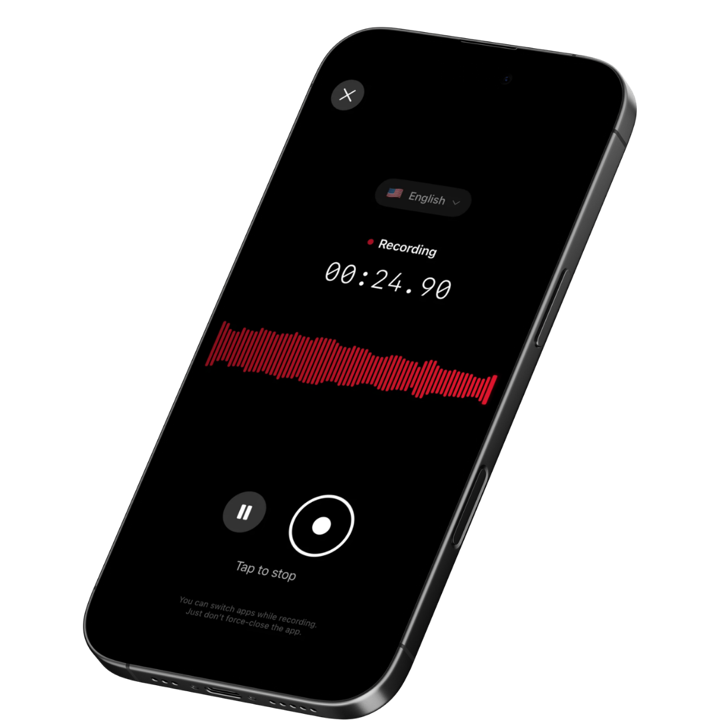
Speakwise lets managers record conversations with one tap and get AI-generated summaries, transcripts, and action items automatically. Instead of choosing between being present in a conversation and capturing it, managers can do both. Everything syncs to Notion, creating an organized record of every coaching session, team meeting, and strategic discussion.
Download Speakwise from the App Store and give your managers the tool that captures conversations so they can focus on leading their teams.
Join 10,000+ professionals who use AI-powered voice notes to document meetings, track commitments, and stay on top of their responsibilities.
Get Speakwise Free
4.9-star App Store Rating | iOS Optimized

🎯 4.9★ App Store Rating | 📱 Built for iOS
