Multitasking Statistics 2026: The Real Cognitive Costs
Used by recruiters, executives, consultants, and more.
Multitasking Statistics 2026: The Myth of Doing More, Cognitive Costs, and Performance Loss
Multitasking reduces productivity by up to 40%, increases error rates by 50%, and can temporarily cut IQ test scores by about 10 points, a widely misreported finding from a small 2005 study. Only 2.5% of the population can genuinely multitask without performance degradation. For the other 97.5% of us, what feels like doing more is actually a neurological illusion that costs the global economy $450 billion every single year.
We live in an era that celebrates the juggler. Job descriptions demand the ability to "wear many hats." Open-plan offices and always-on chat tools encourage constant availability. Smartphones deliver a never-ending stream of notifications that fracture our attention into ever-smaller fragments. The implicit message is clear: if you are not doing multiple things at once, you are falling behind.
But two decades of rigorous neuroscience and cognitive psychology research tell a radically different story. The human brain does not multitask in the way we imagine. It cannot process two cognitively demanding streams of information simultaneously. What we experience as multitasking is actually rapid task-switching-a neurological juggling act in which the brain disengages from one task, reconfigures its cognitive resources, and re-engages with another. Every single switch carries a hidden tax on speed, accuracy, memory, and mental energy. The cumulative cost of these micro-penalties is staggering, both for individual performance and for the organizations that depend on focused knowledge work.
The disconnect between perception and reality is perhaps the most troubling aspect of the multitasking problem. Surveys consistently show that the vast majority of professionals believe they are effective multitaskers, yet the laboratory data reveals precisely the opposite. The people who multitask the most frequently are demonstrably the worst at it. Chronic multitaskers show impaired memory, degraded attention filtering, increased stress hormones, and-in the most alarming findings-measurable structural changes in the brain regions responsible for cognitive control. This is not a minor efficiency issue. It is a widespread cognitive crisis hiding in plain sight behind a cultural narrative that equates busyness with productivity.
In this post, we'll explore 19 statistics that quantify the true cognitive, economic, and professional costs of multitasking. From landmark neuroscience studies at Stanford and the University of London to workplace productivity research by the American Psychological Association and behavioral economics data from global consultancies, these numbers paint a sobering portrait of what happens when we split our attention. Whether you are a knowledge worker trying to protect your focus, a manager designing team workflows, or simply someone who wants to understand why the end of the day feels so exhausting despite constant busyness, these data points offer the evidence you need to rethink the multitasking habit once and for all.
Each statistic below is drawn from peer-reviewed research or established workplace studies. Together, they build a comprehensive case that multitasking is not a skill to be developed but a liability to be minimized.
Key Multitasking Statistics (2026)
- Multitasking can slash productivity by up to 40%, according to research cited by the American Psychological Association (APA).
- Only 2.5% of people, dubbed "supertaskers," can multitask with zero measurable performance loss (Watson & Strayer, Psychonomic Bulletin & Review).
- Multitasking raises error rates by 50% and makes tasks take twice as long to finish (Steelcase, via The HR Director).
- The average attention span on a screen has shrunk to just 47 seconds, down from 2.5 minutes in 2004 (Gloria Mark, PhD, via APA).
- Organizational multitasking costs the global economy an estimated $450 billion every year (Realization, via PR Newswire).
- Workers now spend 1 hour and 33 minutes a day multitasking, up 12% since 2023 (ActivTrak 2026 State of the Workplace).
- It takes an average of 23 minutes and 15 seconds to resume a task after an interruption (Gloria Mark, UC Irvine, via Gallup).
1. Multitasking can reduce productivity by up to 40%
Research by psychologists Joshua Rubinstein, David Meyer, and Jeffrey Evans found that shifting between tasks can consume as much as 40% of a person's productive time. Each switch forces the brain through two distinct cognitive stages-"goal shifting" and "rule activation"-and while each individual switch may cost only fractions of a second, the cumulative toll across a full workday is enormous. For an eight-hour workday, that translates to roughly 3.2 hours of lost productive output spent simply reorienting between tasks. The effect compounds as task complexity increases: the more demanding the work, the steeper the switching penalty.
Source: American Psychological Association - Multitasking: Switching Costs
2. Only 2.5% of people can genuinely multitask without performance loss
University of Utah psychologists Jason Watson and David Strayer tested 200 participants in a high-fidelity driving simulator performing simultaneous cognitive tasks. They discovered that just 2.5% of participants-dubbed "supertaskers"-showed zero performance degradation when combining driving with a demanding auditory memory task. For the remaining 97.5% of the population, braking reaction times increased by 20%, following distances grew by 30%, memory performance declined 11%, and math accuracy dropped 3%. The uncomfortable implication is clear: the overwhelming majority of people who believe they are effective multitaskers are, by the data, wrong.
3. It takes an average of 23 minutes and 15 seconds to refocus after an interruption
Gloria Mark's landmark research at the University of California, Irvine demonstrated that after a single interruption, workers require an average of 23 minutes and 15 seconds to fully return to their original task. While interrupted workers sometimes complete tasks in less clock time, they compensate by working faster-at the cost of significantly elevated stress, frustration, time pressure, and mental effort. In a typical workday filled with dozens of interruptions from email, Slack messages, phone calls, and colleagues, the cumulative refocusing time can consume hours of what should be deep, productive work.
Source: Gloria Mark, UC Irvine - Gallup Business Journal interview
4. Multitasking increases error rates by 50%
Research cited by workplace solutions firm Steelcase found that multitasking raises workers' error rates by 50% and causes tasks to take twice as long to complete. This dual penalty-more mistakes plus slower execution-means that the net effect of multitasking is dramatically worse than simply doing one thing at a time. In high-stakes environments like healthcare, finance, or engineering, where errors carry outsized consequences, the 50% increase in error rates represents not just a productivity problem but a genuine safety risk that organizations cannot afford to ignore.
Source: The HR Director - Multi-tasking Increases Workers' Error Rate by 50%
5. Multitasking cut IQ test scores by about 10 points in a famous study, but the "worse than marijuana" claim is a myth
In 2005, a small study tested eight office workers hired as publicists for Hewlett-Packard. Each person took an IQ test twice: once in a quiet room, and once while phones rang and emails arrived. Average scores fell by about 10 points during the distraction, and the drop was much bigger for men than for women. News coverage at the time turned this into a viral claim that multitasking hurts your IQ more than smoking marijuana. That comparison was never part of the actual research. Dr. Glenn Wilson, the psychologist at the Institute of Psychiatry, University of London, who ran the study, later published a note saying the results were "widely misrepresented in the media." He explained that the marijuana and sleep-loss comparisons came from separate studies he did not conduct, and called the legitimacy of those comparisons "doubtful." The real, narrower finding still stands: being distracted by incoming messages can measurably hurt your performance on a task while the distraction is happening.
Source: Psychology Today - Is Multitasking Making Us Less Smart?; Dr. Glenn Wilson - Clarifying Note on the "Infomania" Study (2010)
6. The average attention span on a screen has shrunk to just 47 seconds
Gloria Mark's nearly two decades of research at UC Irvine documents a dramatic decline in sustained attention. In 2004, the average time a person spent focused on a single screen before switching was two and a half minutes. By 2012, it had dropped to 75 seconds. In the most recent measurements, taken over the last several years and replicated by other researchers, the average attention span on any screen has collapsed to approximately 47 seconds, with a median of just 40 seconds. This means that half of all observed focus episodes last less than 40 seconds before the person switches to something else-a pace of fragmentation that makes sustained deep work nearly impossible without deliberate intervention.
Source: APA - Why Our Attention Spans Are Shrinking, with Gloria Mark, PhD
7. Organizational multitasking costs the global economy $450 billion annually
A study by Realization, a project management consultancy, estimated that organizational multitasking-the practice of assigning employees to multiple concurrent projects-costs global businesses $450 billion every year. The losses stem from extended project timelines, increased rework, reduced throughput, and the cognitive overhead of constant context-switching. At the individual level, the American Psychological Association estimates that even brief mental blocks created by switching between tasks can cost as much as 40% of someone's productive time. When multiplied across millions of knowledge workers, the economic damage reaches a scale that rivals the GDP of entire nations.
Source: PR Newswire - Study: Organizational Multitasking Costs Global Businesses $450 Billion Each Year
8. Heavy media multitaskers have less gray matter in the brain's cognitive control center
A 2014 study at the University of Sussex used MRI brain scans of 75 adults and found that people who frequently used multiple media devices simultaneously had significantly smaller gray matter density in the anterior cingulate cortex (ACC)-the brain region responsible for cognitive control, emotional regulation, and decision-making. While the researchers cautioned that the study reveals correlation rather than proven causation, the finding is alarming: chronic multitasking is associated with measurable structural differences in the very part of the brain we depend on for focus, impulse control, and higher-order thinking.
9. Heavy multitaskers perform worse on every cognitive control task-including task-switching itself
In a landmark 2009 study at Stanford University, researchers Eyal Ophir, Clifford Nass, and Anthony Wagner tested 262 students and found that heavy media multitaskers were significantly worse at filtering irrelevant information, maintaining working memory, and-most surprisingly-switching between tasks. As co-author Clifford Nass summarized: "They're suckers for irrelevancy. Everything distracts them." The cruel irony is that the people who multitask the most are demonstrably the worst at it, while those who rarely multitask outperform chronic multitaskers on every measure of cognitive control, including the very task-switching skills that multitasking supposedly develops.
Source: Stanford News - Media Multitaskers Pay Mental Price
10. 52% of employees multitask often or always during virtual meetings
A survey of workplace meeting behavior found that 52% of employees multitask often or always during virtual meetings with two or more attendees. The generational gap is wide: 75% of Gen Z workers say they multitask "very often" or "always" on video calls, compared to just 34% of Baby Boomers. The same gap shows up in person, too: 76% of Gen Z workers say it is acceptable to use their phone for work tasks during in-person meetings, versus 55% of Boomers. As virtual and hybrid meetings have become routine, full attention during a meeting looks more like the exception than the rule, especially for younger workers.
Source: Notta - 100+ Eye-Opening Meeting Statistics 2025
11. Interruptions consume 28% of the average knowledge worker's day
Research by Basex, an information-technology research firm, found that unnecessary interruptions and the recovery time they demand consume 28% of the average knowledge worker's day-equivalent to roughly 2.2 hours of lost productivity in an 8-hour workday. Extrapolated across the U.S. workforce, this amounts to 28 billion lost person-hours per year at an estimated cost of $588 billion annually. The research encompassed hundreds of knowledge workers across industries and found that the majority of interruptions were not urgent, yet each one triggered the same costly refocusing cycle regardless of its importance.
Source: Basex Research - The Cost of Not Paying Attention
12. Task switching costs increase dramatically with task complexity
The foundational research by Rubinstein, Meyer, and Evans, published in the Journal of Experimental Psychology, demonstrated that switching-time costs scale with the complexity of the task rules involved. In their experiments, participants alternated between classifying geometric objects and solving arithmetic problems under varying conditions. When the tasks required more complex rules, the time penalty for switching grew significantly. When visual cues about which task to perform were removed, switching costs rose further still. The practical lesson is devastating for modern knowledge workers: the more intellectually demanding your work, the higher the price you pay every time you allow an interruption.
13. The average worker toggles between apps nearly 1,200 times a day
Research on workplace behavior found that the average digital worker toggles between applications and websites nearly 1,200 times during a typical workday. Workers use approximately 10 different applications per day, switching between them roughly 25 times on average-and each switch forces the brain to reload context, recall where it left off, and re-engage with a fundamentally different type of cognitive demand. This relentless pace of fragmentation leaves almost no room for the kind of sustained, deep focus that produces the highest-quality knowledge work.
Source: Conclude.io - Context Switching Is Killing Your Productivity
14. Brief interruptions of just 4.4 seconds triple the rate of sequence errors
A study published in the Journal of Experimental Psychology found that interruptions averaging only 4.4 seconds in duration tripled the rate of sequence errors on post-interruption trials compared to uninterrupted baseline conditions. Even interruptions as short as 2.8 seconds doubled the error rate. The implications are staggering: you do not need a long, drawn-out distraction to derail your performance. A single glance at a phone notification, a momentary Slack ping, or a brief question from a colleague is sufficient to triple your likelihood of making a mistake on the very next step of whatever you were doing. In an era of constant micro-interruptions, these brief disruptions may actually be more damaging than longer ones because of their sheer frequency.
15. Multitasking during lectures is associated with lower GPAs
Research published in Computers & Education examined 1,839 college students and found that using Facebook and texting during schoolwork were significantly and negatively associated with overall college GPA. Students who multitasked during class reported spending more total time studying outside class-not because they were more diligent, but because their in-class multitasking made their study sessions less efficient, forcing them to relearn material they failed to absorb the first time. The pattern held even after controlling for demographics and prior academic performance, confirming that multitasking was the cause of the performance decline rather than simply a habit of already-struggling students.
16. People who think they are great multitaskers are actually the worst at it
Research from the University of Utah's Department of Psychology, led by David Sanbonmatsu, found that the people who multitask the most and rate themselves highest at multitasking are, paradoxically, the least skilled at it. The study revealed that heavy multitaskers tend to be more impulsive, more sensation-seeking, and more overconfident in their abilities-traits that drive them toward multitasking but do not actually help them perform it well. In other words, the Dunning-Kruger effect is alive and well in the world of task-switching: those who most need to stop multitasking are precisely the ones least likely to recognize the problem.
17. Digital multitasking is linked to hyperactivity symptoms and declining brain health
A 2024 editorial in Annals of Medicine and Surgery synthesized findings across neuroscience and behavioral research to conclude that chronic digital multitasking is associated with increased hyperactivity symptoms, reduced executive function, diminished working memory, greater difficulty filtering irrelevant stimuli, and elevated mental fatigue and stress. The piece warned that as digital environments become more fragmented and notification-heavy, the cognitive health consequences of habitual multitasking are likely to worsen-creating a feedback loop in which declining attention spans drive more multitasking behavior, which further erodes the brain's capacity for sustained focus.
18. Workers now spend 1 hour and 33 minutes a day multitasking, up 12% since 2023
ActivTrak's 2026 State of the Workplace report, built on behavioral data from 163,638 employees at 1,111 companies, found that time spent multitasking, defined as work time in productive applications that involves frequent attention shifts between activities, rose 12% to 1 hour and 33 minutes a day, up from 1 hour and 23 minutes in 2023. The increase came during the same period that focus efficiency, the share of work time spent in focused, uninterrupted activity, fell to a three-year low of 60%. The two trends move together: as more of the workday gets carved into multitasking, less of it is available for the kind of sustained attention that produces high-quality work.
Source: ActivTrak - 2026 State of the Workplace Report
19. Average focus sessions have shrunk to 13 minutes and 7 seconds, down 9% in three years
The same ActivTrak dataset found that the average focused work session, the length of time a worker spends on one task before switching away, fell 9% to 13 minutes and 7 seconds, down from 14 minutes and 23 seconds. That is a direct behavioral signature of rising multitasking: workers are not only spending more total time switching between tasks, they are also switching sooner within each task, leaving less time to reach real depth on any one piece of work before the next distraction arrives.
Source: ActivTrak - 2026 State of the Workplace Report
The Multitasking Paradox: Why We Keep Doing What the Data Says We Shouldn't
The statistics above tell a remarkably consistent story. Across decades of research, from controlled laboratory experiments to large-scale workplace studies, the evidence is unambiguous: multitasking degrades performance on virtually every metric that matters-speed, accuracy, memory, creativity, and even the structural integrity of the brain itself. A 40% productivity penalty. A 50% increase in errors. A 10-point IQ drop. Gray matter reduction in the brain's cognitive control center. An average of 23 minutes to recover from a single interruption. These are not marginal effects. They represent a fundamental mismatch between how we work and how the human brain is designed to operate.
And yet, multitasking remains not just common but celebrated. More than half of employees multitask during virtual meetings. Workers toggle between apps nearly 1,200 times per day. The average attention span on a screen has cratered to 47 seconds. Why? Because multitasking feels productive. The dopamine hit of checking off a quick email, the illusion of staying on top of everything, the social pressure of responding instantly-these reward signals are immediate and visceral, while the costs of fragmented attention are diffuse, cumulative, and largely invisible until the end of the day when you wonder why you feel exhausted but accomplished so little.
The research points to a single, uncomfortable conclusion: the most productive thing most people can do is stop trying to do more than one cognitively demanding thing at a time. Single-tasking is not a luxury or a lifestyle choice. It is a biological imperative. The 97.5% of us who are not supertaskers are fighting our own neurology every time we split our attention-and the neurology wins, every time, whether we notice the penalty or not. The organizations and individuals who internalize this lesson and design their workflows, tools, and habits around focused single-tasking will hold an enormous competitive advantage over those who continue to worship at the altar of busyness.
The practical challenge, of course, is that modern work environments are engineered for interruption. Open offices, real-time messaging, back-to-back meetings, and smartphones conspire to ensure that sustained focus is the exception rather than the rule. The average knowledge worker now faces nearly 1,200 app switches per day, with attention spans on screens averaging just 47 seconds. The workplace itself has become a multitasking machine, and individual willpower is no match for systemic design that rewards constant responsiveness over sustained concentration.
Solving the multitasking problem requires more than discipline-it requires rethinking the tools and processes we use to capture, organize, and retrieve information. If the root cause of most workplace multitasking is the fear of missing or forgetting something, then the solution is not to try harder to pay attention to everything at once. It is to build systems that capture information reliably so that your brain can afford to focus on one thing at a time. The most effective anti-multitasking strategy is not to resist distraction but to eliminate the conditions that make distraction feel necessary in the first place.
The data is unequivocal: multitasking is the single most widely practiced, socially reinforced, and scientifically debunked productivity strategy in the modern workplace. Every minute spent splitting your attention is a minute spent operating with a diminished brain. The question is no longer whether multitasking hurts performance-it is why we continue to tolerate a way of working that the evidence has condemned for over twenty years.---
Ready to capture your thoughts without splitting your attention?
One of the most common and costly forms of workplace multitasking is attempting to take notes while simultaneously listening, processing, and participating in a conversation. It is the definition of divided attention: your brain must encode what is being said, decide what is important, translate thoughts into written words, and maintain your place in the discussion-all at the same time. The statistics above show exactly what happens when you try: your comprehension drops, your error rate climbs by up to 50%, your retention suffers, and the notes you produce are incomplete fragments that fail to capture the full picture. You end up with the worst of both worlds-poor notes and poor engagement.
Think about what the data means for a typical meeting. With more than half of employees already multitasking during virtual meetings, and each interruption requiring 23 minutes to recover from, most people leave most meetings having absorbed a fraction of what was discussed. The notes they took while distracted are riddled with gaps. The action items they captured are incomplete. And the cognitive cost of all that switching lingers long after the meeting ends, degrading the quality of whatever they work on next.
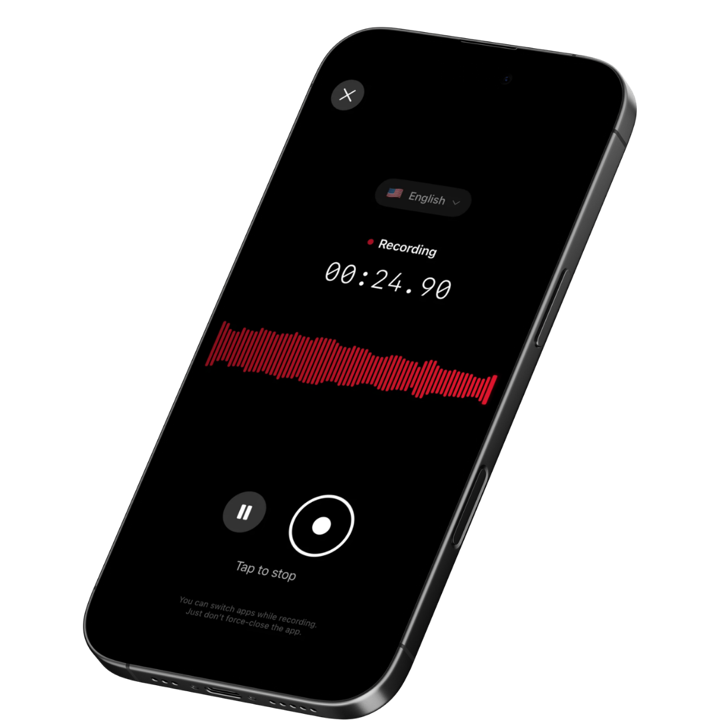
Voice capture offers a fundamentally different approach. Instead of splitting your attention between listening and typing, you simply speak-and AI handles the rest. No divided attention. No degraded performance. No cognitive switching cost. A voice-to-text app for iPhone lets you capture a conversation hands-free instead of dividing your focus to type.
Download SpeakWise from the App Store and discover how one-tap recording, AI transcription, intelligent summaries, and Notion integration can help you capture information without multitasking-because the best ideas deserve your full attention.
Join 10,000+ professionals who've discovered that the best way to fight multitasking isn't doing more-it's capturing more with less effort.
Get SpeakWise Free →
4.9★ App Store Rating | iOS Optimized

🎯 4.9★ App Store Rating | 📱 Built for iOS
