Notification Overload Statistics 2026: Push Alerts, Badge Counts, and the Attention Tax
Used by recruiters, executives, consultants, and more.
Notification Overload Statistics 2026: Push Alerts, Badge Counts, and the Attention Tax
The average U.S. smartphone user receives 46 push notifications per day, while the average person checks their phone 352 times-once every two minutes and 43 seconds. An interruption lasting just 2.8 seconds doubles the risk of making an error, and it takes a full 23 minutes and 15 seconds to regain deep focus after each disruption. These 20 statistics reveal how notification overload has become the defining productivity crisis of the modern workplace.
We designed notifications to keep us informed. Instead, they have made us anxious, fragmented, and perpetually distracted. Every buzz, badge, and banner represents a micro-demand on our attention-a tiny withdrawal from a cognitive bank account that is already overdrawn. The smartphone in your pocket is not just a communication device; it is an interruption engine firing dozens of times per hour, training your brain to expect disruption and making sustained focus feel almost impossible. From Slack pings to email badges to push alerts from apps you forgot you installed, the modern worker exists in a state of permanent partial attention that decimates deep work, inflates error rates, and fuels chronic stress. The problem has only intensified as workplace communication has fractured across more platforms-the average employee now juggles 10 different apps daily, each with its own notification stream, its own badge count, and its own claim on your already-depleted attention.
In this post, we'll explore 20 statistics that quantify the true scope of notification overload in 2025 and 2026. These numbers expose not just how many alerts we receive, but how those alerts fragment our attention, elevate our stress, and erode our ability to produce meaningful work. Whether you're a knowledge worker who feels perpetually behind, a manager wondering why your team's output doesn't match their hours, or anyone who has ever felt a phantom vibration in their pocket, these data points explain what's really happening to your attention-and why the solution isn't as simple as "just turn off your phone."
Key Notification Overload Statistics (2026)
- Notification overload starts with sheer volume: the average U.S. smartphone user receives 46 push notifications every day (Business of Apps).
- Checking behavior compounds it further-Americans now pick up their phones 352 times per day, once every two minutes and 43 seconds (Asurion).
- Even a brief glance costs accuracy: interruptions averaging 4.4 seconds triple the error rate on sequence-based tasks (Altmann, Trafton & Hambrick, Journal of Experimental Psychology: General).
- Recovering from a single interruption takes an average of 23 minutes and 15 seconds, according to UC Irvine researcher Gloria Mark (Gallup Business Journal).
- Nearly half of employees-48%-say their work feels chaotic and fragmented amid the constant stream of pings, emails, and chats (Microsoft Work Trend Index).
- A single smartphone notification is enough to disrupt concentration, slowing cognitive processing for roughly seven seconds, per 2026 research in Computers in Human Behavior (PsyPost).
- The psychological toll is severe: 80% of employees report "productivity anxiety" driven by the pressure to keep up with an endless stream of alerts (American Institute of Stress).
1. The average U.S. smartphone user receives 46 push notifications per day
The volume of push notifications hitting the average American's phone has reached a level that makes sustained focus nearly impossible. Research compiled by Business of Apps found that U.S. smartphone users receive an average of 46 push notifications daily-nearly six per waking hour, assuming a 16-hour day. Each notification, whether from a messaging app, news outlet, social platform, or workplace tool, represents a decision point: check it now, dismiss it, or let it linger as a badge count that nags at the edge of your awareness. The cumulative cognitive load of 46 daily decisions to engage or ignore is substantial, even when most individual notifications seem trivial. And this figure only counts push notifications-it doesn't include email alerts, calendar reminders, Slack messages, or the dozens of other pings that compete for your attention throughout the day. Source: Business of Apps - Push Notifications Statistics
2. Americans check their phones 352 times per day-once every 2 minutes and 43 seconds
The compulsion to check our devices has accelerated dramatically. An Asurion survey found that Americans now reach for their phones an average of 352 times per day, which translates to once every two minutes and 43 seconds during waking hours. This represents a massive increase from the company's earlier finding of 96 times per day in 2019-a 267% jump in just a few years. Each check, whether triggered by a notification or by habit alone, represents a micro-interruption that fragments whatever task was underway. Critically, research shows that many of these checks are not prompted by an actual alert; they are habitual, driven by the anxiety that something might have arrived since the last check. When you are checking your phone every three minutes, there is no such thing as deep work-only an endless cycle of interruption and partial recovery. Source: Asurion - Americans Now Check Their Phones 352 Times Per Day
3. A 2.8-second interruption doubles the error rate on a task
You don't need a long distraction to derail your work-even the briefest glance at a notification has measurable consequences. A study led by Michigan State University found that interruptions averaging just 2.8 seconds-roughly the time it takes to glance at a push notification on your phone-doubled the error rate on sequence-based tasks. When the interruption lasted 4.4 seconds, errors tripled. The researchers noted that these findings have serious implications for professions where errors carry high stakes, from healthcare to aviation, but the principle applies universally: every notification that pulls your eyes from your work, even for a moment, makes your work worse. Source: Altmann, Trafton & Hambrick - Momentary Interruptions Can Derail the Train of Thought (Journal of Experimental Psychology: General)
4. It takes 23 minutes and 15 seconds to fully regain deep focus after an interruption
The most widely cited productivity statistic in modern research comes from Gloria Mark at the University of California, Irvine: it takes an average of 23 minutes and 15 seconds to fully regain deep focus after a single interruption. This figure is devastating in the context of notification overload. If a worker receives notifications every few minutes-as most do-the math makes sustained deep work structurally impossible. You cannot achieve 23 minutes of recovery when the next ping arrives in three. The result is a workforce that spends entire days in a state of shallow, fragmented attention, never reaching the cognitive depth where their best work lives. Source: Gallup Business Journal - Too Many Interruptions at Work?
5. The average attention span on any screen has dropped to 47 seconds
Our collective ability to sustain attention has been in freefall. Gloria Mark's two decades of research, documented in her 2023 book Attention Span, reveals that the average time a person spends on any single screen before switching has collapsed from two and a half minutes in 2004, to 75 seconds in 2012, to just 47 seconds in recent years. The median is even lower-just 40 seconds, meaning half of all observed screen sessions last less than that. Notifications are both a cause and a symptom of this decline: they train the brain to expect interruption, which in turn makes the brain less capable of resisting the urge to switch even when no notification arrives. Source: Gloria Mark - Attention Span (Steelcase Interview)
6. Workers toggle between apps and websites 1,200 times per day
Notifications don't just interrupt-they trigger chains of app switching that consume hours. A study published in the Harvard Business Review found that the average digital worker toggles between different applications and websites nearly 1,200 times per day. These transitions add up to roughly four hours per week spent simply reorienting after each switch-approximately 9% of annual work time lost entirely to the cognitive overhead of navigating between digital tools. A single notification on Slack can cascade into checking email, then a project board, then a document, each switch compounding the attentional debt. Source: Harvard Business Review - How Much Time and Energy Do We Waste Toggling Between Applications
7. Knowledge workers average only 2 hours and 48 minutes of productive work per day
Despite spending eight or more hours at their desks, most knowledge workers produce far less than a full day's output. A RescueTime analysis of millions of hours of anonymized productivity data found that the average knowledge worker manages only 2 hours and 48 minutes of truly productive work per day. The remaining five-plus hours evaporate into notification checks, app switching, shallow communication, and the cognitive recovery time required after each interruption. Furthermore, 40% of workers never go more than 30 minutes without being interrupted during the workday, making even those 2.8 productive hours highly fragmented. This figure helps explain the disconnect between how busy workers feel and how little meaningful output they produce-they are busy being interrupted, not busy being productive. Source: RescueTime via Scrum.org - The 8-Hour Workday Myth
8. 60% of knowledge workers' time is consumed by "work about work"
Notifications exist to coordinate work-but the coordination itself has become the work. Asana's Anatomy of Work Index, which surveyed over 10,000 knowledge workers globally, found that 60% of their time is spent on "work about work": communicating about tasks, searching for information, switching between apps, managing priorities, and chasing status updates. Only 40% goes to the skilled, strategic work these professionals were hired to do. Over the course of a year, this translates to 103 hours in unnecessary meetings, 209 hours on duplicative work, and 352 hours simply talking about work rather than doing it. The vast majority of knowledge workers (88%) agree that time-sensitive projects and large initiatives have fallen through the cracks due to the sheer volume of tasks on their plate-a direct consequence of notification-driven work patterns that prioritize responsiveness over results. Source: Asana - How Work About Work Gets in the Way
9. 37% of Americans have turned off notifications entirely on their smartphones
The backlash against notification overload is measurable and growing. A YouGov survey found that 37% of Americans have turned off notifications on their smartphones-making it one of the most commonly adopted strategies for managing phone use. An additional 33% have used Do Not Disturb mode, and 83% have tried at least one method to take a break from their phone. These figures reveal a growing recognition that the default notification settings on most devices and apps are optimized for engagement, not for the user's wellbeing or productivity. When more than a third of the population takes active steps to silence their phone, and the vast majority have tried some form of digital intervention, the system is clearly broken by design. Source: YouGov - Smartphone Usage Survey
10. Up to 60% of app users opt out of push notifications when given the choice
The gap between what apps want to send and what users want to receive is enormous. Data compiled by Andrew Chen shows that up to 60% of users opt out of push notifications when platforms give them the choice. On iOS, where users must explicitly grant notification permission, opt-in rates vary sharply by category-from just 39% for social apps to 79% for ride-sharing apps-meaning most iPhone users decline notifications from the majority of apps they install. This represents a massive, silent vote against the notification-driven model of engagement, and it signals that users understand, even intuitively, that most push notifications subtract more value than they add. Source: Andrew Chen - Why People Are Turning Off Push
11. Sending 3-6 push notifications per week causes 40% of users to disable app notifications
There is a precise breaking point at which notification frequency drives users away. Research from Business of Apps found that sending three to six push notifications per week will cause 40% of users to disable that app's notifications entirely. Even a single weekly push notification causes 10% of users to opt out, while 6% will abandon the app altogether after receiving just one push per week. These thresholds reveal how narrow the margin is between useful and annoying-and how quickly "keeping users informed" becomes "driving users away." Source: Business of Apps - Push Notifications Statistics
12. 80% of knowledge workers report "productivity anxiety"
The psychological toll of notification overload extends far beyond momentary distraction. A study reported by the American Institute of Stress found that 80% of employees experience "productivity anxiety"-a persistent stress response driven by the feeling that they should always be doing more, responding faster, and staying on top of an unending stream of messages. Among Gen Z workers, the impact is even more severe: 30% battle productivity anxiety daily and 58% experience it multiple times per week. Notifications fuel this anxiety by creating a visible, quantified backlog of unread messages, unacknowledged alerts, and rising badge counts that serve as a constant reminder of everything still demanding attention. Source: American Institute of Stress - 80% of Employees Report Productivity Anxiety
13. 89% of college students experience phantom vibration syndrome
Perhaps no statistic better captures the psychological rewiring caused by notification overload than this: nearly 89% of college students report experiencing phantom vibration syndrome-the false perception that their phone is vibrating when it is not. Research published by CBS News, based on a study of 290 U.S. college students, found that 40% experienced these phantom vibrations at least once per week, with 13% experiencing them daily. The phenomenon has been documented across populations, with prevalence rates ranging from 29.6% to 89% depending on the study-including 68% of medical staff in a separate clinical survey. When your nervous system hallucinates notifications that don't exist, the notification system has fundamentally altered your neurology. Your brain has become so conditioned to expect interruption that it manufactures the sensation even in its absence. Source: CBS News - Phantom Vibration Syndrome Common in Cellphone Users
14. Heavy multitasking triggered by notifications can cause a temporary 10-point IQ drop
The cognitive damage from constant notification-driven task switching goes beyond lost time-it temporarily makes you measurably less intelligent. Research from the University of London found that participants who multitasked during cognitive tasks experienced IQ score declines of up to 10 points, a reduction similar to what you'd expect from losing a full night of sleep. While the effect is temporary and occurs during the distractions rather than permanently, the implication for the modern workplace is stark: a worker who is constantly bouncing between notifications is operating with significantly diminished cognitive capacity throughout the entire workday. Separate research from the University of Sussex found that people who frequently multitask across multiple devices actually showed less brain density in the anterior cingulate cortex-the region responsible for cognitive and emotional control-suggesting that the effects of chronic notification-driven multitasking may extend beyond the temporary. Source: World Economic Forum - Is Multitasking Limiting Your Potential
15. Employees use an average of 10 apps per day, each with its own notification stream
The tool proliferation driving notification overload is well documented. Asana's Anatomy of Work Index found that the average knowledge worker uses 10 different applications every day. Each of those apps brings its own notification stream, its own badge counts, and its own claim on attention-so the more tools an organization adopts, the higher the notification tax on every employee, and the harder it becomes to tell which alerts actually matter. Source: Asana - How Work About Work Gets in the Way
16. 62% of U.S. workers feel compelled to respond to emails immediately upon receiving them
Notifications don't just interrupt-they create a psychological pressure to respond that makes the interruption last far longer than the alert itself. Asana's international Anatomy of Work research found that 62% of U.S. workers feel the need to reply to emails straight away, the highest rate of any country surveyed. Additionally, 63% of U.S. workers continue checking email outside of work hours, effectively extending the notification-driven workday into evenings, weekends, and vacations where cognitive recovery should be happening. This compulsion transforms every email notification into an urgent demand, regardless of actual priority, creating an "always-on" mentality where the line between work and rest dissolves entirely. The result is not just lost productivity during work hours, but compromised recovery during off-hours-a double penalty that accelerates burnout. Source: HR Dive - Notification Fatigue Is Tanking Productivity
17. Workers are interrupted every 2 minutes during core hours-275 times per day
The density of interruptions in the modern workplace has reached a level that makes the concept of "focus time" almost theoretical. Microsoft's Work Trend Index, analyzing trillions of productivity signals, found that during core work hours, employees face a ping-from meetings, emails, or chats-every two minutes. Over a full day, that adds up to 275 interruptions. Combined with email (an average of 117 messages per day), chat platforms (153 Teams messages per day for the average worker), and push notifications from mobile apps, the total interruption load creates an environment where sustained attention is not merely difficult-it is architecturally impossible. If each interruption requires even a fraction of the 23-minute recovery time identified by Gloria Mark's research, the entire eight-hour workday would be consumed by recovery alone-with zero time left for the work itself. Source: Microsoft Work Trend Index - Breaking Down the Infinite Workday
18. Nearly half of employees say their work feels chaotic and fragmented
The sheer volume and sprawl of notifications is reshaping how work feels, not just how it gets done. Microsoft's 2026 Work Trend Index found that nearly half of employees (48%) and more than half of leaders (52%) say their work feels chaotic and fragmented, a direct consequence of communication modes multiplying and mental load increasing. The same report found that 57% of meetings are now ad hoc calls booked without a calendar invite, adding a further layer of unpredictability to a workday already interrupted every two minutes. When workers can no longer predict when the next ping, meeting, or message will arrive, the psychological toll compounds the productivity cost. Source: Microsoft Work Trend Index - Breaking Down the Infinite Workday
19. After-hours chat messages are up 15% year-over-year, with 58 messages now arriving outside the 9-to-5
Notification overload no longer respects the boundaries of the traditional workday. Microsoft's 2026 Work Trend Index found that chats sent outside standard working hours are up 15% year-over-year, with the average worker now receiving 58 such messages before or after the 9-to-5. Nearly 20% of employees who work on weekends are checking email before noon on Saturday and Sunday, and more than 5% are back in their inbox on Sunday evenings. Each of these after-hours pings carries the same interruption cost as a daytime notification, meaning the attention tax no longer clocks out at 5 p.m.-it follows workers home, and into their weekends. Source: Microsoft Work Trend Index - Breaking Down the Infinite Workday
20. A single notification disrupts cognitive processing for about seven seconds
New 2026 research confirms that even one brief notification carries a measurable neurological cost. A study published in Computers in Human Behavior by researchers at the University of Lausanne found that a single smartphone-style notification triggered a transient slowdown in cognitive processing lasting approximately seven seconds, driven by the notification's perceptual salience, learned associations, and perceived relevance. The disruption was more pronounced among people with higher habitual smartphone use, suggesting that the more conditioned we become to checking our phones, the more each notification hijacks our attention-even when we never act on it. Source: PsyPost - New Psychology Research Reveals the Cognitive Cost of Smartphone Notifications
The Notification Paradox: Designed to Inform, Engineered to Distract
The statistics above reveal a profound irony at the heart of modern work: the systems we built to keep people informed have made it nearly impossible for them to think. Notifications were supposed to be a convenience-a way to ensure no important message went unnoticed, no deadline slipped, no colleague waited too long for a reply. Instead, they have created an attention crisis so severe that the average knowledge worker produces less than three hours of meaningful output per day while spending the remainder in a state of perpetual reactivity. We have optimized our communication infrastructure for speed at the expense of depth, and the trade-off has been catastrophic for the quality of work that actually moves organizations forward.
The damage is not merely economic, though the economic cost is staggering. It is psychological. When 80% of workers report productivity anxiety, when nearly 90% of young adults experience phantom vibrations from devices that aren't buzzing, and when more than a third of the population has resorted to disabling notifications entirely, we are looking at a systemic failure-not of individual discipline, but of design. These systems are working exactly as intended: they maximize engagement. The problem is that engagement and productivity are not the same thing, and the gap between them is where focus goes to die. The notification model treats every piece of information as equally urgent, every message as equally deserving of an immediate interruption-and in doing so, it ensures that nothing receives the sustained attention it deserves.
The path forward requires a fundamental shift in how we think about information capture and communication. Reducing notification volume helps, but it treats the symptom rather than the disease. The deeper issue is that most workplace notifications exist because information needs to travel between people and tools-and our current model requires real-time, attention-demanding alerts to accomplish that transfer. Any real solution must find a way to capture and move information without shattering the recipient's focus in the process. The goal is not to be less connected-it is to be connected in ways that respect the cognitive reality of how human attention actually works.
The workers who thrive in this environment won't be those who check their notifications fastest. They will be those who find ways to capture important information without entering the notification cycle at all-who can record a thought, document a decision, or process an insight without triggering the 23-minute recovery penalty that comes with every app switch and every glowing badge count. The future of productivity belongs not to the most responsive, but to the most intentional.
The average worker receives 46 notifications, checks their phone 352 times, toggles between apps 1,200 times, and produces less than 3 hours of real work-every single day. The attention tax isn't a minor inconvenience. It is the defining productivity crisis of our time.---
Ready to capture information without breaking your focus?
The irony of notification overload is that most alerts stem from a legitimate need-someone shared a decision in Slack, an important email arrived, a project status changed. The information matters. The interruption is what's killing you. Every time you switch to an app to jot down a note, check a message, or document a thought, you're paying the full 23-minute cognitive recovery penalty-whether the task takes five seconds or five minutes.
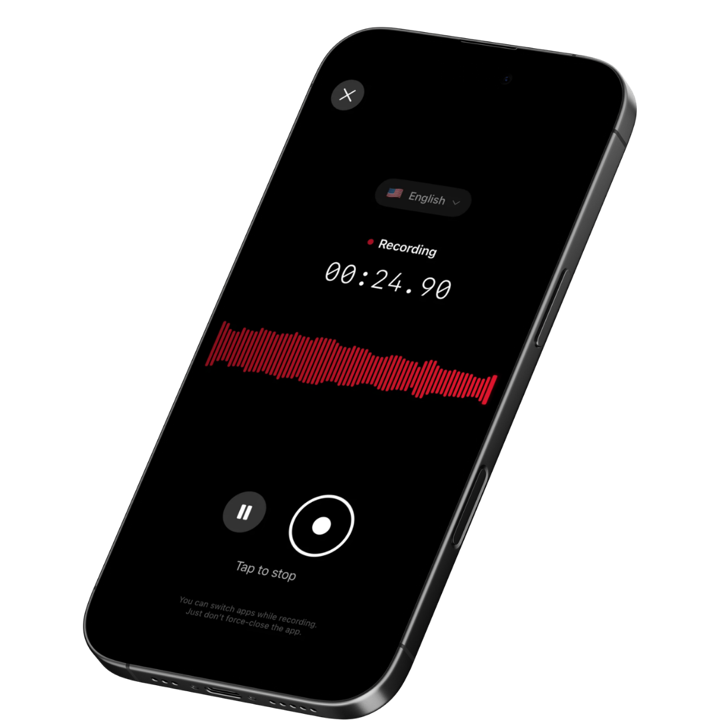
Voice capture offers a fundamentally different approach. Instead of switching to another app to type a note, send an update, or document a decision, you simply speak-and AI handles the rest. No app switch. No context break. No 23-minute recovery.
Download SpeakWise from the App Store and discover how one-tap recording, AI transcription, intelligent summaries, and Notion integration can help you capture information without breaking your flow-no app switching required.
Join 10,000+ professionals who've discovered that the best way to fight notification overload isn't fewer notifications-it's a tool that works without demanding your attention.
Get SpeakWise Free →
4.9★ App Store Rating | iOS Optimized

🎯 4.9★ App Store Rating | 📱 Built for iOS
