Notion vs Obsidian: Honest Comparison (2026)


Used by recruiters, executives, consultants, and more.
Notion vs Obsidian: Which Is Better in 2026?
Choose Notion if you need team collaboration, project management, and structured databases in one workspace. Choose Obsidian if you prioritize privacy, speed, and building a personal knowledge base with linked notes. Notion is the better all-in-one workspace for teams. Obsidian is the better tool for individual knowledge workers who want local-first data ownership and lightning-fast performance.
Both Notion and Obsidian are powerful note-taking tools with passionate user bases. They approach personal knowledge management from opposite directions. Notion is cloud-first with real-time collaboration. Obsidian is local-first with complete data ownership. This comparison breaks down where each tool wins across seven key dimensions.
Notion vs Obsidian at a Glance
| Feature | Notion | Obsidian |
|---|---|---|
| Best For | Team workspaces | Personal knowledge bases |
| Platform | Web, Mac, Windows, iOS, Android | Mac, Windows, Linux, iOS, Android |
| Collaboration | Real-time multiplayer | Limited (via third-party) |
| AI Features | Native Notion AI | Community plugins only |
| Offline Access | Limited | Full offline support |
| Data Storage | Cloud-based | Local Markdown files |
| Pricing From | Free (personal use) | Free (all features) |
| G2 Rating | 4.6/5 (10,494 reviews) | 4.2/5 |
What Is Notion?
Notion is an all-in-one workspace that combines note-taking, databases, project management, and team collaboration. It uses a block-based editor where every element is a movable block. You can create documents, Kanban boards, calendars, tables, and custom dashboards all in one platform. Notion 3.0, launched in September 2025, rebuilt its AI capabilities as a full agent that can perform tasks autonomously. With a 4.6-star G2 rating across 10,494 reviews, Notion is one of the most widely adopted productivity tools for teams and individuals.
Notion Key Features
- Block-Based Editor: Every element is a block. Drag, rearrange, and nest text, images, databases, embeds, and more with complete flexibility.
- Databases with Views: Create databases and view the same data as a table, list, calendar, Kanban board, or gallery.
- Real-Time Collaboration: Multiple users can edit pages, leave comments, and assign tasks simultaneously.
- Notion AI Agent: AI that works autonomously across your workspace to draft content, answer questions, and execute tasks.
- Integrations: Connects with Slack, Google Drive, GitHub, Figma, and hundreds of other tools.
Notion Pricing
- Free: Unlimited pages and blocks for personal use, 10 guest collaborators, 5MB file upload limit
- Plus: $10/user/month (annual) or $12/month - unlimited uploads, 30-day version history
- Business: $15/user/month (annual) or $20/month - SSO, advanced permissions, Notion AI included
- Enterprise: ~$25-30/user/month - workspace analytics, advanced security, custom contracts
What Is Obsidian?
Obsidian is a Markdown-based knowledge management app that stores all notes as plain-text files on your local device. It pioneered linked thinking for personal knowledge bases with bidirectional links and a visual graph view that shows connections between notes. Obsidian is lightning fast because everything runs locally. It supports 1,800+ community plugins that extend functionality in almost any direction. With complete data ownership and no vendor lock-in, Obsidian appeals to researchers, writers, and developers who value privacy and control.
Obsidian Key Features
- Local-First Storage: All notes saved as plain Markdown files on your device. No cloud dependency. Full offline access.
- Bidirectional Linking: Create connections between notes with [[wikilinks]]. See all backlinks and mentions for any note.
- Graph View: Visualize your entire knowledge base as an interactive network graph showing how notes connect.
- 1,800+ Plugins: Community-built plugins add everything from Kanban boards to spaced repetition, calendars, and AI integrations.
- Canvas: Visual workspace for arranging notes, images, and connections on an infinite canvas.
Obsidian Pricing
- Personal: Free for all features
- Sync Add-on: $4/month (annual) or $5/month - end-to-end encrypted sync across devices
- Publish Add-on: $10/month - publish notes as a website
Head-to-Head Comparison
Collaboration
Notion wins on collaboration. It offers native real-time editing where multiple users work on the same page simultaneously. Comments, mentions, and task assignments are built in. Obsidian is designed for individual use. While you can share files through third-party tools or Obsidian Publish, it lacks real-time multiplayer editing. For teams that need to work together in a shared workspace, Notion is the only viable option.
Winner: Notion - real-time multiplayer collaboration is a core strength
Privacy and Data Ownership
Obsidian wins on privacy. All notes are stored as plain Markdown files on your local device. You own your data completely and can access it without any internet connection or software dependency. Notion stores everything in the cloud, which means your data lives on their servers. Obsidian with the Sync add-on uses end-to-end encryption. For professionals handling sensitive information, Obsidian's local-first architecture provides fundamentally stronger privacy.
Winner: Obsidian - local storage with full data ownership and no cloud dependency
Performance and Speed
Obsidian is noticeably faster. Because it reads local files, search is instant and navigation is snappy even with thousands of notes. Notion can feel sluggish, especially with large workspaces or complex databases. Page load times in Notion depend on internet speed. Obsidian works at full speed offline. For users with large knowledge bases who value responsiveness, Obsidian's local performance is a clear advantage.
Winner: Obsidian - local processing makes it faster than cloud-dependent Notion
AI Features
Notion has a significant AI advantage. Notion AI is now a full autonomous agent that can draft content, answer questions about your workspace, summarize documents, and execute multi-step tasks. This is native, deeply integrated functionality. Obsidian relies on community plugins for AI integration, which varies in quality and requires manual setup. For users who want AI built into their workflow without configuration, Notion delivers a polished experience.
Winner: Notion - native AI agent with deep workspace integration
Customization and Extensibility
Obsidian wins on extensibility. Its 1,800+ community plugins let you build a truly personalized system. Add Kanban boards, spaced repetition, daily journals, citation managers, or custom CSS themes. The possibilities are nearly unlimited. Notion offers templates and integrations but does not support the same level of deep customization. If you want a tool that adapts exactly to your workflow, Obsidian's plugin ecosystem is unmatched.
Winner: Obsidian - 1,800+ plugins enable deep customization Notion cannot match
Organization Structure
Notion offers more structured organization out of the box. Its databases let you create tables, Kanban boards, calendars, and galleries from the same data set. Notion's top-down hierarchy of workspaces, pages, and databases is intuitive for structured thinkers. Obsidian uses a bottom-up approach centered on linked notes and folder hierarchies. Graph view reveals emergent connections. Notion is better for structured projects. Obsidian is better for networked thinking.
Winner: Notion - databases with multiple views provide superior structured organization
Who Should Choose Notion?
- You should choose Notion if your team needs a shared workspace with real-time collaboration
- You should choose Notion if you want project management, databases, and notes in one platform
- You should choose Notion if you prefer a polished UI that works without configuration or plugins
- You should choose Notion if built-in AI for writing, summarization, and task automation matters to you
Who Should Choose Obsidian?
- You should choose Obsidian if data privacy and local storage are non-negotiable requirements
- You should choose Obsidian if you build a personal knowledge base with interconnected ideas
- You should choose Obsidian if performance speed on large note collections is important to you
- You should choose Obsidian if you want deep customization through community plugins and CSS
- You should choose Obsidian if you need full offline access without internet dependency
Speakwise gets your hours back.
- ✓Built for in-person meetings, interviews, and site visits.
- ✓Trusted by recruiters, consultants, agents, and field pros.
- ✓One tap to record. Notion-ready summary in minutes.

Frequently Asked Questions
Is Notion better than Obsidian?
It depends on your workflow. Notion is better for teams, collaboration, and structured project management. Its all-in-one workspace combines notes, databases, and tasks in a polished interface. Obsidian is better for individual knowledge workers who value privacy, speed, and linked thinking. If you work mostly alone and care about data ownership, Obsidian wins. If you work in a team and need shared workflows, Notion wins.
Can I use Notion and Obsidian together?
Yes, and many knowledge workers do. A common setup uses Obsidian for personal thinking and research, and Notion for team collaboration and project management. Notes can be exported from Obsidian as Markdown and imported into Notion. Some users also use the Notion integration in Speakwise to send meeting notes from in-person conversations directly to their Notion workspace.
Which is cheaper, Notion or Obsidian?
Obsidian is cheaper for most use cases. The full app is free for personal use. Sync costs $4/month annually. Notion's free plan is generous for solo users but limits file uploads to 5MB and version history to 7 days. Notion Plus at $10/user/month is needed for teams. For individual users, Obsidian is free versus Notion's functional limitations on the free tier.
Is there a better alternative to both Notion and Obsidian?
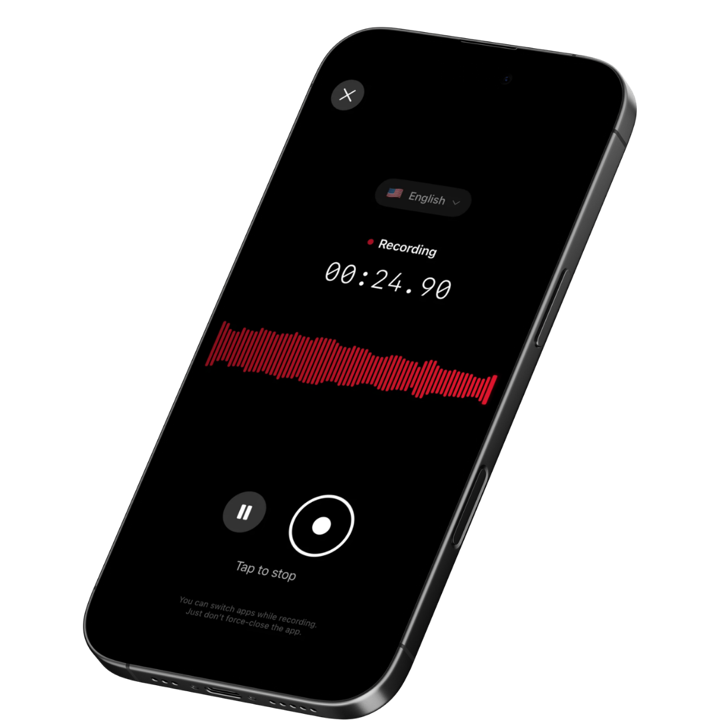
For note-taking after meetings and conversations, Speakwise complements both tools. Neither Notion nor Obsidian records and transcribes audio natively. Speakwise is a mobile-first iOS app that records in-person conversations via iPhone or AirPods, delivers 95%+ transcription accuracy in 100+ languages, and syncs directly to Notion. At $59.99/year, it bridges the gap between capturing conversations and organizing knowledge in your preferred tool.
Can Obsidian replace Notion?
For individual use, largely yes. Obsidian with plugins can replicate many Notion features like Kanban boards, calendars, and task management. For team collaboration, no. Obsidian lacks real-time multiplayer editing, shared workspaces, and the structured database views that make Notion essential for teams. Evaluate based on whether you work primarily alone or with others.
Final Verdict: Notion vs Obsidian
Notion is the right choice for teams and structured thinkers in 2026. Real-time collaboration, powerful databases, and native AI make it the best all-in-one workspace for organizations. If your work involves shared projects, task management, and team documentation, Notion is the clear winner.
Obsidian is the right choice for individual knowledge workers. Local-first storage, blazing speed, bidirectional linking, and 1,800+ plugins create a personal knowledge management system that Notion cannot match. If you value privacy, performance, and deep customization, Obsidian is the stronger tool.
Both tools benefit from audio capture, which neither provides natively. If you record in-person meetings or conversations, Speakwise fills the gap with iOS-native recording, AI transcription, and native Notion sync at $59.99/year.
Bottom line: Notion wins for teams and collaboration. Obsidian wins for individual knowledge management. Speakwise adds audio capture to either workflow.> If you want meeting notes to flow directly into Notion, download Speakwise from the App Store and record conversations with one-tap AI transcription and native Notion sync.
🎯 4.9★ App Store Rating | 📱 Built for iOS
