Open Office Statistics 2026: Noise Levels, Productivity Impact, and the Privacy Crisis
Used by recruiters, executives, consultants, and more.
Open Office Statistics 2026: Noise Levels, Productivity Impact, and the Privacy Crisis
Open offices were supposed to tear down walls and spark collaboration. Instead, face-to-face interaction dropped 70% in companies that adopted them, workers in open layouts take 62% more sick days than those in private offices, and over 59% of open-plan occupants report dissatisfaction with sound privacy. These 19 statistics reveal why the world's most popular office design is quietly undermining the very productivity and teamwork it promised to unlock.
Key Open Office Statistics (2026)
- Open offices are used by roughly 70% of U.S. companies, more than any other layout (Gallup)
- Face-to-face interaction drops by 70% after a company switches to an open-plan layout, while email and instant-messaging volume surge (Harvard Business School)
- Workers in open-plan offices with more than six occupants take 62% more sick days than those in private offices (PubMed)
- Open-plan office noise routinely reaches 60-65 decibels, well above the 55 dB threshold for concentrated intellectual work (Zenbooth)
- 69% of managers in open-plan environments say they don't have access to the workplace privacy they need (Steelcase)
- Two-thirds of open office workers now "hack" their workspace -- improvising fixes for noise and privacy gaps the office itself should have solved (Gensler 2026 Global Workplace Survey)
- It takes 23 minutes and 15 seconds, on average, to resume a task after an interruption in a noisy workspace (Gallup Business Journal)
The open office is everywhere. Roughly 70% of American companies now use some version of an open-plan layout, driven by the twin promises of reduced real estate costs and enhanced collaboration. The logic seemed sound: remove physical barriers, and people will talk more, share ideas freely, and innovate faster. Architects designed sweeping floor plates with rows of shared desks. Executives celebrated the savings. Magazine covers featured gleaming open workspaces as temples of modern productivity. The open office became the default, rarely questioned and almost never tested before deployment.
But the research tells a very different story. Over two decades of peer-reviewed studies, large-scale employee surveys, and neurophysiological experiments have converged on a troubling conclusion: open offices consistently underperform private offices on nearly every metric that matters -- acoustics, privacy, concentration, health, and even the collaboration they were built to foster. The costs are not abstract. They show up in sick days, in cognitive performance, in employee engagement scores, and in the quiet epidemic of workers who have simply stopped trying to do deep work at their desks. They show up in the steady hum of noise-canceling headphones, the proliferation of "do not disturb" signals, and the paradox of colleagues sitting five feet apart communicating exclusively through Slack.
In this post, we examine 19 data-backed statistics that capture the full scope of the open office problem. From decibel readings to brain wave activity, from Danish sick leave records to Harvard interaction tracking, these numbers provide a clear, research-driven picture of what open layouts actually do to the people inside them -- and why capturing information in these environments demands new tools and approaches. Whether you work in a fully open floor plan, a hybrid layout, or a traditional cubicle farm that has been "modernized" with lower partitions, these findings will change the way you think about your workspace and the hidden toll it may be exacting on your performance.
1. Approximately 70% of U.S. companies use some form of open office layout
The open office has become the dominant American workplace design. Research indicates that around 70% of U.S. companies now employ some version of an open-plan layout, including low-partition cubicles, high-partition cubicles, and fully open desk arrangements. Roughly 15-20% of these use a completely open plan with no partitions at all. Despite mounting evidence of its drawbacks, the economic incentive remains powerful: open layouts can reduce per-employee real estate costs by 50% or more compared to private offices, making them difficult for CFOs to resist even when productivity data suggests the savings are illusory. The result is a workplace monoculture where the vast majority of knowledge workers have no choice but to attempt focused, cognitively demanding work in environments designed for visibility rather than concentration. Source: Gallup - How to Make an Open Office Floor Plan Work
2. Open offices reduce face-to-face interaction by approximately 70%
In what may be the most damaging finding against open offices, Harvard researchers Ethan Bernstein and Stephen Turban tracked employees at two Fortune 500 companies before and after their transition to open-plan layouts. Using sociometric badges equipped with sensors that recorded face-to-face contact, speaking, listening, and movement, they found that in-person interaction dropped by roughly 70% after walls came down. Rather than sparking conversation, the open layout triggered a natural human instinct to socially withdraw. Workers retreated into headphones and screens, choosing digital communication over the spontaneous hallway exchanges that open offices were supposed to generate. Source: Harvard Business School - The Impact of the 'Open' Workspace on Human Collaboration
3. Email volume surged 56% and instant messaging rose 67% after the switch to open plan
The same Harvard study revealed the flip side of declining face-to-face interaction: electronic communication exploded. Email volume increased by 56%, and instant messaging activity jumped by 67% after companies moved to open offices. Workers who could physically see their colleagues a few desks away were choosing to send messages rather than speak to them. The open office didn't eliminate communication barriers -- it transformed physical proximity into digital distance, replacing rich, nuanced conversation with fragmented text exchanges that lack tone, context, and the trust-building qualities of face-to-face dialogue. Source: Harvard Business School - The Impact of the 'Open' Workspace on Human Collaboration
4. Open-plan noise levels routinely reach 60-65 decibels -- well above the concentration threshold
While the ideal background noise level for office work ranges from 40 to 55 decibels, measurements in open-plan offices regularly register between 60 and 65 decibels. To put that in context, 55 decibels is the maximum recommended level for "mainly intellectual work" that requires high complexity and creative thinking, according to acoustic guidelines. Once noise exceeds the 55-60 dB range, it begins to interfere with concentration and elevate stress, particularly during cognitively demanding tasks. At 60-65 dB, open offices are operating above the threshold where deep, focused work becomes physiologically difficult -- not just annoying, but neurologically impaired. Source: Zenbooth - Acceptable Noise Levels in the Workplace for Productivity
5. Workers in open-plan offices with 6+ people take 62% more sick days than those in private offices
A landmark national cross-sectional study of Danish workers aged 18-59 found that employees in open-plan offices with more than six occupants had 62% more days of sickness absence compared to those in single-occupant offices. Workers in two-person offices had 50% more sick days, and those in three-to-six-person offices had 36% more. The pattern was clear and dose-dependent: the more people sharing a space, the more sick days taken. The mechanisms likely include airborne pathogen transmission in shared airspace, the psychological stress of constant exposure to others, and the difficulty of taking restorative breaks in environments with no privacy. Source: PubMed - Sickness Absence Associated with Shared and Open-Plan Offices
6. Over 59% of open-plan occupants report dissatisfaction with sound privacy
A major study by Jungsoo Kim and Richard de Dear, published in the Journal of Environmental Psychology, analyzed data from the Center for the Built Environment's occupant survey database and found that more than 59% of workers in open-plan offices were dissatisfied with sound privacy. The study concluded that enclosed private offices "clearly outperformed open-plan layouts in most aspects of indoor environmental quality, particularly in acoustics, privacy and the proxemics issues." Most critically, the supposed benefit of open offices -- ease of interaction -- was found to be smaller than the penalties of increased noise and decreased privacy. The collaboration payoff, in other words, does not cover the privacy cost. Source: Journal of Environmental Psychology - Workspace Satisfaction: The Privacy-Communication Trade-off
7. It takes 23 minutes and 15 seconds to refocus after a single interruption
Research by Gloria Mark at the University of California, Irvine found that the average worker needs 23 minutes and 15 seconds to return to a task after being interrupted. In an open office, where interruptions from neighboring conversations, phone calls, and passersby are constant, this recovery time compounds throughout the day. Mark's research also found that interrupted work involves at least two intervening tasks before the original work is resumed, and that interrupted workers experience significantly higher stress, frustration, mental effort, time pressure, and overall workload compared to uninterrupted workers. In open offices, where distraction is the ambient condition, sustained focus becomes the exception rather than the rule. Source: Gallup Business Journal - Too Many Interruptions at Work?
8. Employees in open offices can be up to 66% less productive, primarily due to nearby conversations
Research has found that workers in open-space environments can experience productivity reductions of up to 66%, with nearby conversations identified as the primary culprit. Human speech is uniquely distracting because our brains are wired to process language automatically -- we cannot simply "tune out" a conversation happening three meters away the way we might filter mechanical noise. This involuntary processing consumes cognitive resources that would otherwise be directed at the task at hand, creating a productivity tax that compounds across every hour of the workday. The irony is pointed: the conversations that open offices were designed to encourage are the very thing destroying the focused work those offices also need to support. Source: TechRadar - How Your Noisy, Open-Plan Office Is Making You 66% Less Productive
9. 69% of middle managers say they lack access to the privacy they need at work
Steelcase's research on middle managers uncovered a privacy crisis concentrated among the people organizations depend on most. Sixty-nine percent of managers reported that they don't have access to the privacy they need, and 66% ranked privacy as their single most important workplace need -- yet when leaders prioritize what to fix, privacy ranks only fourth on their list. These are the individuals responsible for translating strategy into execution, handling sensitive personnel conversations, and making judgment calls that require concentration -- yet the offices they work in are designed to deny them the very thing they need most. Source: Steelcase - The Modern Challenges of Middle Management
10. Noise is the number-one complaint among open-plan office employees
Across multiple large-scale workplace surveys, noise consistently ranks as the single greatest source of dissatisfaction in open-plan offices. According to the Leesman Index, nearly 75% of employees consider managed noise levels important to an effective workplace, but only 30% are satisfied with the noise levels they actually experience. That 45-percentage-point gap between importance and satisfaction represents a massive unmet need. Furthermore, dissatisfaction with noise is statistically the strongest indicator of poorly perceived productivity -- more predictive than temperature, lighting, or any other environmental factor. Source: Rockfon/ROCKWOOL - Exploring the Link Between Building Acoustics, Health and Wellbeing
11. Open-plan employees receive 29% more interruptions than those in private offices
Research from the University of California, Irvine found that cubicle workers experience 29% more interruptions than their counterparts in private offices. Those who were frequently interrupted reported 9% higher rates of exhaustion. In a fully open office without even cubicle partitions, the interruption rate climbs higher still. Each interruption carries a cascading cost: the immediate break in focus, the 23-minute recovery period, the increased stress and cognitive load, and the subtle demoralization of repeatedly losing one's train of thought. Over the course of a workday, these interruptions don't merely chip away at productivity -- they fundamentally alter the type of work that is possible in the space. Source: Adobe Business Blog - What Science Says About Open Offices and Productivity
12. Open-plan office noise causes a 25% increase in negative mood after just eight minutes
The psychological impact of open-office noise is both rapid and measurable. Research found a 34% increase in sweat response (a physiological stress marker) and a 25% increase in negative mood after just eight minutes of exposure to simulated open-office noise conditions. This is not the gradual wear of an eight-hour day -- it is a near-instant shift in both physiology and psychology that occurs within the time it takes to make a cup of coffee. The finding suggests that open-office workers begin each focused work attempt already operating at an emotional and physiological disadvantage, with stress hormones elevated before they've even opened their first document. Source: The Conversation - Why Your Brain Has to Work Harder in an Open-Plan Office
13. 90% of recent studies on open-plan offices show they may lead to stress, conflicts, and high blood pressure
A comprehensive review of the scientific literature found that 90% of studies published on open-space offices reported negative health and wellness outcomes, including increased stress, interpersonal conflict, and elevated blood pressure. The remaining 10% showed neutral results -- virtually none demonstrated positive health outcomes. This near-unanimity in the research stands in stark contrast to the continued popularity of the design. The disconnect between scientific consensus and corporate practice suggests that the decision to use open offices is driven primarily by cost savings and aesthetic trends, with employee health data either unknown to or ignored by decision-makers. Source: BBC News - The Pleasures and Perils of the Open-Plan Office
14. 98% of the most highly engaged workers say they can concentrate easily -- but only 17% of the most disengaged can
Steelcase's global research exposed a striking concentration gap between engaged and disengaged employees. Among the most highly engaged and satisfied workers, 98% reported having the ability to concentrate easily. Among the most highly disengaged and dissatisfied workers, that figure plummeted to just 17%. While concentration ability is not solely determined by office layout, the research makes clear that the capacity for focused work is inseparable from employee engagement. Open offices, which consistently underperform on concentration metrics, may therefore be undermining not just productivity but the deeper psychological connection employees feel to their work. Source: Steelcase - New Research Reveals Lack of Privacy Takes Toll on Employee Engagement
15. Open-plan offices require greater cognitive effort, shown by increased gamma and theta brain wave activity
Neuroscience research has moved the open-office debate beyond surveys and into the brain itself. Studies using EEG monitoring found that employees in open-plan environments show increased gamma and theta brain wave activity compared to those in private offices, indicating higher cognitive load and greater mental fatigue. In practical terms, this means the brain is working harder in an open office -- not because the work itself is more demanding, but because the environment imposes an additional processing burden. The brain must constantly filter irrelevant stimuli, suppress responses to distracting conversations, and maintain task focus against an unrelenting background of sensory input. This hidden cognitive tax reduces the mental resources available for the actual work. Source: The Conversation - Why Your Brain Has to Work Harder in an Open-Plan Office
16. 63% of workers say a lack of quiet spaces impacts their productivity
Nearly two-thirds of employees report that insufficient access to quiet environments directly reduces their ability to do productive work. This statistic reflects a fundamental design failure in many open offices: while they may allocate space for collaboration -- huddle rooms, lounge areas, open meeting zones -- they chronically under-invest in spaces for concentration. The result is an office that supports talking but not thinking, that enables spontaneous conversation but not sustained thought. For knowledge workers whose value depends on cognitive quality, not just communication quantity, the absence of quiet is not a minor inconvenience -- it is a structural impediment to their core function. Source: iSpace Office - 5 Common Employee Complaints About Office Noise
17. A review of 300+ papers found office layout is "highly significant" in affecting occupant productivity
A comprehensive review of more than 300 research papers from 67 academic journals concluded that office layout is a highly significant factor in determining occupant productivity, and that sound and acoustic strategies should be given the highest priority in office design decisions. The review further found that open-plan offices can reduce real estate costs but impose a "productivity tax" that may outweigh the initial savings. This finding reframes the economic argument for open offices: what appears as a cost reduction on the facilities budget may actually be a cost increase on the human capital budget, paid in lost focus, diminished output, and the invisible drain of employees who can never quite reach their full cognitive potential. When 300 papers from nearly 70 journals point in the same direction, the evidence is no longer ambiguous -- it is a consensus that workplace designers and executives ignore at their organization's expense. Source: Management Review Quarterly - The Productivity Tax of New Office Concepts
18. Two-thirds of office workers "hack" their workspace to compensate for noise and privacy gaps
Gensler's 2026 Global Workplace Survey, which polled more than 16,000 full-time office workers across 16 countries, found that two-thirds of employees now improvise their own fixes because their workplace doesn't support how they actually work. One in four have resorted to DIY solutions for problems like inadequate visual privacy, while unresolved noise and limited meeting-space availability remain among the most common complaints. The finding underscores that the open office's core promises -- an environment that supports focus and privacy -- remain unmet nearly two decades into the design's dominance, leaving workers to solve environmental problems the office itself was supposed to solve. Source: Gensler - Global Workplace Survey 2026
19. 49% of managers say they aren't consulted when their office layout is designed
Steelcase's research on middle managers found that nearly half -- 49% -- say they are not, or likely wouldn't be, considered in the layout of their office, despite carrying as heavy a meeting load as senior leaders and having far less access to private space. The disconnect compounds the privacy gap documented above: the people least able to escape an open floor plan for focused or sensitive conversations are also the ones with the least input into how that floor plan gets designed in the first place. Giving managers a voice in shaping their own workspace, rather than simply inheriting whatever layout leadership selects, is one of the more direct levers organizations have for reducing the toll open offices take on their middle layer of management. Source: Steelcase - The Modern Challenges of Middle Management
The Open Office Paradox: Designed for Collaboration, Built for Isolation
The 19 statistics above converge on a central irony that defines the modern workplace: the office layout explicitly designed to bring people together is, by nearly every measure, pushing them apart. Face-to-face interaction doesn't increase when walls come down -- it collapses by 70%, replaced by a surge in emails and instant messages sent between people sitting within arm's reach of each other. The open office didn't remove barriers to communication. It replaced physical walls with psychological ones -- headphones, averted gazes, and the unspoken social contract of "please don't talk to me, I'm trying to concentrate." Walk through any open-plan office at midday and you will see a floor full of people who are physically proximate and socially distant, each constructing an invisible bubble of privacy in an environment that provides none.
The health data adds a dimension that economic analysis alone cannot capture. Workers in open offices take dramatically more sick days -- 62% more in the largest study. Their stress markers spike within minutes of sitting down. Their brains operate under measurably greater cognitive load, burning mental fuel on environmental filtering that should be directed at the work itself. Ninety percent of published studies report negative health outcomes, with zero reporting positive ones. When an office layout makes its occupants sicker, more stressed, and less cognitively capable, the question shifts from "is this layout optimal?" to "is this layout ethical?" The original promise of the open office was fundamentally about people -- bringing them together, encouraging human connection, fostering creativity through proximity. But the data shows that the people inside these offices are paying a steep biological price for a design philosophy that prioritized aesthetics and cost savings over human needs.
The privacy crisis revealed by the Steelcase and Leesman research adds yet another layer. The people most affected by privacy deprivation -- middle managers responsible for sensitive conversations, strategic thinking, and personnel decisions -- are precisely the people organizations can least afford to impair. When 69% of middle managers report that they lack the privacy they need, that is not a facilities complaint. That is a leadership effectiveness problem with downstream consequences for every team those managers oversee. Consider what it means when a manager cannot find a quiet space to give candid feedback, prepare a thoughtful strategic recommendation, or simply think without interruption. The costs ripple outward through the organization in ways that never appear on a real estate spreadsheet.
Perhaps most telling is the concentration gap. When 98% of highly engaged workers can concentrate easily, and only 17% of disengaged workers can, the link between environment and engagement becomes impossible to ignore. Open offices do not merely reduce productivity in the narrow sense of output-per-hour. They erode the psychological conditions -- focus, flow, autonomy, and a sense of control over one's environment -- that enable workers to do their best thinking and feel connected to their work. The open office was supposed to create a sense of community. For many, it has created a sense of helplessness -- a daily experience of being unable to control one's own working conditions, unable to find quiet when quiet is needed, and unable to do the deep work that gives professional life its sense of meaning and accomplishment.
The data is clear: the open office experiment has produced the opposite of its intended results. Rather than more collaboration, we got more isolation. Rather than more productivity, we got more distraction. Rather than more innovation, we got more email. The question is no longer whether open offices have failed -- it is what we do about it in a world where most of us still have to work in one.---
Ready to stay productive in any office layout?
The open office makes one of the most fundamental professional tasks -- capturing information -- significantly harder. When noise levels hover at 60-65 decibels, when interruptions arrive every few minutes, and when 23 minutes of recovery time follows each disruption, writing detailed notes or typing out thoughts becomes an exercise in frustration. Ideas surface during a quick conversation at a shared desk, a flash of insight arrives between meetings, a critical decision gets made in a hallway huddle -- and by the time you find a quiet corner to document it, the details have already begun to fade. The very environment that generates information also destroys your ability to capture it. In a space where 66% of your productive capacity may be lost to ambient conversation, every additional second spent hunting for a notebook or opening a typing app is another moment where valuable thoughts slip away.
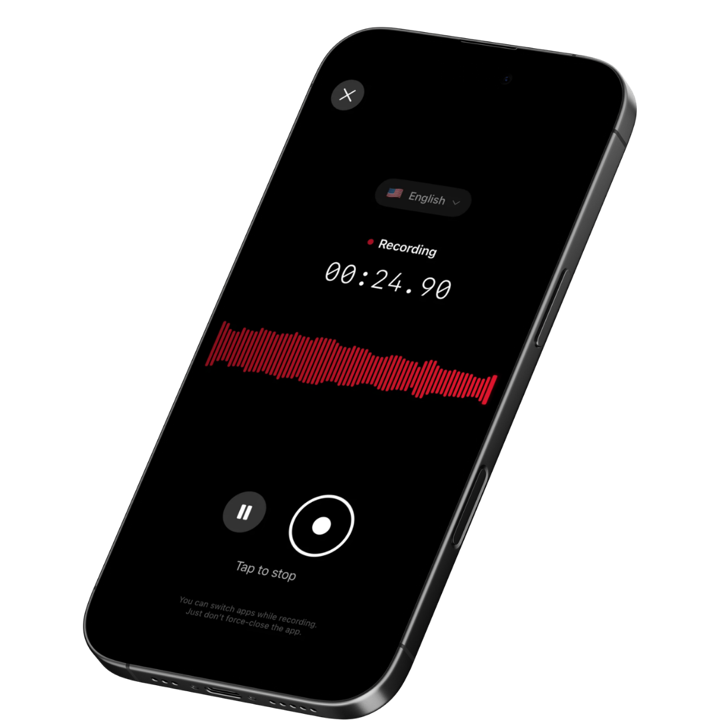
Voice capture offers a fundamentally different approach. Even in a bustling open office, you can quickly capture a thought with a brief voice note--and AI handles the rest. No need to find a quiet room. No need to type in a noisy environment. Just speak, and SpeakWise's AI transcription captures every word.
Download SpeakWise from the App Store and discover how one-tap recording, AI transcription, intelligent summaries, and Notion integration can help you capture information in any office environment.
Join 10,000+ professionals who've discovered that you don't need a private office to capture private thoughts--you just need the right tool.
Get SpeakWise Free →
4.9★ App Store Rating | iOS Optimized

🎯 4.9★ App Store Rating | 📱 Built for iOS
