Procrastination Statistics 2026: Data on Delays
Used by recruiters, executives, consultants, and more.
Procrastination Statistics 2026: Data on Delays
88% of workers procrastinate for at least one hour every workday. The average employee wastes 2 hours and 11 minutes daily on task avoidance, costing employers roughly $15,000 per $40,000 salaried worker. Chronic procrastination now affects 20% of adults - up from just 5% in the 1970s. Beyond the workplace, bedtime procrastination alone costs the average American more than 332 hours of sleep every year.
Procrastination is no longer a personal quirk. It is a measurable workplace crisis with real financial consequences. From social media scrolling to endless email checking, today's digital environment makes it easier than ever to delay the work that matters most. The result is a growing gap between hours logged and actual output produced.
This post covers 14 statistics that quantify the scope and cost of procrastination in the modern workplace. Whether you manage a team, run a business, or simply want to understand why your to-do list never shrinks, these data points reveal just how pervasive the problem has become.
Key Procrastination Statistics (2026)
- Procrastination affects at least 88% of the workforce, who admit to delaying work for at least one hour during every workday (Giodella).
- Workplace procrastination costs employers roughly $15,000 a year for every employee earning a $40,000 salary (Passive Secrets).
- Chronic procrastination affects 20% of adults today, up from just 5% in the 1970s (University Affairs).
- Internet browsing is the top workplace distraction, consuming 47% of employees' work time (ElectroIQ).
- Task-switching and multitasking can cost as much as 40% of a person's productive time, according to the American Psychological Association (APA).
- Bedtime procrastination costs the average American more than 332 hours of sleep a year, with 96% admitting to staying up late despite knowing better (Talker Research/Avocado Green Mattress via New York Post).
- A 2025 UC Santa Barbara study of over 1,000 adults found that a brief, seven-question reflection exercise significantly raised people's stated likelihood of tackling a task they had been putting off (BMC Psychology).
1. 88% of workers procrastinate for at least one hour every workday
88% of the workforce admits to procrastinating for at least one hour during each workday. Among those, 8.7% of salaried workers qualify as "hardcore procrastinators" who waste eight or more hours per day - effectively their entire shift. This statistic comes from workplace surveys tracking how employees actually spend their time versus how they report spending it. The gap between perceived productivity and real output is enormous. When nearly nine out of ten workers lose at least an hour daily to procrastination, organizations are paying for a full workweek but receiving far less in return.
Source: Giodella - Procrastination Statistics and Facts 2025
2. The average worker wastes 2 hours and 11 minutes procrastinating daily
In a survey of 2,000 full-time UK workers, the average person spent 2 hours and 11 minutes per day engaged in procrastination behavior. That adds up to nearly 11 hours per week and roughly 55 full days per year spent avoiding productive work. At scale, this represents a staggering amount of lost capacity. A team of 10 people effectively loses more than one full-time employee's worth of output to procrastination alone. The daily average also understates peak behavior - many workers report entire afternoons lost to avoidance cycles, especially when facing complex or ambiguous tasks without clear deadlines.
Source: Human Resources Online - How much time are your employees spending procrastinating?
3. Procrastination costs employers $15,000 per $40,000 salaried worker annually
Workplace procrastination carries a direct financial cost of approximately $15,000 for every employee earning $40,000 per year. That means employers lose roughly 37.5% of their labor investment to task avoidance and productivity delays. These figures account for time spent on non-work activities during paid hours, delayed project completions, and the cascading effects of missed deadlines on team output. For small businesses operating on thin margins, even a handful of habitual procrastinators can meaningfully impact the bottom line.
Source: Passive Secrets - 40+ Useful Procrastination Statistics
4. Chronic procrastination has quadrupled since the 1970s - from 5% to 20% of adults
In the 1970s, only about 5% of the population identified as chronic procrastinators. Today, that figure has risen to approximately 20% of adults, according to research by Piers Steel, a leading procrastination researcher at the University of Calgary. His 2007 meta-analysis in Psychological Bulletin reviewed nearly 800 studies and identified four key drivers of procrastination: low self-confidence, task aversiveness, high impulsiveness, and an inability to set realistic goals. The fourfold increase over five decades maps closely to the rise of digital distractions. Smartphones, social media, and infinite entertainment options have made avoiding difficult tasks easier than at any point in history.
Source: University Affairs - The Pull of Procrastination
5. 75% of college students consider themselves procrastinators
Approximately 75% of college students identify as procrastinators, and nearly 50% procrastinate consistently and problematically, according to Steel's research. This statistic matters because these students are entering the workforce with deeply ingrained avoidance habits. If three-quarters of recent graduates already view procrastination as a core part of their work behavior, employers face a structural challenge. The habit does not disappear with a diploma. Without intervention, workplace procrastination rates will continue climbing as each generation arrives more accustomed to instant gratification and less practiced in sustained, focused effort.
Source: PubMed - The Nature of Procrastination: A Meta-Analytic and Theoretical Review
6. 47% of work time is lost to internet browsing - the top workplace distraction
Internet browsing is the leading workplace distraction, consuming 47% of employees' work time according to survey data. Social media follows closely at 45%, and texting rounds out the top three at 44%. These digital distractions are the primary vehicle through which procrastination manifests in modern workplaces. The overlap between these categories is significant - a worker who opens a browser tab to check news often drifts to social media, then responds to personal messages. Each micro-distraction may feel trivial. In aggregate, they consume nearly half the workday.
Source: ElectroIQ - Wasting Time at Workplace Statistics
7. 89% of employees waste at least 30 minutes daily; 16% waste over two hours
89% of employees admit to wasting at least 30 minutes of work time every day, while 16% report that wasting more than two hours daily is their norm. These are self-reported figures, meaning the actual numbers are likely higher. People consistently underestimate how much time they spend on non-productive activities. The 16% figure is particularly revealing - it represents roughly one in six workers who openly acknowledge losing a quarter of their workday to non-work activities. For a company with 100 employees, that means 16 people are effectively working six-hour days while being paid for eight.
Source: ElectroIQ - Wasting Time at Workplace Statistics
8. 9% of employees waste over 40 hours per month browsing the internet
Roughly 9% of employees waste more than 40 hours per month surfing the internet at work. That equals an entire working week lost each month to non-productive online activity. Over a year, these employees effectively take 12 additional weeks of unproductive time. For employers, this represents a complete ghost workforce - people who are physically present and logged in, but producing virtually nothing. The internet's infinite scroll design makes this behavior particularly resistant to change. Without physical barriers or monitoring, the path from a work task to a YouTube video is one click away.
Source: Motion - Stay Focused in the Age of Social Media
9. Task-switching can cost as much as 40% of a person's productive time
Even brief mental blocks created by shifting between tasks can cost as much as 40 percent of someone's productive time, according to psychologist David Meyer's research summarized by the American Psychological Association. What feels like a quick Instagram check or a brief scroll through Twitter triggers a context switch that fragments cognitive focus. The brain must disengage from the work task, process the new content, and then re-engage with the original task. Each switch carries a time cost. When workers check social media dozens of times per day, the cumulative productivity hit is devastating. An eight-hour workday effectively shrinks to under five hours of real output.
Source: American Psychological Association - Multitasking: Switching Costs
10. Procrastination is linked to higher stress, anxiety, and lower wellbeing
Research consistently connects procrastination with poorer mental health outcomes. Chronic procrastinators report significantly higher levels of stress, anxiety, and depression compared to non-procrastinators. Steel's meta-analysis found the strongest correlations between procrastination and task aversiveness, low self-efficacy, high impulsiveness, and low conscientiousness. The relationship is bidirectional - stress causes procrastination, and procrastination causes stress, creating a cycle that is difficult to break. Workers trapped in this loop experience declining performance and declining wellbeing simultaneously, making procrastination both a productivity problem and a health problem.
Source: PubMed - The Nature of Procrastination: A Meta-Analytic and Theoretical Review
11. One in four employees spends a significant part of their workday on social media
25% of employees spend a meaningful portion of their workday on social media platforms. For these workers, social media is not an occasional break - it is a parallel activity that runs alongside their work throughout the day. The notification-driven design of platforms like Instagram, TikTok, and Twitter ensures a constant stream of prompts to re-engage. Each notification represents a procrastination trigger that competes with whatever productive task is underway. When a quarter of the workforce is regularly losing time to social feeds, the aggregate productivity loss reaches into the billions of dollars annually.
Source: Motion - Stay Focused in the Age of Social Media
12. It takes 23 minutes to refocus after each procrastination episode
Research from psychologist Gloria Mark (UC Irvine) shows that it takes an average of 23 minutes and 15 seconds to resume a task after an interruption or distraction. Since procrastination episodes are essentially self-imposed interruptions, each time a worker drifts to social media or internet browsing, they lose not just the distraction time but also the recovery time. A five-minute Instagram check actually costs closer to 28 minutes of productive time. When workers experience multiple procrastination episodes per hour, the math becomes impossible. There simply are not enough minutes in the day to both procrastinate and recover from procrastinating.
Source: Gallup Business Journal - Too Many Interruptions at Work
13. Bedtime procrastination costs Americans over 332 hours of sleep a year
A survey of 2,000 Americans conducted by Talker Research on behalf of Avocado Green Mattress found that 96% admit to "revenge bedtime procrastination" - intentionally staying up late for personal time even though they know it will hurt their sleep. Respondents reported doing this about 3.5 times a week, staying up roughly an hour and 50 minutes later than usual each time, which adds up to an estimated 332 hours of lost sleep per year. The behavior mirrors workplace procrastination almost exactly: people delay something they know they should do (going to bed) in favor of an immediately rewarding activity, even while aware of the cost. It is a reminder that procrastination is not confined to the workday - it follows people into the one part of life meant to help them recover from it.
Source: New York Post - Bedtime procrastination is stealing hundreds of hours of Americans' sleep
14. A brief reflection exercise measurably increases the odds of starting
A 2025 study from UC Santa Barbara, published in the peer-reviewed journal BMC Psychology, recruited 1,035 adults to test a brief intervention aimed at the moment of resistance right before beginning a procrastinated task. Compared with a control group, participants who completed a seven-question guided reflection exercise (writing about how they felt about the task, breaking it into a smaller subtask, estimating the time it would take, and picking a small reward) reported a better mood, a bigger gap favoring the payoff of finishing over their aversion to starting, and a significantly higher likelihood of acting on the task within the next 24 hours. Notably, the exercise did not reduce task aversion on its own - it worked by making the payoff feel more immediate. The findings suggest procrastination is less a fixed personality trait than a momentary emotional hurdle that responds to small, well-timed interventions.
The Procrastination Paradox: Working More, Producing Less
The fourteen statistics above reveal a workforce that is simultaneously busy and unproductive. Workers spend long hours at their desks, attend meetings, respond to messages, and feel exhausted at the end of the day. Yet nearly half their time disappears into distraction, delay, and avoidance. The paradox is that modern work environments - with their open offices, constant connectivity, and infinite digital temptations - are almost perfectly designed to encourage procrastination.
The financial consequences are staggering but largely unacknowledged. When procrastination costs $15,000 per employee, it represents one of the largest productivity drains in the economy. Yet most organizations have no strategy for addressing it. Performance management systems measure output but rarely examine the behavioral patterns that suppress it.
The data points toward a structural problem, not a moral failing. When 88% of workers procrastinate daily and chronic procrastination has quadrupled in 50 years, the issue is environmental. Digital tools designed to capture attention are winning the battle against focused work. The most effective response is not discipline - it is designing workflows that reduce the friction between intention and action.
The average worker loses 2 hours and 11 minutes daily to procrastination. Across a career, that adds up to years of lost potential. The solution is not trying harder - it is capturing productive thoughts the moment they arise, before procrastination takes hold.---
Stop procrastinating on your best ideas
These 14 statistics show that procrastination thrives in the gap between thinking and doing. You have an insight during a meeting, a breakthrough on your commute, a critical next step while reviewing a project - but the friction of opening an app, finding the right document, and typing it out creates just enough delay for procrastination to take over. The thought slips away. The task gets postponed. The cycle continues.
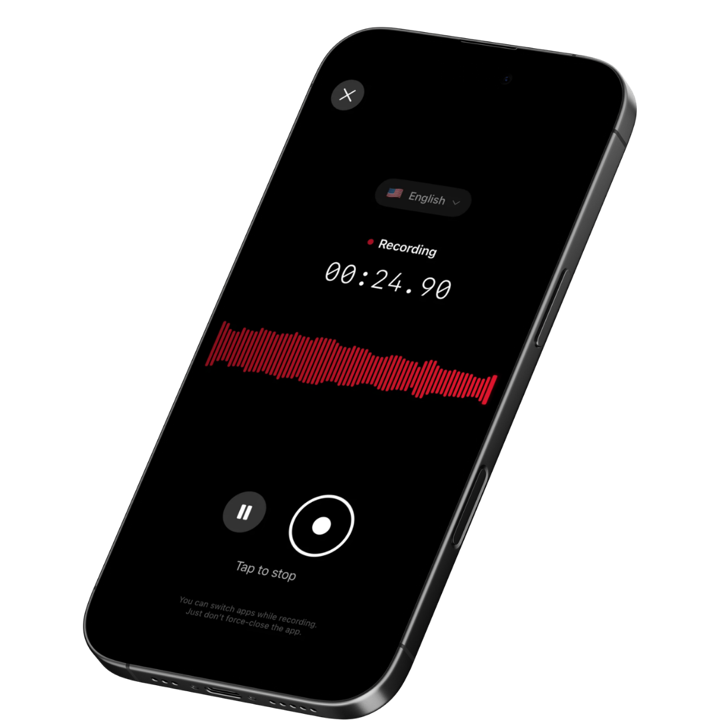
Voice capture eliminates that gap entirely. Speaking a thought takes seconds. No app switching, no typing, no friction. The idea moves from your mind to a structured, searchable record before procrastination has a chance to intervene.
Download Speakwise from the App Store and turn fleeting thoughts into instant action items, meeting notes, and organized records - all through one-tap voice capture with AI transcription and Notion sync.
Join 10,000+ professionals who have discovered that the fastest way to beat procrastination is to capture ideas before the urge to delay kicks in.
Get Speakwise Free
4.9-star App Store Rating | iOS Optimized

🎯 4.9★ App Store Rating | 📱 Built for iOS
