Productivity Loss Statistics 2026: Hidden Drains, Time Leaks, and Output Gaps
Used by recruiters, executives, consultants, and more.
Productivity Loss Statistics 2026: Hidden Drains, Time Leaks, and Output Gaps
The average employee is productive for just 2 hours and 23 minutes of an 8-hour workday. Disengaged workers cost the global economy $438 billion in a single year. And knowledge workers spend 60% of their time on "work about work" instead of the skilled tasks they were hired to perform. These are not edge cases or worst-case scenarios. They are the norm.
Productivity loss is the silent tax on every business. It does not announce itself in quarterly reports or show up as a single line item on the balance sheet. Instead, it hides inside unnecessary meetings that could have been emails, inside the 23 minutes it takes to refocus after every interruption, inside the 1,200 app toggles each worker performs every day, and inside the 1.8 hours spent each morning just searching for the right information. These micro-losses compound relentlessly. Over the course of a year, they drain hundreds of billions of dollars from the global economy and steal thousands of hours from the professionals who can least afford to lose them.
The problem is not that people are lazy. The problem is that the modern workplace is structurally designed to waste time. Communication tools multiply. Meeting invites stack. Documentation demands grow. And the actual skilled work that moves organizations forward gets squeezed into smaller and smaller windows of fragmented attention. Every new collaboration platform promises to streamline workflows, but each one adds another tab to check, another notification to process, and another place where critical information might be buried. The result is a workforce that is busier than ever but less productive than it should be. Understanding where productivity actually goes is the first step toward getting it back.
In this post, we will explore 17 statistics that expose the hidden drains, time leaks, and output gaps costing businesses billions every year. These numbers span meeting overload, digital distractions, context switching, employee disengagement, information search failures, and the compounding cost of workplace stress. Each statistic is sourced from verifiable research by organizations including Gallup, Microsoft, Harvard Business Review, McKinsey, Asana, and the American Psychological Association. Whether you are a team leader trying to justify better tools, an individual contributor fighting for focus time, or an executive looking for the biggest productivity levers, these data points will change how you think about where your workday actually goes.
1. Knowledge workers spend 60% of their time on "work about work"
According to Asana's Anatomy of Work Index, the average knowledge worker devotes 60% of their day to activities that are not the skilled work they were hired to do. This includes chasing status updates, attending unnecessary meetings, searching for documents, and switching between tools. Over the course of a full year, this translates to 103 hours in unnecessary meetings, 209 hours on duplicative work, and 352 hours simply talking about work rather than doing it. Only 40% of the workday remains for the strategic, creative, and analytical tasks that actually drive business outcomes. The vast majority of knowledge workers (88%) agree that time-sensitive projects and large initiatives have fallen through the cracks due to the sheer volume of coordination work on their plate.
Source: Asana Anatomy of Work Index
2. The average employee is interrupted 56 times per day
Workplace interruptions are far more frequent than most people realize. Research shows that the average worker faces 56 interruptions throughout the workday, roughly one every 8.5 minutes during a standard 8-hour shift. These interruptions come from colleagues stopping by with questions, push notifications from messaging apps, incoming emails, calendar reminders, chat messages, and impromptu meetings. Each one breaks concentration and forces the brain to context-switch, creating a cascading loss of productive output that far exceeds the duration of the interruption itself. Workers spend an average of 2.1 hours per day dealing with distractions. Additionally, 98% of the workforce reports being interrupted at least three or four times a day, meaning almost no one is immune to this problem regardless of their role, seniority, or work environment.
Source: TeamStage Workplace Distractions Statistics
3. It takes 23 minutes and 15 seconds to refocus after a single interruption
Research from the University of California, Irvine found that after being interrupted, employees require an average of 23 minutes and 15 seconds to fully return to the task they were working on. This means that a five-second tap on the shoulder or a brief notification ping does not cost five seconds of productivity. It costs nearly half an hour. When you multiply this recovery time by the 56 daily interruptions the average worker experiences, the math becomes devastating. Even if only a fraction of those interruptions cause full attention breaks, the cumulative refocusing time can consume hours of every workday. The researchers also found that interrupted work is performed faster to compensate for lost time, but at a significant cost: higher stress levels, greater frustration, more time pressure, and increased effort required to produce the same quality of output.
Source: University of California, Irvine Research
4. Workers toggle between apps and websites 1,200 times per day
A Harvard Business Review study found that employees toggle between different applications and websites approximately 1,200 times per day. This constant switching adds up to nearly four hours per week spent simply reorienting after toggling, which over a full year equals roughly five working weeks, or about 9% of total annual work time, lost entirely to the cognitive overhead of navigating digital tools. In one particularly striking case study, researchers found that employees working on a single supply-chain transaction at a Fortune 500 company toggled 350 times between 22 different apps and websites to complete one task. The sheer volume of tool-switching illustrates a deeper problem: as organizations adopt more specialized software, the tax paid in attention fragmentation grows faster than the productivity gained from any individual tool.
Source: Harvard Business Review
5. Multitasking drains up to 40% of productive time
The American Psychological Association has documented that switching between tasks, commonly referred to as multitasking, can reduce productive time by as much as 40%. This is not a minor efficiency dip. It means that a worker who spends eight hours at their desk may produce the equivalent of only 4.8 hours of focused output. The cognitive cost comes from what researchers call "switching rules," the mental reconfiguration the brain must perform every time it shifts from one task framework to another. Each switch requires the brain to deactivate the cognitive rules for the previous task and activate the rules for the new one. Despite widespread belief that multitasking increases output, the research consistently shows the opposite is true. Workers who believe they are good multitaskers are often the worst at it, because frequent task-switching creates an illusion of productivity while actually degrading the quality and speed of every task involved.
Source: American Psychological Association
6. Employees spend 31 hours per month in meetings, and half that time is wasted
The average employee sits through 31 hours of meetings every month. Research indicates that 50% of that meeting time is considered unproductive by the attendees themselves. That means roughly 15.5 hours each month, nearly two full workdays, are spent in meetings that produce little or no value. Furthermore, 48% of workers say the most recent meeting they attended was entirely unnecessary, while 53% say it was a complete waste of time, and 61% said little was accomplished. Time wasted in unproductive meetings has actually doubled since 2019 to roughly five hours per week, suggesting that hybrid and remote work structures have made the problem worse, not better. The problem is not that meetings exist; it is that they have multiplied unchecked while their quality has declined.
Source: Atlassian via My Hours
7. Unnecessary meetings cost U.S. businesses $37 billion per year
When you calculate the salary cost of employees sitting in meetings that deliver no value, the aggregate number is staggering. Research estimates that unnecessary meetings cost American businesses approximately $37 billion annually. This figure accounts primarily for wages paid to employees during unproductive meeting time but does not capture the downstream costs of lost focus, delayed projects, decision fatigue, and the opportunity cost of what those hours could have produced. For large companies specifically, a study by Steven G. Rogelberg at UNC Charlotte found that reducing unnecessary meetings and trimming invite lists could save individual organizations up to $100 million per year. Workers who attend what they view as unnecessary meetings report multitasking in 70% of those gatherings, which means even when they are physically present, their attention is elsewhere, further diminishing whatever value the meeting might have delivered.
Source: Inc. / Atlassian Research
8. Employees spend 1.8 hours every day searching for information
A McKinsey Global Institute analysis found that employees spend an average of 1.8 hours each day, or 9.3 hours per week, searching for and gathering information. This means that nearly 25% of the average workday is consumed by the act of looking for things rather than doing things. To put it in organizational terms, for every five employees a company hires, one of them is effectively spending their entire workday searching for answers instead of contributing productive output. A separate survey by SearchYourCloud found that workers take up to eight searches to find the right document, and nearly half (47%) of workers spend more than one hour per day searching for files or specific data. More recent surveys suggest this number has grown even larger as the volume of digital documents, communication channels, and SaaS tools has expanded across the modern workplace.
Source: McKinsey Global Institute via Cottrill Research
9. Global employee engagement dropped to just 21% in 2024, costing $438 billion
Gallup's State of the Global Workplace report revealed that global employee engagement fell from 23% in 2023 to 21% in 2024, only the second decline in 12 years. This two-percentage-point drop cost the world economy an estimated $438 billion in lost productivity. The numbers break down bleakly: 62% of employees worldwide are classified as "not engaged," meaning they show up but put in minimal effort, while 15% are "actively disengaged," meaning they are actively undermining the work of others. If every organization could match the engagement levels of today's best-practice companies, Gallup estimates the world economy could grow by an additional $9.6 trillion.
Source: Gallup State of the Global Workplace 2025
10. Disengaged employees cost the U.S. economy $1.9 trillion annually
Within the United States specifically, the cost of employee disengagement is enormous. Research cited by Bloomberg and multiple workforce analysts estimates that unhappy, disengaged, and quietly quitting employees cost the U.S. economy approximately $1.9 trillion in lost productivity every year. This number includes missed deadlines, reduced output quality, higher error rates, poor customer service, and the ripple effects of disengaged team members dragging down the performance of their colleagues. Research suggests that each disengaged employee costs their employer between $3,999 and $20,683 annually, depending on their role and salary level. The cost is not hypothetical. It shows up in slower growth, lower margins, and diminished competitive positioning across virtually every industry sector.
Source: Bloomberg / Gallup
11. Workplace distractions cost American businesses $650 billion per year
The total economic cost of workplace distractions in the United States reaches an estimated $650 billion annually. This figure encompasses the full range of distraction sources: social media browsing, personal phone use, non-work conversations, email overload, notification interruptions, and environmental noise. Social media alone costs businesses approximately $4,500 per employee per year in lost productive time, with 64% of employees admitting to visiting non-work websites during the workday. The average worker wastes 60 hours every month due to workplace distractions, which over a year represents roughly 720 hours of lost output per person, the equivalent of 18 full working weeks. To put the scale in perspective, if you eliminated just half of these distractions across a mid-sized company of 500 employees, the annual productivity recovery would be worth millions of dollars in equivalent labor output.
Source: TeamStage Productivity Statistics
12. 57% of the average workday is spent communicating, not creating
Microsoft's Work Trend Index found that the average employee spends 57% of their time on communication activities, including meetings, email, and chat, while only 43% of their time goes toward creating work in documents, spreadsheets, and presentations. This communication-heavy split means that for the majority of each day, workers are talking about work, coordinating work, or responding to messages about work rather than actually producing output. The imbalance has grown worse in hybrid and remote environments where asynchronous communication tools have multiplied without replacing the synchronous ones. Microsoft's data also shows that after-hours communication continues to expand, with after-8-PM meetings up 16% year over year and daily chats outside work hours reaching 58 per worker, a 15% increase. The boundary between work communication and personal time is dissolving, adding to the overall productivity and well-being burden.
Source: Microsoft Work Trend Index
13. Multitasking can lower effective IQ by up to 15 points
A study conducted at the University of London found that multitasking can reduce effective IQ scores by as much as 15 points for men and 5 points for women. To put that in perspective, a 15-point IQ drop is equivalent to the cognitive impairment of staying up all night or, according to the Institute of Psychiatry, roughly three times the effect of smoking cannabis. The implication for the workplace is stark: every time an employee juggles multiple tasks, their effective intelligence drops to a level that would be considered cognitively impaired in other contexts. This is not about willpower or discipline. It is a neurological constraint.
Source: University of London / Institute of Psychiatry
14. Workplace stress costs U.S. employers over $500 billion annually
Research cited by the American Psychological Association estimates that workplace stress drains more than $500 billion from the U.S. economy every year. This figure includes direct costs like healthcare spending and absenteeism, as well as indirect costs like presenteeism (being physically at work but mentally checked out), reduced decision-making quality, and higher turnover rates. Presenteeism alone has been estimated to cost employers ten times more than absenteeism, roughly $150 billion versus $15 billion, because stressed employees who show up but cannot perform are far more common than those who stay home entirely. According to a separate study by the American Institute of Stress, 54% of actively disengaged workers reported experiencing "a lot of stress" the previous day, compared to 30% of engaged employees. Stress does not only reduce output; it creates a feedback loop where diminished performance generates more stress, which further diminishes performance.
Source: American Psychological Association / American Institute of Stress
15. 80% of workers experience information overload daily
A comprehensive study found that eight out of ten employees experience information overload on a daily basis, up from 60% in 2020. The primary drivers are 24/7 information streams, too many apps to check throughout the day, and an ever-growing volume of emails, notifications, and documents. The average office worker now receives roughly 121 emails per day, each one representing a micro-decision about whether to read, respond, delegate, or delete. This overload does not just reduce efficiency. It creates decision fatigue, increases error rates, and contributes to burnout. When workers are overwhelmed by the sheer volume of incoming information, they default to shallow processing rather than deep engagement, meaning critical details are more likely to be missed, important action items are overlooked, and the quality of decision-making deteriorates across the board.
Source: OpenText / Coveo Research
16. 45% of workers say app switching makes them less productive, and 43% say it causes fatigue
Nearly half of all workers report that constantly toggling between different applications actively reduces their productivity, while 43% say it is mentally exhausting. This is not merely a perception problem. It reflects the well-documented cognitive cost of context switching, where every transition between tools forces the brain to reload mental models, re-establish context, and reorient attention. Separate research from Microsoft found that employees who experienced more digital interruptions reported 26% higher stress levels and lower overall job satisfaction compared to those with more protected focus time. The result is a workforce that feels perpetually busy but is actually getting less done. The fatigue compounds over the course of the day, leading to declining output quality and increasing errors as the afternoon wears on, while the subjective feeling of being "overwhelmed" prevents workers from recognizing that their actual throughput has dropped significantly.
Source: Harvard Business Review / Cornell Research
17. U.S. employers lose $530 billion per year to illness-related productivity decline
Beyond stress and disengagement, the physical health of employees represents a massive productivity drain. Research from the Integrated Benefits Institute found that illness-related lost productivity costs U.S. employers $530 billion per year. This includes both absenteeism (days missed due to illness) and presenteeism (reduced performance while working sick). The presenteeism component is especially insidious because it is invisible. A sick employee at their desk appears to be working, but their cognitive function, decision-making speed, and output quality are all significantly degraded. Research suggests that presenteeism accounts for up to 89% of the total cost of employee health-related productivity loss, making it far more expensive than absenteeism. Most employers dramatically underestimate this cost because it never appears on a timesheet. It shows up instead as slower project timelines, more errors that need correction, and a general drag on team performance that is difficult to attribute to any single cause.
Source: Integrated Benefits Institute via Wellable
The Productivity Paradox: More Tools, Less Output
The statistics above paint a picture that should alarm every business leader, team manager, and individual contributor. We live in an era of unprecedented access to productivity software, collaboration platforms, project management tools, and communication applications. And yet, productivity is not improving at anything close to the rate these tools promised. In many cases, it is getting worse.
This is the productivity paradox of the modern workplace. Every new tool added to the stack introduces another source of notifications, another app to toggle between, another place where information might be stored, and another surface for interruptions. The average knowledge worker now uses dozens of applications throughout the day, toggling between them more than a thousand times. Each toggle is a micro-interruption. Each micro-interruption triggers a refocusing penalty. And each refocusing penalty steals minutes that compound into hours, days, and weeks of lost output over the course of a year.
The financial implications are difficult to overstate. When you combine the $1.9 trillion lost to disengagement, the $650 billion lost to distractions, the $500 billion lost to stress, the $530 billion lost to illness, and the $37 billion lost to unnecessary meetings, you begin to see that productivity loss is not a marginal issue. It is the single largest economic drag on the modern workforce. These are not separate problems with separate solutions. They are interconnected symptoms of a work environment that has become structurally hostile to focused, deep work.
The path forward is not to add more tools. It is to fundamentally rethink how information flows through the workday. The biggest wins will come from eliminating unnecessary context switches, reducing the friction of information capture, streamlining documentation processes, and protecting the focused time that makes high-quality output possible. Consider the compounding effect: a worker who eliminates just three unnecessary app switches per hour saves roughly 30 minutes of refocusing time each day. A team that replaces two weekly status meetings with asynchronous updates reclaims dozens of hours per month. An organization that centralizes documentation in a single searchable system can cut the 1.8 daily hours of information searching in half.
These are not theoretical gains. They are the predictable outcomes of removing the structural friction that the statistics above have quantified. The organizations and individuals that solve for these inefficiencies will unlock productivity improvements that no amount of overtime, hustle, or motivational posters can match. The data tells us exactly where the time is going. The only remaining question is what we choose to do about it.
The data is unambiguous: the biggest productivity opportunity in every organization is not getting people to work more hours. It is eliminating the hidden drains, time leaks, and output gaps that are silently consuming the hours they already have.---
Ready to reclaim the hours you're losing every day?
A surprising amount of the productivity loss documented above comes down to a single problem: the friction of capturing, organizing, and retrieving information. Every time you stop what you are doing to type a note, you context-switch. Every time you search for a document someone mentioned in a meeting, you lose minutes. Every time you try to reconstruct what was said in a conversation from memory, you produce a degraded version of reality. These micro-losses are invisible in the moment but devastating in aggregate. When 1.8 hours of every day goes to searching for information, 23 minutes evaporates after every interruption, and 60% of the workday disappears into "work about work," the opportunity cost of slow, manual documentation becomes enormous. The statistics make it clear: the way most professionals capture and manage information is one of the largest hidden productivity drains in the modern workplace.
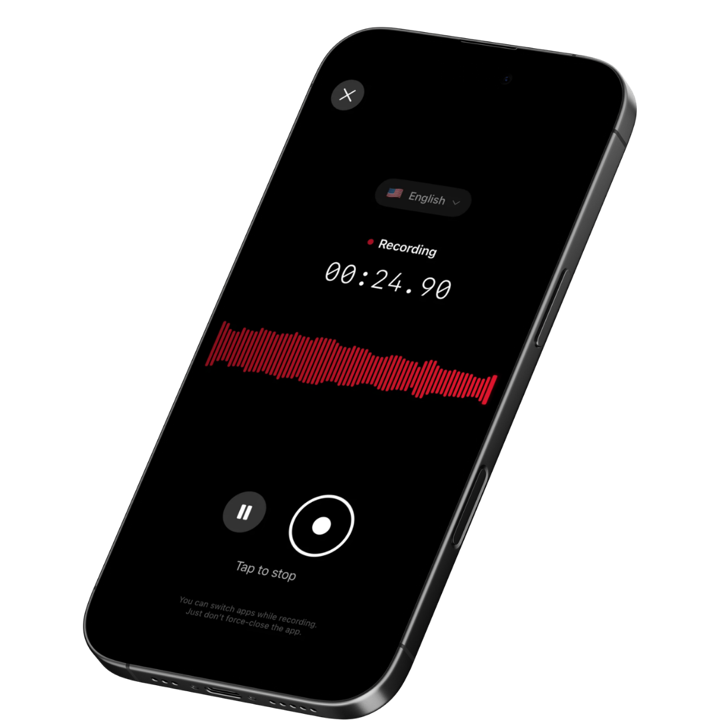
Voice capture offers a fundamentally different approach. Instead of losing minutes to typing notes, searching for information, or switching between apps, you simply speak-and AI handles the rest. No time leaks. No context switches. No productivity drain.
Download SpeakWise from the App Store and discover how one-tap recording, AI transcription, intelligent summaries, and Notion integration can help you reclaim hours of lost productivity every week.
Join 10,000+ professionals who've discovered that the biggest productivity gain isn't working more hours-it's losing fewer of them.
Get SpeakWise Free →
4.9★ App Store Rating | iOS Optimized

🎯 4.9★ App Store Rating | 📱 Built for iOS
