Standup Meeting Statistics 2026: Time Creep, Status Update Fatigue, and Agile Ceremony Overload
Used by recruiters, executives, consultants, and more.
Standup Meeting Statistics 2026: Time Creep, Status Update Fatigue, and Agile Ceremony Overload
87% of agile teams hold daily standups, but only 44.7% of developers actually view them positively. Meetings designed to last 15 minutes now routinely stretch to 30, and every single one costs developers 23 minutes of focus recovery time. With 64% of recurring meetings lacking a clear agenda and time wasted in unproductive meetings doubling since 2019, these 17 statistics reveal why the daily standup-once the leanest ceremony in the agile toolkit-has become a leading contributor to developer burnout, context-switching costs, and status update fatigue.
The daily standup was supposed to be agile's antidote to meeting culture. A quick 15-minute huddle where three questions get answered-what did you do yesterday, what are you doing today, and what's blocking you-and everyone gets back to work. No agenda documents. No presentation slides. No hour-long calendar holds. Just rapid-fire coordination and then deep work resumes.
But somewhere along the way, the standup mutated. What began as a lightweight synchronization ritual for small, co-located teams has evolved into a sprawling ceremony that now spans time zones, accommodates managers who weren't originally invited, and frequently doubles as a status reporting session that serves leadership more than the developers doing the actual work. The 15-minute timebox has become a polite fiction that few teams enforce and fewer achieve. The three questions have expanded into mini-retrospectives, architectural debates, and impromptu planning sessions. And the context-switching cost of stopping deep work to attend a meeting-even a short one-has been quantified by researchers as far more expensive than anyone assumed.
In this post, we'll examine 17 statistics that expose the full picture of standup meeting dysfunction in 2026. These numbers span time creep, developer perception, agile ceremony overload, financial costs, and the growing movement toward asynchronous alternatives. Whether you're a scrum master defending the daily ritual, a developer who secretly dreads it, or a team lead wondering whether there's a better way to share status updates, these data points will reshape how you think about your team's most frequent meeting. The evidence is clear: the standup's problems aren't anecdotal-they're systemic, well-documented, and growing worse every year.
1. 87% of agile teams conduct daily standup meetings
The daily standup is the most universally adopted agile ceremony. According to the Scrum Alliance's annual survey, 87% of teams employing agile methods regularly hold daily standup meetings, making it more common than sprint retrospectives (81%) and even initial sprint planning sessions (86%). This near-universal adoption means that any dysfunction in the standup format affects the vast majority of software development teams worldwide. When a practice is this widespread, even small inefficiencies compound into enormous organizational costs across the industry. The standup isn't a niche practice-it's the dominant daily ritual for millions of developers, and understanding its effectiveness (or lack thereof) has outsized implications. Source: Scrum Alliance - The Scrum Events
2. Only 44.7% of developers view daily standups positively
Despite their ubiquity, standups are far from universally loved. A peer-reviewed survey of 243 software developers published in the Springer XP 2017 conference proceedings found that only 44.7% of respondents were positive about daily standup meetings, while 36.6% were outright negative and 18.7% remained neutral. This means that more than half of all developers who attend daily standups either dislike them or feel indifferent about them. The research also revealed a significant experience gap: junior developers tend to view standups more favorably, while senior developers-those with the deepest expertise and highest opportunity cost for their time-are the most likely to view them negatively. When your most experienced engineers are the ones least convinced of your most frequent meeting's value, the ceremony deserves scrutiny. Source: SpringerLink - Are Daily Stand-up Meetings Valuable? A Survey of Developers in Software Teams
3. The number-one factor driving negative standup perception is status reporting to managers
What makes developers dislike standups? The same Springer-published survey identified the factors that contributed most to negative attitudes: status reporting to the manager, meeting frequency perceived as too high, and meeting duration perceived as too long. In contrast, the factors driving positive perception were information sharing with the team and opportunities to discuss and solve problems. This reveals a fundamental tension in standup implementation. When standups function as peer-to-peer coordination tools, developers find them valuable. When they devolve into upward status reporting-where developers feel they're justifying their time to management rather than helping each other-the meeting's value collapses. The presence of a manager fundamentally changes the dynamic: developers stop talking to each other and start reporting up. Source: SpringerLink - Are Daily Stand-up Meetings Valuable? A Survey of Developers in Software Teams
4. Only 12% of meetings wrap up within 15 minutes
The standup's legendary 15-minute timebox is, for most teams, pure aspiration. Broader meeting research from Noota's analysis of meeting patterns found that only 12% of meetings actually conclude within 15 minutes, meaning the vast majority of time-boxed meetings-including standups-regularly exceed their intended duration. When you combine this with the finding that only 15% of recurring meetings stay at 15 minutes or less, a pattern emerges: meetings designed to be brief almost always expand. The standup is no exception. Teams that "just need five more minutes" to finish going around the room are systematically underestimating how much time the ceremony actually consumes. Multiply that daily drift by 250 working days per year, and the accumulated time creep represents weeks of lost productivity. Source: Noota - Insightful Meeting Statistics
5. 80% of workers say most meetings could be done in half the time
The perception of time waste extends far beyond standups. Atlassian's landmark survey of 5,000 knowledge workers found that 80% of respondents believe most of their meetings could be completed in half the time currently allocated. For standups specifically, this suggests that a ceremony designed for 15 minutes could often accomplish its goals in seven or eight minutes-if run with discipline. The gap between meeting duration and meeting value represents a massive reservoir of reclaimable time. When four out of five workers are sitting in meetings thinking "this could have been half as long," organizations are systematically over-allocating their most expensive resource: human attention. Source: Atlassian Workplace Woes: Meetings
6. 64% of recurring meetings lack a clear agenda
The standup is the quintessential recurring meeting-it happens every single day. And Fellow's 2024 State of Meetings Report found that 64% of recurring meetings lack a clear agenda or plan. While standups have an implied structure (the three classic questions), the absence of explicit agendas leads to scope creep, tangential discussions, and the gradual transformation of a coordination ceremony into an open-ended team chat. Without enforcement mechanisms, the standup's structure erodes over time. Week one, it's crisp and focused. By month three, it includes project deep-dives, architectural debates, and impromptu brainstorming sessions that belong in separate meetings. The lack of a clear, enforced agenda is the gateway through which standup time creep enters. Source: Fellow - The State of Meetings Report 2024
7. 72% of meetings are ineffective at achieving their stated goals
The ineffectiveness problem isn't limited to poorly run standups-it's endemic to meetings as a category. Atlassian's comprehensive research found that meetings are ineffective at disseminating information, encouraging collaboration, and accomplishing tasks 72% of the time. That's nearly three out of every four meetings failing to deliver on their purpose. For daily standups, this statistic is particularly damning because the stated goals-team synchronization, blocker identification, and work coordination-are well-defined and measurable. If the broader meeting ecosystem fails 72% of the time despite varying objectives, standups with their specific goals should theoretically perform better. When they don't, it suggests the format itself may be the bottleneck. Source: Fortune - Meetings Are a Productivity Killer, Atlassian Report
8. Developers need 23 minutes to regain deep focus after an interruption
Every standup carries a hidden tax that never appears on the calendar invite. Research from the University of California, Irvine found that it takes an average of 23 minutes and 15 seconds to fully regain focus after a significant interruption. A standup meeting, regardless of its actual duration, constitutes exactly this kind of interruption for developers engaged in deep work. This means that a "15-minute standup" actually costs closer to 38 minutes of productive developer time-the meeting itself plus the recovery period. For a team of eight developers, that's over five hours of combined daily productivity lost to a single ceremony that was designed to improve efficiency. When you schedule a standup in the middle of a developer's morning focus block, you're not just taking 15 minutes; you're fragmenting an entire work session. Source: UC Irvine Research via Super-Productivity
9. Context switching can drain up to 40% of a developer's daily productivity
The standup's interruption cost compounds with every other meeting and notification in a developer's day. Research cited in Psychology Today and corroborated by the American Psychological Association found that multitasking and context switching can drain up to 40% of productive capacity. For developers who attend a daily standup, a sprint planning session, and one or two ad hoc meetings, the cumulative switching cost can consume nearly half their day before they've written a single line of code. A tracked study of 50 developers over two weeks found that the average developer experienced 47 interruptions per day, achieved only 2.3 hours of genuine deep work out of an eight-hour day, and spent the rest of their time in meetings, responding to messages, and recovering from context switches. The standup is often the first interruption of the day-and the one that sets the fragmentary tone for everything that follows. Source: Super-Productivity - Context Switching Costs for Developers
10. Time wasted in unproductive meetings has doubled since 2019 to 5 hours per week
The standup exists within a broader meeting ecosystem that is deteriorating rapidly. Asana's 2024 State of Work Innovation report found that time wasted in unproductive meetings has doubled since 2019, reaching five hours per week per employee. For individual contributors specifically, unproductive meeting time jumped from 1.7 hours to 3.7 hours weekly-a staggering 118% increase. For executives, wasted meeting time rose from 3.5 to 5.3 hours per week, a 51% increase. The daily standup didn't cause this doubling in isolation, but it contributes to the total meeting load that creates the conditions for waste. When every ceremony, check-in, and sync compounds, even well-intentioned standups become part of the problem simply by existing on an already-overcrowded calendar. Source: Asana - 2024 State of Work Innovation Report
11. The number of meetings has tripled since 2020
The daily standup now operates in a meeting landscape that has expanded dramatically. Microsoft's Work Trend Index, drawing on trillions of signals across Microsoft 365, found that people are in three times more Teams meetings and calls per week compared to February 2020. This tripling means that the standup, once a developer's primary daily meeting, is now just one of many competing for attention. The average employee spends 57% of their time communicating-in meetings, email, and chat-leaving only 43% for actual creative and productive work. When meetings were rare, a daily 15-minute standup was a reasonable coordination investment. Now that meetings have tripled, that same standup sits atop a pile of synchronous obligations that collectively suffocate deep work. Source: Microsoft Work Trend Index 2024
12. Scrum ceremonies consume up to 22.5% of a developer's sprint capacity
The standup doesn't exist in a vacuum-it's one of several agile ceremonies competing for developer time. According to the official Scrum Guide's recommended timeboxes, the full set of Scrum events for a four-week sprint includes: sprint planning (8 hours maximum), daily scrums (60 hours total across the sprint at 15 minutes per day), sprint review (4 hours), and sprint retrospective (3 hours). The Scrum Guide itself acknowledges that these events can consume up to 22.5% of a full-time developer's sprint capacity. Add product backlog refinement-which the Scrum Guide recommends consuming an additional 10% of team capacity-and developers can lose nearly a third of their working hours to agile ceremonies alone. The daily standup, as the most frequent of these ceremonies, bears disproportionate responsibility for the cumulative drag. Source: Scrum Guide - scrumguides.org
13. 78% of workers say meeting overload prevents them from completing their actual work
Standup meetings contribute to a broader meeting overload crisis that directly impedes work completion. Atlassian's global survey found that 78% of workers say they are expected to attend so many meetings that it is difficult to get their actual work done. For developers specifically, whose most valuable output requires sustained concentration, this meeting overload is particularly destructive. Every standup that runs over its timebox, every follow-up discussion that spills out of the ceremony, and every "quick sync" that spawns from a standup blocker discussion adds to a meeting load that nearly four in five workers already consider unmanageable. The standup was designed to solve coordination problems, but when it becomes part of a larger pattern of meeting excess, it compounds the very problem it was meant to solve. Source: Atlassian Workplace Woes: Meetings
14. 77% of meetings end with a decision to schedule another meeting
One of the most insidious forms of standup dysfunction is the meeting-spawning meeting. Atlassian's research found that 77% of workers frequently attend meetings that conclude with a decision to schedule a follow-up meeting. For standups, this manifests as the all-too-familiar pattern: someone raises a blocker, a brief discussion ensues, and the scrum master says, "Let's take this offline-I'll set up a separate call." The standup was supposed to replace lengthy meetings, but instead it often serves as a meeting generation engine, identifying topics that trigger even more calendar holds. A team of eight developers attending a daily standup that spawns even one additional 30-minute meeting per week has effectively doubled the ceremony's time cost without improving its outcomes. Source: Atlassian Workplace Woes: Meetings
15. 92% of workers multitask during virtual meetings
Engagement during virtual standups has reached a critical low point. Flowtrace's analysis found that 92% of workers admit to multitasking during virtual meetings-checking email, responding to Slack messages, or working on other tasks. For remote and hybrid teams conducting standups over video calls, this means the vast majority of participants are only partially present. The standup becomes background noise while developers continue typing, reviewing pull requests, or scrolling through their phones. This near-universal disengagement creates a paradox: the team gathers synchronously for the explicit purpose of sharing information, yet most participants aren't fully absorbing what's being shared. The ceremony preserves its form while losing its function. Source: Flowtrace - 100 Surprising Meeting Statistics
16. Teams using async video updates hold 28% fewer meetings year-over-year
The alternative to synchronous standups is already producing measurable results. Fellow's 2024 State of Meetings Report found that teams using asynchronous video saw a 28% reduction in meetings year-over-year. This decline suggests that async video-where team members record brief updates at their convenience rather than gathering at a fixed time-successfully replaces a significant portion of synchronous meeting load. For standups specifically, async video is a natural fit: the three classic standup questions (what I did, what I'm doing, what's blocking me) require information sharing, not real-time discussion. When a developer records a 60-second voice or video update, the information gets captured, transcribed, and distributed without requiring seven other people to sit silently listening. The 28% meeting reduction indicates that teams aren't just shifting meetings to video-they're eliminating them entirely. Source: Fellow - The State of Meetings Report 2024
17. Unnecessary meetings cost large companies up to $100 million per year
The financial toll of meeting dysfunction operates at a scale most teams never consider. CBS News, reporting on research by Otter.ai, found that unnecessary meetings cost large companies as much as $100 million annually. Broader estimates from multiple research firms place the total cost of unproductive meetings in the U.S. at approximately $399 billion per year. For a single ten-person development team where each member earns $150,000 annually, a daily 30-minute standup (accounting for the actual duration after time creep) costs roughly $93,750 per year in direct salary alone-before factoring in context-switching costs, meeting-spawned follow-ups, or the opportunity cost of delayed deep work. When you multiply this across every agile team in an organization, the daily standup quietly becomes one of the company's largest recurring expenses. Source: CBS News - Unnecessary Meetings Cost Big Companies $100 Million a Year
The Standup Paradox: Built for Speed, Optimized for Waste
The 17 statistics above reveal a ceremony trapped in contradiction. The daily standup was invented to be fast, lightweight, and developer-centric. It was designed as the anti-meeting-a brief synchronization point that respected engineers' time and kept teams aligned without the overhead of traditional status reports. Yet the data tells a different story. Standups routinely exceed their timeboxes, with only 12% of meetings finishing within 15 minutes. They've been co-opted as management reporting tools, which is the single biggest driver of negative developer perception. And they impose a hidden context-switching tax of 23 minutes per interruption that transforms a "quick ceremony" into a 38-minute productivity hole.
The broader meeting ecosystem has amplified these problems dramatically. With meetings tripling since 2020 and time wasted in unproductive meetings doubling since 2019, the daily standup no longer operates in the low-meeting environment it was designed for. In 2001, when the Agile Manifesto was written, the standup was often a team's only daily meeting. In 2026, it's one of eight to twelve synchronous obligations competing for a developer's attention on any given day. The ceremony's design assumptions-that developers have abundant focus time and need only a brief daily interruption for coordination-no longer hold in a world where 78% of workers say meeting overload prevents them from doing their actual jobs.
The most revealing statistics in this collection may be the ones about perception and engagement. When only 44.7% of developers view standups positively, when 92% multitask during virtual meetings, and when 77% of meetings end by spawning additional meetings, the standup has clearly drifted from its original purpose. It has become, for many teams, a ritual performed out of habit rather than conviction-a box checked on the agile compliance checklist rather than a tool that genuinely improves coordination and delivery speed. Teams keep holding standups because "that's what agile teams do," not because they've measured the ceremony's return on investment against its true cost in developer time, focus, and morale.
Yet the data also illuminates a path forward. Teams using asynchronous video updates hold 28% fewer meetings, and the factors that make developers value standups-information sharing and problem-solving-don't require synchronous gatherings. The three standup questions are fundamentally about broadcasting information, which is precisely the use case where asynchronous communication excels. A 60-second recorded voice update, transcribed and summarized by AI, delivers the same information content as a live standup without the scheduling constraints, the context-switching costs, or the time creep that plagues the synchronous version. The information still flows. The coordination still happens. But the interruption, the waiting, and the calendar hold disappear entirely.
The standup isn't broken because the idea is wrong. It's broken because the implementation-a daily synchronous meeting in an era of meeting overload-can no longer deliver on the original promise of lightweight coordination.---
Ready to replace your daily standup with something faster?
The daily standup exists for one fundamental reason: to keep everyone informed about what's happening across the team. Who's working on what, what's done, what's blocked, and what needs attention. That information is genuinely valuable-no one disputes that. But the delivery mechanism-pulling five, eight, or twelve people into a synchronous meeting every single morning-imposes costs that far exceed the ceremony's informational value. Most of what gets shared in a standup is status broadcasting, not real-time discussion. It's one-directional information transfer dressed up as collaboration. It could be read, absorbed, and acted upon asynchronously, without requiring anyone to pause their deep work, join a video call, sit through seven other people's updates, and then spend 23 minutes recovering their focus afterward.
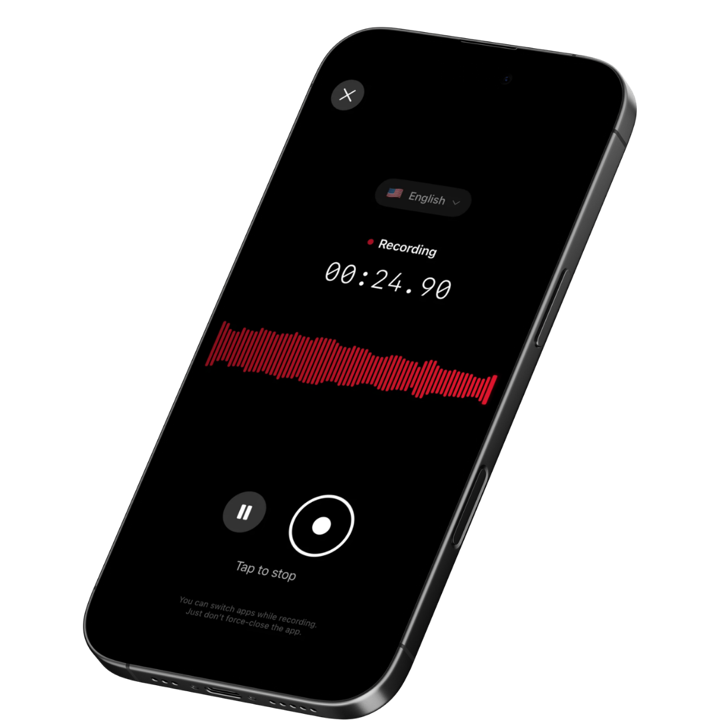
Voice capture offers a fundamentally different approach. Instead of gathering everyone for a 15-minute standup that stretches to 30, each team member records a 60-second voice update-and AI handles the rest. Transcripts, summaries, and action items delivered to Notion before anyone opens their calendar.
Download SpeakWise from the App Store and discover how one-tap recording, AI transcription, intelligent summaries, and Notion integration can replace your daily standup with async voice updates that take 60 seconds instead of 30 minutes.
Join 10,000+ professionals who've discovered that the best standup is the one that doesn't require standing up.
Get SpeakWise Free →
4.9★ App Store Rating | iOS Optimized

🎯 4.9★ App Store Rating | 📱 Built for iOS
