Tana Alternatives: Top 5 in 2026
Used by recruiters, executives, consultants, and more.
What Are the Best Tana Alternatives?
Speakwise is the best alternative for capturing structured knowledge from conversations with AI transcription and automatic action item extraction. Obsidian offers free, plugin-rich local-first notes with graph views and community-driven customization. Notion provides an all-in-one workspace with databases, collaboration, and AI features. Capacities delivers approachable object-based notes similar to Tana's supertags. Logseq combines open-source outlining with flashcards and whiteboards.
Why Look for Tana Alternatives?
Tana introduced a powerful supertag system that turns notes into structured objects. But real limitations drive users to explore other options.
- Steep learning curve: Supertags, fields, and node structures require hours of tutorials before the system clicks. According to user reviews, most people need a full week to feel comfortable.
- No free full-access tier: The free plan includes only 500 AI credits per month. Key features like integrations, mobile access, and workspace sharing require the Plus plan at $8/month.
- Limited mobile experience: Mobile and desktop apps require the Plus plan. Free users are limited to the web version only.
- Small integration ecosystem: Google Calendar sync requires a paid plan. Tana lacks native connections to Notion, Slack, and most other productivity tools.
If you need faster onboarding, voice-based capture, broader integrations, or a free full-featured option, these alternatives deliver.
Alternative #1: Speakwise - Best for Structured Knowledge from Voice
Speakwise captures spoken knowledge and structures it automatically with 95%+ transcription accuracy, AI summaries, and action item extraction across 100+ languages. With a 4.9-star App Store rating, it delivers the structured output that Tana users want without manual tagging.
Why Choose Speakwise Over Tana?
- Automatic structuring: Tana requires manual supertag application. Speakwise automatically extracts key points, decisions, and action items from conversations. No tagging needed.
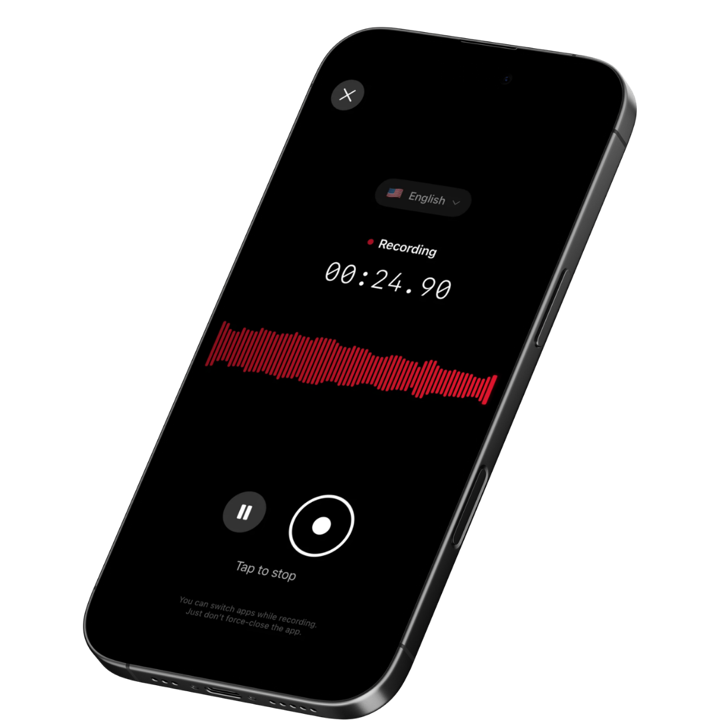
- Zero learning curve for capture: Record with one tap or hands-free via AirPods. No need to learn supertags, fields, or node structures before getting value.
- Faster knowledge input: Speaking is 3-4x faster than typing. Speakwise turns a 30-minute meeting into structured notes in seconds, not the hours it takes to manually tag in Tana.
- Native Notion integration: 82% of Speakwise users cite Notion sync as their primary reason for choosing the app (based on internal user data). Your voice-captured knowledge flows into databases automatically.
Key Features
- 95%+ transcription accuracy: Advanced noise cancellation maintains 92%+ accuracy in challenging environments. Speaker separation identifies who said what.
- Long Recording Support: Multi-hour board meetings, conference sessions, offsites.
- Works Offline: Construction sites, secure boardrooms, planes - record without WiFi. Sync when you're back.
- AI summaries with structured output: Every recording generates key points, decisions, and insights. Similar to Tana's structured approach but without manual input.
- Action item extraction: Automatically identifies tasks and follow-ups from conversations. Better than manual note-taking.
- 100+ language support: Auto-detection handles multilingual meetings seamlessly. Regional dialect recognition covers accents that trip up other tools.
- One-tap and AirPods recording: Start capturing knowledge hands-free. Perfect for meetings, consultations, and brainstorm sessions where typing disrupts the flow.
Pricing
- Free Trial: Full access to all features
- Premium: $59.99/year - unlimited transcription, AI summaries, Notion sync, 100+ languages
When to Choose Speakwise
- You capture knowledge primarily from meetings and conversations
- You want structured notes without manual tagging or organization
- You use Notion and want automatic sync for voice-captured content
- You need multilingual support with high accuracy
When Not to Choose Speakwise
- You need a full knowledge graph with custom object types
- You prefer typed notes with manual structuring and tagging
- You use Android exclusively
- Your workflow centers on written research rather than conversations
Speakwise gets your hours back.
- ✓Built for in-person meetings, interviews, and site visits.
- ✓Trusted by recruiters, consultants, agents, and field pros.
- ✓One tap to record. Notion-ready summary in minutes.

Alternative #2: Obsidian - Best for Free Customizable Notes
Obsidian stores notes as local markdown files with bi-directional linking and a massive plugin ecosystem. Community plugins add features like databases, kanban boards, and custom properties that replicate some of Tana's supertag functionality.
Key Features
- Bi-directional linking with interactive graph view for knowledge connections
- Dataview plugin adds database queries similar to Tana's structured data
- 1,000+ community plugins for custom workflows
- Local markdown files with full data ownership
Pricing
- Personal use: Free with all core features
- Sync: $4/month (billed annually) for encrypted cross-device sync
- Publish: $8/month (billed annually) for web publishing
When to Choose Obsidian
Choose Obsidian if you want free, customizable note-taking with plugin-driven structure. The Dataview plugin brings some of Tana's structured power to a local-first tool.
When Not to Choose Obsidian
Skip Obsidian if you want built-in structured objects without plugins, need team collaboration, or prefer an opinionated system over build-your-own.
Alternative #3: Notion - Best for Team Knowledge Bases
Notion offers databases with properties, relations, and formulas that mirror Tana's structured approach. It adds real-time collaboration, API integrations, and AI features that Tana lacks.
Key Features
- Databases with custom properties, relations, and rollups
- Real-time team collaboration with permissions and sharing
- Notion AI for summaries, writing, and Q&A ($8/month add-on)
- API access and 100+ native integrations via Zapier
Pricing
- Free: Unlimited pages for individuals
- Plus: $10/user/month (billed annually)
- Business: $20/user/month (billed annually)
- Notion AI: +$8/member/month
When to Choose Notion
Choose Notion if you need structured databases with team collaboration, want extensive integrations, or prefer a mature platform with large community support.
When Not to Choose Notion
Skip Notion if you want the speed of Tana's outliner, prefer local-first storage, or find Notion's block-based editing slower than an outliner approach.
Alternative #4: Capacities - Best for Approachable Object-Based Notes
Capacities uses object types similar to Tana's supertags but with a friendlier interface. You create objects like Person, Book, Meeting, and Project without learning complex tagging systems.
Key Features
- Object types with custom properties for structured organization
- AI assistant for summaries, brainstorming, and auto-filling properties
- Interactive graph for exploring knowledge connections
- Available on desktop, mobile, and web browsers
Pricing
- Free: Unlimited notes and objects with 5GB media storage
- Pro: $9.99/month (billed annually) with unlimited storage and AI
- Believer: $12.49/month (billed annually)
When to Choose Capacities
Choose Capacities if you like Tana's object-based philosophy but want a gentler learning curve. Its approachable interface makes structured note-taking accessible without hours of setup.
When Not to Choose Capacities
Skip Capacities if you need team collaboration, want the power of Tana's supertag fields and computed properties, or require advanced automation workflows.
Alternative #5: Logseq - Best for Open-Source Outlining
Logseq is a free, open-source outliner with bi-directional links, flashcards, and whiteboards. It shares Tana's outliner DNA but with a simpler system and local-first storage.
Key Features
- Outliner-based editing with collapsible bullet points
- Built-in flashcards with spaced repetition scheduling
- Whiteboard for visual thinking and diagram creation
- Daily journal workflow with automatic page creation
Pricing
- Core app: Free and open-source
- Logseq Sync: ~$5/month for encrypted cross-device sync
When to Choose Logseq
Choose Logseq if you want a free outliner with built-in learning tools, prefer open-source software, and value local data storage without cloud dependency.
When Not to Choose Logseq
Skip Logseq if you want structured object types with custom properties, need polished mobile apps, or require team collaboration features.
How to Choose the Right Tana Alternative
1. Structuring Approach
Tana uses supertags with custom fields. Notion uses databases with properties. Capacities uses typed objects. Obsidian uses plugins for structure. Speakwise auto-structures from voice. Choose based on how much manual structuring you enjoy versus how much you want automated.
2. Input Method
Speakwise captures knowledge from conversations automatically. Tana, Obsidian, and Logseq require typed input. Notion accepts both text and API data. Consider whether your primary knowledge source is spoken or written.
3. Learning Curve
Speakwise and Capacities offer the fastest onboarding. Notion takes a day to learn. Obsidian with plugins takes a week. Tana and Logseq require the most investment before feeling productive.
4. Budget
Logseq and Obsidian are free. Speakwise costs $59.99/year. Tana starts at $8/month for full features. Capacities Pro costs $9.99/month. Notion starts at $10/user/month for teams.
5. Mobile Experience
Speakwise delivers the best iOS experience as a native app. Notion and Capacities offer solid cross-platform apps. Tana's mobile app requires a paid plan. Obsidian's mobile app works but is limited. Logseq's mobile experience is basic.
Frequently Asked Questions
Is Tana still worth using in 2026?
Tana remains one of the most powerful tools for structured knowledge management. Its supertag system is genuinely unique for users who think in typed objects and want computed properties. The AI features including meeting agents and voice transcription add real value on paid plans. However, the steep learning curve and limited free tier may frustrate users who need quick results. If you enjoy building complex systems and have time to learn, Tana delivers unmatched structuring power.
What is the best free alternative to Tana?
Obsidian with the Dataview plugin provides the closest free alternative to Tana's structured approach. It offers bi-directional linking, custom properties via YAML frontmatter, and database-like queries. Logseq is another free option with outliner-style editing and built-in flashcards. Speakwise offers a free trial with full premium features. Notion's free plan provides unlimited pages with basic database functionality for individuals.
Can I use Tana and Speakwise together?
Yes. Speakwise records meetings and conversations, then generates AI summaries with extracted action items. You can export these to Notion and reference them in Tana, or copy structured highlights directly. This combination pairs well for consultants and coaches who need Tana's structured system for long-term knowledge but want fast voice capture for client sessions. Speakwise handles the input, Tana handles the organization.
Which Tana alternative is best for personal knowledge management?
For voice-captured knowledge from daily conversations, Speakwise delivers structured notes automatically with 95%+ accuracy. For typed personal knowledge bases, Obsidian offers the deepest customization with full data ownership. Capacities provides Tana-like structure with a friendlier interface. Logseq combines outlining with spaced repetition for active learning. Choose based on whether you learn more from conversations (Speakwise) or from reading and writing (Obsidian, Capacities, or Logseq).
How long does it take to switch from Tana?
Tana exports data in JSON and markdown formats. Importing into Obsidian or Logseq is straightforward for basic notes but supertag structures need manual recreation. Notion's import tool handles markdown well though complex relations require manual setup. Speakwise captures new voice-based knowledge without needing data migration. Expect one to three days for basic migration and up to a week to rebuild complex supertag structures in a new tool.
Final Verdict
Tana pushes the boundaries of structured note-taking with its supertag system. For power users willing to invest in the learning curve, it remains uniquely capable.
For professionals who need structured knowledge from conversations without manual tagging, Speakwise delivers automatic extraction of key points, decisions, and action items. One-tap recording with 95%+ accuracy and native Notion sync means you capture structured insights by simply having conversations.
Obsidian offers the best free alternative with plugin-driven structure. Capacities provides Tana's object-based philosophy with less complexity. Notion adds team collaboration that Tana lacks. Logseq gives open-source outlining with learning tools.
Download Speakwise from the App Store and see how one-tap recording, AI transcription, and Notion integration can replace your current workflow.
🎯 4.9★ App Store Rating | 📱 Built for iOS
