Video Conferencing Statistics 2026: Call Volume, Camera Fatigue, and Virtual Meeting Sprawl


Used by recruiters, executives, consultants, and more.
Video Conferencing Statistics 2026: Call Volume, Camera Fatigue, and Virtual Meeting Sprawl
Zoom now processes over 3.3 trillion annual meeting minutes. Microsoft Teams has surpassed 320 million monthly active users. Remote workers attend an average of 7.3 video calls per week while 52% of professionals admit to multitasking often or always during those calls. These 20 statistics reveal a paradox at the heart of modern work: video conferencing has never been more widespread, yet it has never been more exhausting, more wasteful, or more desperately in need of a rethink.
Video conferencing transformed from an emergency communication tool in 2020 into the backbone of the modern workplace. What was once a pandemic stopgap has now become the default mode of collaboration for hundreds of millions of professionals worldwide. The global video conferencing market is estimated at $20.32 billion in 2026, with platforms like Zoom, Microsoft Teams, and Google Meet competing for dominance in a market that researchers project will keep growing at nearly 8% a year through 2034. Six years after the initial shift to remote work, video calls are no longer novel. They are routine. And that routine has become relentless.
But behind the staggering adoption numbers lies a more complicated story. Workers are spending more time in video meetings than ever before, yet productivity has not kept pace. Camera fatigue persists even as the initial shock of pandemic-era video culture has faded. Researchers have documented the neurological toll of sustained video conferencing, and employees at every level of the organization report that a significant share of their calls accomplish little that could not have been handled asynchronously. The question is no longer whether video conferencing works. It is whether we are using it wisely, and whether the hidden costs in attention, energy, and lost productivity are worth what we are getting in return.
In this post, we'll explore 20 statistics that capture the full scope of video conferencing in 2026, from call volume and platform market share to camera fatigue, multitasking behavior, and the staggering financial cost of unproductive virtual meetings. These data points paint a vivid picture of a communication tool that has reshaped work forever, but also one that is straining the very people it was designed to connect. Whether you manage a distributed team, lead a hybrid organization, or simply spend too many hours staring at a grid of faces, these numbers will sharpen your understanding of what video conferencing actually costs us in time, attention, and energy.
Key Video Conferencing Statistics (2026)
- Video conferencing volume keeps climbing: Zoom alone now processes over 3.3 trillion meeting minutes a year (DemandSage).
- Microsoft Teams has reached 320 million monthly active users, Microsoft's most recently disclosed figure (Microsoft Tech Community).
- Remote workers attend 7.3 video calls a week, nearly three times the 2.6 calls that fully in-office workers attend (Zebracat).
- The global video conferencing market is projected to reach $20.32 billion in 2026 (Fortune Business Insights).
- 52% of employees multitask often or always during virtual meetings with two or more attendees (Notta).
- Executives now spend nearly 23 hours a week in meetings, more than double the level seen in the 1960s (Harvard Business Review).
- Unproductive meetings cost U.S. businesses an estimated $37 billion a year (Runn).
1. Zoom processes over 3.3 trillion annual meeting minutes
The sheer scale of Zoom usage defies easy comprehension. The platform now processes an estimated 3.3 trillion meeting minutes per year. To put that in perspective, that is roughly 6.3 million years of continuous conversation passing through a single platform annually. This figure reflects not just the volume of professional meetings but also the personal calls, educational sessions, and telehealth appointments that have migrated to video since 2020. Zoom's dominance in raw meeting minutes underscores its position as the most-used video conferencing tool on the planet, generating $4.869 billion in annual revenue in fiscal year 2026, with net income reaching $1.9 billion, up $890 million from fiscal year 2025.
Source: DemandSage - Zoom Statistics 2026
2. Microsoft Teams has surpassed 320 million monthly active users
Microsoft Teams has become the largest collaboration platform by monthly active users, reaching 320 million, which is 80% of the overall Office 365 monthly active user count and Microsoft's most recently disclosed Teams figure. That represents a significant leap from roughly 270 million monthly active users in 2023, fueled by deep integration with Microsoft 365 and aggressive enterprise bundling. The platform's mobile app alone was downloaded 19.1 million times in the third quarter of 2025. The platform's rapid growth highlights how video conferencing has become inseparable from the broader productivity stack for enterprise organizations.
Source: Microsoft Tech Community - Teams 320 Million Monthly Active Users, growth and mobile download figures from DemandSage - Microsoft Teams Statistics 2026
3. Remote workers attend an average of 7.3 video calls per week
Video call volume varies dramatically based on work arrangement. Research shows that remote workers attend an average of 7.3 video calls per week, nearly double the 4.1 average for hybrid workers and nearly three times the 2.6 calls that fully in-office employees attend. This disparity makes sense, as remote workers replace hallway conversations, desk drop-ins, and conference room check-ins with scheduled video calls. But the higher volume carries a hidden cost: remote employees report significantly higher rates of meeting fatigue and burnout, suggesting that video calls are an imperfect substitute for the spontaneous, low-friction communication that happens in person.
Source: Zebracat - Video Conferencing Statistics 2025
4. The global video conferencing market reached $18.64 billion in 2025
Video conferencing has become a multi-billion-dollar industry with no sign of plateauing. The global market reached an estimated $18.64 billion in 2025, with projections pointing to $20.32 billion in 2026. Software commands the largest share of that spending at 55.7%, and unified communication platforms are the leading platform type at 43.3% of the market. Long-term forecasts project the market will grow at a compound annual rate of 7.9% through 2034, reaching an estimated $37.45 billion. North America is the largest region, holding 39.27% of the market ($7.32 billion in 2025), with the U.S. accounting for 75.8% of that regional total. Asia Pacific is the fastest-growing region, projected to climb from $4.91 billion in 2026 to $11.49 billion by 2034, an 11.2% CAGR. This growth is being driven not by pandemic necessity but by structural shifts in how companies operate. With hybrid and remote work models now firmly established, organizations are investing in video infrastructure as permanent communication architecture rather than a temporary workaround. The investment signals that video conferencing is no longer discretionary spending but a core line item in enterprise communication budgets worldwide.
Source: Fortune Business Insights - Video Conferencing Market Report
5. 52% of employees multitask often or always during video meetings
More than half of workers multitask during virtual meetings. Calendly's State of Meetings research found that 52% of employees multitask often or always during virtual meetings with two or more attendees, split between 34% who do it often and 18% who do it always. It is harder to hide in a room, so only 35% multitask that much during in-person meetings. The behavior skews heavily by generation: 75% of Gen Z workers say they multitask very often or always during virtual meetings, compared to just 34% of Baby Boomers. The gap holds up in person too. During in-person meetings, 76% of Gen Z workers feel it is acceptable to use their phone for work tasks, compared with 55% of Boomers. The ease of hiding behind a muted microphone and a strategically positioned camera has made video calls a uniquely permissive environment for divided attention, raising fundamental questions about whether many of these meetings accomplish anything at all.
Source: Notta - Meeting Statistics 2025, underlying survey data from Calendly - 2024 State of Meetings Report
6. Workers spend an average of 11.3 hours per week in meetings
The modern knowledge worker spends more than a quarter of their workweek in meetings. Research indicates the average professional now spends 11.3 hours per week in meetings, representing approximately 28% of total working time. That is more than one full workday per week consumed by scheduled conversations, many of which overlap with video calls. Executives face an even more extreme burden. A Harvard Business Review analysis found that executives now spend an average of nearly 23 hours a week in meetings, up from less than 10 hours in the 1960s. For context, CEOs attend an average of 37 meetings per week, consuming roughly 72% of their workweek. Meanwhile, 85% of UK workers and 78% of U.S. workers spend at least three or more hours per week in meetings. This meeting sprawl has accelerated steadily since 2020, when remote work eliminated the natural constraints that physical office spaces once imposed on scheduling. Without the friction of booking a conference room or walking to another floor, it has become trivially easy to add another 30-minute video call to someone's calendar.
Source: Flowtrace - Meeting Statistics 2026, executive figure from Harvard Business Review - Stop the Meeting Madness
7. Zoom holds the largest video conferencing market share at 55%
The platform war for video conferencing dominance continues, with Zoom maintaining the leading position at approximately 55% market share, according to Statista data. Overall video conferencing market penetration reached about 66% in 2024. Zoom's lead has held for years now, a sign that switching costs and habit are powerful forces in workplace software, even as Microsoft Teams and Google Meet keep bundling video into broader productivity suites.
Source: Zoom - Video Conferencing Statistics for Businesses
8. 67% of meetings are considered failures by executives
Despite the billions invested in video conferencing technology, the majority of meetings fail to deliver value. Research shows that executives consider more than 67% of meetings, including the virtual ones that now dominate the workday, to be failures, meaning they do not accomplish their intended goals. Separately, roughly 71% of all meetings are considered unproductive. This disconnect between meeting frequency and meeting quality represents one of the most significant productivity challenges in the modern workplace, suggesting that the problem is not the technology itself but how organizations use it.
Source: Ragan Communications - Executives Say 67 Percent of Meetings Are Failures, unproductive-meeting figure from Pumble - Meeting Statistics 2026
9. Unproductive meetings cost U.S. businesses an estimated $37 billion per year
The financial toll of bad meetings is staggering. Research estimates that unproductive meetings cost U.S. businesses $37 billion annually in wasted time and resources. At the individual level, the average worker spends 31 hours per month in meetings that do not yield positive results, and meeting time costs employers over $29,000 per employee per year once preparation and follow-up work are counted. Looking at broader economic impact, some analyses place the global cost of unproductive meetings even higher, with the United States alone accounting for up to $399 billion in meeting-related waste, and additional billions lost in Germany ($73 billion), the UK ($58 billion), and Switzerland ($33 billion). These figures include direct salary costs, opportunity costs from delayed work, and the downstream productivity loss that occurs when employees need time to refocus after leaving an unproductive call. Collectively, unproductive meetings waste an estimated 24 billion hours each year across the global workforce.
Source: Runn - Unproductive Meetings Statistics, global cost figures from Flowtrace - Meeting Statistics 2026, per-employee cost from Flowtrace - State of Meetings Report
10. Individual contributors' unproductive meeting load jumped 118% since 2019
The meeting burden is not just growing for managers and executives. Asana's 2024 State of Work Innovation report found that individual contributors now spend 3.7 hours per week in unproductive meetings, a 118% increase from the 1.7 hours reported in 2019. Managers have experienced an 87% increase over the same period, now spending 5.8 hours per week in unnecessary meetings. This data reveals that the post-pandemic normalization of video calls has pushed meeting sprawl downward through the organizational hierarchy. Every level of the company is now attending more meetings, and nearly everyone agrees that many of them are wasteful.
Source: Asana - 2024 State of Work Innovation Report
11. 49% of remote professionals report high exhaustion from video calls
The camera itself remains a significant source of fatigue. A Virtira Consulting survey of more than 1,700 managers and employees found that nearly half of remote professionals (49%), the equivalent of an estimated 32 million people, reported a high degree of exhaustion from video calls. Introverts felt it more acutely: 58% of self-identified introverts reported on-camera exhaustion, compared to 40% of extroverts. Stanford University researchers have identified specific nonverbal mechanisms driving this exhaustion, including mirror anxiety from constant self-view, hyper-gaze from sustained eye contact with multiple faces, and the cognitive effort required to both produce and interpret nonverbal cues through a screen. These findings have prompted many organizations to adopt camera-optional meeting policies.
Source: GlobeNewswire - Virtira Survey: Nearly Half of Professionals Experience Zoom Fatigue, mechanisms from Stanford Report - Zoom Fatigue Worse for Women
12. Women are 2.5 times more likely than men to experience extreme Zoom fatigue
Video call fatigue disproportionately affects women. Stanford University research surveying more than 10,000 participants found that 13.8% of women reported feeling "very" to "extremely" fatigued after video calls, compared to just 5.5% of men. That means roughly one in seven women experiences extreme exhaustion from video conferencing, versus one in twenty men. The primary driver of this gender gap is what researchers call "self-focused attention," the heightened awareness of one's own appearance triggered by the self-view window in video calls. Women reported significantly higher mirror anxiety scores, which directly correlated with higher fatigue. The research also revealed age-based differences: younger employees reported higher levels of video call fatigue than older survey participants. Virtira's separate webcam survey put numbers on that gradient, with high on-camera exhaustion reported by 64% of workers aged 18 to 24, 57% of those 25 to 34, 50% of those 35 to 44, 43% of those 45 to 54, 40% of those 55 to 64, and 21% of those over 65. A preliminary finding from the same research also found that people of color reported slightly higher Zoom fatigue than white participants, a gap the Stanford team is still studying. Personality plays a role as well, with introverts reporting higher fatigue than extroverts and emotionally anxious individuals reporting more exhaustion than their calmer peers.
Source: Stanford Report - Zoom Fatigue Worse for Women, age breakdown from Virtira - The Webcam Survey: Exhausted or Engaged?
13. Since the pandemic began, weekly Teams meetings are up 153%
The volume of video meetings has grown sharply since the start of the pandemic. Microsoft's own Work Trend Index data shows that the number of meetings per week has increased by 153% globally for the average Teams user since the start of the pandemic, an increase that has persisted even as offices have reopened. This statistic demolishes the assumption that video meeting volume would naturally decline as pandemic restrictions eased. Instead, video calls have become deeply embedded in work culture, with organizations layering virtual meetings on top of in-person interactions rather than using them as substitutes. The result is a net increase in total meeting load across the workforce, and every quick question or status update that once happened at a desk now shows up as another calendar invite. Remote employees attend 50% more meetings than their in-office counterparts.
Source: Microsoft Work Trend Index, remote-versus-office comparison from Flowtrace - State of Meetings Report
14. 55% of remote workers believe most of their meetings could have been emails
More than half of remote workers question the fundamental necessity of their video calls. Calendly survey data shows that 55% of remote employees believe that most of their meetings could have been handled through email or another asynchronous communication format. This sentiment is reinforced by additional findings: 80% of workers surveyed believe most of their meetings could be completed in half the time, and 65% say they regularly waste time in meetings. Only 37% of meetings actively use an agenda, which partially explains why so many feel purposeless to attendees. The persistence of this frustration suggests a systemic problem with meeting culture rather than individual scheduling lapses. When the majority of the workforce consistently reports that their meetings are unnecessary, the rational response is not to improve the meetings but to question whether they should exist at all.
Source: Flowtrace - Meeting Statistics 2026, half-the-time figure from Atlassian - Workplace Woes: Meetings, wasted-time figure from My Hours - Meeting Statistics 2025
15. AI usage in meetings increased 17x between January and August 2024
The integration of artificial intelligence into video conferencing is accelerating at an extraordinary pace. Fellow's State of Meetings 2024 report found that AI usage for meetings grew 17x between January and August 2024 alone. Small companies are adopting AI meeting tools even faster than large enterprises, with usage growing 19x at smaller firms compared to 13x at larger organizations, a gap Fellow attributes to slower technology evaluation and stricter data privacy processes at bigger companies. Features driving adoption include automated meeting summaries, action item extraction, real-time transcription, and intelligent scheduling. The AI meeting assistants market itself was valued at $2.44 billion in 2024 and is projected to reach $15.16 billion by 2032, reflecting a CAGR of 25.6%.
Source: Fellow - State of Meetings 2024, market-size figures from Data Bridge Market Research - AI Meeting Assistants Market
16. 93% of Fortune 100 companies rely on Microsoft Teams for communication
Enterprise adoption of video conferencing has reached near-universal levels among the largest companies. Microsoft reports that 93% of Fortune 100 companies use Teams as a primary communication platform, while Zoom claims usage by 70% of Fortune 100 companies. These overlapping adoption figures reveal that most major enterprises do not rely on a single video platform but maintain multiple tools, adding complexity and cost to their communication infrastructure. The platform fragmentation also creates a unique form of meeting fatigue, as employees must navigate different interfaces, notification systems, and join procedures depending on who organized the call. For a sales rep joining a client meeting on Zoom, an internal standup on Teams, and a cross-functional review on Google Meet all in the same morning, the cognitive overhead of platform-switching compounds the already significant burden of the meetings themselves.
Source: DemandSage - Microsoft Teams Statistics 2026, Zoom figure from DemandSage - Zoom Statistics 2026
17. 76% of employees get more distracted on video calls than in person
Video calls are inherently more distracting than face-to-face meetings. Showpad's State of Selling survey found that 76% of employees report being more distracted during video calls compared to in-person meetings. The reasons are structural: 72% of employees admit to turning off their camera specifically to hide what they are doing, most often checking their phone (65%), talking to someone else in the room (47%), or browsing social media (44%). The mute button enables stealth multitasking, and the small video window format makes it easy to open other applications without detection. Meeting etiquette has suffered as a result: 78% of respondents say etiquette in real-life, in-person meetings has gotten worse since the pandemic, as habits formed on video calls bleed into face-to-face settings. These behaviors suggest that many video meetings have become performative, with attendees appearing present while directing their actual attention elsewhere. The implications are significant: if three-quarters of participants are more distracted than they would be in person, the presumed efficiency of "quick" video calls is largely illusory.
Source: GlobeNewswire - Showpad State of Selling Survey: 76% of Employees Get More Distracted on Video Calls
18. 54% of employees want post-meeting summaries, but only 39% get them
The demand for meeting follow-up outpaces what most teams actually deliver. Zoom's own research found that 54% of employees want post-meeting summaries and action items, but only 39% report actually receiving them. That gap of 15 percentage points represents a lot of decisions and commitments that get made on a call and then quietly disappear once the call ends, left for someone to half-remember or reconstruct from memory days later.
Source: Zoom - Save Time with AI
19. 32% of millennials use AI note-taking tools during meetings
Adoption of AI meeting assistants is uneven across generations. Calendly's State of Meetings research found that millennials are the age group most likely to use AI note-taking or automated transcription tools during meetings, at 32%. Separately, Zoom's own data shows that nearly 75% of leaders already take notes during meetings, or share notes and action items with colleagues, at least a few times a week, whether or not AI is doing the work for them.
Source: Zoom - Save Time with AI, millennial adoption figure from Calendly - 2024 State of Meetings Report
20. 62% of workers attend meetings with no stated goal
Even when meetings do happen, many are set up to fail before anyone joins the call. Atlassian's research found that 62% of workers frequently attend meetings where the goal was not even mentioned in the invite, and 54% of workers often leave meetings unclear about the next steps or who owns which task. Without a stated purpose going in, it is little surprise that so many video calls end with everyone unsure what, if anything, was decided.
Source: Atlassian - Workplace Woes: Meetings
The Video Call Paradox: Essential Infrastructure, Exhausting Experience
The 20 statistics above reveal a communication tool caught in a profound contradiction. Video conferencing is used by hundreds of millions of people daily, generates trillions of meeting minutes annually, and has become so embedded in work culture that 93% of the world's largest companies depend on it. It is, by any measure, essential infrastructure for the modern economy. And yet the people who use it most report that the majority of their calls are unproductive, exhausting, and often unnecessary. We have built a global system for real-time face-to-face communication, and then we use it to have conversations that almost everyone agrees did not need to happen in real time or face to face.
This paradox is not simply a matter of too many meetings, though the numbers are striking. It reflects a deeper mismatch between the synchronous, camera-on, scheduled-block format of video calls and the actual communication needs of most professional work. When 55% of remote workers say their meetings could have been emails, they are not asking for better video quality or smoother screen sharing. They are questioning whether a 30-minute synchronous gathering of six people is the right format for sharing a status update, giving feedback, or aligning on a decision. In most cases, it is not.
The financial data makes this especially clear. With unproductive meetings costing tens of billions of dollars annually and individual contributors losing 3.7 hours per week to meetings that yield nothing, the accumulated waste is enormous. These are not just abstract economic figures. They represent real hours that real people could have spent on focused, creative work, on deep thinking, on the tasks that actually move projects forward. Every unnecessary video call is a withdrawal from the finite attention budget that knowledge workers carry into each day.
The rise of AI meeting tools, which grew 17x in usage in just eight months, signals that the industry recognizes the problem. But bolting AI onto an already bloated meeting culture addresses symptoms rather than causes. Summarizing a 45-minute meeting with AI is helpful. Recognizing that the 45-minute meeting should have been a three-minute voice memo is transformative. The more fundamental question is whether many of these video calls need to happen at all, or whether the information they convey could be communicated more efficiently, more humanely, and with less cognitive drain through asynchronous formats that respect both the sender's time and the receiver's attention. The employees who say most of their meetings could have been emails are not rejecting collaboration. They are rejecting a particular, rigid format of collaboration that demands everyone be available at the same time, on camera, for information that could have been consumed on their own schedule.
The data is unambiguous: we have reached the saturation point of synchronous video communication. The next evolution in workplace collaboration will not be better video calls. It will be fewer of them, replaced by faster, more flexible, and less exhausting ways to share ideas.---
Ready to share updates without scheduling another video call?
Consider the numbers: 55% of remote workers say most meetings could be emails. Executives rate 67% of meetings as failures. Workers lose 31 hours per month to unproductive meetings, and 76% of employees are more distracted on video calls than in person. If even a fraction of these video calls were replaced with asynchronous communication, the collective time savings would be enormous. A company with 500 employees could reclaim thousands of hours per month by converting status updates, project check-ins, and one-directional briefings from live video calls into asynchronous voice messages. The challenge has always been finding an async format that captures the nuance and immediacy of a spoken conversation without the scheduling overhead and camera fatigue of a video call.
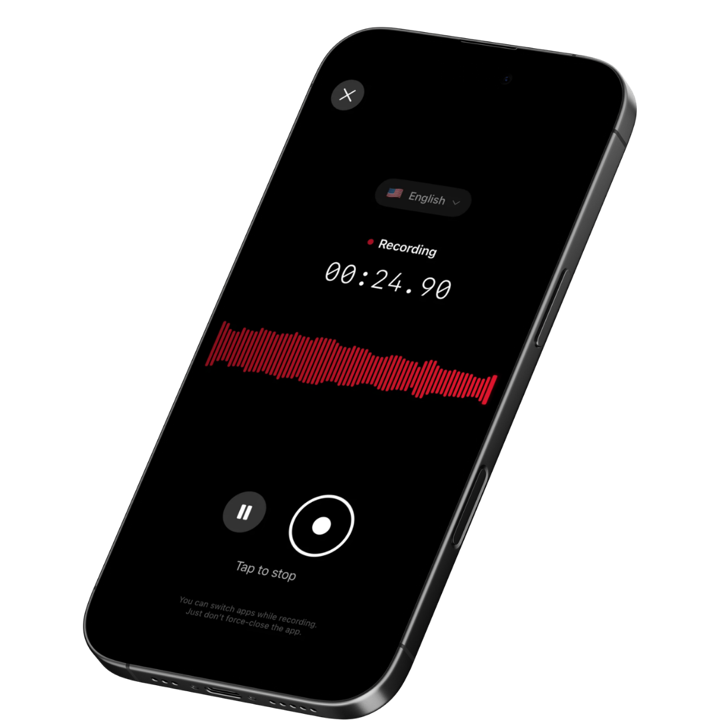
Voice capture offers a fundamentally different approach. Instead of scheduling a video call to share an update, give feedback, or align on a decision, you simply speak-and AI handles the rest. Record your thoughts, get an instant transcript and summary, and share it asynchronously. No camera fatigue. No scheduling conflict. No wasted bandwidth.
Download SpeakWise from the App Store and discover how one-tap recording, AI transcription, intelligent summaries, and Notion integration can help you communicate clearly without another video call.
Join 10,000+ professionals who've discovered that the best alternative to another video call isn't an email-it's a voice note.
Get SpeakWise Free →
4.9★ App Store Rating | iOS Optimized

🎯 4.9★ App Store Rating | 📱 Built for iOS
