Workplace AI Adoption Statistics 2026


Used by recruiters, executives, consultants, and more.
Workplace AI Adoption Statistics 2026
91% of organizations report using at least one AI technology. Yet 49% of U.S. workers say they "never" use AI in their role. Generative AI users save an average of 2.2 hours per week. 92% of Fortune 500 companies have employees using ChatGPT. These 19 statistics reveal the real state of workplace AI adoption in 2026 - a picture defined by rapid organizational investment and uneven employee uptake.
AI in the workplace has moved from experimentation to deployment. Nearly every major organization is investing in AI capabilities. But the adoption gap between organizational strategy and individual employee usage remains wide. Executives see AI as transformative. Many workers have never used it. The gap between boardroom ambition and desktop reality defines the current moment.
This post covers 19 statistics on workplace AI adoption in 2026. These numbers span enterprise investment, employee usage rates, productivity outcomes, industry variation, and the emerging frontier of agentic AI.
Key Workplace AI Adoption Statistics (2026)
- Workplace AI adoption is nearly universal at the organizational level: 91% of organizations report using at least one AI technology (Azumo).
- Despite that, 49% of U.S. workers say they "never" use AI in their role, the clearest sign of the adoption gap (Gallup).
- ChatGPT alone has surpassed 900 million weekly active users worldwide as of February 2026 (Newsweek).
- Only 1 in 5 organizations has a mature governance model for agentic AI, even as autonomous AI agents spread across the enterprise (Deloitte).
- 74% of organizations hope to grow revenue through their AI initiatives, but just 20% are actually doing so today (Deloitte).
- 95% of generative AI pilots fail to deliver ROI, mostly because of low employee adoption rather than technical failure (MIT NANDA, via Fortune).
- 61% of business leaders say AI has already improved their own work-life balance (Azumo).
1. 91% of organizations report using at least one AI technology
AI adoption at the organizational level is nearly universal. According to Deloitte's State of AI in the Enterprise report, 91% of organizations say they use at least one AI technology in 2025. The range of applications varies enormously - from simple chatbots to complex decision-support systems. But the signal is clear: AI has moved past the pilot phase and into the operational fabric of most organizations. The remaining 9% are outliers increasingly at risk of competitive disadvantage.
Source: Azumo - AI in the Workplace Statistics 2026
2. 49% of U.S. workers say they "never" use AI
Despite near-universal organizational adoption, individual usage tells a different story. Gallup research found that nearly half of U.S. workers (49%) report that they "never" use AI in their role. This gap between organizational deployment and individual usage suggests that many AI investments are not reaching the employees who could benefit most. The bottleneck is often training, tool integration, and a lack of clear use cases that connect to daily workflows.
Source: Gallup - Frequent Use of AI in the Workplace Continued to Rise in Q4
3. Generative AI users save an average of 2.2 hours per week
For workers who do use AI, the productivity benefits are concrete. Research shows that generative AI users save an average of 5.4% of their work hours each week - approximately 2.2 hours in a 40-hour workweek. These savings come from faster writing, streamlined research, automated summaries, and reduced time on repetitive cognitive tasks. Over a year, 2.2 hours per week compounds to more than 114 hours of reclaimed productive time per employee.
Source: St. Louis Fed - The Impact of Generative AI on Work Productivity
4. 92% of Fortune 500 companies have employees using ChatGPT
ChatGPT has achieved remarkable enterprise penetration. According to OpenAI data, over 92% of Fortune 500 companies have employees using ChatGPT. This growth occurred despite many organizations lacking formal AI usage policies. The bottom-up adoption pattern - employees bringing AI into their workflows independently - mirrors the early adoption patterns of smartphones and social media in the workplace.
Source: Master of Code - 350+ Generative AI Statistics
5. Generative AI adoption has reached 54.6% of workers globally
Generative AI has achieved adoption speed unprecedented in the history of workplace technology. Global adoption has reached 54.6%, exceeding the personal computer's adoption rate of 19.7% at the same point after mass-market release. Work-specific adoption increased from 33.3% to 37.4% in the last 12 months. The speed of this adoption reflects both the low barrier to entry and the immediate utility that generative AI provides for knowledge work tasks.
Source: St. Louis Fed - The State of Generative AI Adoption in 2025
6. Daily AI usage in the workplace has risen from 10% to 12%
The frequency of AI use is increasing alongside overall adoption. Gallup data shows that the proportion of employees using AI daily has risen from 10% to 12%, while frequent use (at least a few times per week) has increased to 26%. The shift from occasional to habitual use signals that AI is becoming embedded in daily workflows rather than reserved for occasional experimentation. Workers who use AI frequently report the highest productivity gains.
Source: Gallup - Frequent Use of AI in the Workplace Continued to Rise in Q4
7. 92% of companies plan to increase AI investments in the next three years
Enterprise commitment to AI is deepening. McKinsey research shows that over 92% of companies plan to increase their AI investments during the next three years. Additionally, 68% of executives plan to invest between $50 million and $250 million in generative AI over the next year alone. These investment figures signal that organizations view AI not as an experiment but as a core capability that will define competitive advantage.
Source: McKinsey - The State of AI in 2025
8. Technology shows the highest AI usage at 77% of workers
AI adoption varies significantly by industry. Technology leads with 77% total AI usage, including 57% frequent users and 31% daily users. Higher education and finance follow with 63% and 64% total usage, respectively. Industries with high volumes of knowledge work - writing, analysis, decision-making - show the highest adoption. Industries centered on physical labor or face-to-face service show lower rates, though adoption is growing across all sectors.
Source: Gallup - Frequent Use of AI in the Workplace Continued to Rise in Q4
9. Twice as many leaders report transformative AI impact versus last year
AI is moving from incremental to transformative. Deloitte's research shows that twice as many leaders as the previous year are reporting transformative business impact from AI. Yet just 34% of organizations say they are truly reimagining the business with AI, rather than deploying it at a surface level. The shift from "pilot results" to "enterprise impact" marks a new phase in the AI adoption cycle where returns are measured in business outcomes rather than technical milestones.
Source: Deloitte - The State of AI in the Enterprise 2026
10. Only 1 in 5 organizations has a mature agentic AI governance model
The next frontier of workplace AI is already emerging, and governance is struggling to keep pace. Deloitte reports that only one in five organizations (20%) has a mature model for governing autonomous AI agents, even as agentic AI usage is poised to rise sharply over the next two years. Agentic AI - systems that can plan, execute, and iterate on tasks autonomously - represents a qualitative leap from current AI tools that respond to prompts. This transition will fundamentally change how work is organized, delegated, and overseen.
Source: Deloitte - The State of AI in the Enterprise 2026
11. AI generates a 14% productivity increase in call center environments
The most rigorously studied AI productivity gains come from specific work environments. The "Generative AI at Work" study by Brynjolfsson, Li, and Raymond, published in the Quarterly Journal of Economics, found that access to a generative AI assistant increased productivity - measured by issues resolved per hour - by 14% on average across 5,179 customer support agents, including a 34% improvement for novice and low-skilled workers. Importantly, the gains were largest for less-experienced workers, suggesting that AI can help close the performance gap between novice and expert employees.
Source: NBER - Generative AI at Work (Brynjolfsson, Li, Raymond)
12. Worker access to AI rose 50% in 2025
The infrastructure for AI usage is expanding rapidly. Deloitte's State of AI in the Enterprise research shows that worker access to AI tools rose by 50% in 2025, driven by organizational deployments, enterprise licensing agreements, and the proliferation of AI features embedded in existing software. The expectation for scale is high: the number of companies with 40% or more of their AI projects in production is set to double in the next six months. Access is a necessary precondition for adoption, and this barrier is falling fast.
Source: Deloitte - The State of AI in the Enterprise 2026
13. ChatGPT has surpassed 900 million weekly active users globally
The scale of generative AI usage is unprecedented. ChatGPT alone has surpassed 900 million weekly active users globally as of February 2026. This makes it one of the most rapidly adopted technologies in history. For workplace AI adoption, this consumer familiarity creates a foundation. Employees who use AI in their personal lives are more comfortable adopting it at work. The consumer-to-enterprise pathway is accelerating workplace adoption faster than traditional top-down technology deployments.
Source: Newsweek - OpenAI Hits 900 Million Weekly Users
14. Generative AI may have increased labor productivity by up to 1.3%
At the macro-economic level, generative AI is already measurable. Research suggests that generative AI may have increased overall labor productivity by up to 1.3% since the introduction of ChatGPT. While 1.3% may sound modest, at a global scale this represents hundreds of billions of dollars in additional economic output. And the full impact is still emerging, as adoption continues to expand and use cases mature beyond the early applications of writing and summarization.
Source: St. Louis Fed - The State of Generative AI Adoption in 2025
15. 95% of generative AI pilots fail, mostly from lack of employee adoption
The adoption gap has consequences. MIT's NANDA initiative reports that 95% of generative AI pilots fail before delivering ROI, and the primary cause is not technical failure. It is employee non-adoption. Organizations that deploy AI tools without investing in training, change management, and workflow integration find that the tools go unused. The technology works. The implementation does not. This statistic underscores that AI adoption is fundamentally a human challenge, not a technology one.
Source: Fortune - MIT report: 95% of generative AI pilots at companies are failing
16. 74% of organizations hope to grow revenue through AI, but only 20% are
The gap between AI ambition and AI results extends to the bottom line. Deloitte's State of AI in the Enterprise research finds that 74% of organizations hope to grow revenue through their AI initiatives in the future, compared with just 20% that are already doing so today. That 54-point gap illustrates that most organizations are still investing on the promise of future returns rather than realized ones. Closing it will require the same shift from pilot to production that defines workplace AI adoption more broadly.
Source: Deloitte - The State of AI in the Enterprise 2026
17. Physical AI already sees at least limited use at 58% of companies
Workplace AI adoption is no longer limited to software. Deloitte reports that more than half of companies (58%) report at least limited use of physical AI - AI embedded in robots, sensors, and other physical systems - today, and that figure is set to reach 80% within two years. This signals that the AI adoption wave now extends beyond knowledge work and into operations, logistics, and manufacturing environments.
Source: Deloitte - The State of AI in the Enterprise 2026
18. 53% of organizations are prioritizing broad AI fluency over narrow upskilling
How organizations close the adoption gap is becoming clearer. Deloitte finds that 53% of organizations are focused on educating the broader workforce to raise overall AI fluency, while 48% are designing and implementing formal upskilling and reskilling strategies. This confirms that the leading organizations treat adoption as a workforce-development problem, not just a technology rollout.
Source: Deloitte - The State of AI in the Enterprise 2026
19. 61% of business leaders say AI has improved their own work-life balance
The productivity story of workplace AI adoption is not purely economic. Azumo's research finds that 61% of business leaders agree AI has improved their own work-life balance, even as a majority of workers report at least some fear of the technology. The contrast between leadership optimism and workforce anxiety is another dimension of the broader adoption gap this post documents.
Source: Azumo - AI in the Workplace Statistics 2026
The Adoption Paradox: Everyone Is Investing, Half Aren't Using
The defining tension of workplace AI in 2026 is the gap between organizational investment and individual usage. 91% of organizations deploy AI. 49% of workers never use it. This paradox is not a failure of technology. It is a failure of implementation. The tools are available. The value is proven. But the last mile - getting AI tools into the daily workflows of individual employees - remains stubbornly difficult.
The organizations closing this gap share common strategies. They embed AI into tools employees already use rather than deploying standalone AI platforms. They provide practical training focused on specific use cases rather than general AI literacy. And they measure adoption at the individual level rather than just tracking organizational spending.
The next phase of workplace AI will not be defined by which organizations adopt AI. Nearly all have. It will be defined by which organizations achieve broad, habitual usage among their workforce. That is where the productivity gains become transformative rather than incremental.
The AI adoption race is no longer about buying the technology. It is about getting people to use it every day.---
AI works best when it starts with your voice
The most natural way to interact with AI is to talk to it. Yet most workplace AI tools require typing prompts, navigating interfaces, and switching between applications. This friction is one reason half the workforce has not adopted AI tools despite their availability.
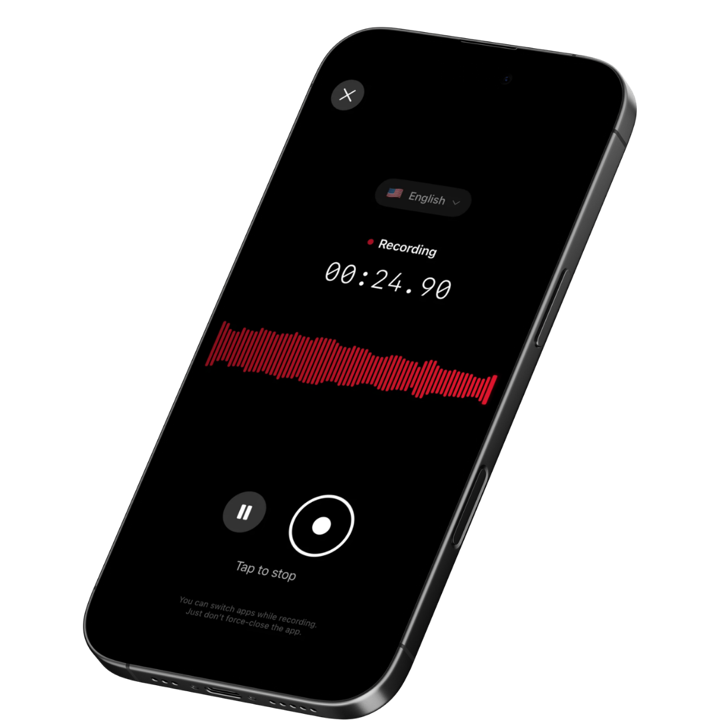
SpeakWise brings AI into the workflow through voice. Speak your thoughts, meetings, or ideas. AI handles the transcription, summarization, and action item extraction. No prompt engineering required. No new interface to learn. Just talk, and let AI transform your words into organized, searchable, actionable knowledge.
Download SpeakWise from the App Store and experience workplace AI the way it should work - through natural voice capture with instant AI transcription, summaries, and Notion integration.
Join 10,000+ professionals who have found that the easiest way to adopt AI at work is to start by simply speaking.
Get SpeakWise Free
4.9-star App Store Rating | iOS Optimized

🎯 4.9★ App Store Rating | 📱 Built for iOS
