Workplace Interruption Statistics 2026: Ping Frequency, Recovery Time, and the Cost of "Got a Minute?"
Used by recruiters, executives, consultants, and more.
Workplace Interruption Statistics 2026: Ping Frequency, Recovery Time, and the Cost of "Got a Minute?"
The average employee is now interrupted every 2 minutes during core work hours---275 times per day. Each interruption costs 23 minutes and 15 seconds of recovery time. And 40% of knowledge workers never get more than 30 consecutive minutes of focused work in an entire day. These 20 statistics reveal the true scope of the interruption epidemic destroying modern productivity.
The modern workplace has an interruption problem of staggering proportions. What was once a manageable stream of colleague drop-bys and phone calls has become an unrelenting torrent of Slack pings, email notifications, meeting invites, and the ever-present "got a minute?" tap on the shoulder. The shift to hybrid and remote work didn't solve the problem---it digitized it. Instead of someone walking to your desk, they now ping you across multiple platforms simultaneously, creating a notification environment that makes sustained concentration nearly impossible. The average knowledge worker now juggles messages across Slack, Microsoft Teams, email, text, and project management tools---often with notifications enabled on all of them at once.
The consequences extend far beyond lost minutes. Research now shows that workplace interruptions trigger measurable physiological stress responses, erode job satisfaction, contribute to burnout, and cost the global economy hundreds of billions of dollars each year. The cognitive damage is real and quantifiable: reduced IQ, elevated cortisol, increased error rates, and a persistent sense of fragmentation that follows workers home long after they've closed their laptops. Yet most organizations continue to treat interruptions as a minor inconvenience rather than the systemic productivity crisis the data reveals them to be. There are no line items in budgets for "interruption costs," no KPIs tracking recovery time, and no executive dashboards showing the cumulative toll of fragmented attention.
In this post, we'll explore 20 research-backed statistics that quantify the true cost of workplace interruptions---from the frequency of pings and the neuroscience of recovery time to the financial toll on businesses and the health consequences for employees. These numbers draw from peer-reviewed studies, large-scale workplace surveys, and behavioral data from millions of users across major productivity platforms. Whether you're a manager trying to protect your team's focus, an individual contributor fighting for deep work, or a leader evaluating the hidden costs buried in your communication culture, these numbers make the case for treating interruptions as one of the most urgent workplace challenges of our time.
Key Workplace Interruption Statistics (2026)
- Workplace interruptions strike every 2 minutes during core work hours, adding up to 275 disruptions across a full day (Microsoft Work Trend Index 2025)
- Nearly half of employees, 48%, say their workday feels chaotic and fragmented---a figure that climbs to 52% among leaders (Microsoft Work Trend Index 2025)
- Fully refocusing after a single interruption takes 23 minutes and 15 seconds on average, because workers cycle through two intervening tasks first (Gloria Mark, UC Irvine, via Gallup)
- U.S. businesses lose an estimated $650 billion every year to workplace distractions (CFO.com / Basex Research)
- Knowledge workers spend 60% of their time on "work about work" instead of the skilled tasks they were hired to do (Asana Anatomy of Work)
- The average worker now receives 117 emails and 153 Teams messages every weekday, per Microsoft's 2025 Work Trend Index (Microsoft Work Trend Index 2025)
- Global employee engagement fell to just 20% in 2025---its lowest level since 2020---contributing to an estimated $10 trillion in lost productivity worldwide (Gallup State of the Global Workplace 2026)
1. Employees are interrupted every 2 minutes during core work hours---275 times per day
Microsoft's 2025 Work Trend Index analyzed billions of signals from Microsoft 365 users and found that the average employee receives a meeting invite, email, or chat ping every 2 minutes during the 9-to-5 workday. When after-hours activity is factored in, the total climbs to 275 interruptions per day. This relentless cadence means that the typical knowledge worker never gets a meaningful stretch of uninterrupted time during their entire working day. To put this in perspective: in an 8-hour workday, 275 interruptions means there are fewer than 2 minutes between each one---barely enough time to read and process a single email, let alone engage in complex, creative, or analytical work. The sheer volume has redefined what "normal" looks like---and normal is now a state of perpetual fragmentation.
Source: Microsoft Work Trend Index 2025
2. It takes 23 minutes and 15 seconds to fully refocus after a single interruption
In what has become one of the most cited findings in workplace productivity research, Gloria Mark and her team at the University of California, Irvine observed knowledge workers and discovered that after being interrupted, people don't simply return to their original task. Instead, they cycle through an average of two intervening tasks before getting back to what they were doing---a process that takes 23 minutes and 15 seconds on average. This means a "quick question" that takes 30 seconds to answer actually costs nearly half an hour of productive work. Multiply that by dozens of daily interruptions, and the math becomes devastating.
Source: Gloria Mark, UC Irvine---Gallup Business Journal interview
3. 48% of employees say their workday feels "chaotic and fragmented"
Microsoft's research also uncovered a widespread sense of fragmentation across the modern workforce. Nearly half of all employees---and more than half of leaders (52%)---describe their work as feeling chaotic and fragmented. This isn't a perception problem; it's a direct reflection of the constant context-switching that the interruption data confirms. When your day is sliced into 2-minute intervals by notifications, the feeling of chaos isn't psychological---it's an accurate assessment of working conditions. What makes this statistic particularly striking is that leaders, who typically have more control over their calendars and schedules, report even higher rates of fragmentation than their direct reports---suggesting that seniority and authority provide no immunity from the interruption epidemic.
Source: Microsoft Work Trend Index 2025
4. U.S. businesses lose an estimated $650 billion annually due to workplace distractions
The financial toll of interruptions reaches staggering levels when aggregated across the entire economy. Analysts at Basex estimate that U.S. businesses lose approximately $650 billion every year to workplace distractions---a figure that accounts for lost productive time, reduced output quality, increased error rates, and the downstream effects of fragmented attention. For a company with 1,000 knowledge workers, this translates to millions of dollars in invisible productivity losses that never show up on a balance sheet but profoundly affect the bottom line.
Source: CFO.com / Basex Research
5. Employees lose approximately 720 hours per year---roughly 90 full workdays---to distractions
When researchers tracked time lost to workplace interruptions and distractions across a full year, the cumulative figure reached approximately 720 hours per employee. That is the equivalent of 90 eight-hour workdays, or more than four months of productive capacity, evaporating due to fragmented attention and the recovery time that each disruption demands. To put it another way: organizations are effectively paying for twelve months of work but receiving only eight months of focused output. If a company could recover even a fraction of those 720 hours per employee, the impact on innovation, project delivery timelines, and employee satisfaction would be transformational.
Source: Clockify Workplace Distractions Research
6. 40% of knowledge workers never get more than 30 consecutive minutes of focused time in a workday
Analysis of digital behavior data from over 50,000 RescueTime users reveals a sobering reality: four out of ten knowledge workers go through their entire working day without achieving even a single 30-minute block of uninterrupted focus, and 17% can't even sustain 15 minutes. In a work environment that increasingly demands creative problem-solving and complex thinking, the absence of sustained focus time represents a fundamental barrier to high-quality output.
Source: RescueTime Communication Overload Study
7. Workers check email and instant messaging every 6 minutes on average
Data on digital communication habits from RescueTime shows that knowledge workers check email and messaging platforms like Slack every 6 minutes on average, with 35.5% checking every 3 minutes or less. This compulsive checking behavior creates a self-reinforcing cycle: frequent checking trains the brain to expect stimulation at short intervals, which makes sustained focus progressively harder. Even when no new message has arrived, the act of checking itself constitutes an interruption that breaks concentration and requires cognitive recovery. The distinction between checking because you received a notification and checking "just in case" is critical---the latter represents a voluntary interruption driven by anxiety about missing something, which means the damage occurs regardless of whether anything actually needs your attention.
Source: RescueTime Communication Overload Study
8. Workplace interruptions cause cortisol levels to nearly double---even when workers don't feel more stressed
A groundbreaking study by researchers at ETH Zurich demonstrated for the first time that workplace interruptions trigger a measurable physiological stress response. In a controlled experiment with 90 participants in a simulated office environment, those who were repeatedly interrupted by chat messages produced almost twice the level of cortisol---the body's primary stress hormone---compared to those who worked without interruptions. Perhaps most alarmingly, the interrupted group did not report feeling more stressed as a result, suggesting that the biological damage of chronic interruptions can accumulate silently, without conscious awareness. When workplace stress becomes chronic, it can lead to states of exhaustion that carry a significant impact on public health---and when the body is producing double the normal cortisol levels for eight hours a day, five days a week, the long-term health consequences become a serious concern.
Source: ETH Zurich / Psychoneuroendocrinology Journal
9. 44% of workplace interruptions are self-inflicted
While it's tempting to blame colleagues, notifications, and meetings for all interruptions, research shows that nearly half---44%---of the time, employees interrupt themselves. Self-interruptions occur when workers voluntarily shift their attention away from a primary task, often checking email, browsing the web, or switching to a different project without an external trigger. Studies suggest these self-interruptions often function as unconscious coping mechanisms, triggered by boredom, fatigue, or the cognitive demands of complex work. Understanding that we are often our own worst interrupters is a critical first step toward reclaiming focused time.
Source: NexaLearning / Gloria Mark Self-Interruption Research
10. Knowledge workers spend 60% of their time on "work about work" instead of skilled or strategic tasks
Asana's Anatomy of Work research found that "work about work"---responding to messages, attending status meetings, chasing updates, searching for documents, and coordinating with colleagues---consumes 60% of the average knowledge worker's time, leaving well under half the day for the skilled and strategic work they were actually hired to do. Globally, this translates to over 352 hours per year spent merely talking about work rather than doing it. This coordination overhead represents the structural scaffolding of interruptions: every status check, every "just following up" message, and every unnecessary meeting is an interruption dressed in the clothing of productivity. The irony is palpable---the systems we build to coordinate work have become the primary obstacle to doing it.
Source: Asana / Why Work About Work Is Bad
11. A widely-cited HP/University of London study found up to a 10-point IQ drop under distraction---and debunked the "worse than cannabis" myth around it
A 2005 study commissioned by Hewlett-Packard and conducted by the Institute of Psychiatry at the University of London found that when a small group of employees were distracted by incoming emails and phone calls, men's effective IQ dropped by about 10 points during the distraction itself, though the study found little effect on women. The finding was later amplified by media coverage into a viral claim that multitasking is "worse for your IQ than smoking cannabis"---a comparison the original study never actually made. Even stripped of that exaggeration, the real result still illustrates how a barrage of alerts can measurably degrade in-the-moment thinking, particularly for workers navigating a nonstop stream of pings throughout the day.
Source: Psychology Today: Is Multitasking Making Us Less Smart?
12. 79% of workers get distracted within one hour, and 59% can't stay focused for even 30 minutes
An Insightful survey of 1,200 workers found that nearly four out of five employees experience at least one significant distraction within their first hour of work. Even more striking, 59% reported being unable to maintain focus for a 30-minute stretch---not even the length of a single TV episode. These numbers suggest that the problem isn't a few bad-actor interruptions---it's a pervasive environment in which sustained attention has become the exception rather than the norm. Consider what this means for work that requires deep thinking: writing a proposal, debugging code, developing a strategy, or designing a product. None of these tasks can be meaningfully advanced in sub-30-minute fragments. When the majority of your workforce can't achieve even half an hour of continuous focus, you don't have a distraction problem; you have a systemic design failure.
Source: Insightful Lost Focus Report
13. 92% of employers are worried about lost focus among their employees
The interruption crisis isn't invisible to leadership. Insightful's research found that 92% of employers say lost focus is an alarming problem in their organizations. Over one-third of respondents (34%) say their teams lose six to ten hours per week to distractions, and 15% of leaders put the toll even higher, at 11 to 15 hours a week---nearly 40% of a standard workweek. Despite this widespread awareness, few organizations have implemented structural changes to protect focused time, relying instead on individual willpower to overcome an environment that is architecturally designed for constant interruption.
Source: Insightful Lost Focus Report
14. Burned-out employees are 2.6x more likely to be actively seeking a new job
The link between chronic interruptions, burnout, and employee turnover is well established. Gallup research shows that employees who frequently experience burnout are 2.6 times more likely to be actively looking for a new position and 63% more likely to call in sick. The cost of replacing an employee due to burnout-related turnover can range from 50% to 200% of their annual salary, depending on the role and seniority. While burnout has multiple contributing factors, the constant stress of fragmented attention---compounded by the invisible cortisol spikes that ETH Zurich's research documented---plays a significant role. For organizations, this means the cost of interruptions extends far beyond lost minutes: it includes the substantial expense of recruiting, hiring, and training replacements for employees who leave because their work environment made sustained, satisfying work impossible.
Source: Gallup Workplace Research
15. The average digital worker toggles between apps and websites 1,200 times per day
Harvard Business Review research on digital work patterns, based on a study of 137 employees across three Fortune 500 companies, found that the typical knowledge worker switches between different applications, tabs, and websites approximately 1,200 times in a single workday. That adds up to just under four hours a week---about 9% of total work time---spent reorienting after each switch. Each toggle represents a micro-interruption---a brief cognitive tax that may seem negligible in isolation but compounds into massive productivity losses over the course of a day. The constant app-switching is both a symptom of the interruption-saturated workplace and a cause of further fragmentation, as each switch creates an opportunity for a new notification, message, or rabbit hole to derail your attention entirely.
Source: Harvard Business Review / Context Switching Research
16. Only 2.5% of the population can effectively multitask---yet the modern workplace demands it of everyone
Despite the universal expectation that workers should be able to juggle multiple communication channels, projects, and interruptions simultaneously, University of Utah research led by psychologists Jason Watson and David Strayer found that only about 2.5% of people---roughly 1 in 40---are genuine "supertaskers" capable of multitasking without performance degradation. For the remaining 97.5%, every attempt at multitasking---which is really just rapid task switching---results in reduced accuracy, slower processing speeds, increased error rates, and elevated stress. The modern workplace has been designed around an assumption that applies to roughly 1 in 40 people, leaving the vast majority to struggle with a work environment fundamentally mismatched to human cognitive architecture.
Source: University of Utah / Psychonomic Bulletin & Review (Watson & Strayer)
17. The average worker now sends or receives 117 emails and 153 Teams messages every weekday
Microsoft's 2025 Work Trend Index shows the raw volume of workplace messaging climbing even further: the average Microsoft 365 user now receives 117 emails a day, most skimmed in under 60 seconds, on top of 153 Teams messages during a typical weekday. Message volume per person is up 6% year-over-year, meaning the ping frequency behind the "interrupted every 2 minutes" statistic keeps intensifying rather than plateauing. Each of those emails and messages represents a potential context switch---a moment where a worker has to decide whether to engage now, defer, or risk missing something time-sensitive. At this volume, simply triaging incoming messages becomes a job in itself, layered on top of whatever "real" work a person was hired to do.
Source: Microsoft Work Trend Index 2025
18. 57% of meetings now happen with no calendar invite at all
Beyond scheduled meetings, Microsoft's 2025 Work Trend Index found that 57% of meetings are now ad hoc calls that show up with no calendar invite---effectively a scheduled interruption with none of the advance warning. Add in the finding that 1 in 10 scheduled meetings are booked at the last minute, and it's clear that even the "planned" parts of the workday have become unpredictable. For workers trying to protect blocks of focus time, an ad hoc meeting is functionally indistinguishable from any other interruption---it simply arrives with a video call attached instead of a chat notification.
Source: Microsoft Work Trend Index 2025
19. Global employee engagement fell to 20% in 2025, contributing to an estimated $10 trillion in lost productivity worldwide
Gallup's State of the Global Workplace report found that global employee engagement dropped to 20% in 2025---its lowest level since 2020---with manager engagement falling even further. Gallup ties this disengagement to an estimated $10 trillion in lost productivity worldwide, equivalent to roughly 9% of global GDP. Engagement is a broader measure than interruptions alone, but the two are closely linked: workers who never get an uninterrupted stretch to do meaningful work are far less likely to feel engaged with it. The global scale of this figure puts the $650 billion U.S.-only interruption cost estimate in perspective---it's one slice of a much larger worldwide productivity crisis.
Source: Gallup State of the Global Workplace 2026
20. An immediately answered email alert adds 16 minutes and 33 seconds of resumption time
Researchers Shamsi Iqbal (University of Illinois) and Eric Horvitz (Microsoft Research) tracked 27 information workers for two weeks, logging exactly what happened after every email or instant-message alert. On average, people spent nearly 10 minutes responding to the alert itself before even attempting to return to their original task, then needed another 10 to 15 minutes after that to fully resume focused work, depending on the type of interruption. For an email alert answered immediately, the full resumption phase alone averaged 16 minutes and 33 seconds. This means a "quick reply" that takes seconds to send can still cost the better part of half an hour once the full chain of diversion and recovery is counted.
Source: Microsoft Research / University of Illinois (Iqbal & Horvitz, CHI 2007)
The Interruption Paradox: Why We Can't Stop What's Hurting Us
The 20 statistics above paint a picture that is both clear and deeply paradoxical. We know interruptions are destroying productivity---92% of employers say so. We know the recovery cost is enormous---23 minutes per interruption, 720 hours per year, $650 billion across the economy. We know they damage our health, with cortisol levels nearly doubling even as we remain unaware of the stress building inside us. And yet the interruption count keeps climbing. Why?
Part of the answer lies in the architecture of modern work itself. The tools we use---Slack, Teams, email, project management platforms---are designed for immediacy, not for focus. Every feature that makes communication faster and more accessible simultaneously makes concentration harder and more fragile. Notifications are opt-out rather than opt-in. Presence indicators create social pressure to respond instantly. And the cultural expectation of rapid response times means that anyone who tries to protect their focus risks being perceived as unresponsive or disengaged.
Another part of the answer is the self-interruption problem. With 44% of interruptions being self-inflicted, the enemy isn't just external noise---it's our own minds, trained by years of dopamine-driven notification loops to seek stimulation at ever-shorter intervals. When your brain has been conditioned to expect a ping every 2 minutes, silence itself becomes uncomfortable, prompting you to check your phone, open a new tab, or "quickly" respond to that message that could easily wait.
The most insidious aspect of the interruption epidemic is its invisibility. Unlike meetings, which appear on calendars and can be counted and canceled, interruptions are diffuse, informal, and almost impossible to track without deliberate measurement. The cortisol research from ETH Zurich captures this perfectly: the physical damage accumulates even when we don't feel it. We've normalized a state of perpetual fragmentation to such a degree that most workers can't imagine---and have never experienced---what a truly uninterrupted workday would feel like. Studies show that workers with at least 3.5 hours of daily focus time report significantly higher productivity and job satisfaction---yet achieving that threshold feels like a luxury in today's workplace, not a baseline expectation.
There is also a generational and cultural dimension to this problem. Younger workers who entered the workforce in the era of always-on messaging have never known anything different. For them, 275 daily interruptions isn't alarming---it's Tuesday. Meanwhile, organizational cultures that reward responsiveness over thoughtfulness create perverse incentives: the employee who responds to every Slack message within minutes is celebrated, while the one who blocks off three hours for deep work is seen as unavailable. Until organizations begin to measure and value focused output with the same rigor they apply to communication speed, the interruption crisis will continue to intensify.
The solution isn't to eliminate communication---that would be neither possible nor desirable. The solution is to fundamentally rethink how we capture, share, and process information so that communication happens on our terms, not at the mercy of every ping, pop-up, and "got a minute?" that fractures our attention throughout the day.---
Ready to capture information without interrupting your flow?
Most workplace interruptions don't stem from malice or poor management. They stem from information---a thought that needs to be captured, a detail that needs to be shared, an idea that will be forgotten if it isn't documented right now. Think about the last time you were deep in a task and a useful idea popped into your head. Maybe it was a follow-up item from this morning's meeting, a question you needed to ask a colleague, or a creative insight that arrived at the worst possible moment. The problem isn't that the information is unimportant. The problem is that our tools for capturing it demand the very thing the information isn't worth: a complete break in concentration.
Every time you stop what you're doing to open a note-taking app, type out a thought, format it properly, and file it in the right place, you've just inflicted one of those 23-minute recovery interruptions on yourself. Every time you switch to Slack to send someone an update, you've added to that 1,200-app-switch daily total. Every time you grab your phone to set a reminder, you've exposed yourself to a screen full of notifications waiting to hijack your attention. The tools designed to help you manage information have themselves become one of the primary sources of interruption.
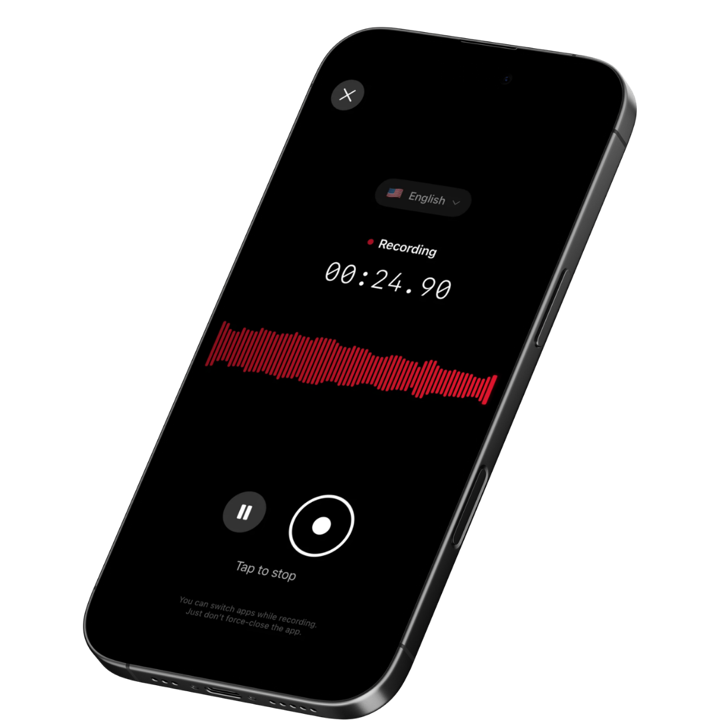
Voice capture offers a fundamentally different approach. Instead of interrupting yourself to type a note or switching apps to document a thought, you simply speak---and AI handles the rest. No flow state broken. No 23-minute recovery. No "where was I?"
Download SpeakWise from the App Store and discover how one-tap recording, AI transcription, intelligent summaries, and Notion integration can help you capture information without breaking your concentration.
Join 10,000+ professionals who've discovered that the best way to handle interruptions isn't preventing them---it's having a tool that doesn't create them.
Get SpeakWise Free →
4.9★ App Store Rating | iOS Optimized

🎯 4.9★ App Store Rating | 📱 Built for iOS
