Zoom Fatigue Statistics 2026: Video Call Exhaustion, Screen Time, and Mental Drain
Used by recruiters, executives, consultants, and more.
Zoom Fatigue Statistics 2026: Video Call Exhaustion, Screen Time, and Mental Drain
Brain scans now prove what we've felt all along: video calls exhaust us more than face-to-face meetings. With 61% of remote workers reporting mental drain after back-to-back video meetings and employees attending 2.6 times more likely to experience burnout when joining more than four video calls daily, these 17 statistics reveal why Zoom fatigue has evolved from pandemic buzzword to measurable neurological phenomenon.
The term "Zoom fatigue" emerged almost overnight in 2020, giving a name to the peculiar exhaustion that follows a day of video conferencing. But five years later, this phenomenon has transformed from anecdotal complaint to scientifically validated condition. Researchers using EEG brain scans and heart rate monitors have now proven that video calls trigger distinct neurophysiological responses-measurably draining us more than equivalent in-person interactions.
In this post, we'll explore 17 compelling statistics that capture the true science and human cost of video call exhaustion in 2025. These numbers reveal not just usage patterns and screen time hours, but the neurological mechanisms, demographic disparities, and psychological toll of our video-saturated work lives. Whether you're a manager designing meeting policies, a remote worker seeking validation for your exhaustion, or simply curious about why that Thursday afternoon Zoom leaves you depleted, these data points offer a clear, research-backed picture of what video calls actually do to our minds and bodies.
1. Brain scans prove video calls cause measurably more fatigue than face-to-face meetings
For the first time, researchers have neurophysiological proof that Zoom fatigue is real. A landmark study published in Scientific Reports used EEG and ECG monitoring to demonstrate that a 50-minute video conference exhausted participants significantly more than an identical in-person meeting. The brain data showed distinct fatigue patterns in the videoconference condition, with heart rate variability metrics confirming autonomic nervous system stress. This research transforms "Zoom fatigue" from subjective complaint to measurable phenomenon. Source: Scientific Reports - Videoconference Fatigue Neurophysiological Study
2. Fatigue sets in after just 15 minutes of video calls
The speed of video call exhaustion is striking. Research using neurophysiological measurements found that participants' heart rates slowed and brain wave activity indicated exhaustion and a struggle to focus just fifteen minutes into a virtual session. The researchers attributed this rapid fatigue onset to the brain's difficulty processing video lag, the absence of reliable body language cues, and the self-consciousness triggered by seeing one's own image on screen. Source: NPR - New Research on Zoom Fatigue
3. 61% of remote workers feel mentally drained after back-to-back video meetings
Video call fatigue has become a defining feature of remote work. Research shows that 61% of remote workers report feeling mentally drained after consecutive video meetings, with the exhaustion compounding throughout the day. The cognitive load of processing faces on screens, managing self-presentation, and maintaining attention without natural social cues creates a cumulative toll that many employees describe as more depleting than equivalent in-person workdays. Source: Zebracat Video Conferencing Statistics
4. Employees attending 4+ video meetings daily are 2.6 times more likely to report burnout
The relationship between video call volume and burnout is now quantified. Research demonstrates that employees attending more than four video meetings per day are 2.6 times more likely to report signs of burnout compared to those attending just one or two calls. This finding underscores why organizations implementing "Zoom-free days" have reported improvements in employee wellbeing and productivity-the solution isn't better video technology, but fewer video meetings. Source: Zebracat Video Conferencing Statistics
5. Women are 2.5 times more likely to experience Zoom fatigue than men
Zoom fatigue affects people unequally across gender lines. Stanford University research surveying over 10,000 participants found that women are 2.5 times more likely to experience significant video call exhaustion. The study revealed that 13.8% of women reported extreme fatigue after Zoom meetings compared to just 5.5% of men-roughly one in seven women versus one in twenty men. Researchers attribute this disparity to "mirror anxiety," the heightened self-focused attention women experience when seeing themselves on screen. Source: Technology, Mind, and Behavior - Stanford Research
6. 52% of introverts suffer from webcam exhaustion compared to 40% of extroverts
Personality type significantly influences video call fatigue. Survey data shows that 52% of introverts report suffering from webcam exhaustion, compared to 40% of extroverts. While neither group is immune, the higher rate among introverts aligns with research showing they find the constant social performance and lack of natural breaks in video calls particularly depleting. The absence of the buffer time that in-person meetings provide-walking between conference rooms, casual hallway interactions-removes recovery moments introverts rely upon. Source: Notta Meeting Statistics
7. 49% of employees say video calls are more exhausting with cameras on
The camera itself is a fatigue factor. Research shows that 49% of employees find video calls more exhausting when cameras are turned on compared to audio-only calls. The constant self-view, the pressure to maintain appropriate facial expressions, and the awareness of being watched all contribute to the additional cognitive load. This finding has fueled debates about mandatory camera policies, with many organizations now implementing "camera-optional" meeting norms. Source: AI Jobs - Zoom Fatigue Statistics
8. 82% of regular meeting attendees report video conferences increase cognitive load
The mental burden of video calls is nearly universal. Research indicates that 82% of regular meeting attendees say video conferences increase their cognitive load and fatigue levels compared to other meeting formats. The brain must work harder to interpret facial expressions displayed at unnatural sizes and distances, process audio that may be slightly delayed, and filter out distracting backgrounds-all while suppressing the instinct to look away from the intense, sustained eye contact that video grids create. Source: Coolest Gadgets - Zoom Fatigue Statistics
9. 66-69% of regular computer users experience digital eye strain symptoms
Video call fatigue overlaps significantly with broader screen exhaustion. A comprehensive meta-analysis of over 100 studies encompassing 66,577 participants found that approximately 66-69% of regular computer users experience digital eye strain symptoms including dry eyes, blurred vision, and headaches. For knowledge workers spending hours in video meetings, these physical symptoms compound the mental fatigue, creating a comprehensive exhaustion that affects both visual and cognitive systems. Source: Nature Meta-Analysis - Digital Eye Strain Research
10. Remote workers attend an average of 7.3 video calls per week
Video call volume has stabilized at significant levels. Research shows remote workers now attend an average of 7.3 video calls per week, compared to 4.1 for hybrid workers and 2.6 for fully in-office employees. This nearly three-fold difference in video exposure between remote and office workers helps explain why remote employees report higher rates of screen fatigue despite the benefits of eliminating commutes-the time saved on travel often gets absorbed by additional virtual meetings. Source: Zebracat Video Conferencing Statistics
11. The average video call lasts 38 minutes-with business calls averaging 29 minutes
Meeting duration patterns reveal interesting differences between work and personal video use. Research shows the average video call lasts 38 minutes overall, but business calls average 29 minutes while personal calls average 51 minutes. The shorter business call duration suggests that professional video meetings are often scheduled in 30-minute blocks, though back-to-back scheduling of these "shorter" calls creates the cumulative fatigue that defines the modern remote workday. Source: Zebracat Video Conferencing Statistics
12. Five nonverbal mechanisms drive Zoom fatigue: mirror anxiety, hyper-gaze, feeling trapped, and the effort of producing and monitoring nonverbal cues
Stanford researcher Jeremy Bailenson's groundbreaking work identifies five specific nonverbal mechanisms that make video calls exhausting. Mirror anxiety comes from constantly seeing yourself on screen. Hyper-gaze results from feeling watched by multiple faces in an unnatural, sustained way. Feeling physically trapped describes the confinement of staying in the camera frame. Finally, the additional cognitive effort required to both produce exaggerated nonverbal cues and interpret others' cues through a screen creates what researchers call "nonverbal overload." Source: Stanford Virtual Human Interaction Lab
13. 56% of employees say Zoom meetings run too long
Duration dissatisfaction is widespread. Research shows that 56% of employees believe their Zoom meetings typically run too long, contributing to fatigue that extends beyond the cognitive demands of the medium itself. This perception persists despite the finding that video meetings are often shorter than in-person equivalents-suggesting that the fatigue-per-minute of video calls is higher, making even shorter meetings feel drawn out. Source: AI Jobs - Zoom Fatigue Statistics
14. 63% of remote workers participate in more online meetings than they did in the office
The shift to remote work didn't just change where meetings happen-it increased their frequency. Research shows that 63% of remote workers now participate in more online meetings than they did when working in an office, with 30% spending two to three hours daily in video meetings. The irony is clear: remote work promised freedom from commutes and office interruptions, but for many, that time has been consumed by an even more exhausting form of interaction. Source: AI Jobs - Zoom Fatigue Statistics
15. 75% of employees have declined a meeting because they didn't feel like attending
Meeting fatigue has spawned avoidance behaviors. Research reveals that 75% of employees have declined a meeting simply because they didn't feel like attending, offering various excuses: internet problems (32%), scheduling conflicts (28%), sick days (27%), power outages (26%), issues with the Zoom app (26%), computer updates (22%), and doctor's appointments (20%). This widespread avoidance suggests that current video meeting cultures have exceeded employees' capacity for sustained virtual interaction. Source: AI Jobs - Zoom Fatigue Statistics
16. Turning off self-view significantly reduces both cognitive load and fatigue
Scientific research offers a simple intervention. A 2025 study published in Scientific Reports found that turning off the self-view feature during video calls can significantly reduce both cognitive load and fatigue. When participants couldn't see their own image, they reported less mirror anxiety and spent less mental energy monitoring their appearance-energy that could instead be directed toward the meeting's actual content. This finding suggests that one of video conferencing's most distinctive features may also be one of its most problematic. Source: Scientific Reports - Fighting Zoom Fatigue
17. Fatigued individuals show increased conformity in virtual meetings
Zoom fatigue has consequences beyond personal wellbeing-it affects decision-making. Research published in Scientific Reports found a clear link between fatigue and conformity, showing that exhausted participants in virtual meetings were more likely to agree with majority opinions rather than voice dissent. This finding suggests that the cumulative fatigue of video-heavy workdays may be silently shaping organizational decisions, as tired employees take the path of least resistance to escape draining discussions. Source: Scientific Reports - Fatigued Individuals Show Increased Conformity
The Paradox of Presence: Connected Yet Depleted
The statistics paint a picture of technological triumph undermined by human limitation. We built tools that collapse distance and enable global collaboration-yet those same tools exhaust us in ways that in-person interaction doesn't. The culprit isn't the technology itself, but the mismatch between how our brains evolved to communicate and how video platforms present human interaction.
Consider the paradox: video calls show us faces, but at unnatural sizes and distances. They provide eye contact, but with everyone simultaneously, for the entire meeting. They let us see ourselves, but in a way that triggers continuous self-monitoring. They eliminate travel time, but fill that time with more calls. Every feature designed to enhance connection carries a hidden cognitive cost.
The research points toward solutions that are cultural rather than technological. Organizations need meeting-free blocks that are actually protected, camera-optional policies that don't penalize participation, and a fundamental shift from measuring productivity by meeting attendance to measuring it by output. For individuals, the evidence supports hiding self-view, taking breaks between calls, and recognizing that the exhaustion is real-not a personal failing, but a predictable response to an evolutionarily novel form of interaction.
The goal isn't to eliminate video calls-it's to recognize their true cost and deploy them accordingly. In an era where face time can happen anywhere, protecting our cognitive resources may be the most important meeting we never schedule.---
Ready to capture what matters without the screen exhaustion?
The irony of video call fatigue is that our most important insights often emerge in conversation-but the format designed to capture those conversations is leaving us too exhausted to remember them. Key decisions blur together, action items slip away, and the mental energy that should go toward creative thinking gets consumed by the cognitive overhead of being on camera.
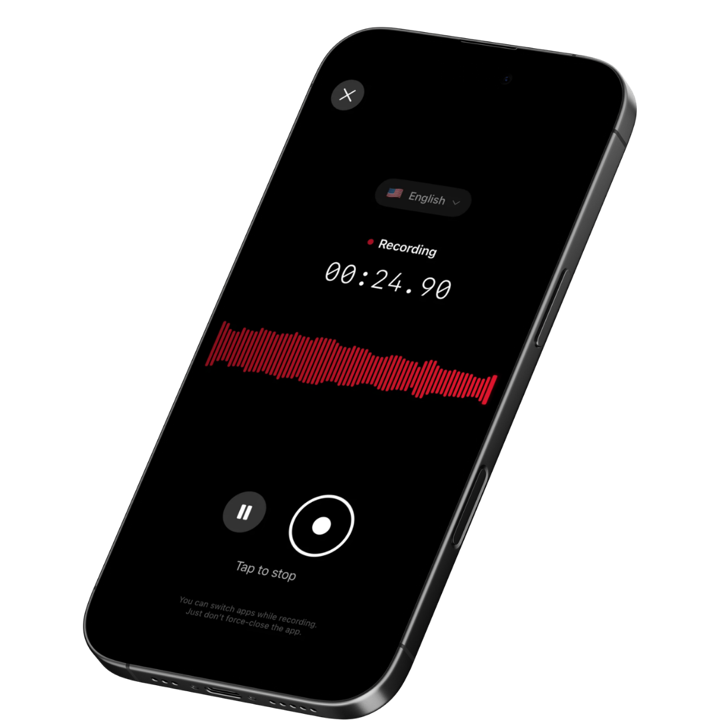
Voice notes offer an alternative. Speaking is 3x faster than typing, requires no camera, and creates no self-view anxiety. With AI transcription accuracy now exceeding 96%, your spoken thoughts instantly become searchable, organized text-capturing the substance of conversations without the exhaustion of another video call.
→ Download SpeakWise from the App Store and discover how one-tap recording, AI transcription, intelligent summaries, and Notion integration can help you capture meetings, ideas, and conversations without contributing to screen fatigue.
Join 10,000+ professionals who've discovered that the best way to remember what matters isn't another video recording-it's a frictionless way to speak your thoughts before they fade.
Get SpeakWise Free →
4.9★ App Store Rating | iOS Optimized

🎯 4.9★ App Store Rating | 📱 Built for iOS
