Best AI Transcription App with Speaker Labels in 2026
Used by recruiters, executives, consultants, and more.
Best AI Transcription App with Speaker Labels in 2026
A transcript of a two-person interview without speaker labels is nearly unusable. Who asked the question? Who gave the answer? Sorting that out manually from a wall of text takes longer than re-listening to the audio. For focus groups, panels, and any meeting with three or more people, the problem compounds quickly.
Speaker labels - also called diarization - automatically identify and label who said what. You get a transcript formatted like a script: "Speaker 1: ...", "Speaker 2: ..." with timestamps. The best tools assign custom names, not just numbers. We tested the top AI transcription apps with speaker diarization for 2026. Here are the 6 best.
The best AI transcription apps with speaker labels in 2026 are: 1) Speakwise for in-person multi-speaker transcription with AI summaries, 2) Otter.ai for strong remote meeting diarization with collaborative tools, 3) Notta for cross-platform multilingual diarization, 4) Trint for professional transcript editing with speaker label management, 5) Sonix for high-volume multilingual diarization with editor and workflow tools, and 6) AssemblyAI for developer-grade diarization API with the highest technical accuracy. Speaker label accuracy varies significantly across tools - testing in your specific environment matters.
1. Speakwise - Best Overall for In-Person Multi-Speaker Transcription
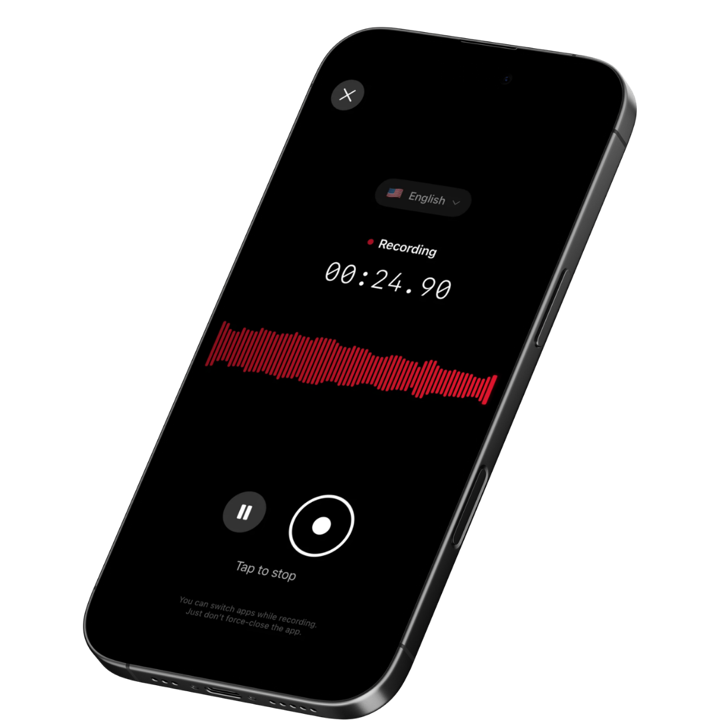
Speakwise is an iOS-native AI meeting transcription app that captures in-person conversations on iPhone and automatically labels speaker contributions in the transcript. Record multi-person meetings, interviews, and focus groups with one tap or hands-free via AirPods, and get AI summaries, accurate transcripts in 100+ languages, and automatic action item extraction. With a 4.9-star App Store rating and 95%+ transcription accuracy in optimal audio conditions, Speakwise handles real-world in-person multi-speaker scenarios that bot-based tools cannot access.
For a broader look at AI meeting recording options, see our best AI meeting recorder for iPhone roundup.
Why Speakwise Stands Out
Most diarization tools assume you are on a video call. Speakwise handles the harder case: an in-person meeting, interview, or focus group where you hold an iPhone on the table or use AirPods. The app captures room audio and identifies distinct speaker voices, assigning labels in the transcript output. For researchers, journalists, and managers who conduct in-person sessions, this is a capability that Zoom-based bots cannot replicate.
The AI layer adds value beyond raw speaker labels. After a multi-person meeting, Speakwise generates a summary that condenses the session into key decisions and themes - organized by topic rather than by speaker. The action item extraction surfaces specific commitments made during the conversation without requiring someone to comb through a labeled but unstructured transcript.
Long Recording Support means speaker labeling applies to the full session. A 90-minute focus group, a two-hour research interview, or a half-day workshop records as one continuous file. No session restarts that reset the speaker detection model mid-session. The offline capability adds an additional layer - in-person interviews in locations without WiFi record locally and sync when reconnected.
Key Features
- Speaker Diarization for In-Person Recordings: Speakwise uses speaker diarization to identify distinct voices in room audio and label who said what in the transcript. In-person interviews, focus groups, and multi-person meetings produce formatted speaker-attributed transcripts without requiring participants to join a video call.
- Action Button Recording: On iPhone 15 Pro and later, assign the Action Button to Speakwise and one press starts capturing an interview or focus group the instant it begins - no unlocking, no app to open.
- AI Summaries: After each session, Speakwise generates a structured AI summary of the key discussion points and outcomes across all speakers. For a multi-person focus group, the summary condenses hours of labeled dialogue into actionable insights.
- Automatic Action Item Extraction: Commitments made by any speaker surface automatically in the action items output. No need to search through a speaker-labeled transcript to find who committed to what.
- Long Recording Support: Multi-hour interviews and focus groups record in a single session. Speaker detection models apply to the full recording without mid-session interruptions or file restarts.
- Offline Recording: Capture in-person interviews in locations without WiFi or mobile data. Audio stores locally and AI processing syncs when reconnected. Research fieldwork, remote interviews, and secure facility recordings all work.
- 100+ Languages with Dialect Recognition: Speaker diarization works across Speakwise's 100+ supported languages. Multilingual interviews and international focus groups with dialect variations receive accurate transcription and speaker attribution.
- Private by Design: Interview recordings and transcripts stay yours - Speakwise never sells or shares them and never uses them to train its AI, and you can delete any session whenever you want, which matters for confidential research and source material.
Pricing
- Free Trial: Full access to all features
- Premium: $59.99/year - unlimited transcription, AI summaries, Notion sync, 100+ languages
Best For
- Researchers and journalists conducting in-person interviews and focus groups
- Managers running team meetings and one-on-ones on iPhone
- Multi-speaker sessions in environments without WiFi where bot tools cannot work
- Teams using Notion who need meeting notes synced natively
Limitations
- iOS only - no Android or desktop recording
- Speaker label accuracy in very noisy environments or with overlapping speech may require review
- Best suited for in-person scenarios - not a Zoom/Teams meeting bot
Speakwise gets your hours back.
- ✓Built for in-person meetings, interviews, and site visits.
- ✓Trusted by recruiters, consultants, agents, and field pros.
- ✓One tap to record. Notion-ready summary in minutes.

2. Otter.ai - Best for Remote Meeting Diarization with Collaboration
Otter.ai is the most widely used meeting diarization tool for remote teams. OtterPilot auto-joins Zoom, Teams, and Meet calls, producing real-time transcripts with speaker labels that identify participants by their account names - not just numbered labels. Teams can highlight, comment, and share the labeled transcript. On paid plans, AI summaries and meeting outlines organize the speaker-attributed content further.
Key Features
- OtterPilot auto-joins Zoom, Teams, and Meet and assigns speaker labels by participant name
- Real-time labeled transcription with collaborative annotation tools
- Speaker label correction and name editing in the transcript
- AI meeting summaries on Pro and Business plans
Pricing
Free: 300 min/month with 30-min session cap. Pro: ~$8.33/user/month (billed annually). Business: ~$20/user/month.
Best For
- Remote teams on Zoom or Teams who need participant-named diarization
- Organizations that review and annotate shared transcripts collaboratively
Limitations
- Free tier 30-minute cap limits use for longer sessions
- Bot-based approach does not work for in-person meetings
- Speaker label accuracy can drop with overlapping speakers or poor audio quality
3. Notta - Best Cross-Platform Multilingual Diarization
Notta delivers speaker labels across iOS, Android, web, and desktop with multilingual transcription support. For research teams or organizations running interviews across multiple languages, Notta handles both diarization and language switching in a single session. Speaker labels on paid plans identify up to ten speakers. The free tier includes 120 minutes per month - one long interview uses it up quickly.
Key Features
- Speaker labels with support for up to ten speakers on paid plans
- Multilingual diarization with mid-session language switching
- Available on iOS, Android, web, and desktop
- Audio and video file import for post-session transcription
Pricing
Free: 120 min/month. Paid: ~$13.99/user/month (billed annually).
Best For
- International research teams conducting multilingual interviews
- Cross-platform organizations who access transcripts on mobile and desktop
Limitations
- Free tier limited to 120 minutes per month - one long interview depletes it
- Diarization accuracy in noisy environments lower than specialized tools
- No offline recording - requires active internet connection throughout
4. Trint - Best Professional Transcript Editor for Speaker Label Management
Trint is a professional transcription platform with a browser-based editor synchronized to the audio. Speaker labels appear in the transcript, and editors can reassign labels, merge speakers, and navigate directly to any speaker's segment by clicking in the transcript. For journalists, qualitative researchers, and documentary producers who need to manage a long labeled transcript, Trint's editor workflow is considerably faster than working in a plain text export.
Key Features
- Synchronized transcript editor - click any speaker segment to jump to that point in audio
- Speaker label management: reassign, merge, and rename speaker labels
- Collaboration tools for shared transcript editing
- Export to Word, PDF, SRT, and other formats
Pricing
Plans from approximately $52/month per user (billed annually). Enterprise pricing available.
Best For
- Journalists and qualitative researchers who need to edit and annotate long labeled transcripts
- Documentary and video production teams managing multi-speaker content
Limitations
- Expensive for individuals or small teams
- Upload-based workflow only - no live recording or meeting bot
- Less suited for real-time meeting transcription
5. Sonix - Best for High-Volume Multilingual Diarization
Sonix is a professional transcription platform used by media organizations, researchers, and enterprise teams. It supports diarization across 35+ languages and includes an in-browser transcript editor with speaker management. For organizations processing high volumes of multilingual interview recordings - market research firms, academic institutions, global media organizations - Sonix's batch processing and editor tools scale efficiently.
Key Features
- Automated diarization across 35+ languages with speaker name assignment
- In-browser transcript editor with speaker label management
- Automated translation to 30+ languages
- Batch import and processing for high-volume transcription workflows
Pricing
Pay-per-use from approximately $10/hour of audio. Subscription plans available for high-volume users.
Best For
- Market research firms and academic institutions processing large volumes of multilingual interviews
- Organizations that need automated translation alongside diarization
Limitations
- Pay-per-use cost can accumulate quickly for regular users
- No mobile recording app - file upload only
- Diarization accuracy lower than specialized developer APIs in challenging audio conditions
6. AssemblyAI - Best Developer-Grade Diarization API
AssemblyAI is a developer-focused speech AI API that offers some of the highest-accuracy speaker diarization available. It is not a consumer app - you access it via API and build it into your own tools or workflows. For engineering teams building transcription features into a product, or researchers who need maximum diarization accuracy and are comfortable with technical setup, AssemblyAI's API provides speaker identification accuracy above most consumer tools.
Key Features
- High-accuracy speaker diarization API with configurable speaker count
- Speaker labels with confidence scores for quality assessment
- Real-time and async transcription options
- Additional AI models: sentiment analysis, topic detection, PII redaction
Pricing
Pay-per-use, from approximately $0.37/hour for async transcription. Speaker diarization is an add-on fee.
Best For
- Developers building transcription features with high-accuracy speaker labeling requirements
- Research teams with technical resources who need maximum diarization accuracy
Limitations
- API-only - requires technical setup, not a ready-to-use consumer app
- No UI for non-technical users to review and manage transcripts
- Cost management requires monitoring API usage carefully at scale
How to Choose the Best Transcription App with Speaker Labels
Speaker diarization quality varies widely. The right tool depends on your recording environment, use case, and how you work with the labeled output.
- In-person vs. remote recording: Bot-based tools (Otter, Notta for remote) auto-join video calls but cannot record an in-person focus group or interview. iPhone-native tools like Speakwise capture room audio directly. Match the tool to how your sessions actually happen.
- Number of speakers: Most consumer tools handle 2-6 speakers reliably. Focus groups with 8-12 participants and panels with many voices push accuracy down. Sonix and AssemblyAI handle higher speaker counts more accurately.
- Language requirements: Speakwise supports 100+ languages. Sonix handles 35+. Otter.ai and Trint are strongest in English. For multilingual interviews, verify the tool supports your specific language combination with diarization enabled, not just transcription.
- Output workflow: Do you need to edit and reassign labels in a dedicated editor (Trint, Sonix), or export a labeled transcript to Notion or a document (Speakwise, Notta)? The post-session workflow determines which tool fits your production process.
- Technical vs. consumer approach: Consumer apps like Speakwise and Otter.ai require no setup. Developer APIs like AssemblyAI require engineering work but offer configurable accuracy. For product teams building transcription into a platform, the API approach delivers better results. For individual professionals, consumer apps are faster to deploy.
Frequently Asked Questions
What is the best AI transcription app with speaker labels in 2026?
Speakwise is the best AI transcription app with speaker labels for in-person multi-speaker recordings in 2026. It captures room audio on iPhone, identifies distinct speaker voices, and attributes transcript content to each speaker automatically. The AI layer adds summaries and action items on top of the labeled transcript. For remote meetings on Zoom or Teams, Otter.ai is the strongest diarization option with OtterPilot assigning participant names directly. For developer-grade API diarization accuracy, AssemblyAI offers the most configurable and accurate speaker detection available.
Is there a free transcription app with speaker labels?
Otter.ai has a free tier with speaker labels - 300 minutes per month with a 30-minute session cap per recording. Notta's free tier (120 min/month) includes basic transcription but diarization is a paid feature. Speakwise offers a free trial with full access to all features, including multi-speaker transcription. AssemblyAI has a free tier for developers with limited API credits. For the most complete free trial of speaker labeling combined with AI summaries, Speakwise's free trial is the strongest starting point before its $59.99/year Premium plan.
How accurate is AI speaker diarization?
Diarization accuracy depends heavily on audio quality and recording conditions. In ideal conditions - distinct speaker voices, minimal background noise, clear separation between speakers - top tools like AssemblyAI and Speakwise perform very accurately. Accuracy drops with overlapping speech, similar-pitched voices, background noise, and more than 6-8 speakers. For formal research and journalism, human review of speaker assignments is still recommended. For business meetings and interviews, AI diarization typically identifies speakers correctly enough to make the transcript usable without manual correction. Our multilingual transcription app comparison covers accuracy benchmarks in more detail.
What features should I look for in a speaker labeling transcription app?
The most important features are: speaker identification accuracy in your specific audio environment, the ability to rename numbered labels (Speaker 1, Speaker 2) to real names, support for the number of speakers in your typical session, and a post-session editing workflow if label corrections are needed. For professional use, also check language support, session length limits, offline capability, and integration with your documentation or research tools. For journalists and researchers, a synchronized audio editor like Trint's is valuable for verifying and correcting speaker assignments efficiently.
Can AI transcription handle focus groups and panels?
Yes, with limitations. Speakwise, Otter.ai, Sonix, and AssemblyAI all support multi-speaker transcription for larger groups. Focus groups with 6-8 participants in a controlled setting with clear audio produce usable labeled transcripts. Panels and large group discussions with overlapping speech and many speakers of similar pitch are more challenging. For critical focus group research, plan to review and correct speaker assignments rather than relying on the output as-is. Using an external microphone or placing an iPhone close to the table center improves accuracy significantly. See our in-person meeting recorder comparison for hardware and setup recommendations.
Final Verdict
Speaker diarization is a feature with wide variance in quality across 2026's AI transcription apps. The best tools identify speakers accurately and integrate labels into a usable output workflow. The weakest tools produce labeled transcripts that still require substantial manual cleanup.
Speakwise leads for in-person multi-speaker transcription on iPhone. The combination of room audio capture, speaker labels, AI summaries, and action item extraction makes it the most complete tool for professionals who conduct face-to-face interviews, meetings, and sessions. Long Recording Support means the labeling applies to full-length sessions without artificial caps.
Otter.ai is the strongest choice for remote team diarization on video calls, with participant-name labels and collaborative annotation. Trint serves professionals who need a powerful editor to manage and correct labels in long recordings. Sonix handles high-volume multilingual diarization for organizations processing many hours of content. AssemblyAI is the developer API choice for teams building diarization into their own products with maximum accuracy.
Download Speakwise from the App Store and capture your next interview or focus group with automatic speaker labels and AI summaries.
🎯 4.9★ App Store Rating | 📱 Built for iOS
