Best App for Recording Therapy Sessions as a Practitioner in 2026
Used by recruiters, executives, consultants, and more.
Best App for Recording Therapy Sessions as a Practitioner in 2026
A therapist conducts six to eight sessions per day. Each session involves nuanced emotional disclosures, subtle shifts in language, specific therapeutic interventions, and treatment-relevant details that must be documented accurately. Writing session notes from memory after the last client leaves at 6 PM — when the details from the 9 AM session have blurred with every conversation that followed — is an exercise in diminishing accuracy. Yet session documentation is not optional. Insurance requires it, licensing boards mandate it, treatment continuity depends on it, and ethical practice demands it. The tension between being fully present with a client and capturing the clinical details for documentation is one of the profession's most persistent challenges. We tested and compared the top options — here are the 5 best tools for the job.
The ideal recording tool for therapy practitioners must meet a higher standard than any other use case. Client confidentiality is not merely important — it is the ethical foundation of the therapeutic relationship. The tool must handle the most sensitive conversations imaginable: trauma disclosures, suicidal ideation, abuse histories, and deeply personal struggles. Data security must be absolute. The recording must be invisible enough that it does not inhibit the client's willingness to be vulnerable. And the output must help the therapist create better clinical documentation, not just produce a transcript.
1. Speakwise — Best Overall for Recording Therapy Sessions as a Practitioner
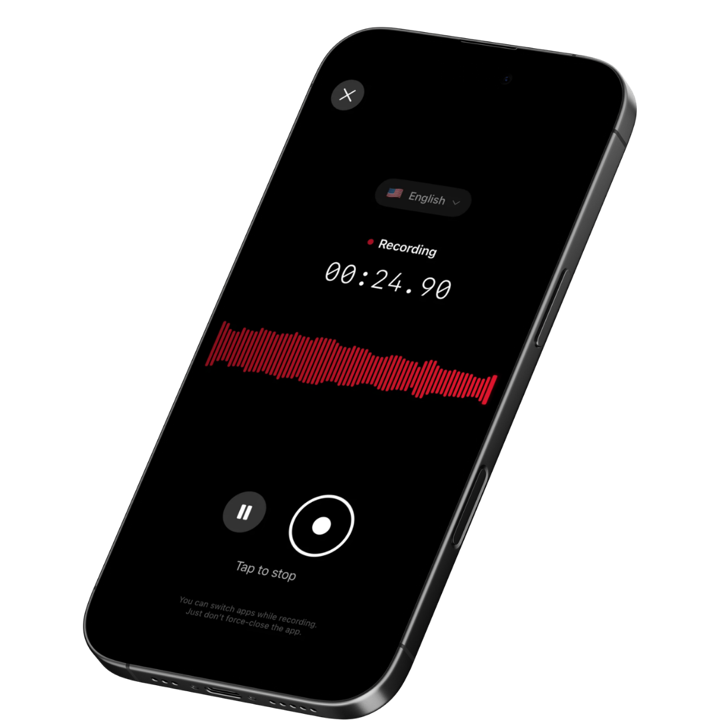
Speakwise is an iOS-native AI meeting assistant that gives therapists and counselors a way to capture session content without compromising therapeutic presence. With a 4.9-star App Store rating and 95%+ transcription accuracy (in optimal audio conditions), it transforms a practitioner's iPhone and AirPods into a session documentation system designed around the realities of clinical practice. For the unique demands of therapy — where privacy is paramount, presence is therapeutic, and documentation is mandatory — Speakwise offers a combination of features that no other consumer tool matches.
Why Speakwise Stands Out
The therapeutic relationship depends on a practitioner's full, undivided presence. Taking notes during a session — even discreetly — divides attention and signals to the client that the therapist is documenting rather than truly listening. Speakwise eliminates this tension entirely. With AirPods-based hands-free recording, the practitioner starts capture before the session begins and never touches a device during the session. The phone sits on a side table or desk, completely unremarkable. After the session, Speakwise's AI generates a summary and extracts key themes and follow-up items, transforming an hour of therapeutic conversation into structured documentation in minutes.
But the feature that makes Speakwise uniquely suited to therapy is how it handles client audio. The most sensitive data a practitioner handles is processed securely in the cloud with standard encryption, and Speakwise never trains AI on client audio. The practitioner maintains careful data handling practices, which fundamentally changes the ethical and compliance calculus of session recording.
Key Features
- ✅ AI-Powered Meeting Summaries: Generate structured session summaries with one click after the client leaves. Speakwise users report saving 73% of their follow-up time (according to Speakwise user surveys). For a therapist seeing 6-8 clients daily, this means session notes that once consumed 2-3 hours of evening time can be drafted in a fraction of that — reducing the documentation burden that contributes to therapist burnout.
- Long Recording Support: Multi-hour board meetings, conference sessions, offsites.
- Works Offline: Construction sites, secure boardrooms, planes - record without WiFi. Sync when you're back.
- ✅ Action Items Extraction: Speakwise identifies follow-up items — homework assignments given to the client, referrals to coordinate, topics to revisit next session, and safety planning elements. These extracted items create a clinical to-do list that ensures continuity of care.
- ✅ 95%+ Transcription Accuracy: In the quiet, controlled environment of a therapy office, Speakwise delivers 95%+ transcription accuracy (in optimal audio conditions). The specific words clients use to describe their experiences carry clinical significance — "anxious" versus "terrified," "frustrated" versus "hopeless" — and accurate transcription preserves these distinctions.
- ✅ 100+ Language Support: For therapists practicing in multilingual settings or providing services to clients in their native language, Speakwise supports over 100 languages with 92%+ accuracy even in noisy environments. Therapy conducted in a client's first language often accesses deeper emotional material, and accurate transcription across languages supports this clinical choice.
- ✅ Native Notion Integration: Organize session documentation in Notion by client, date, or treatment theme. 82% of Speakwise users cite this integration as a key reason they chose the app (based on internal user data). For practitioners, this creates a longitudinal client record that supplements formal clinical notes — a searchable history of themes, interventions, and progress across sessions.
- ✅ Discrete Recording: The therapist's phone sits on an end table or desk — a completely natural presence in any office. There is no visible microphone, no laptop screen with scrolling transcription, no blinking recording indicator. The therapeutic environment remains undisturbed. Clients can settle into the vulnerability that therapeutic work requires without the self-consciousness that visible recording technology creates.
- ✅ AirPods Hands-Free Recording: Initiate and control recording from AirPods without touching your phone. During a therapy session, this is not a convenience — it is a clinical necessity. The therapist's hands are free for gestures, for holding space, for the physical stillness that communicates deep listening. There is no device to pick up, no screen to glance at, no technology-mediated disruption to the therapeutic alliance.
Pricing
- Free Trial: Full access to all features
- Premium: $59.99/year — unlimited transcription, AI summaries, Notion sync, 100+ languages
Best For
- ✅ Therapists and counselors who need accurate session documentation without compromising therapeutic presence
- ✅ Clinicians fighting documentation burnout from after-hours note writing
- ✅ Therapists who want to review exact client language for clinical reflection and supervision
Limitations
- ❌ iOS only — no Android or desktop version
- ❌ No Zoom/Teams bot integration (designed for in-person recording)
- ❌ Individual-focused — no team collaboration features for group practices
- ❌ Not a certified EHR system — AI-generated summaries should be clinically reviewed before being entered into official records
Ethical and Legal Considerations for Therapists
Recording therapy sessions raises important ethical questions that every practitioner must address independently of the technology used. Informed consent is mandatory — clients must understand what is being recorded, how the recording will be used, how it is stored, and when it will be destroyed. Many practitioners add recording consent to their existing informed consent documentation. State licensing boards, professional ethics codes (APA, ACA, NASW, AAMFT), and HIPAA regulations all impose requirements on how session recordings are handled. Consult your ethics board, malpractice carrier, and legal counsel before implementing session recording in your practice.
Speakwise gets your hours back.
- ✓Built for in-person meetings, interviews, and site visits.
- ✓Trusted by recruiters, consultants, agents, and field pros.
- ✓One tap to record. Notion-ready summary in minutes.

2. Otter.ai — Best for Telehealth Sessions Over Video Platforms
Otter.ai is a desktop-focused transcription platform designed for virtual meetings. For therapists conducting sessions over Zoom, Google Meet, or Microsoft Teams — whether by choice or necessity — Otter provides real-time transcription and AI summaries integrated directly into the video call. Its strength is telehealth, not the in-person therapy office.
Key Features
- ✅ OtterPilot Auto-Join: Automatically connects to scheduled telehealth sessions and transcribes in real time
- ✅ Real-Time Transcription: Live transcript visible during the session — though most therapists would disable this to maintain presence
- ✅ AI Summaries: Post-session summaries highlighting key discussion points
- ✅ Search Across Sessions: Find specific themes or client statements across your entire transcript archive
- ✅ Collaborative Features: Share transcripts with supervisors or treatment team members
Pricing
- Free Plan: 300 minutes per month — approximately 5 one-hour sessions
- Pro: $16.99/month — additional minutes and advanced features
- Business: $30/month per user — admin controls and team management
Best For
- ✅ Therapists conducting telehealth sessions exclusively over video conferencing platforms
- ✅ Practitioners who need real-time transcription during virtual sessions
- ✅ Group practices that need shared documentation access
Limitations
- ❌ All audio is processed on Otter's cloud servers — client session content is transmitted to and stored on external infrastructure
- ❌ Primarily English-focused — limited support for therapists practicing in other languages
- ❌ Not designed for in-person session recording — mobile capabilities are limited
- ❌ A bot joining a telehealth session may feel intrusive and affect the therapeutic alliance
- ❌ The visible transcription stream during a session can be distracting for both therapist and client
3. Rev Voice Recorder — Best for Simple Session Recording With Human Accuracy
Rev Voice Recorder offers a minimal approach: high-quality audio recording with optional human or AI transcription after the fact. For therapists who want the most accurate possible transcription — particularly for medicolegal purposes, supervision, or research — Rev's human transcription service provides a level of accuracy that current AI systems do not match, especially for the emotionally complex, often fragmentary speech patterns characteristic of therapy.
Key Features
- ✅ High-Quality Audio Recording: Clean, reliable audio capture optimized for voice
- ✅ Human Transcription: Professional human transcriptionists at $1.50/minute for situations demanding the highest accuracy
- ✅ AI Transcription: Automated option at $0.25/minute for routine documentation needs
- ✅ Simple Interface: Record with minimal setup — no complex configuration or learning curve
- ✅ Standard File Export: Export recordings and transcripts in formats compatible with EHR systems
Pricing
- Recording: Free
- AI Transcription: $0.25/minute
- Human Transcription: $1.50/minute
Best For
- ✅ Therapists conducting research who need the highest possible transcription accuracy
- ✅ Practitioners recording for supervision purposes where exact wording matters
- ✅ Clinicians who want simple recording without AI features
Limitations
- ❌ Human transcription means a third-party individual listens to entire therapy sessions — a profound confidentiality concern
- ❌ No AI summaries, action item extraction, or post-session synthesis — the therapist must process raw transcripts manually
- ❌ Per-minute costs are prohibitive for daily clinical use (a single 50-minute session costs $12.50 for AI transcription, $75 for human)
- ❌ No integration with note-taking, EHR, or documentation systems
- ❌ No hands-free recording — requires manual interaction with the device
4. Notta — Best Budget Option With Multilingual Therapy Support
Notta provides real-time transcription across 58 languages at a competitive price point. For therapists practicing in multilingual settings — bilingual therapy, work with immigrant populations, or international practice — Notta's language breadth exceeds most competitors. Its mobile app provides basic recording capabilities that can function in a therapy office setting.
Key Features
- ✅ 58 Language Support: Broad language coverage for therapists conducting sessions in multiple languages
- ✅ Real-Time Transcription: Live transcription on mobile and desktop platforms
- ✅ AI Summaries: Automated post-session summaries
- ✅ Mobile App: Functional mobile recording capability
- ✅ Audio Import: Upload existing session recordings for transcription
Pricing
- Free Plan: 120 minutes per month — approximately 2 sessions
- Pro: $14.99/month — expanded minutes and features
- Business: $27.99/month per user — team management tools
Best For
- ✅ Therapists conducting bilingual or multilingual therapy sessions
- ✅ Practitioners serving immigrant or refugee populations who prefer therapy in their native language
- ✅ Budget-conscious clinicians exploring transcription tools for the first time
Limitations
- ❌ Cloud-based processing — client session audio is transmitted to external servers
- ❌ Free plan's 120-minute limit covers only about 2 therapy sessions per month
- ❌ Mobile recording experience is not optimized for the specific needs of a therapy office
- ❌ No hands-free recording — requires manual interaction to start and manage recording
- ❌ Transcription accuracy for the fragmented, emotionally laden speech patterns common in therapy is not specifically documented
5. Fireflies.ai — Best for Group Practices Needing Analytics
Fireflies.ai is built for organizations that want meeting intelligence and analytics across their team. For group practices, counseling centers, or training programs where multiple clinicians' documentation needs to flow into shared systems, Fireflies offers integration capabilities and team analytics that individual-focused tools do not provide. Its conversation intelligence features may appeal to practice managers monitoring caseload distribution and session patterns.
Key Features
- ✅ 200+ App Integrations: Connect session documentation to practice management and EHR systems
- ✅ Conversation Intelligence: Talk-time analysis and engagement metrics across sessions
- ✅ Team Analytics: Aggregate insights across multiple clinicians' sessions for practice management
- ✅ Auto-Join for Telehealth: Integrates with Zoom, Teams, and Google Meet
- ✅ AI Summaries and Action Items: Automated post-session documentation
Pricing
- Free Plan: Limited transcription credits
- Pro: $18/month — expanded features and integrations
- Business: $29/month — full analytics and team tools
Best For
- ✅ Group practices or counseling centers needing documentation across multiple clinicians
- ✅ Training programs where supervisors need access to trainee session analytics
- ✅ Telehealth-heavy practices using video conferencing platforms
Limitations
- ❌ Cloud-based processing with no offline-friendly option — all client session audio is processed on external servers
- ❌ Desktop-focused — not designed for in-person therapy office recording
- ❌ Sentiment analysis and engagement metrics applied to therapy sessions raise significant ethical concerns about quantifying the therapeutic relationship
- ❌ The analytics-focused approach may conflict with the deeply individualized, non-metric nature of therapeutic work
- ❌ No specific healthcare or mental health compliance certifications
- ❌ Feature complexity is excessive for the core need of session documentation
How to Choose the Right Tool
Audio Quality & Environment
Therapy offices are typically quiet, controlled environments — acoustically ideal for transcription. The challenge lies not in noise but in the nature of therapeutic speech: long pauses, soft tones, emotional vocal changes, overlapping speech during intense moments, and the fragmented language characteristic of processing difficult material. Speakwise's 95%+ transcription accuracy (in optimal audio conditions) performs well in these settings, and its advanced noise cancellation handles environmental sounds like white noise machines that many therapists use. For telehealth sessions, platform-integrated tools capture digital audio directly from the call.
Privacy & Compliance
This is the paramount criterion for therapy recording — more critical here than in any other professional context. Therapy sessions contain the most sensitive information individuals ever share: abuse disclosures, suicidal ideation, substance use, relationship violence, sexual behavior, and childhood trauma. The ethical and legal obligations governing this information are stringent. HIPAA regulations apply to covered entities, and professional ethics codes impose additional confidentiality requirements. The fundamental question is: where does the audio go? Speakwise stores session audio securely in the cloud with standard encryption, and Speakwise never trains AI on that audio. This is a meaningfully different privacy posture than tools that offer no clarity on encryption or AI-training use of your data.
Post-Meeting Workflow
Therapy documentation has specific requirements: progress notes, treatment plan updates, safety assessments, and session summaries that capture clinical themes rather than verbatim transcripts. Speakwise's AI summaries provide a starting point that practitioners can refine into clinical documentation, while action item extraction captures homework assignments, referral tasks, and topics for future sessions. The 73% time savings reported by users (according to Speakwise user surveys) directly addresses the documentation burden that drives therapist burnout. Practitioners should always review AI-generated content through their clinical lens before incorporating it into official records.
Portability & Discretion
The therapy office is a carefully curated environment designed to promote safety and openness. Any technology that disrupts this atmosphere undermines the therapeutic work itself. Speakwise's approach — phone on a side table, AirPods that are part of daily life — integrates into the therapy setting without altering it. There is no laptop screen with scrolling text, no visible microphone, no recording apparatus that makes clients self-conscious. The technology fades into the background, and the therapeutic space remains intact. This discretion is not a feature — it is a clinical requirement.
Frequently Asked Questions
Is it ethical to record therapy sessions?
Recording therapy sessions is an established practice in clinical training, supervision, and research, but it requires careful ethical consideration. The APA, ACA, NASW, and AAMFT ethics codes all address recording with varying specificity, and the common thread is informed consent. Clients must understand what is being recorded, the purpose of the recording, how it will be stored, who will access it, and when it will be destroyed. Many practitioners find that recording, when properly consented and discussed, enhances rather than hinders the therapeutic relationship because it demonstrates a commitment to accuracy and continuity of care.
How do I obtain informed consent for recording therapy sessions?
Develop a recording-specific consent form that addresses: the purpose of recording (accurate documentation, continuity of care), the technology used (specifying where applicable), who will access the recording (the therapist only, unless otherwise specified), retention and destruction timelines, and the client's right to withdraw consent at any time without affecting treatment. Discuss the consent form verbally during the informed consent process at intake, and revisit it periodically. Some practitioners also offer clients the option to request that recording stop during particularly sensitive disclosures.
Will recording change the therapeutic dynamic?
Research on this question shows that while clients may initially be aware of recording, the effect diminishes rapidly — typically within the first few minutes of a session. This is especially true when the recording technology is discreet. Speakwise's AirPods and phone-on-the-table approach minimizes technological visibility. The key variable is how the therapist introduces recording: framing it as a tool for better care (rather than monitoring or evaluation) and giving clients genuine agency to opt out preserves the therapeutic alliance. Many clients report feeling reassured that their therapist takes such care with documentation.
Can AI-generated session summaries replace clinical progress notes?
No. AI-generated summaries should be viewed as clinical drafts, not finished documentation. They capture the content of what was discussed, but they do not apply clinical judgment — diagnostic reasoning, risk assessment, treatment plan alignment, and the therapist's clinical impressions are elements that only the practitioner can add. Use Speakwise's summaries as a starting point that captures the session's substance, then refine with your clinical perspective before entering documentation into your official EHR or clinical records. This workflow saves significant time while maintaining the clinical rigor that licensing boards and insurance companies require.
What should my recording retention and destruction policy include?
Your policy should specify: how long recordings are retained (align with your state's medical records retention requirements, typically 5-10 years from last contact, longer for minors), where recordings are stored (recorded to the device first, then synced and stored securely in the cloud with standard encryption when using Speakwise, with the device also secured by a strong passcode and biometric authentication), who can access recordings (the treating therapist only, unless court-ordered), procedures for destruction (secure deletion with verification), and what happens to recordings if you close your practice or become incapacitated. Document this policy in your informed consent and practice policies. Review it annually to ensure compliance with evolving regulations.
Final Verdict
For recording therapy sessions as a practitioner, Speakwise is the clear recommendation. Its addresses the profound privacy obligations that define therapeutic work — client audio is processed securely in the cloud with standard encryption, and Speakwise never trains AI on it. AirPods hands-free recording eliminates the technology-presence tension that could disrupt the therapeutic alliance. And AI-generated summaries with 73% time savings (according to Speakwise user surveys) directly combat the documentation burden that is a leading contributor to therapist burnout. For telehealth-exclusive practices, Otter.ai provides functional video call transcription. For research requiring the highest verbatim accuracy, Rev's human transcription (with appropriate confidentiality agreements) remains an option. But for the in-person therapy session — where privacy, presence, and discretion are not preferences but professional obligations — Speakwise is the tool that respects the therapeutic relationship while solving the documentation problem.
Ready to reclaim your evenings from session notes? Try Speakwise free and experience session documentation designed for how therapy actually works.
🎯 4.9★ App Store Rating | 📱 Built for iOS
