Best Apps for Structured Meeting Notes (2026)
Used by recruiters, executives, consultants, and more.
Best Apps for Structured Meeting Notes in 2026
The best apps for structured meeting notes in 2026 all solve the same complaint: a raw transcript is not a record. Nobody reads 4,000 words of dialogue to find out what was decided. What people need is the shape of the meeting - the decisions, the open questions, the owner of each next step - in a format that reads the same way every time. We tested and compared the top options - here are the 6 best.
Structure comes from two different places, and the distinction decides which tool suits you. Some apps impose a template you define in advance. Others infer structure from what was actually said. Template tools are consistent and rigid. Inference tools are flexible and occasionally surprising.
Best Apps for Structured Meeting Notes at a Glance (2026)
The best apps for structured meeting notes in 2026 are:
- Speakwise - Best for structured notes from in-person meetings on iPhone
- Fellow - Best for agenda-driven notes with recurring templates
- Granola - Best for merging your own typed notes with an AI structure
- Supernormal - Best for industry-specific note formats
- Sembly - Best for separating decisions, issues and tasks automatically
- Notion AI Meeting Notes - Best for notes that live inside your documentation
Five of these are built around scheduled video calls. Speakwise ranks first because it produces the same structured output for the meetings that never appear on a calendar invite.
1. Speakwise - Best Overall for Structured Notes From In-Person Meetings
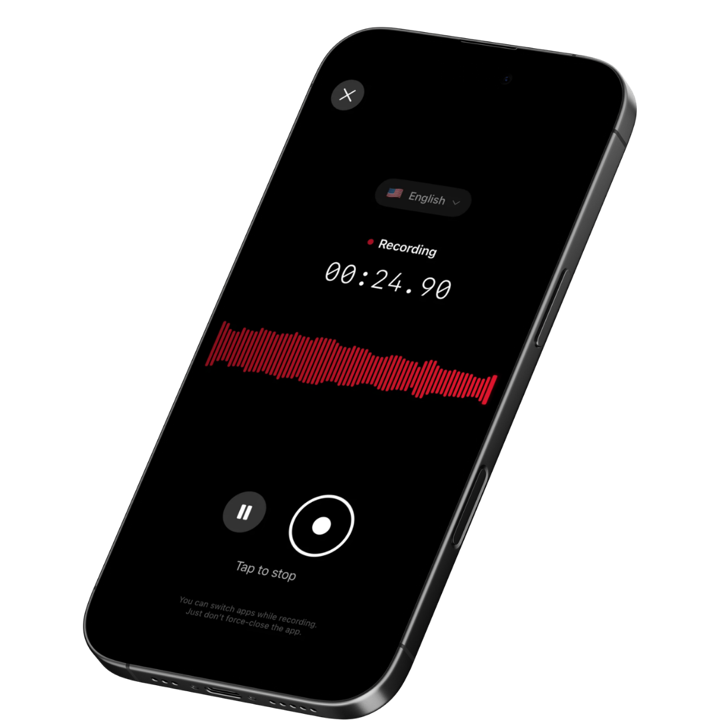
Speakwise handles meeting transcription on iPhone: it records in-person conversations through the phone's microphone and returns a structured record rather than a transcript dump: an AI summary organized by topic, a list of action items, and a speaker-labeled transcript underneath for anyone who wants the detail. One tap starts the recording, and the structure is applied automatically when it ends.
The gap it fills is coverage. Template-driven notetakers produce beautiful structure for the meetings they can attend, and nothing at all for a client lunch, a workshop, a site walkthrough or a conversation in someone's office. Those meetings tend to be the ones where the decisions actually get made.
Why Speakwise Stands Out
Structure is only worth something if it survives contact with a messy meeting. In-person conversations wander: the agenda item about pricing turns into a staffing conversation, then back again. Speakwise organizes the summary by topic rather than chronologically, which is what makes a rambling 50-minute discussion readable in a minute.
Speaker labels do the second half of the job. Decisions in a shared record need owners, and a summary that shows which participant committed to the revised timeline is worth several rounds of follow-up email. Our roundup of apps that turn recordings into action items covers why attribution is the part most tools get thin on.
The output is designed to leave the app. Copy the summary into your minutes template, your project page or an email, or send a share link to someone who was not in the room. Notion sync runs automatically once you connect it. Slack still has no automatic sync, so there is no integration setup, no admin approval and no destination lock-in there.
Key Features
- Topic-Organized AI Summaries: Each recording is condensed into the themes, decisions and open questions from the conversation, grouped by subject rather than replayed in order.
- Action Item Extraction: Commitments made during the meeting are pulled out into a list you can paste into a task tracker or minutes document.
- Speaker Labels: Distinct voices in the room are separated and labeled, so the structured notes show who raised each point and who agreed to each next step.
- One-Tap In-Person Recording: Place the iPhone on the table and tap once. No bot, no meeting link, no participant list.
- Long Recordings: Workshops, offsites and multi-hour planning sessions record in a single pass, so the structure applies to the whole session.
- 100+ Languages: Meetings held in more than 100 languages transcribe and summarize with automatic language detection.
- Share by Link or Export: Send structured notes as a link, or copy the text into any minutes format, wiki or document.
Pricing
Paid subscription via the App Store. iPhone only.
Best For
- Consultants and account managers who need clean minutes from client meetings
- Founders and managers running in-person planning sessions and workshops
- Anyone writing meeting minutes by hand today after a face-to-face conversation
- Teams that want structured notes without connecting a tool to their workspace
Limitations
- iOS only, with no Android or desktop app
- No user-defined note templates; the structure is summary, action items and labeled transcript
- Not a meeting bot, so it does not join Zoom, Teams or Google Meet
Speakwise gets your hours back.
- ✓Built for in-person meetings, interviews, and site visits.
- ✓Trusted by recruiters, consultants, agents, and field pros.
- ✓One tap to record. Notion-ready summary in minutes.

2. Fellow - Best for Agenda-Driven Notes and Recurring Templates
Fellow treats the meeting as the unit of work rather than the recording. You build a collaborative agenda before the meeting, the AI notetaker fills in what happened, and action items carry forward into the next occurrence of the same recurring meeting. For managers running structured one-on-ones and weekly team meetings, that continuity is the feature: last week's commitments appear at the top of this week's agenda.
Key Features
- Collaborative agendas that participants edit before the meeting
- Reusable templates for one-on-ones, standups and project reviews
- Action items that persist and resurface across recurring meetings
- AI notes, recording and a searchable meeting library
Pricing
Free plan with a lifetime allowance of ~5 AI notes per user. Team from ~$7 per user per month billed annually. Business from ~$15 per user per month billed annually. Enterprise from ~$25 per user per month.
Best For
- Managers running structured one-on-ones with several direct reports
- Teams that want the agenda and the notes to be the same artifact
Limitations
- Heavier to adopt than a pure notetaker, since it changes how meetings are run
- The free plan's lifetime AI allowance is a trial, not a working plan
- Built around scheduled meetings rather than spontaneous in-person conversations
3. Granola - Best for Merging Your Own Notes With AI Structure
Granola is a notepad that listens. You type sparse notes during the meeting the way you always have, and Granola combines them with the transcript it captured from your Mac's audio to produce a structured summary. Paid plans let you pick the underlying model and apply your own note formats, so recurring meeting types come out in a consistent shape.
Key Features
- Bot-free capture of the audio your computer hears
- AI notes built on top of your own typed fragments rather than replacing them
- Custom formats for recurring meeting types on paid plans
- Slack posting and Notion export on paid plans
Pricing
Free plan capped at 25 notes of history. Business ~$14 per user per month. Enterprise ~$35 per user per month.
Best For
- People who already take notes and want the AI to fill the gaps
- Mac-first teams that avoid visible meeting bots
Limitations
- Desktop-first, so it needs a laptop open in the meeting
- The 25-note history cap on the free plan runs out fast
- Team features are lighter than dedicated meeting platforms
4. Supernormal - Best for Industry-Specific Note Formats
Supernormal generates structured notes shaped for a particular kind of work rather than a generic summary. Templates cover sales calls, recruiting interviews, medical and real estate contexts among others, and the 2026 version extends into agents that draft briefs and follow-up material from the meeting content. Language coverage is broad, at 60 or more languages.
Key Features
- Industry-specific note templates that shape the output automatically
- Broad language support for international teams
- AI agents that generate follow-up documents from meeting context
- Sharing and export into common documentation tools
Pricing
Credit-based rather than per-seat: you invite unlimited teammates and pay for the credits you consume, with a Pro tier for individuals and small teams.
Best For
- Teams whose meetings follow a repeatable professional format
- Organizations that want unlimited participants without per-seat billing
Limitations
- Credit-based pricing makes monthly cost harder to predict
- Template quality varies by industry
- Capture depends on virtual meetings rather than in-person recording
5. Sembly - Best for Separating Decisions, Issues and Tasks
Sembly is the most opinionated tool here about what a meeting record should contain. Rather than a paragraph summary, it breaks the meeting into timestamped discussion topics, decisions, issues, requirements, events and tasks. For teams that treat meetings as inputs to a project plan, that decomposition saves the work of reading a summary and manually sorting it into categories.
Key Features
- Meeting content split into decisions, issues, requirements, tasks and events
- Timestamped topic cards that link back to the moment in the recording
- Risk and issue detection layered on top of the summary
- Integrations for pushing tasks into project tools
Pricing
Basic from ~$17 per month for a single user. Pro ~$29 per user per month, MAX ~$39 per user per month, with roughly 30% off for annual billing. Enterprise is custom.
Best For
- Project managers who convert meetings into tracked work items
- Teams that need decisions recorded separately from discussion
Limitations
- More expensive per seat than most alternatives
- The rigid structure can feel forced for informal conversations
- Virtual meeting capture only
6. Notion AI Meeting Notes - Best for Notes That Live in Your Documentation
Notion creates the meeting note as a page inside your workspace, connected to your calendar, so the structure of the note matches the structure of everything else your team writes. Notes created from a calendar entry are shared automatically with participants in the workspace, and workspace search can answer questions across transcripts alongside connected tools like Slack, Jira and Google Drive.
Key Features
- Meeting notes created natively as Notion pages, with no import step
- Calendar-triggered capture and automatic sharing with workspace participants
- Database properties and templates applied to meeting pages like any other content
- Workspace-wide search across transcripts and documents
Pricing
Notion AI, including AI Meeting Notes, is bundled into the Business plan at ~$20 per user per month billed annually. Free and Plus accounts get only a small trial allowance.
Best For
- Teams whose specs, projects and decisions already live in Notion
- Organizations that want meeting records searchable next to their documentation
Limitations
- Only worth the price if Notion is genuinely your team's workspace
- Capture is built around scheduled calls
- The AI features are gated behind Business
How to Choose an App for Structured Meeting Notes
- Decide whether you want a template or an inference. Fellow, Supernormal and Sembly impose a shape. Speakwise and Granola infer the shape from what was said. Recurring, standardized meetings favor templates. Varied, unpredictable conversations favor inference.
- Check coverage before features. A tool that produces perfect minutes for Zoom calls and nothing for the room is a partial solution if half your meetings are face to face. Coverage determines whether a record exists; structure only determines how pleasant it is to read.
- Look for owners, not just tasks. Structured notes are most valuable when each action item is attached to a person. Speaker attribution is what makes that possible, especially in multi-person meetings.
- Match the output to your existing minutes format. If your organization has a required minutes template, prioritize clean text export you can paste, over a proprietary layout you have to reformat. Our guide to turning recordings into meeting minutes covers that workflow in detail.
- Handle consent properly. Recording rules vary by country and by state, and some require every participant to agree before you start. Announce the recording, wait for agreement, and keep that exchange at the top of the file.
Frequently Asked Questions
What are the best apps for structured meeting notes in 2026?
Speakwise leads for in-person meetings, producing a topic-organized summary, action items and a speaker-labeled transcript from a phone on the table. Fellow is the strongest choice for agenda-driven recurring meetings. Granola merges your own typed notes with AI structure on Mac. Supernormal offers industry-specific formats, Sembly splits meetings into decisions, issues and tasks, and Notion AI Meeting Notes keeps the record inside your existing workspace.
What makes meeting notes structured rather than just a transcript?
A transcript records every word in the order it was spoken. Structured notes reorganize that content into categories a reader can scan: the decisions made, the topics discussed, the open questions, and the action items with owners and deadlines. The difference matters most for people who were not in the meeting. They will read a structured summary and they will not read forty minutes of dialogue.
Can I get structured notes from an in-person meeting?
Yes. Record the conversation on your phone with an app like Speakwise, which captures room audio through the iPhone microphone and returns a topic-organized summary, extracted action items and a speaker-labeled transcript. Bot-based tools cannot do this, since they need a video meeting to join. Place the phone in the middle of the table rather than in front of one person, and the structure comes out considerably cleaner.
Do meeting note apps let you use custom templates?
Some do. Fellow, Supernormal and Sembly are built around predefined structures, and Granola applies custom formats to recurring meeting types on paid plans. Speakwise does not offer user-defined templates; it produces a consistent summary, action item and labeled transcript output that you paste into whatever minutes format your organization uses. For teams with a mandatory minutes layout, clean text export usually matters more than in-app templating.
How do I turn structured notes into minutes people will read?
Lead with the decisions, not the discussion. Put action items directly under each decision with a named owner and a date. Keep the narrative summary to a few lines per topic and link or attach the full transcript for anyone who wants detail. Most AI tools produce output close to this already, so the remaining work is deleting what nobody needs rather than writing anything new.
Final Verdict
For teams running recurring, standardized meetings on video, Fellow and Sembly give the most disciplined structure: agendas that carry commitments forward, and meeting records split into decisions, issues and tasks. Granola is the best fit for people who take their own notes and want AI to complete them rather than replace them.
Speakwise is the pick for structured notes from meetings that happen in a room. It turns a phone on the table into a topic-organized summary with attributed action items, then gets out of the way so you can paste the result wherever your minutes live. No bot, no integration project, no meetings missed because nobody sent a calendar invite.
The most common setup in 2026 is not one tool but two: a notetaker for the calendar, and a phone for everything else.
Download Speakwise from the App Store and turn your next in-person meeting into structured notes with owners attached.
🎯 4.9★ App Store Rating | 📱 Built for iOS
