Best Note-Taking iPhone App with Voice Recording 2026
Used by recruiters, executives, consultants, and more.
Best Note-Taking iPhone App with Voice Recording 2026
Most note-taking apps and voice recording apps sit in separate buckets. You type notes in Notion or Apple Notes, and you record voice in Voice Memos or a dedicated recorder. That means two apps, two libraries, and a manual step every time you want to connect a voice recording to written notes.
The better approach is a single app that captures voice and produces searchable, organized text notes from that capture. Not a basic recorder with a transcript attached - a real note-taking system where voice is a first-class input.
We tested and compared the top options - here are the 6 best note-taking iPhone apps with voice recording in 2026.
The best note-taking iPhone apps with voice recording in 2026 are: 1) Speakwise for AI-structured voice notes with meeting summaries and Notion sync, 2) Otter.ai for voice capture with shareable annotated transcripts, 3) AudioPen for converting voice to polished text notes, 4) Voicenotes.com for a voice-first searchable note library, 5) Just Press Record for simple transcribed recordings linked to notes, and 6) Mem.ai for AI-organized notes with voice input. The key differentiator is how well voice input becomes a usable, organized note.
1. Speakwise - Best Note-Taking iPhone App with Voice Recording
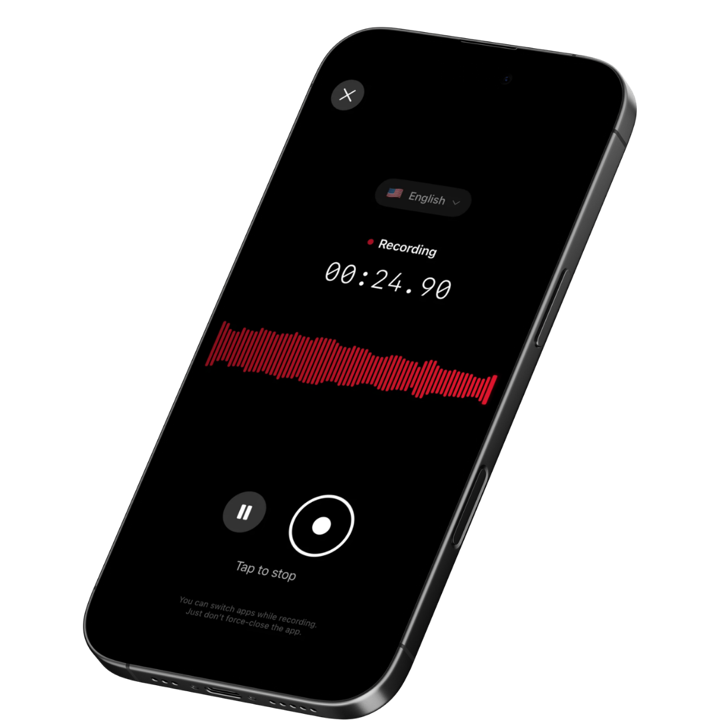
Speakwise is an iOS-native AI voice notes app that treats voice recording as the starting point for structured, organized notes. Tap once or use AirPods hands-free to record a meeting, a brainstorm session, or an idea dump. When you stop recording, Speakwise produces a full transcript, an AI summary with key points and decisions, and automatically extracted action items - all organized as a searchable note in your library.
Why Speakwise Stands Out
Most apps treat voice as an attachment to a note. Speakwise treats voice as the note's source. The AI processing step between recording and note means you do not get a raw audio file - you get a structured document with the substance of what was said already organized. For professionals who capture most of their working day through conversations rather than typing, that structure is the entire value.
The combination of note-taking and voice recording extends across use cases. Capture a client meeting, a product brainstorm, a voice memo with three ideas, or a research interview. Each recording becomes a searchable, summarized note in the same library. For users who work in Notion, the native sync pushes notes directly to their existing workspace.
AirPods hands-free control means voice can be captured without touching your phone - useful for capturing thoughts while walking, commuting, or between meetings. This hands-free capture model is covered in more depth in our best AI note taker for iPhone roundup. For users focused specifically on the voice memo side of this workflow, see the best app for voice notes on iPhone.
Key Features
- AI-Structured Notes from Voice: After recording, Speakwise extracts key points, decisions, and action items - turning a spoken note into a structured document rather than a raw transcript.
- Full Transcript with Searchable Library: Every recording gets a searchable transcript stored in your note library. Find any word or idea you spoke weeks ago.
- Long Recording Support: No session cap. Capture multi-hour meetings, extended brainstorms, and long lectures all in one recording.
- Works Offline: Record ideas and meetings anywhere without signal. The recording saves locally and syncs when you reconnect to the internet.
- Action Items Extracted Automatically: Commitments, follow-ups, and next steps are pulled from voice recordings and ready to act on immediately.
- 100+ Languages: Speak in any of 100+ supported languages with automatic detection. Multilingual note-takers who switch between languages mid-session are supported.
- Native Notion Sync: Voice notes, summaries, and transcripts push directly to your Notion workspace - not as a file export but as a native integration.
- AirPods Hands-Free Control: Start, pause, and stop recording with a tap on your AirPods. No phone interaction needed during capture.
Pricing
- Free Trial: Full access to all features
- Premium: $59.99/year - unlimited transcription, AI summaries, Notion sync, 100+ languages
Best For
- Professionals whose notes come primarily from spoken conversations
- Anyone who wants a single app for both voice recording and structured note organization
- Notion users who need voice input to flow into their existing workspace
- Multilingual note-takers working across languages
Limitations
- iOS only - no Android app or web-based note editor
- AI summaries work best with focused, coherent recordings - freeform creative recordings produce less structured output
- Not a keyboard-first text editor for typed notes; primarily voice-in, text-out
Speakwise gets your hours back.
- ✓Built for in-person meetings, interviews, and site visits.
- ✓Trusted by recruiters, consultants, agents, and field pros.
- ✓One tap to record. Notion-ready summary in minutes.

2. Otter.ai - Best for Voice Notes with Team Collaboration
Otter.ai is built for transcription-first note capture. Record a voice note or a meeting on the iOS app, get a real-time transcript, and immediately share it with teammates via a link. Collaborators can highlight sections, add comments, and assign action items within the transcript - making it practical for team note-taking workflows.
OtterPilot auto-joins Zoom and Teams calls as a bot, extending Otter's voice capture beyond manual recordings. For teams who split between in-person meetings and video calls, both modes land in the same Otter workspace.
The free tier gives 300 minutes per month with a 30-minute session cap. AI summaries require a paid plan. Otter's strength is the collaborative layer around notes - search, annotation, and sharing - rather than the depth of AI structuring.
Key Features
- Real-time transcription via iOS app
- Shareable, annotatable transcripts for team collaboration
- OtterPilot for automatic video call transcription
- AI-generated summaries and action items on paid plans
Pricing
Free: 300 min/month, 30-min session cap. Paid from ~$8.33/user/month.
Best For
- Teams who need shared, annotatable voice notes from meetings
- Users already in the Otter ecosystem for video call transcription
Limitations
- 30-minute session cap restricts longer recordings on free tier
- AI summaries require a paid subscription
- Less structured note output compared to Speakwise
3. AudioPen - Best for Converting Voice to Polished Text Notes
AudioPen is purpose-built for one use case: you speak in an unstructured, exploratory way and it rewrites that input as clean, organized prose. For note-takers who capture ideas by voice but struggle to organize them into coherent notes, AudioPen eliminates the manual structuring step.
You speak for a minute or two, choose a writing style, and AudioPen returns a polished text note in that style. It is not a verbatim transcription tool - it rewrites your spoken input, which means it works best for idea capture and short notes rather than verbatim meeting records. At ~$99/year for Pro, it targets users who value rewriting quality over raw transcript accuracy.
Key Features
- Voice-to-structured-text rewriting (not verbatim)
- Adjustable writing tone and style
- iOS app with quick capture
- Organized note library
Pricing
Free tier available. Pro ~$99/year.
Best For
- Note-takers who brainstorm verbally but need polished written output
- Short idea capture and paragraph drafting
Limitations
- Not suited for verbatim transcription or long meeting notes
- Short session focus limits multi-hour recordings
- No meeting-specific features like speaker detection or action item extraction
4. Voicenotes.com - Best for a Voice-First Searchable Note Library
Voicenotes.com is designed around the premise that voice is the fastest and most natural way to capture a thought. Record a voice note, get a transcript, and the note becomes part of a searchable library. The AI layer adds a basic summary to each note.
For users who currently speak their thoughts into Voice Memos and lose them forever, Voicenotes.com replaces that habit with something organized and findable. It is not as deep as Speakwise on AI structuring, but for personal idea capture and voice journaling, it is a clean, focused tool.
The web app and iOS app stay in sync. Pro is around $10/month.
Key Features
- Voice note capture with automatic transcription
- AI-generated summaries for each note
- Searchable voice note library
- iOS and web sync
Pricing
Free tier available. Pro ~$10/month.
Best For
- Personal idea capture and voice journaling
- Users replacing the Voice Memos habit with a searchable library
Limitations
- Not built for meeting transcription or team use
- Less structured AI output than Speakwise
- No integrations with Notion or project management tools
5. Just Press Record - Best for Simple Transcribed Voice Notes
Just Press Record is a one-time purchase iOS app that turns a voice recording into a transcribed note with minimal friction. Tap the iOS widget, speak, get a transcript. The transcript is the note.
For users who want a voice-to-text note workflow without subscriptions, AI overhead, or complex organization, Just Press Record is the most direct path. The one-time $4.99 purchase covers all core functionality. Offline recording works without signal. Notes are accessible via the iOS share sheet for copying into other apps.
Key Features
- One-tap recording from iOS widget
- Transcription with basic speaker detection
- Offline recording with sync
- Share sheet integration with any app
Pricing
One-time purchase (~$4.99).
Best For
- Users who want simple voice-to-transcript notes without ongoing cost
- Offline environments with no reliable signal
Limitations
- No AI organization or summaries
- Notes require manual editing and organization
- No library features like search across past recordings
6. Mem.ai - Best for AI-Organized Notes with Voice Input
Mem.ai is an AI-powered note-taking app focused on automatic organization. Notes are not filed into folders - the AI surfaces relevant notes based on context, links related ideas, and builds a searchable second brain from your inputs. Voice input is supported through transcription, though Mem is primarily a keyboard-first note editor.
The AI curation layer is Mem's standout feature. If you maintain a large personal knowledge base and want the AI to surface relevant past notes automatically, Mem's approach is distinct from folder-based tools. At ~$14.99/month, it targets power users with deep note archives. For voice-first users, combining Mem with a separate voice capture tool is a common workflow.
Key Features
- AI-powered automatic note organization and linking
- Voice input transcription
- Cross-device sync
- Semantic search across all notes
Pricing
~$14.99/user/month.
Best For
- Knowledge-heavy users who maintain large note archives
- Users who want AI to surface relevant past notes automatically
Limitations
- Primarily keyboard-first; voice is a secondary input method
- Expensive for users who only need basic note-taking
- Less meeting-specific than dedicated transcription apps
How to Choose the Best Note-Taking iPhone App with Voice Recording
The right tool depends on how central voice is to your note-taking workflow:
-
Voice as primary vs. secondary input: If voice is your main note input - you record meetings, brainstorms, and ideas by speaking - choose an app designed around voice-first capture like Speakwise or Voicenotes.com. If voice is occasional and typing is primary, a keyboard-first note app with a recording attachment feature may fit better.
-
AI structuring depth: Basic transcription gives you text from audio. AI structuring gives you a summary, key points, and action items from that audio. For meeting notes specifically, structuring depth matters far more than raw transcription speed.
-
Note organization model: Some tools organize notes in folders (like Notion). Others use AI-driven surfacing (Mem.ai). Others use a flat searchable library (Voicenotes.com). Match the organization model to how you actually find and use past notes.
-
Team vs. personal use: If notes need to be shared, annotated, or collaborative, look for team features. Otter.ai and Speakwise (via Notion) both support team access. For personal capture only, simpler tools work fine.
-
Integration with your existing workflow: If your work already lives in Notion, Speakwise's native sync is the lowest-friction path. If it lives in another system, check whether the voice note app exports to your destination without extra steps.
Frequently Asked Questions
What is the best note-taking iPhone app with voice recording in 2026?
Speakwise is the best note-taking iPhone app with voice recording in 2026. It captures voice recordings and transforms them into structured notes - including an AI summary, full searchable transcript, and automatically extracted action items. Each recording becomes an organized note in a searchable library, with optional native sync to Notion. The free trial includes full access to all features before committing to $59.99/year Premium.
Can I use an iPhone note-taking app for voice recording without internet?
Yes. Speakwise records offline and stores the audio locally on your iPhone, syncing the transcript and notes when you reconnect. Just Press Record also records fully offline. This matters for users who capture notes during travel, in buildings with poor signal, or in environments where mobile data is unavailable. Note that cloud-dependent features like AI summaries typically require an internet connection to process.
What is the difference between a voice recorder and a note-taking app with voice recording?
A dedicated voice recorder captures audio and may transcribe it. A note-taking app with voice recording goes further: the voice capture feeds into an organized note system with search, tagging, and AI processing. The output of a good voice-first note app is a searchable, structured note - not just a transcript. Apps like Speakwise produce AI summaries and action items from recordings, making the result more useful than a raw audio file or plain transcript.
What features should I look for in a note-taking iPhone app with voice recording?
Four features matter most: AI structuring (summaries and action items, not just transcription), a searchable note library (find any voice note by keyword), offline recording capability, and integration with your existing workflow (Notion, email, or sharing via iOS share sheet). For team use, also check for collaborative features like shared notes and annotations. For personal use, focus on AI depth and search quality.
Does Speakwise replace a traditional note-taking app like Notion or Apple Notes?
Not entirely. Speakwise is optimized for voice-first input - it excels at capturing spoken content and turning it into structured notes. For keyboard-based writing, task management, and document organization, traditional note apps like Notion are more capable. Many Speakwise users run both: Speakwise for capturing meetings and voice input, Notion for the broader note and project system. Speakwise's native Notion sync means those two tools connect without a manual copy-paste step.
Final Verdict
The best note-taking iPhone app with voice recording is not a dedicated voice recorder with transcription bolted on. It is a tool where voice is the primary input and the output is an organized, structured, searchable note.
Speakwise earns the top spot because it completes that full workflow: voice in, structured note out, native Notion sync for users with existing note systems. For teams who need collaborative voice notes, Otter.ai is a strong second. For users who want AI to rewrite their voice input as polished prose, AudioPen fills a specific need.
For context on how voice recording tools compare more broadly, see the best AI note-taking app roundup for 2026 and the best app for capturing ideas by voice.
Download Speakwise from the App Store and start turning your voice recordings into organized, searchable notes.
🎯 4.9★ App Store Rating | 📱 Built for iOS
