ChatGPT at Work Statistics: 23 Adoption Findings for 2026
Used by recruiters, executives, consultants, and more.
ChatGPT at Work Statistics: 23 Adoption Findings for 2026
ChatGPT's workplace penetration has accelerated sharply. Pew Research found that 28% of employed adults use ChatGPT at work as of 2025 - more than triple the 8% who did two years earlier. OpenAI reports over 7 million ChatGPT for Work seats, with enterprise seat count growing approximately 9x year-over-year. Writing tasks dominate: approximately 40% of all work-related ChatGPT messages involve writing, and 61% of users rely on it for emails, blog posts, and reports. The productivity data is striking - access to a generative AI assistant increased issues resolved per hour by 14% in a large-scale customer support experiment, while knowledge workers report saving 40-80 minutes per day. Yet adoption is deeply unequal: employees aged 18-29 are more than twice as likely to use ChatGPT at work as those over 50, and 59% of employees hide AI use from their managers. These 23 statistics trace ChatGPT's trajectory from novelty to workplace infrastructure.
ChatGPT crossed 1 million users in its first five days after launch in November 2022. By mid-2026, it has become the most widely adopted AI tool in workplace history. Yet widespread adoption coexists with significant policy gaps, governance challenges, and an emerging divide between workers who use AI confidently and those who use it covertly or not at all.
For the foundational adoption context, our generative AI at work statistics post covers the broader category. For data on AI anxiety among workers navigating these shifts, see our workplace AI adoption statistics analysis.
1. 28% of employed adults use ChatGPT at work - triple the rate from two years ago
Pew Research Center's 2025 survey found that 28% of employed adults report using ChatGPT at work, up from approximately 8% two years earlier. Among those workplace users, 24.2% used it at least one day in the preceding week, and 10.6% used it every workday. The tripling of workplace adoption in two years is one of the fastest technology diffusion rates recorded for a professional tool. For context, email took over a decade to reach equivalent penetration among knowledge workers. The acceleration reflects both improving AI capabilities and organizational normalization - ChatGPT has moved from experimental novelty to accepted tool in most knowledge-worker environments, even in organizations without formal AI policies.
Source: Pew Research Center - ChatGPT Use Among Americans Roughly Doubled Since 2023
2. 40% of all work-related ChatGPT messages involve writing tasks
OpenAI's analysis of 2.5 billion daily ChatGPT messages found that as of July 2025, approximately 56% of work-related messages are classified as "Doing" (performing job tasks), and of those, nearly three-quarters are Writing tasks. About 40% of all work-related ChatGPT messages involve writing - making it by far the most common workplace use case. This writing dominance is consistent across industries: computer-related occupations use ChatGPT for 57% of work tasks, while management and business professionals show 50% usage. Writing in the workplace context covers emails, reports, meeting summaries, proposals, documentation, performance reviews, and communications of all kinds - the ambient output of organizational life.
Source: OpenAI - ChatGPT Usage and Adoption Patterns at Work
3. Enterprise ChatGPT seat count has grown approximately 9x year-over-year
By February 2026, OpenAI reported over 9 million paying business users across Team, Enterprise, and Edu plans, with more than 7 million ChatGPT for Work seats specifically. Enterprise seat growth of approximately 9x year-over-year represents extraordinary demand from organizations formalizing AI use that was previously happening informally. Enterprise and Team plans give organizations administrative controls, data privacy protections, and usage visibility - adoption of paid tiers thus represents a shift from uncontrolled individual use toward managed organizational deployment. The shift from shadow use to formal procurement also provides organizations with the usage data needed to identify high-value use cases and address adoption gaps.
Source: OpenAI - ChatGPT Usage and Adoption Patterns at Work
4. Workers 18-29 are more than twice as likely to use ChatGPT at work as those over 50
OpenAI's workplace adoption research found that employees aged 18-29 are more than twice as likely to use ChatGPT at work as colleagues over 50. Younger, less experienced, high-performing, and predominantly male employees lead adoption across the approximately 100,000-worker sample spanning 11 occupations. The age gap in adoption is not simply about technology comfort: younger workers have less accumulated tacit knowledge to draw on, making AI assistance relatively more valuable for tasks that experienced workers handle through pattern recognition. This creates an interesting dynamic where AI tools may be disproportionately valuable to early-career workers while also raising questions about whether AI-mediated shortcuts affect the development of deep expertise over time.
Source: PNAS - The unequal adoption of ChatGPT exacerbates existing inequalities among workers
5. 61% of users rely on ChatGPT for email and written communication tasks
A survey of ChatGPT users found that 61% rely on the tool specifically for writing tasks including emails, blog posts, and social media content. In workplace contexts, email drafting is the most commonly cited individual use case. The appeal is clear: email composition requires switching from deep work to communication mode, finding the right tone, and managing the cognitive overhead of professional writing conventions. ChatGPT reduces that overhead by providing a draft structure that workers then edit and personalize. The edit-from-draft workflow is consistently faster than compose-from-scratch for most workers, even accounting for the time spent reviewing and correcting AI output.
Source: Intelliarts - 100 ChatGPT Statistics to Know in 2025 & Its Future Trends
6. Access to a generative AI assistant increased customer support productivity by 14%
A large-scale experiment involving 5,000 customer support agents found that access to a generative AI assistant increased the number of issues resolved per hour by 14% on average. The productivity gain was concentrated among less experienced agents: newer agents who received AI assistance showed performance improvements approaching those of experienced agents. More experienced agents showed smaller percentage gains, likely because they already had robust pattern recognition and communication strategies. The 14% figure is one of the more rigorous productivity estimates available for AI in a workplace context, as it is based on controlled deployment with randomized access rather than self-reported time savings.
Source: Science - Experimental evidence on the productivity effects of generative artificial intelligence
7. Professional writing tasks completed 40% faster with ChatGPT use
A study published in Science examining professional writing tasks found that average completion time decreased by 40% for workers with access to ChatGPT, while output quality rose by 18%. The simultaneous improvement in speed and quality is significant: most productivity interventions achieve one at the cost of the other. The quality improvement (as rated by blind evaluators) suggests that AI assistance does not simply speed up mediocre work but helps workers produce better-structured, more complete outputs. The study covered a range of professional writing tasks including memos, reports, and analytical summaries - tasks common across knowledge-worker roles in most industries.
Source: Science - Experimental evidence on the productivity effects of generative artificial intelligence
8. Knowledge workers report saving 40-80 minutes per day with generative AI
OpenAI's research notes that enterprise users report saving 40-60 minutes per day, while broader estimates across generative AI tools suggest 40-80 minutes daily for consistent users. A separate 2024 global survey of over 13,000 workers across 15 countries found that approximately half of employees using generative AI save at least five hours per week. Five hours per week represents more than 12% of a standard work schedule - a substantial reallocation of time that, depending on how it is used, can translate to either higher output, reduced work hours, or improved work quality. The variance in time savings reflects differences in task mix, AI proficiency, and workflow integration.
Source: The Decoder - OpenAI Claims Generative AI Saves Knowledge Workers 40 to 80 Minutes a Day
9. Sales professionals using AI are 47% more productive and save 12 hours per week
Among sales professionals, AI adoption shows particularly strong productivity effects: workers using AI tools report being 47% more productive and saving approximately 12 hours per week. Sales roles involve high volumes of written communication (prospecting emails, follow-ups, proposals), research tasks (account prep, competitive research), and documentation (CRM updates, call notes), all of which are well-suited to AI assistance. The 12-hour weekly saving is striking - it represents nearly a full additional workday per week returned to higher-value selling activities. The productivity effect in sales also has measurable revenue implications, making AI adoption economics more straightforward to quantify in this function than in roles with less direct revenue attribution.
Source: Chanty - ChatGPT in 2026: Statistics, Productivity Impact, and Hidden Risks
10. 43% of AI-using workers admit sharing sensitive work data with AI without employer knowledge
A 2024 multi-country study by CybSafe and the National Cybersecurity Alliance, covering over 7,000 participants, found that 38% of employed respondents who use AI have submitted sensitive work-related information to AI tools without their employer knowing. Other surveys show higher figures: 43% of workers admit to sharing sensitive information without employer knowledge, with source code, customer data, and internal financial information among the most commonly shared data types. Cyberhaven tracked a 485% increase in corporate data pasted into AI tools from March 2023 to March 2024. This behavior is driven partly by genuine ignorance of data governance policies and partly by the productivity value workers perceive in using the most capable available tools, regardless of approval status.
Source: Cybernews - 59% of employees hide AI use from their bosses
11. 59% of employees hide their AI use from managers
A survey of employed workers found that 59% hide their AI use from managers or do not disclose that outputs were AI-assisted. Workers in this group report two primary motivations: concern that managers will perceive AI-assisted work as less valuable or skillful, and concern about violating unstated organizational norms even in the absence of explicit policy. The hide-from-manager behavior creates a reporting problem for organizations: actual AI adoption is substantially higher than visible adoption, making it impossible to assess productivity gains, data governance risks, or training needs accurately. Organizations with explicit AI acceptance policies show lower hiding rates - openness about AI use increases when organizational culture signals that AI assistance is legitimate.
Source: Cybernews - 59% of employees hide AI use from their bosses
12. Workers at 90% of companies use personal chatbot accounts for daily tasks without IT approval
Fortune's 2025 reporting on shadow AI found that workers at more than 90% of companies are using personal chatbot accounts for daily work tasks, often without approval from IT or their organization. Only 40% of companies actually have official LLM subscriptions. The gap between where AI use is occurring (everywhere) and where it is sanctioned (minority of organizations) defines the shadow AI problem. Less than 11% of AI applications in use at any given workplace are visible to IT teams, according to one 2025 security research firm. This visibility gap makes it structurally impossible for organizations to govern AI data flows, ensure consistent quality, or extract organizational learning from distributed AI use.
Source: Fortune - The 'shadow AI economy' is booming
13. 63% of organizations have no AI governance policy or are still developing one
Security and compliance surveys consistently find that 63% of organizations either lack an AI governance policy or are in early-stage development. This policy vacuum creates compounding risks: data leakage (46% of organizations report internal data leaks through generative AI), inconsistent quality of AI-assisted outputs, liability exposure from AI errors in client deliverables, and inability to systematically build on AI use learnings across the organization. The policy gap is not unique to small organizations: many large enterprises that moved quickly to adopt AI capabilities outpaced their governance frameworks, creating the same vacuum at scale with higher stakes.
Source: Skywork AI - Shadow AI: Why 37% of Employees Are a 2025 Security Threat
14. Marketing has the highest ChatGPT workplace adoption at 77%
Industry-level ChatGPT adoption varies substantially. Marketing leads with 77% of professionals reporting ChatGPT use at work, followed by consulting at 71% and advertising at 67%. The insurance sector shows the lowest adoption at 33%. Marketing's leading position reflects the high volume of written content production required in the function - brand copy, campaign briefs, email sequences, social content, reports - all well-suited to AI drafting. Consulting's high adoption reflects the research, synthesis, and document production demands of the role. The wide range from 33% to 77% across industries suggests that sectoral adoption is still in progress and will likely converge upward as AI capabilities improve and organizational familiarity grows.
Source: Intelliarts - 100 ChatGPT Statistics to Know in 2025 & Its Future Trends
15. Daily ChatGPT use among workplace users has doubled year-over-year
Among workers who use ChatGPT at all, the frequency of use has intensified: daily use doubled year-over-year through 2025. Gallup data covering the second and third quarters of 2025 showed that the share of U.S. workers using AI on the job at least a few times a week grew from 19% to 23% in a single quarter. The shift from occasional to frequent use signals a transition from experimental adoption to workflow integration. Workers who use AI tools daily develop higher skill with them, integrate them into habitual workflows, and derive systematically larger productivity benefits than occasional users. The frequency gap between daily and occasional users is therefore likely to widen over time as daily users compound their AI literacy.
Source: Allwork - U.S. Workplace AI Use Jumps to 45%, According to Gallup Data
16. U.S. workplace AI use jumped from 40% to 45% in a single quarter (2025)
Gallup's tracking data showed U.S. workplace AI use rising from 40% to 45% between Q2 and Q3 2025 - a 5-percentage-point gain in roughly 90 days. At this growth rate, U.S. workplace AI adoption is on track to approach majority status among knowledge workers within the next 12-18 months. The quarter-over-quarter acceleration suggests that adoption is not plateauing but is in the steep portion of the diffusion curve - the phase where social proof, improving tool quality, and competitive pressure among employers all reinforce each other to accelerate uptake.
Source: Allwork - U.S. Workplace AI Use Jumps to 45%, According to Gallup Data
17. Generative AI users estimated to boost U.S. labor productivity by 1.3%
Economists at the Federal Reserve and affiliated institutions estimate that self-reported time savings from generative AI correspond to 1.6% of all U.S. work hours, implying a 1.3% labor productivity boost since ChatGPT's release when incorporated into a standard production model. While 1.3% may sound modest, productivity gains of this magnitude across an entire economy are economically significant - equivalent to the productivity impact of major industrial-era innovations in their early deployment phases. The St. Louis Fed analysis also notes that as AI adoption increases and users become more proficient, the aggregate productivity effect is expected to grow further.
Source: St. Louis Fed - Generative AI, Productivity and the Future of Work
18. ChatGPT has 800 million+ monthly active users globally as of early 2026
By early 2026, ChatGPT surpassed 800 million monthly active users globally - a scale that makes it one of the most rapidly adopted software products in history. For comparison, it took Facebook seven years to reach 1 billion users; ChatGPT reached two-thirds of that figure in approximately three years. In workplace contexts, global user scale creates network effects: more users generate more use cases, more fine-tuning feedback, and more organizational knowledge about effective AI prompting practices. The scale also means that competitors to ChatGPT face a user familiarity advantage: workers who learn ChatGPT's interaction patterns apply that knowledge to other LLM tools, creating a general AI literacy rather than a tool-specific one.
Source: Index.dev - ChatGPT Stats in 2026: 800M Users, Traffic Data & Usage Breakdown
19. 85% of employees with approved AI tools also use unapproved ones
A 2025 security survey found that 85% of employees who have access to approved organizational AI tools also use unapproved tools in parallel. This finding reveals that even organizations that have established AI tool governance do not achieve exclusive adoption of sanctioned tools. Workers supplement approved tools with personal favorites, specialized tools for specific tasks, or the most recently released capabilities not yet available in enterprise-approved versions. For IT and security teams, this means that approved tool adoption is necessary but not sufficient for data governance: shadow AI persists even where official AI exists, driven by the pace of capability development in the consumer AI market.
Source: Unseen Security - The State of Shadow AI 2026
20. ChatGPT reaches half of 100,000-worker sample across 11 occupations
An OpenAI-affiliated study of approximately 100,000 workers across 11 different occupations found that roughly half had adopted ChatGPT, with the distribution heavily skewed by age, experience level, and performance tier. This large-sample cross-occupational study provides more granular adoption data than most surveys. The finding that approximately 50% adoption exists even in a cross-occupational sample that includes lower-AI-exposure roles confirms that ChatGPT has penetrated well beyond technology-adjacent roles. The study also found that adoption was higher among high performers - workers who were already above median in performance metrics showed faster and more extensive AI adoption, potentially amplifying existing performance gaps within organizations.
Source: PNAS - The unequal adoption of ChatGPT exacerbates existing inequalities among workers
21. 42% of companies scrapped most AI initiatives in 2025 - up from 17% in 2024
Despite surging individual adoption, S&P Global data shows that 42% of companies scrapped most of their AI initiatives in 2025, up dramatically from 17% in 2024. The corporate abandonment rate coexists with growing individual adoption because the two operate on different scales and timelines. Individual workers adopting ChatGPT for personal task assistance face low barriers and quick feedback. Enterprise AI initiatives involve complex integration, change management, governance, and ROI timelines that are harder to sustain. The gap between grassroots individual adoption and enterprise initiative success rates is one of the defining paradoxes of the current AI deployment phase.
Source: aiqlabs - Why Companies Are Abandoning ChatGPT in 2025
22. 75% of organizations considered banning ChatGPT - primarily over data security
A BlackBerry survey from 2023 found that 75% of organizations worldwide were implementing or considering bans on ChatGPT and generative AI applications, primarily to protect confidential information (cited by nearly 70%) and due to cybersecurity concerns (83%). While the blanket ban rate has declined since 2023 as organizations developed more nuanced governance approaches, data security remains the primary concern driving AI policy. The most common policy evolution has been from outright bans to conditional use policies: AI tools approved for specific task categories with prohibitions on entering specific data types. This governance maturation reflects organizations learning to balance productivity benefits against data risk rather than choosing between them.
Source: Darkreading - 75% of Organizations Worldwide Set to Ban ChatGPT
23. Generative AI adoption reached 54.6% of U.S. adults aged 18-64 by August 2025
Federal Reserve monitoring data found that by August 2025, 54.6% of U.S. adults aged 18-64 had used generative AI, up from 44.6% a year earlier. Work-related use specifically rose from 33.3% to 37.4% over the same period. The Fed data is notable for its methodology: it provides nationally representative estimates with consistent definitions, unlike vendor-reported figures that may reflect different usage thresholds. The rising share of adults using generative AI for work-related tasks - approaching four in ten employed adults - confirms that AI assistance has become a mainstream work practice rather than an early-adopter phenomenon, even accounting for variation across occupations and age groups.
Source: Federal Reserve - Monitoring AI Adoption in the US Economy
What the ChatGPT Adoption Data Reveals for 2026
The statistics above describe a technology adoption curve at an inflection point. ChatGPT is moving from early-majority adoption among knowledge workers toward late-majority, with daily use patterns deepening among current adopters while new users continue to enter. The 9x enterprise seat growth, 40% of messages being writing tasks, and 28% employed adult adoption rate all point to a tool that has become genuine workplace infrastructure rather than an experiment.
The governance gap is the most significant structural problem the data reveals. Shadow AI, policy vacuums at 63% of organizations, and 59% of workers hiding AI use all describe an adoption pattern running well ahead of organizational capacity to manage it. This is not unusual in technology history - consumer internet use preceded corporate internet governance by years - but it creates compounding risks around data exposure and compliance that will require deliberate organizational response.
The productivity evidence is more robust than initial skepticism suggested. A 40% reduction in writing task time, a 14% customer support productivity gain, and a 1.3% aggregate labor productivity boost in Fed estimates are all measured from real deployments rather than vendor projections. The productivity effects are real and growing as users develop AI proficiency. The distributional question - who captures the productivity gains, workers through shorter hours or employers through higher output - remains unresolved.
ChatGPT's workplace story in 2026 is one of individual adoption outpacing organizational governance, with productivity gains concentrated among frequent adopters and the gap between high and low adopters widening.
How Speakwise Fits Into the AI Work Stack
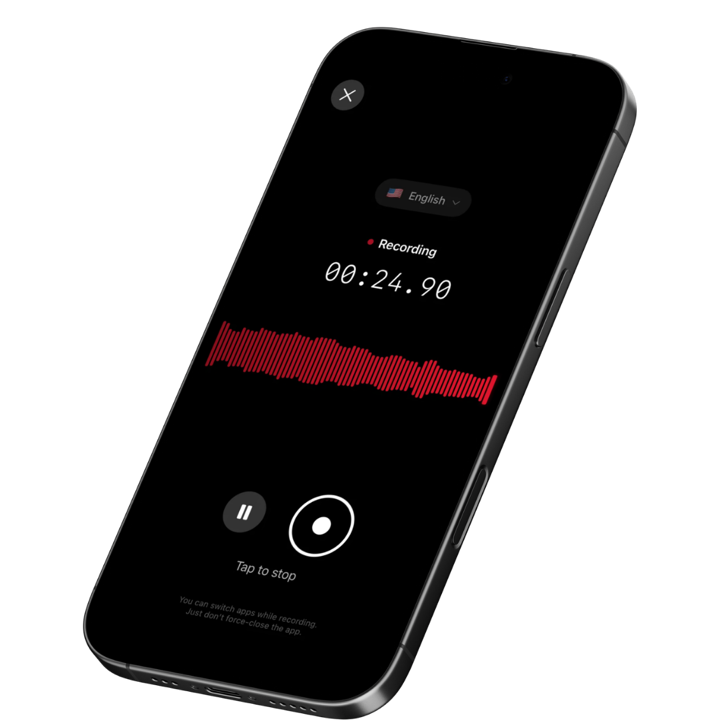
ChatGPT excels at text generation from text prompts. What it cannot do without additional tools is capture spoken context from meetings and conversations - the raw material of much workplace knowledge. Speakwise fills that gap as the audio-to-insight layer: one-tap or AirPods hands-free recording captures in-person conversations, then produces summaries, accurate transcripts in 100+ languages, and automatic action item extraction. Native Notion sync means captured knowledge flows directly into the workflows where teams already operate.
For the growing segment of workers building a personal AI work stack, Speakwise handles the meeting and conversation layer that text-based tools like ChatGPT cannot access directly. The combination covers the full information cycle: capture spoken context with Speakwise, then use ChatGPT or similar tools for downstream analysis and communication. As documented in our meeting transcription statistics analysis, the post-meeting processing burden is one of the most time-consuming knowledge worker activities and one of the highest-value targets for AI-assisted efficiency.
Download Speakwise on the App Store and add the audio intelligence layer to your AI work stack.
4.9-star App Store rating with thousands of installs.
Download Speakwise on the App Store

🎯 4.9★ App Store Rating | 📱 Built for iOS
