Forgetting Curve Statistics 2026: How Fast We Forget
TL;DR
Forgetting curve statistics for 2026 show memory drops fast, then levels off. In 1885, Hermann Ebbinghaus reported that savings, not percent remembered, fell to 34% after one day and 21% after a month. This post collects 16 statistics on the forgetting curve and what slows it down. Speakwise keeps a transcript so what was said does not depend on memory.
Used by recruiters, executives, consultants, and more.
Forgetting Curve Statistics 2026: How Fast We Forget
Forgetting curve statistics start with Hermann Ebbinghaus, who reported in 1885 how much faster he could relearn a list rather than how much of it he could recite. His relearning savings fell to about 58% after 20 minutes and 21% after a month, a shape a 2015 replication in PLOS ONE largely confirmed. The popular claim that workers forget 70% of training in a day is not a fixed rule: a 2010 review of 69 cases found forgetting from 0% to 94% across gaps from hours to 8 years, and from 0% to 73% when people were tested one to two days later. What reliably slows forgetting is spacing out study sessions and testing yourself: one 2006 meta-analysis found spaced study beat massed study (repeats with no break) 47.3% to 36.7%, and a classic 2006 study found that one recall test beat restudying a week later, 56% to 42%.
Meetings, lectures and training sessions all assume people will remember what was said. Ebbinghaus's curve, and more than a century of research since, shows that assumption does not hold up on its own. Without something that interrupts the natural decay, a review, a retrieval attempt, or an accurate record of what happened, part of what gets covered can fade within a day or two, and how much depends on the material and how well it was learned.
This post covers 16 statistics on the forgetting curve: what Ebbinghaus actually measured, how a modern replication held up, what the evidence says about spacing and testing, and why the popular "70% forgotten" training claim does not hold up.
Key Forgetting Curve Statistics (2026)
- Forgetting curve statistics from Hermann Ebbinghaus's 1885 book show his savings score fell to 58% after 20 minutes and 21% after a month (SuperMemo).
- The claim that employees forget 70% of training within 24 hours is not a fixed rule: a 2010 review of 69 cases found forgetting from 0% to 94%, and from 0% to 73% for gaps of one to two days (cited in this L&D newsletter).
- A 2015 replication found its one subject, the paper's second author, had 31-day savings of just 4.1% (13.7% after a correction for slower learning), far below Ebbinghaus's original 21% (Murre and Dros, PLOS ONE).
- A 1991 study found that forgetting follows a power function of time rather than a straight line, a pattern confirmed across human word recall, face recognition and pigeon memory tests (Wixted and Ebbesen, Psychological Science).
- Spaced study produced 47.3% recall versus 36.7% for massed study (repeats with no break), across 271 comparisons, most of them tested within 10 minutes (Cepeda et al., Psychological Bulletin).
- One recall test beat restudying a week later: the tested group recalled 56% of a passage and the restudy group 42% in a classic 2006 memory study (Roediger and Karpicke, Psychological Science).
- A 2014 meta-analysis of 61 studies found retrieval practice beat restudying with an effect size of g = 0.50 (Rowland, Psychological Bulletin).
1. Ebbinghaus's savings fell to 58% after just 20 minutes
In 1879 and 1880, the German psychologist Hermann Ebbinghaus ran memory experiments on himself (he published them in 1885), using lists of meaningless three-letter syllables, so no real-world meaning could help him remember them. He read a list until he could recite it perfectly, then came back later and relearned it. He did not test how many syllables he could still recite from memory. He timed how much faster the second round went, and called that gain his "savings" score. Just 20 minutes after first learning a list, Ebbinghaus needed about 58% less effort to relearn it. That is a measure of relearning speed, not a percentage of the list he could recall on demand. The distinction matters: a savings score and a "percent remembered" score answer different questions, so a savings number should not be read as a share of facts remembered.
Source: Classics in the History of Psychology: Ebbinghaus's Memory, Chapter 7 and SuperMemo: Ebbinghaus and the Forgetting Curve
2. By the next day, savings had dropped to about a third
One day after learning a list, Ebbinghaus's savings had fallen to about 34%, or as he put it in his book, "after 24 hours about one third was always remembered." The sharpest drop in the whole curve happens in this first day: savings fall from 58% at 20 minutes to roughly a third by the next day, a loss of about 24 percentage points. After that, the curve keeps falling, but far more slowly. The shape, a steep early plunge followed by a long, shallow tail, is the real "forgetting curve" people mean when they cite Ebbinghaus. It is also the shape that a popular workplace training statistic gets badly wrong, as the next section explains. In Ebbinghaus's data the biggest drop came in the first day. His lists were nonsense syllables, so real meetings and lectures can fade faster or slower.
Source: Classics in the History of Psychology: Ebbinghaus's Memory, Chapter 7 and SuperMemo: Ebbinghaus and the Forgetting Curve
3. A month later, relearning still saved about one fifth of the effort
By 31 days after learning, Ebbinghaus's savings had leveled off at about 21%, close to his own description that "after a whole month fully one fifth of the first work persisted in effect." At 6 days, his savings were about one fourth, or 25%. Measured another way, savings fell by about 24 percentage points in the first day alone, from 58% to 34%, but by only about 13 more points over the next 30 days. Forgetting is heavily front-loaded: once material survives the first day or two, what is left tends to stick around much longer. This pattern, a steep early fall followed by a long, flat tail, shows up again in the modern research below, including studies on school vocabulary that people still remember decades later.
Source: Classics in the History of Psychology: Ebbinghaus's Memory, Chapter 7 and SuperMemo: Ebbinghaus and the Forgetting Curve
4. The "employees forget 70% of training in a day" claim is a myth
No fixed rate of forgetting is true for everyone, so a rule like "employees forget 70% of their training within 24 hours, or 90% within a week" cannot be right. The claim is usually credited to Ebbinghaus, but his actual 24-hour number was a savings score of about 34%. In his own words, "about one third was always remembered." A savings score is not a count of facts forgotten, so it should not be turned into "two thirds forgotten." Workplace learning researcher Will Thalheimer reviewed real forgetting studies in 2010 and analyzed 69 separate cases from 14 research articles in his own collection (he says the sample is not random or representative), covering more than 1,000 learners. He found people forgot anywhere from 0% to 94% depending on the material, the test and how much time passed, from several hours to eight years, and specifically 0% to 73% within the one-to-two-day window the "70%" myth claims to describe. His conclusion: rules of thumb that assign forgetting a single fixed rate are, in his words, "just plain false." How much someone forgets depends on how meaningful the material is, how well it was learned, and whether it gets reviewed.
Source: Will Thalheimer: How Much Do People Forget? (Work-Learning Research, 2010)
5. A 2015 replication confirmed the curve's shape with real data
More than 130 years after Ebbinghaus, researchers Jaap Murre and Joeri Dros ran the experiment again and published the results in PLOS ONE in 2015. The paper's second author was the only subject; he learned and relearned 70 lists of nonsense syllables, tested across the same seven gaps Ebbinghaus used: 20 minutes, 1 hour, 9 hours, 1 day, 2 days, 6 days and 31 days. The replication's savings scores followed a similar overall shape to Ebbinghaus's data: a fast drop at first, then a long, slow decline. The paper defines savings exactly as Ebbinghaus did: "the relative amount of time saved on the second learning trial as a result of having had the first." That shows the replication used Ebbinghaus's own method, which measures forgetting through relearning speed, not a memory quiz. The authors also scored how many syllables were recalled, and that curve was much shallower than the savings curve.
Source: PLOS ONE: Replication and Analysis of Ebbinghaus' Forgetting Curve
6. The replication's long-term savings were far noisier than Ebbinghaus's
The 2015 replication did not match Ebbinghaus's long-term numbers exactly. At the 31-day mark, the single subject's savings measured just 4.1%, far below Ebbinghaus's own 21%. The researchers also found a separate issue: learning took steadily longer across the months-long experiment. Once they corrected for that, the 31-day figure rose to 13.7%, still well under Ebbinghaus's original number. The researchers compared that corrected value with three older results in the same table, Ebbinghaus's own data and two subjects from a 1991 German replication by Heller, Mack and Seitz, and all three were close to 20%. The gap is a reminder that one person's memory on one day is noisy. Averages over many people, like most of the statistics in this article, smooth out a lot of that noise. Ebbinghaus's original data came from one person, himself, so one data set should never be treated as a universal law.
Source: PLOS ONE: Replication and Analysis of Ebbinghaus' Forgetting Curve
7. Forgetting fits a power function, not a straight line
Mathematically, forgetting does not fall in a straight line or a simple exponential decay. In 1991, psychologists John Wixted and Ebbe Ebbesen ran three experiments, human word recall, human face recognition, and a pigeon memory task, and tested six different mathematical curves against the results. In every case, a power function, where forgetting slows down over time rather than continuing at a steady rate, fit the data better than linear, exponential and three other alternatives. The researchers even reanalyzed Ebbinghaus's original 1885 savings numbers and found the same power-function pattern in his data. A power function fitting forgetting in humans and in pigeons, across completely different kinds of memory, suggests this shape, fast at first and then increasingly gradual, is a basic feature of how memory fades, not a quirk of any one experiment.
Source: Psychological Science: On the Form of Forgetting
8. One review pooled 839 measurements of spacing from 317 experiments
How study time is spread out changes how much survives. In 2006, Nicholas Cepeda, Harold Pashler and colleagues reviewed studies comparing spaced-out practice with massed practice (repeats with no break), pooling 839 separate measurements of distributed practice drawn from 317 experiments in 184 published articles, which gave the researchers enough data to compare spacing effects across many retention intervals, participant groups and kinds of material, from word lists to general knowledge facts. Their headline conclusions: spacing out study sessions reliably beats massing them together, and the best gap between sessions depends on how long the material needs to be remembered, a detail statistic 10 covers.
9. Spaced study produced 47.3% recall versus 36.7% for massed study
Pooling all retention intervals, Cepeda and colleagues found that spaced study produced an average of 47.3% correct recall on a final test, compared with 36.7% for massed study, where the same item is shown once or repeated with no break. Most of these tests (229 of 271) came within 10 minutes of studying. That comparison drew on 271 separate performance differences and 254 studies. A gap of about 11 percentage points held up in 259 of the 271 comparisons; only 12 showed no effect or a negative effect. The comparison held total study time roughly constant between the two groups, so the gap came from how that time was spread out, not simply from spaced learners studying more overall.
10. The ideal gap between study sessions grows with retention time
Spacing is not one-size-fits-all. Cepeda and colleagues found that the ideal gap between study sessions depends on how long the material needs to be remembered afterward: the longer the retention interval, the longer the ideal gap. For material that needs to be remembered 6 months or more later, the review found that gaps of at least a month between study sessions produced the best retention. For anything meant to stick around, from training content to lecture material, the spacing has to match how far in the future it needs to be recalled.
11. Testing yourself once beat restudying a week later: 56% vs 42%
Taking a test on material, even once, changes how well it is remembered later, but not right away. In a 2006 study, Henry Roediger and Jeffrey Karpicke had college students read a passage, then either take one recall test or restudy the passage instead. Five minutes later, restudying still won: 81% recall versus 75% for the tested group. One week later, the result flipped hard: the tested group recalled 56% of the material, while the restudy group recalled only 42%. A single test, with no extra study time, outperformed an extra study session once enough time had passed for forgetting to set in.
Source: Psychological Science: Test-Enhanced Learning (Roediger and Karpicke, 2006)
12. Repeated testing widened the gap further: 61% vs 40%
A second experiment in the same study pushed the comparison further. Some students restudied a passage four times; others studied it once and were tested on it three times, with no feedback on whether their answers were right. At the 5-minute mark, the repeated-study group still had an edge, recalling 83% of the material versus 71% for the repeated-testing group. Students who read the passage four times also felt more sure they would remember it a week later than students who took tests, yet they remembered less. A week later, the pattern reversed again, and by more: the repeated-testing group recalled 61% of the material, compared with just 40% for the repeated-study group. Both groups had four sessions, and the testing group read the passage only 3.4 times against 14.2 times for the restudy group, yet it recalled roughly half again as much a week later. The researchers' point was direct: testing is not just a way to measure learning, it is itself one of the more powerful ways to produce it.
Source: Psychological Science: Test-Enhanced Learning (Roediger and Karpicke, 2006)
13. A meta-analysis of 61 studies confirms the testing effect: g = 0.50
The Roediger and Karpicke result was not an isolated finding. In 2014, researcher Christopher Rowland pooled 159 separate effect sizes from 61 studies on testing versus restudying, published between 1975 and 2013, into a single meta-analysis. Across that body of research, practicing retrieval produced a reliable advantage over restudying, with an overall effect size of g = 0.50 (95% range 0.42 to 0.58). Rowland also found the advantage was larger for tests that required recalling an answer than for tests that only required recognizing it among options, suggesting that the effort of retrieval itself, not just seeing the material again, is what helps memory stick. Decades of studies, run by many researchers on many kinds of material, converge on the same basic conclusion.
Source: Psychological Bulletin: The Effect of Testing Versus Restudy on Retention (Rowland, 2014)
14. Knowledge that survives 5 years can last 25 years or more
Laboratory memory studies rarely run longer than a few weeks. Psychologist Harry Bahrick took a different approach, testing adults on Spanish vocabulary they had learned years or decades earlier in school. His research found that some of what people learn is lost within 5 years of their last exposure to it, but material that survives that first window tends to stick. A follow-up study by Bahrick and Elizabeth Phelps describes "virtually no knowledge" being lost during the years between 5 and 25 years after learning, for knowledge with a life span beyond that first 5-year mark. Bahrick called this long-surviving layer of knowledge a "permastore." The forgetting curve's steep early drop and long flat tail, first measured by Ebbinghaus over 31 days with nonsense syllables, shows up again across decades with real, meaningful material.
15. Of three gaps tested, 30 days between practice sessions gave the best 8-year recall
Bahrick did not just document forgetting; he also studied what slowed it. In a follow-up study, he and Elizabeth Phelps tracked 35 adults who had originally learned and relearned 50 English-Spanish word pairs at different spacing intervals, then tested their recall 8 years later. On average, people recalled about 10% of the word pairs after 8 years. Recall was 15% for people whose practice sessions were 30 days apart, 8% for people 1 day apart, and 6% for people with no gap at all. Two things predicted who remembered more: the gap between sessions, and how few tries it took to learn a word in the first place. The best case, a word learned in just 1 or 2 tries with sessions 30 days apart, was recalled 23% of the time. The lesson echoes the spacing research above: for memory meant to last years, not days, wider gaps between review sessions beat frequent, closely packed ones.
16. Only 2 of 10 popular study techniques earned a "high utility" rating
With a century of forgetting and memory research available, five cognitive psychologists published a report in 2013 that grades the study techniques students use. John Dunlosky and colleagues reviewed the evidence behind 10 learning techniques commonly used by students, from highlighting to practice testing, and rated each one's overall usefulness for learning. Only two earned a "high utility" rating: practice testing and distributed practice, the same two techniques behind several statistics above. Widely used habits like rereading, highlighting and underlining, and summarizing were all rated low utility, despite being some of the most common learning strategies used by students. Many students rely on habits the report rates low, so they may get less out of their study time than they could.
Source: Association for Psychological Science: Which Study Strategies Make the Grade?
What the Forgetting Curve Means for Meetings, Lectures and Training
Three things stand out from more than a century of forgetting research. First, Ebbinghaus was right about the shape: a steep early drop followed by a long, slow tail shows up in his own 1885 data, in a 2015 replication, and in Wixted and Ebbesen's power-function analysis of completely different kinds of memory. Second, the popular version of his finding, that people forget a fixed 70% or 90% of what they learn, is not supported by the data Thalheimer reviewed, which ranged from 0% to 94% depending entirely on context. Third, the same few techniques keep winning: spacing out study or review, and testing yourself instead of just rereading, outperform cramming and passive review study after study.
For meetings, without a record or a prompt to revisit what was said, part of what gets covered can fade in the first day or two, and how much depends on the material and whether anyone reviews it. Workplace training runs into the same problem from another angle; our workplace learning statistics show organizations investing heavily in training content, but investment alone does not stop forgetting. For lectures, study sessions and training alike, the research above points to two habits: review with some gap between sessions, and test yourself instead of only rereading. An accurate record, like the one our note-taking productivity statistics describe, gives you something to review and test yourself on.
Forgetting is not a flaw in any one person's memory; it is the default, and only specific habits reliably slow it down.
When the Session Ends, Let the Recording Remember
The forgetting curve is not something willpower fixes. Within a day of a meeting, a lecture or a training session, memory already starts to fade, whether or not everyone in the room was paying full attention. Reviewing material and testing yourself on it help, as the research above shows, but both require an accurate record to review in the first place.
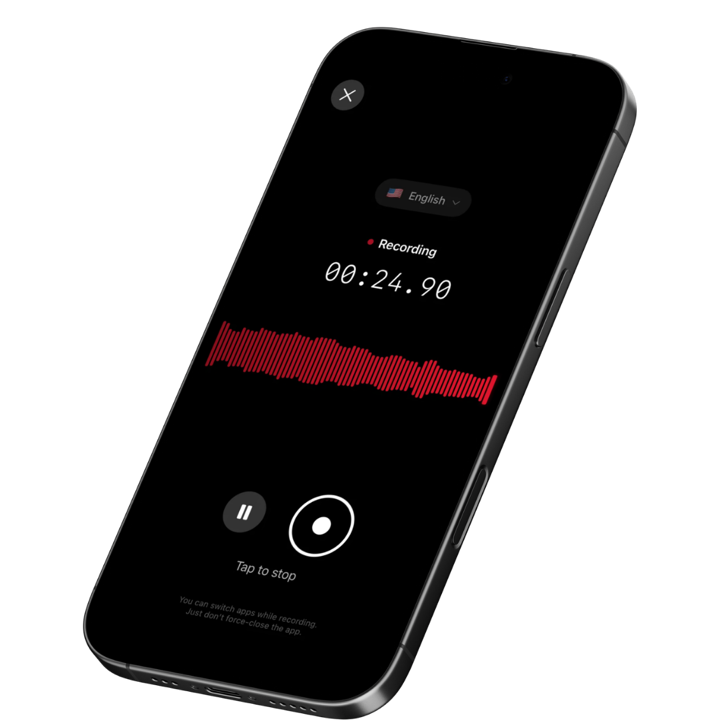
Speakwise is an iPhone app that records in-person conversations, meetings, lectures and interviews with one tap, then turns the recording into a transcript and an AI summary with action items. It reaches 95%+ transcription accuracy in optimal audio conditions and 92%+ in noisy rooms with several speakers. Speakwise works offline, covers 100+ languages, and records up to 5 hours per recording, so you can go back to what was said instead of relying on memory.
Try Speakwise free for 7 days ($0.00). After that, it starts at $69.99 per year, which is about $5.83 a month, billed yearly. Prices shown are for the US and can differ by country.Download Speakwise from the App Store and keep an accurate transcript and summary of what was said, so the record does not depend on memory.
Try Speakwise free for 7 days
Available on the App Store | iOS Optimized

🎯 4.9★ App Store Rating | 📱 Built for iOS
