Speech to Text Statistics 2026: 3x Faster Than Typing
Used by recruiters, executives, consultants, and more.
Speech to Text Statistics 2026: 3x Faster Than Typing
Speech to text statistics show that voice input has quietly overtaken the keyboard: dictation enters text about 3.0x faster than typing on a smartphone, and the best recognition systems now hit a 5.1% word error rate, matching professional human transcribers. The average person speaks around 150 words per minute but types just 52, a gap voice was built to close. Commercially, the global voice and speech recognition market is on track to reach $53.67 billion by 2030. Together these numbers mark speech-to-text as a mainstream productivity tool, not a niche accessibility feature.
The reason these figures matter now is that the gap between talking and typing has become impossible to ignore. Recognition accuracy has crossed the human-parity threshold, language coverage has expanded past 100 languages in leading models, and the hardware to run it sits in every pocket. What was once a slow, error-prone accessibility aid is now faster and often more accurate than thumbs on glass. As a result, voice-first capture is spreading from clinics and call centers to everyday note taking.
This post rounds up 17 of the most useful speech to text statistics for 2026, drawn from peer-reviewed research, major cloud providers, and market analysts. It is written for anyone deciding whether to build voice into a workflow or a product: note takers, clinicians, developers, journalists, and founders. Each stat is self-contained and sourced, so you can cite the ones that fit your case. If you want related context, the companion roundups on AI transcription statistics and voice notes statistics go deeper on adjacent trends.
Key Speech to Text Statistics (2026)
- Speech-to-text enters English text 3.0x faster than typing on a smartphone keyboard, with a 20.4% lower error rate (Stanford HCI Group).
- The average person speaks around 150 words per minute but types just 52 wpm, a gap voice input closes (VirtualSpeech).
- Microsoft's speech recognition reached a 5.1% word error rate that matches professional human transcribers (Microsoft Research).
- OpenAI trained its Whisper model on 680,000 hours of audio spanning 99 languages (OpenAI).
- The global voice and speech recognition market is projected to hit $53.67 billion by 2030 (Grand View Research).
- AI ambient scribes saved clinicians more than 15,700 hours of documentation in a single year (American Medical Association).
- Digital voice assistants in use worldwide reached 8.4 billion units in 2024, more than the global population (Statista).
1. Speech recognition enters English text 3.0x faster than typing
3.0x faster is how much quicker speech recognition entered English text compared with typing on a smartphone keyboard, according to a landmark study from Stanford, the University of Washington, and Baidu. Researchers Ruan and colleagues had participants both speak and type the same phrases on an Apple iPhone, then measured input speed across the two methods. English dictation ran three times faster than thumb typing, and Mandarin Chinese dictation was 2.8 times faster. The result held even after accounting for the time needed to correct recognition errors. For anyone weighing whether to talk or type, the raw throughput advantage of voice is hard to ignore, especially over long passages where typing fatigue compounds. This experiment remains one of the most cited head-to-head comparisons of the two input methods, and it helped reframe dictation as a productivity tool rather than an accessibility feature.
Source: Stanford HCI Group (Ruan et al.)
2. Voice input shows a 20.4% lower error rate than typing
20.4% is how much lower the error rate was for English speech recognition compared with keyboard typing in the same Stanford, University of Washington, and Baidu study. Speaking was not only faster than typing, it was also more accurate once the full editing process was measured. For Mandarin Chinese, the gap was even wider, with speech showing a 63.4% lower error rate than typing on the built-in keyboard. The finding challenges a common assumption that dictation trades accuracy for speed. In practice, modern recognition engines make fewer uncorrected mistakes than thumbs racing across a small glass screen, where autocorrect and mis-taps introduce their own errors. The combination of higher speed and lower error rates is what makes voice input compelling for note taking, messaging, and long-form capture on mobile devices.
Source: Stanford HCI Group (Ruan et al.)
3. People speak about 150 words per minute
150 words per minute is roughly the average conversational speaking rate for English speakers in the United States, a figure widely attributed to the National Center for Voice and Speech. That pace reflects comfortable, unhurried speech in everyday conversation, and trained speakers or auctioneers can push far higher. The number matters because it sets the ceiling for how quickly a person can feed text into a device by voice. When your mouth can produce 150 words a minute and your thumbs cannot keep up, speech becomes the natural interface for capturing thoughts quickly. This baseline helps explain why dictation consistently outpaces typing in controlled studies, and why voice-first workflows are gaining ground for journaling, drafting, and hands-free note taking on phones.
Source: VirtualSpeech (citing NCVS)
4. Average typing speed is just 52 words per minute
52 words per minute is the average typing speed uncovered by Aalto University in the largest typing study ever conducted, an analysis of 136 million keystrokes from 168,000 volunteers. The research measured everyday typists rather than trained professionals, capturing how ordinary people actually perform on physical and on-screen keyboards. At 52 wpm, typing lags far behind the roughly 150 words per minute of natural speech, a gap that grows over longer passages. The study also found that fast typists tend to use more consistent finger movements and rely on rollover, pressing the next key before releasing the last. For most people, though, the takeaway is simple: fingers are a bottleneck. That bottleneck is exactly what voice-to-text is built to remove, letting capture keep pace with thought.
Source: Aalto University
5. Machine transcription reached a 5.1% word error rate
5.1% is the word error rate Microsoft's conversational speech recognition system reached on the Switchboard benchmark, a level the company described as human parity. The milestone meant the system made about the same number of transcription mistakes as professional human transcribers working on the same audio. Reaching this mark required deep neural network acoustic and language models trained on large volumes of conversational speech. The Switchboard corpus consists of recorded telephone conversations between strangers, a deliberately messy real-world test rather than clean studio dictation. Hitting 5.1% on such material signaled that automatic transcription had matured from a novelty into a dependable tool. Every dictation app and ambient scribe on the market today builds on the modeling advances that this result represented.
Source: Microsoft Research
6. Human transcribers post a 5.9% word error rate
5.9% is the word error rate Microsoft measured for professional human transcribers on the Switchboard conversational speech corpus, rising to 11.3% on the harder CallHome portion. These figures are important because they establish the human baseline that machine systems are compared against. Humans are not perfect transcribers, especially with overlapping speech, accents, and background noise, and the numbers put a concrete floor under expectations for any automated tool. When Microsoft's system matched roughly this rate, it confirmed that the remaining errors were the kind even careful people make. The CallHome result, drawn from casual conversations between family and friends, shows how much harder informal speech is than structured dialogue. For app users, the lesson is that no transcription, human or machine, is flawless, so quick review still pays off.
Source: Microsoft Research
7. Whisper was trained on 680,000 hours of audio
680,000 hours of audio is what OpenAI used to train Whisper, its widely adopted speech recognition model, drawing on multilingual and multitask supervised data collected from the web. That volume, equivalent to more than 77 years of continuous audio, gave the model broad exposure to accents, languages, recording conditions, and background noise. The scale of the training set is a big reason Whisper generalizes so well to messy real-world recordings without task-specific fine-tuning. Rather than optimizing narrowly for one clean benchmark, OpenAI prioritized robustness across the long tail of real audio. The approach helped make high-quality transcription broadly accessible, since the model handles everything from podcasts to phone recordings. Whisper's release accelerated a wave of transcription products built on top of large, general-purpose speech models.
Source: OpenAI (Radford et al., arXiv)
8. Whisper supports transcription across 99 languages
99 languages are supported by OpenAI's Whisper model for transcription and language identification, making it one of the most multilingual speech systems openly available. Rather than shipping separate models per language, Whisper handles detection and transcription within a single architecture, automatically identifying the spoken language before converting it to text. That breadth matters for a global user base where a single recording may contain names, phrases, or entire passages in more than one language. Broad language coverage has become a baseline expectation for modern transcription tools, not a premium feature. For users who record interviews, lectures, or meetings across borders, wide language support determines whether a tool is usable at all, and it has quietly become one of the strongest selling points in the category.
Source: OpenAI (Whisper GitHub repository)
9. Google Cloud transcribes 125+ languages and dialects
125 or more languages and dialects can be transcribed by Google Cloud Speech-to-Text, one of the most comprehensive language rosters among commercial recognition services. Google's coverage spans not only major world languages but many regional dialects, reflecting years of data collection across its global products. The number keeps climbing as the company adds support driven by demand from developers building voice features into their own applications. For businesses deploying transcription at scale, this breadth reduces the need to stitch together multiple vendors for different markets. It also signals how competitive the language-coverage race has become, with major providers treating each additional language as a differentiator. Wide dialect support in particular improves accuracy for speakers whose regional pronunciation would trip up a narrower model.
Source: Google Cloud Documentation
10. The speech-to-text API market will hit $8.57 billion by 2030
$8.57 billion is the projected size of the global speech-to-text API market by 2030, up from an estimated $3,813.5 million in 2024. That trajectory represents a compound annual growth rate of 14.4%, according to Grand View Research. The API segment specifically covers the transcription engines that developers embed into other software, from meeting tools to call-center platforms and mobile apps. Its rapid growth reflects how many products now treat voice input as a core feature rather than an add-on. As more companies build speech capabilities into their offerings, demand for reliable, scalable transcription APIs compounds. The figures underscore that the tools powering everyday dictation are riding a durable commercial wave, not a passing trend.
Source: Grand View Research
11. Voice and speech recognition heads toward $53.67 billion by 2030
$53.67 billion is the projected value of the global voice and speech recognition market by 2030, growing at a compound annual rate of 14.6% from 2024, according to Grand View Research. This broader category spans consumer voice assistants, automotive systems, smart home devices, and enterprise transcription, capturing the full sweep of ways people talk to machines. The double-digit growth rate reflects steady adoption across industries that once relied entirely on keyboards, buttons, and touchscreens. Healthcare, automotive, and customer service are among the fastest-moving segments. As recognition accuracy has climbed toward human parity, the technology has crossed the threshold from experimental to expected. For app makers, a market of this size means sustained investment in the underlying speech models that power everyday dictation.
Source: Grand View Research
12. The U.S. transcription market will reach $41.93 billion by 2030
$41.93 billion is the projected value of the U.S. transcription market by 2030, up from $30.42 billion in 2024, a compound annual growth rate of 5.2% according to Grand View Research. Unlike the faster-growing API and voice recognition segments, this figure captures the full transcription industry, including established medical, legal, and media transcription services. Its steady rather than explosive growth reflects a mature market being reshaped, not replaced, by automation. AI tools are increasingly handling the first-pass transcription that humans then review, changing the mix of work rather than eliminating it outright. Healthcare remains the single largest driver, where accurate documentation carries legal and clinical weight. The size of this market shows how deeply transcription is embedded in professional workflows across the country.
Source: Grand View Research
13. AI scribes save clinicians 16 minutes per day
16 minutes per day is the reduction in documentation time associated with AI ambient scribes in a Mass General Brigham and UCSF study spanning five U.S. hospitals. The same research linked the tools to 13 fewer minutes of electronic health record use each day. While a quarter of an hour may sound modest, it compounds meaningfully across a full clinical schedule and a career, and it lands on some of the most time-pressed professionals in any field. Ambient scribes work by listening to the patient visit and drafting the clinical note automatically, freeing the clinician to focus on the person in front of them. The study's multi-site design makes the finding more credible than single-clinic pilots. It offers some of the strongest real-world evidence that speech-driven documentation returns time to overloaded schedules.
Source: Mass General Brigham
14. AI scribe users saved 15,700 hours in a year
15,700 hours of documentation were saved by AI scribe users over a single year compared with non-users, according to an analysis reported by the American Medical Association. That total works out to roughly 1,794 working days, or the equivalent of several full-time staff years reclaimed from paperwork. The figure aggregates small daily savings across many clinicians into a striking organizational total, illustrating how incremental time gains scale. For health systems facing staffing shortages and administrative overload, returning thousands of hours to patient care is a compelling argument for adoption. The same dynamic applies far beyond medicine: anyone who spends hours converting speech into written records stands to reclaim significant time. It is one of the clearest demonstrations that voice-to-text is a genuine productivity lever, not just a convenience.
Source: American Medical Association
15. Ambient AI scribes cut burnout from 51.9% to 38.8%
51.9% to 38.8% is how far clinician burnout fell after 30 days of ambient AI scribe use in a quality-improvement study of 263 clinicians reported by the American Medical Association. That drop of roughly 13 percentage points came alongside a reduction in after-hours documentation, the so-called pajama time that erodes work-life balance. The result connects a technical capability, automatic speech-to-text note taking, to a human outcome that is hard to buy any other way. Burnout is driven heavily by administrative burden, so tools that remove documentation work strike at a root cause rather than a symptom. While the study focused on healthcare, the underlying mechanism generalizes: less time transcribing means more time for meaningful work and rest. It is a reminder that the value of voice-to-text is measured in wellbeing as well as minutes.
Source: American Medical Association
16. There are 8.4 billion digital voice assistants in use
8.4 billion is the number of digital voice assistants in use worldwide in 2024, a figure that exceeds the global human population, according to Statista. That total counts assistants embedded in smartphones, smart speakers, cars, televisions, wearables, and countless other devices, many of which one person may own several of. The sheer scale shows how thoroughly voice interfaces have woven themselves into everyday life over a single decade. Every one of those assistants depends on speech recognition to turn spoken words into commands and text. Widespread familiarity with talking to devices has, in turn, normalized dictation for note taking and messaging, lowering the barrier to voice-first apps. When billions of people already speak to their gadgets daily, capturing notes by voice feels natural rather than novel.
Source: Statista
17. One ambient scribe logged 2.5 million uses in a year
2.5 million patient encounters is how often an ambient AI documentation tool was used at Kaiser Permanente within a single year of deployment, according to NEJM Catalyst. That volume, reported by Tierney and colleagues, marks one of the largest real-world rollouts of speech-driven clinical documentation to date. Reaching millions of uses so quickly signals that clinicians did not merely try the tool, they adopted it into daily practice at scale. Sustained, high-volume use is the strongest evidence that a technology delivers value, since novelty alone rarely survives a busy schedule. The Kaiser deployment demonstrates that speech-to-text has moved from pilot projects to production infrastructure in one of the country's largest health systems. It is a preview of how deeply voice-driven capture is likely to embed across professional software.
Source: NEJM Catalyst (Tierney et al.)
What These Numbers Reveal
Three threads run through these statistics. The first is capability: recognition accuracy has caught up with humans, training data now spans hundreds of thousands of hours, and leading models handle 99 or more languages. The technical case for typing over speaking has largely collapsed.
The second is scale. Billions of voice assistants are already in use, multiple speech markets are compounding at double-digit rates, and a single health system logged 2.5 million uses of an ambient scribe in a year. Voice input is not emerging; it is established and still accelerating.
The third is human payoff. The clearest evidence comes from medicine, where scribes returned thousands of hours and measurably cut burnout, but the mechanism is universal: every minute not spent transcribing is a minute returned to the work that matters. Choosing among the best speech to text apps is now less about whether voice works and more about which tool fits your life. The data is unambiguous: for capturing words at the speed of thought, speaking has beaten typing.
Turn Speech Into Notes With Speakwise
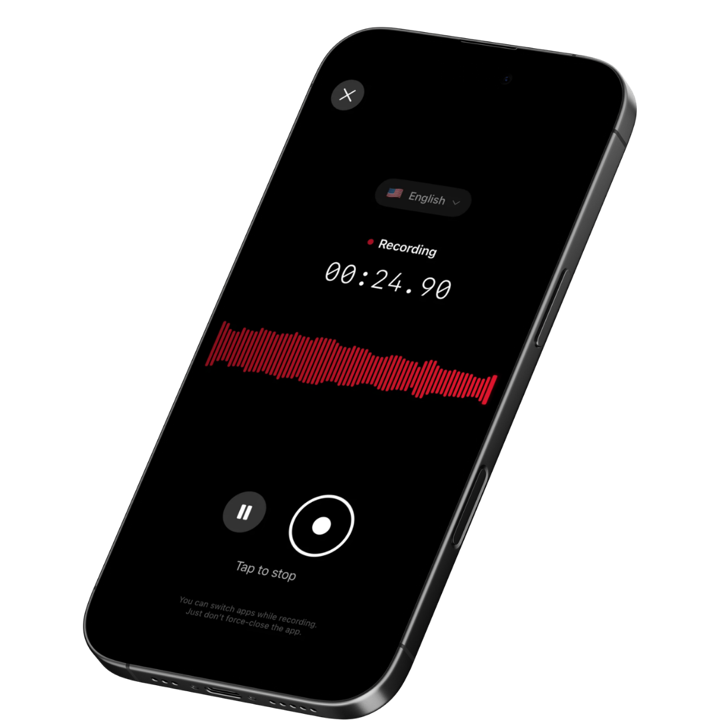
These numbers describe a shift you can put to work today. Speakwise brings fast, accurate voice-to-text to your iPhone, turning spoken thoughts, meetings, and interviews into clean, organized notes in over 100 languages. Instead of thumbing out text at 52 words a minute, you can capture ideas at the speed you speak them, then let Speakwise handle the transcription and structure.
Download Speakwise from the App Store and turn your voice into organized notes in seconds.
Get Speakwise Free
4.9-star App Store Rating | iOS Optimized

🎯 4.9★ App Store Rating | 📱 Built for iOS
