Voice Technology Statistics 2026


Used by recruiters, executives, consultants, and more.
Voice Technology Statistics 2026
The voice recognition market is estimated at $22.49 billion in 2026, up from $18.39 billion in 2025. 157 million Americans use voice assistants, voice AI usage grew 9x in 2025, and cloud-based voice solutions hold 59% of market share. These 16 statistics reveal how voice technology is transforming from a consumer convenience into essential business infrastructure.
Voice technology has entered a new phase. The first wave brought voice assistants to living rooms and smartphones. The second wave is bringing voice AI into offices, hospitals, courtrooms, and cars. Speech recognition, voice agents, and audio intelligence are no longer novelties. They are becoming core interfaces for how humans interact with technology.
This post covers 16 statistics that map the state of voice technology in 2026. From market size and user adoption to accuracy benchmarks and enterprise deployment, these numbers show why voice is emerging as the next major platform shift in how work gets done.
1. The voice recognition market reaches $22.49 billion in 2026
Voice recognition has become a substantial technology market. The voice recognition market was valued at $18.39 billion in 2025 and is estimated to grow to $22.49 billion in 2026, reaching $61.71 billion by 2031. This growth rate of 22.38% CAGR reflects accelerating demand across consumer electronics, automotive, healthcare, enterprise, and accessibility applications. Voice recognition is no longer a single-use feature. It is a platform technology embedded in thousands of products.
Source: Mordor Intelligence - Voice Recognition Market 2025-2030
2. 157 million Americans use voice assistants in 2026
Voice assistant adoption has reached critical mass in the United States. The U.S. voice assistant user count is projected to reach 157.1 million in 2026, up from 153.5 million in 2025. Nearly half the adult population now interacts with voice technology regularly. This massive user base has trained hundreds of millions of people to speak to technology as a natural interaction mode, paving the way for professional and enterprise voice applications.
Source: Statista - Voice Assistant Users United States 2026
3. Voice AI usage grew 9x in 2025
The acceleration of voice AI was dramatic. Voice agent usage grew 9x in 2025, with growth driven by production deployments in real-world environments where speed and accuracy work together. This was not prototype growth. It was production growth - real systems handling real conversations in contact centers, healthcare facilities, and enterprise workflows. The scale of this expansion signals that voice AI has moved from research to revenue.
Source: Speechmatics - Voice AI's Breakthrough Year 2025
4. Cloud-based voice solutions hold 59% of market share
The infrastructure behind voice technology favors the cloud. Cloud-based solutions hold 59% of the speech and voice recognition market share, offering flexibility, scalability, and access to the latest AI models. However, is growing fastest at a 25% CAGR, reflecting a shift toward hybrid or fully local processing. This trend toward voice AI matters for privacy, latency, and offline usage - all critical factors for professional applications.
Source: Scoop Market.us - Speech and Voice Recognition Statistics
5. Google Assistant leads with 92 million U.S. users
The voice assistant market has three dominant players. Google Assistant leads with approximately 92 million U.S. users, followed by Apple's Siri at 86.5 million and Amazon Alexa at 78 million. This competition drives rapid innovation as each platform expands capabilities. For consumers, the choice of voice assistant is increasingly tied to their device ecosystem. For developers, it means building for multiple voice platforms simultaneously.
Source: Yaguara - Voice Search Statistics 2026
6. Global speech recognition revenue projected to reach $25 billion in 2025
The global revenue picture for speech recognition technology shows steady expansion. Revenues are projected to reach $25 billion in 2025, $30 billion in 2026, and $36 billion in 2027. This consistent growth trajectory reflects both expanding use cases and deeper integration of speech recognition into existing products and services. Voice is no longer a standalone market. It is a capability that enhances nearly every digital product.
Source: Statista - Speech Recognition Worldwide Market Forecast
7. 22% of Y Combinator's latest cohort builds voice-first companies
The startup ecosystem is betting heavily on voice. 22% of Y Combinator's latest cohort is building voice-first companies, the highest concentration ever. Voice AI funding surged eightfold to $2.1 billion, signaling strong venture capital confidence in voice technology's commercial potential. When the most competitive startup accelerator in the world tilts this heavily toward voice, it indicates a broader platform shift is underway.
Source: Speechmatics - Voice AI's Breakthrough Year 2025
8. Voice AI funding surged eightfold to $2.1 billion
Investment in voice AI is accelerating at a remarkable pace. Voice AI funding surged eightfold to reach $2.1 billion, dwarfing previous years' investment. This capital is flowing into speech recognition engines, voice agent platforms, conversational AI systems, and professional transcription tools. The funding surge suggests that investors see voice as one of the primary interfaces for the next generation of AI applications.
Source: Speechmatics - Voice AI's Breakthrough Year 2025
9. 103 million Americans have a smart speaker in their household
Smart speakers have established a significant hardware footprint. Approximately 103 million people in the U.S. have a smart speaker in their household, representing a 20.7% adoption rate across the population. This installed base creates a daily touchpoint where voice interaction is the primary interface. The familiarity built through smart speaker usage transfers to professional contexts where voice commands, dictation, and voice search become natural workflows.
Source: Yaguara - Voice Search Statistics 2026
10. On-device voice processing is growing at 25% CAGR
While cloud dominates current market share, the fastest growth is happening at the edge. Embedded is delivering a 25% CAGR, reflecting a decisive shift from cloud-only designs to hybrid or fully local voice processing. On-device processing offers three advantages critical for professional use: zero latency, offline capability, and enhanced privacy. When voice processing happens on the device, conversations never leave the user's hardware.
Source: Scoop Market.us - Speech and Voice Recognition Statistics
11. Medical voice models achieve keyword error rates 70% lower than alternatives
Voice technology is making its deepest impact in healthcare documentation. Models trained on 16 billion words of clinical conversations now deliver keyword error rates 70% lower than generic alternatives. Medical keyword recall hits 96% in production environments. This precision transforms clinical documentation from a time-consuming burden into an automated process, returning millions of hours to the medical workforce for patient care.
Source: Speechmatics - Voice AI's Breakthrough Year 2025
12. The speech recognition market is projected to reach $23.11 billion by 2030
Looking at the medium-term horizon, MarketsandMarkets projects the global speech and voice recognition market will grow from $9.66 billion in 2025 to $23.11 billion by 2030 at a CAGR of 19.1%. This growth is driven by increasing demand for speech-driven interfaces across consumer electronics, automotive, healthcare, BFSI, and enterprise applications, supported by improvements in NLP, deep learning, and cloud deployment.
Source: MarketsandMarkets - Speech and Voice Recognition Market
13. Asia Pacific voice technology market grows at 28.5% CAGR
The fastest regional growth in voice technology is happening in Asia Pacific. The region is projected to grow at a CAGR of nearly 28.5% through 2035, making it the fastest-expanding market globally. This growth reflects large populations adopting smartphones, expanding digital infrastructure, and strong demand for multilingual voice recognition in a region with extraordinary linguistic diversity.
Source: Global Market Statistics - Speech and Voice Recognition Market
14. Contact center call volumes are expected to reach 39 billion by 2029
Voice technology is scaling rapidly in customer service. Contact center call volumes are projected to reach 39 billion by 2029, creating enormous demand for voice AI that can handle, route, transcribe, and analyze conversations at scale. This volume represents a massive opportunity for voice technology to automate routine interactions while improving the quality and documentation of complex ones.
Source: Speechmatics - Voice AI's Breakthrough Year 2025
15. The voice assistant market will reach $59.9 billion by 2033
The voice assistant segment alone is on track to become a massive market. The global voice assistant market is set to reach $59.9 billion by 2033, driven by device proliferation and expanding voice-enabled ecosystems. This projection reflects voice assistants moving beyond smart speakers into cars, appliances, wearables, workplace tools, and industrial equipment. Voice is becoming an ambient interface layer across the physical world.
Source: Globe Newswire - Voice Assistant Market Growth
16. Speaking is 3x faster than typing for content capture
The fundamental advantage of voice over text remains its speed. Speaking is approximately three times faster than typing for capturing thoughts, notes, and ideas. At an average speaking rate of 150 words per minute versus 40-50 words per minute for typing, voice capture eliminates the bottleneck between thinking and recording. For professionals who need to capture ideas quickly - during meetings, while commuting, or between appointments - voice is the most efficient input method available.
Source: Stanford - Writing 3.0: Voice is 3x Faster than Typing
Voice Is Becoming the Primary Interface for Work
The statistics reveal a clear trajectory: voice technology is shifting from a consumer convenience to a professional necessity. A $22.49 billion market, 157 million U.S. users, and 9x growth in voice AI usage all point to voice becoming a primary way people interact with technology at work.
The drivers of this shift are fundamental. Speaking is faster than typing. Voice capture works when hands are occupied. AI transcription converts speech to searchable text almost instantly. And the accuracy improvements in specialized domains like healthcare show that voice technology can handle the precision demands of professional work.
The privacy question remains important. The shift toward at 25% CAGR reflects user demand for voice technology that respects confidentiality. As more voice processing happens locally, the trust barrier that slows enterprise adoption will continue to lower.
Voice is not replacing screens or keyboards. It is filling the gaps between them - capturing the thoughts, conversations, and ideas that happen away from a desk, and turning them into organized, actionable information.---
Your voice is your fastest productivity tool
The data is clear: speaking is 3x faster than typing, and voice AI has reached professional-grade accuracy. Yet most professionals still default to keyboards and screens for capturing information. The result is that the fastest, most natural way to record thoughts and conversations goes largely unused in professional workflows.
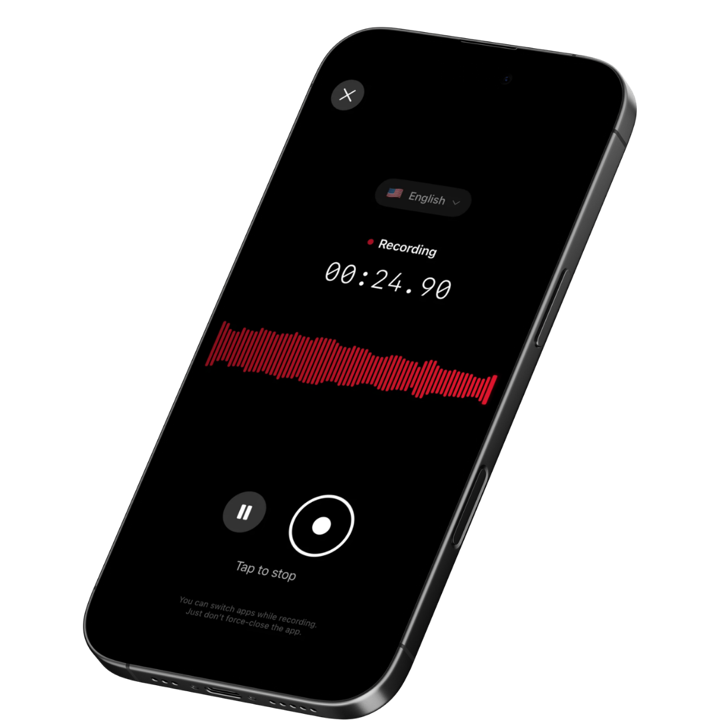
SpeakWise changes this. Turn your iPhone into a voice-powered productivity tool. Record meetings, brainstorms, and ideas with one tap. Get AI transcription in 100+ languages with 95%+ accuracy. Intelligent summaries extract what matters. Everything syncs to Notion automatically. Your voice becomes your most efficient input device.
Download SpeakWise from the App Store and start using your voice as the productivity tool it was always meant to be.
Join 10,000+ professionals who use SpeakWise to capture ideas at the speed of speech and organize them with the precision of AI.
Get SpeakWise Free
4.9-star App Store Rating | iOS Optimized

🎯 4.9★ App Store Rating | 📱 Built for iOS
