AI Anxiety at Work Statistics: 19 Findings for 2026


Used by recruiters, executives, consultants, and more.
AI Anxiety at Work Statistics: 19 Findings for 2026
AI-related anxiety at work has crossed from fringe concern to mainstream psychological phenomenon. A Pew Research Center survey conducted in October 2024 found that 52% of U.S. workers are worried about the future impact of AI on their workplace, and 32% believe AI will lead to fewer job opportunities for them personally. More recent data shows even sharper anxiety: a 2025 Resume Now survey of over 1,000 workers found that 89% express concern about AI's impact on their job security - with 34% "moderately worried" and 8% "extremely worried." Skill obsolescence fears are widespread: 46% of employees fear their skills will become obsolete within five years, and 74% of IT professionals specifically worry that AI tools will make their daily skills irrelevant. These 19 statistics map the scope, demographics, and consequences of AI anxiety at work in 2026.
AI anxiety is not uniform across the workforce. It varies by age, occupation, exposure level, and whether workers feel their employer is preparing them adequately for the transition. Critically, the anxiety is not purely speculative - observable labor market data shows job posting volumes declining in the highest AI-exposure occupations, giving the fears an empirical foundation.
This post examines AI anxiety as a distinct form of workplace anxiety. For the broader picture of workplace anxiety patterns, see our workplace anxiety statistics analysis. For data on how AI tools are actually being adopted at work, our workplace AI adoption statistics post covers the adoption data in detail.
1. 52% of U.S. workers worry about AI's future impact at their workplace
A Pew Research Center survey conducted in October 2024 found that 52% of U.S. workers express worry about the future impact of AI use in their workplace. The survey covered a nationally representative sample of employed adults. Workers in roles with high AI exposure showed higher anxiety than those in low-exposure roles, but the majority sentiment - more worried than hopeful - held across most occupational categories. Pew found that 36% of workers say they feel hopeful about AI at work, meaning the worried-to-hopeful ratio is roughly 1.4:1. This represents a significant shift from earlier surveys that showed more balanced or optimistic sentiment, consistent with the acceleration of AI deployment that characterized 2024.
Source: Pew Research Center - U.S. Workers Are More Worried Than Hopeful About Future AI Use
2. 89% of workers express concern about AI's impact on their job security
A 2025 Resume Now survey of over 1,000 U.S. workers in January 2025 found that 89% express some level of concern about AI's impact on job security: 47% slightly worried, 34% moderately worried, and 8% extremely worried. Only 11% report no concern. The near-universality of some level of worry is the most striking feature of this data. Even "slight" worry across nearly half the workforce represents a significant ambient anxiety load that affects daily attention, motivation, and how workers engage with new AI tools. The 8% who are "extremely worried" - representing millions of workers nationally - show anxiety levels that research links to measurable productivity impairment and intention to leave their current role.
Source: Resume Now - AI Disruption Report
3. 40% of workers worldwide fear losing their job to AI - up from 28% in 2024
A Mercer survey of 12,000 workers globally found that 40% now fear losing their job to AI, up from 28% in 2024 - a 12-percentage-point increase in a single year. The scale and pace of this increase is notable. Fear of AI-driven job loss is growing faster than AI adoption itself, suggesting that workers are updating their risk assessments based on observed AI capabilities and labor market signals rather than direct personal experience. The 40% figure represents a significant population: across the U.S. labor force of approximately 165 million workers, this translates to roughly 66 million people carrying job displacement fears as a background concern.
Source: MetaIntro - 40% of Workers Now Fear Losing Their Job to AI
4. 46% of employees fear their skills will become obsolete within 5 years
A Kahoot! Workplace Culture Report from October 2024, surveying 1,041 full-time office workers across technology, healthcare, and financial services, found that 46% of employees fear their skills will be obsolete within five years due to AI. Twenty-nine percent expect it to happen even sooner - within three years. This is a forward-looking anxiety: workers are not responding only to skills already obsolete but to anticipated acceleration. The 46% figure spans sectors, suggesting that AI-driven skill obsolescence concern is not confined to tech workers but has become a cross-industry worry. Workers who fear obsolescence show higher training-seeking behavior, but also higher anxiety when employer upskilling support is absent.
Source: Kahoot! Workplace Culture Report 2024
5. 74% of IT professionals worry AI will make their day-to-day skills obsolete
Among IT professionals - the workers with the most direct daily exposure to AI tools - 74% expressed concern that AI tools will make many of their day-to-day skills obsolete, and 69% believe they are at risk of being replaced by AI entirely, according to a survey reported by CIO. The paradox here is significant: IT workers are both the implementers of AI systems and among the most anxious about AI's effects on their own roles. This anxiety is informed rather than speculative - IT professionals have visibility into what current AI systems can and cannot do, and that visibility produces more acute concern rather than less. The 74% figure in IT suggests that proximity to AI capability, not distance from it, correlates with higher skill obsolescence anxiety.
Source: CIO - 74% of IT pros see AI making their skills obsolete
6. 32% of U.S. workers believe AI will lead to fewer job opportunities for them personally
Among the 52% of worried U.S. workers in Pew's October 2024 survey, 32% specifically believe AI will reduce job opportunities for them personally in the long run - not just for others. This distinction matters: concern about broad labor market disruption is common, but believing one's own specific role is at risk is a more personal and more anxiety-generating belief. Workers holding this personal displacement belief show different behavioral responses than those worried only about aggregate disruption: they are more likely to consider career changes, seek additional credentials, and update their CVs proactively. The 32% figure represents a substantial minority whose career anxiety is actively shaping workplace behavior.
Source: Pew Research Center - U.S. Workers Are More Worried Than Hopeful About Future AI Use
7. 44% of workers say AI is doing more harm than good for jobs and wealth
A late 2025 survey found that 44% of workers say AI is doing more harm than good for finding jobs, building wealth, and securing quality of life, compared to 38% who say it is doing more good than harm. This net-negative sentiment on AI's economic impact represents a significant shift from earlier survey periods when optimism and pessimism were more evenly split. The shift coincides with observable labor market changes in high-AI-exposure occupations and increased media coverage of specific AI-driven workforce reductions. Public sentiment on technology tends to lag actual deployment by 1-2 years, suggesting that the negative sentiment observed in late 2025 reflects experiences and observations from 2024's rapid AI rollout.
Source: MetaIntro - 40% of Workers Now Fear Losing Their Job to AI
8. Job postings in high AI-exposure occupations declined 15-34% relative to trend
Research published in Frontiers in Human Dynamics (2026) found that occupations in the highest quartile of large language model (LLM) exposure exhibited posting volume declines of 15-34% between 2022 and 2024, relative to trends established in 2019-2021. Low-exposure occupations showed stable or growing posting volumes over the same period. This is among the most rigorous empirical documentation of actual labor market impact from AI adoption, moving beyond worker fears to observed market behavior. For workers in high-exposure roles, this data validates anxieties that employers and commentators have often characterized as irrational or premature. The 15-34% range reflects variation by specific occupation, with entry-level writing, data entry, and some coding roles showing the largest declines.
Source: Frontiers in Human Dynamics - AI-driven labor market displacement, 2020-2025
9. 43% of workers know someone who has lost a job due to AI
Resume Now's 2025 survey found that 43% of workers personally know someone who has lost a job due to AI, and 44% expect AI to take over some of their current tasks within five years. The "knowing someone" figure is significant because social networks amplify risk perception: seeing a peer or colleague displaced by AI makes the risk feel concrete rather than abstract. Risk researchers call this the "availability heuristic" - events that come to mind easily feel more probable. For AI anxiety, this mechanism means that worker anxiety levels will continue to rise as more workers enter the social networks of AI-affected peers, regardless of whether their own role is at risk.
Source: Resume Now - AI Disruption Report
10. 63% of employers provide no AI training to workers - fueling anxiety gaps
A 2025 survey from Jobs for the Future (JFF) found that worker anxiety over AI is growing while employers are failing to prepare employees: 63% of organizations have not provided specific AI training to their workforce. The training gap is a direct driver of anxiety - workers who receive AI training and clear communication about how AI will affect their roles show substantially lower anxiety scores than those left without guidance. The JFF survey framed this as an employer responsibility gap: workers who feel abandoned in the AI transition are more anxious, more likely to use AI tools without guidance, and more likely to consider leaving their organization. The absence of employer communication functions as a signal that AI's impact is too uncertain or too negative to discuss openly.
Source: Jobs for the Future - Worker Anxiety Over AI Is Growing
11. 61% of anxiety-driven workers are considering upskilling or reskilling
EdX's 2025 survey on AI anxiety and career adaptation found that nearly half of workers view AI as a threat to their jobs, and 61% are considering upskilling or reskilling in response. Among millennials, the figure rises to 67%, with 45% of millennials planning to spend over $5,000 on additional education and training in the year surveyed. Anxiety-driven upskilling is productive insofar as it builds genuine capability, but research distinguishes it from purposeful professional development: anxiety-driven learners show shorter attention spans during training, lower retention rates, and higher discontinuation rates compared to intrinsically motivated learners. Organizations that frame AI upskilling as threat-avoidance rather than capability-building may generate less effective learning even as they demonstrate a training response to employee concerns.
Source: edX - AI Anxiety Drives Surge in Upskilling Among Workers: 2025 Survey
12. AI anxiety is highest among millennials - 54% feel threatened by AI
Deloitte's 2025 Global Survey found that millennials show the highest AI job threat perception at 54%, and 56% worry that AI threatens job opportunities for others in their industry. Millennials are in peak earning years with mortgages, families, and career investments - a life stage where occupational disruption carries maximum financial and identity risk. Gen Z workers show somewhat lower explicit anxiety about job displacement, possibly because they are earlier in career formation and perceive more flexibility. Older workers (over 50) show lower anxiety about AI displacement despite holding the least familiarity with AI tools, suggesting that proximity to retirement modulates threat perception differently than skill exposure does.
Source: Deloitte - 2025 Gen Z and Millennial Survey
13. Workers more worried than hopeful: 52% worried vs. 36% hopeful
Pew's data shows that hopeful workers (36%) are substantially outnumbered by worried workers (52%) on AI's workplace impact. This imbalance matters beyond the numbers: in organizational psychology, dominant sentiment in a peer group shapes how individuals interpret ambiguous situations. When worried sentiment is the majority view, workers who are uncertain about AI tend to converge toward anxiety rather than optimism. Organizations with higher proportions of workers who have received training and positive AI experiences show closer parity between worried and hopeful sentiment, suggesting that the current imbalance is not fixed but responsive to employer action.
Source: Pew Research Center - U.S. Workers Are More Worried Than Hopeful About Future AI Use
14. AI-related anxiety is linked to lower willingness to use AI tools
Psychological research on technology anxiety finds that workers experiencing high AI anxiety are less willing to experiment with AI tools voluntarily, even when tools are provided by employers. This creates a self-reinforcing disadvantage: high-anxiety workers avoid AI tools, gain less experience, develop fewer skills, and thus face genuinely greater displacement risk - confirming rather than disproving their initial fears. Low-anxiety workers who engage with AI tools early compound their advantage through experience. Organizational interventions that reduce AI anxiety before requiring AI adoption show higher voluntary adoption rates and better long-term skill development outcomes than those that mandate adoption without addressing anxiety.
Source: EY - Research shows most US employees feel AI anxiety
15. 33% of workers feel overwhelmed by AI change velocity
Pew found that 33% of workers say they feel overwhelmed by AI at work, almost exactly matching the 36% who feel hopeful. Overwhelm is distinct from anxiety: anxious workers focus on specific threats (job loss, skill obsolescence), while overwhelmed workers experience more diffuse cognitive overload - too many changes, too fast, without adequate time to integrate each before the next arrives. The change velocity problem is real: major AI platforms released multiple significant capability updates per quarter through 2024 and 2025, making it genuinely difficult to develop stable competency before tools shift. Organizations that communicate a clear AI integration roadmap - rather than adopting every new capability immediately - report lower overwhelm scores among their workforce.
Source: Pew Research Center - U.S. Workers Are More Worried Than Hopeful About Future AI Use
16. Historically 6% of workforce needed reskilling - now 35%
PricewaterhouseCoopers and other workforce researchers have documented a dramatic expansion of the reskilling challenge: historically, approximately 6% of the workforce needed significant reskilling at any given time. By 2024, that figure reached 35% - representing over one billion workers globally. The six-fold increase in the population requiring significant skill transition explains why individual upskilling ambitions, however genuine, cannot solve the AI anxiety problem at scale. Organizational and policy-level responses are required. For individual workers, the data clarifies the scale of the challenge: the experience of needing to significantly reskill is no longer a niche or exceptional experience but a majority-affecting condition.
Source: Innovative Human Capital - Survey: 46% of Workers Fear Skill Obsolescence
17. KPMG: 81% of workers actively use AI tools despite widespread anxiety
Despite the anxiety data, AI adoption continues. KPMG's 2024 research found that 81% of American workers actively use AI tools - a statistic that coexists with widespread anxiety rather than contradicting it. This "anxious adopter" profile is the most common pattern in the current workforce: workers who are worried about AI's implications but using AI tools anyway, often without clear guidance, training, or employer policy. Anxious adoption produces different behavior than confident adoption - workers who are anxious about AI are more likely to hide their AI use, avoid telling colleagues about AI-assisted work, and experience higher cognitive load during AI tool use due to simultaneous task completion and threat monitoring.
Source: KPMG - American Workers Are Leading the AI Revolution
18. Nature study: AI use is associated with reduced wellbeing in some worker populations
A 2025 study published in Scientific Reports (Nature Publishing Group) examining the relationship between artificial intelligence and worker wellbeing found that AI use is associated with reduced wellbeing in some worker populations - particularly those who feel pressured to use AI without adequate support. The study found that AI's wellbeing effects are heterogeneous: workers with high autonomy and strong social support show neutral to positive wellbeing effects from AI adoption, while those with low autonomy and poor support show negative effects. The population-level finding challenges the assumption that AI adoption is inherently wellbeing-neutral or positive. Implementation context - specifically whether workers feel they have agency in how they use AI - determines the wellbeing direction.
Source: Scientific Reports - Artificial intelligence and the wellbeing of workers
19. 74% of workers report fatigue from upskilling demands driven by AI change
The same Kahoot! Workplace Culture Report that documented skill obsolescence fears (Stat #4) found that 74% of workers report fatigue from the amount of training and upskilling required to stay effective in their roles, with one-third describing feeling completely drained by current workloads and learning demands simultaneously. The combination of full work schedules and mandatory or self-imposed AI upskilling creates a double demand: workers must perform their current jobs while simultaneously learning to perform jobs that may not yet exist in stable form. This dual-track exhaustion is a specific form of cognitive and emotional depletion that standard burnout interventions do not fully address because the learning component is self-preservational rather than organizationally imposed.
Source: Kahoot! Workplace Culture Report 2024
What the AI Anxiety Data Reveals for 2026
The statistics above describe a workforce in a state of genuine, empirically grounded anxiety. This is not technophobia or irrationality: job posting declines of 15-34% in high-AI-exposure occupations, 43% of workers personally knowing someone who lost a job to AI, and a six-fold expansion of the reskilling challenge all provide real-world anchors for the anxiety surveys are capturing. The worried majority is responding to observable signals.
The employer response gap is one of the most actionable findings. When 63% of organizations provide no AI training and most workers report insufficient communication about their organization's AI strategy, anxiety fills the information vacuum. Workers who receive training, clear communication, and genuine agency in how they adopt AI tools show measurably lower anxiety, higher adoption willingness, and better outcomes than those who receive mandates without support. The anxiety problem is, at its core, an information and agency problem as much as a capability problem.
The "anxious adopter" profile - 81% using AI tools despite widespread worry - creates a specific organizational risk. Workers who use AI anxiously are more likely to hide their use, less likely to share learning with colleagues, and more likely to experience the cognitive cost of simultaneous task performance and threat monitoring. Organizations that acknowledge the anxiety explicitly, rather than ignoring it, create the conditions for more productive adoption.
AI anxiety at work is both a psychological challenge and a signal about the gap between AI's deployment pace and workers' preparation for it - a gap that employers have the most power to close.
Speakwise and the AI Tool Adoption Gap
One of the clearest findings in the AI anxiety research is the link between positive early experiences with AI tools and reduced anxiety. Workers who use AI tools that deliver clear, immediate value - rather than requiring significant upfront learning investment - show lower anxiety and higher voluntary adoption of additional AI tools over time.
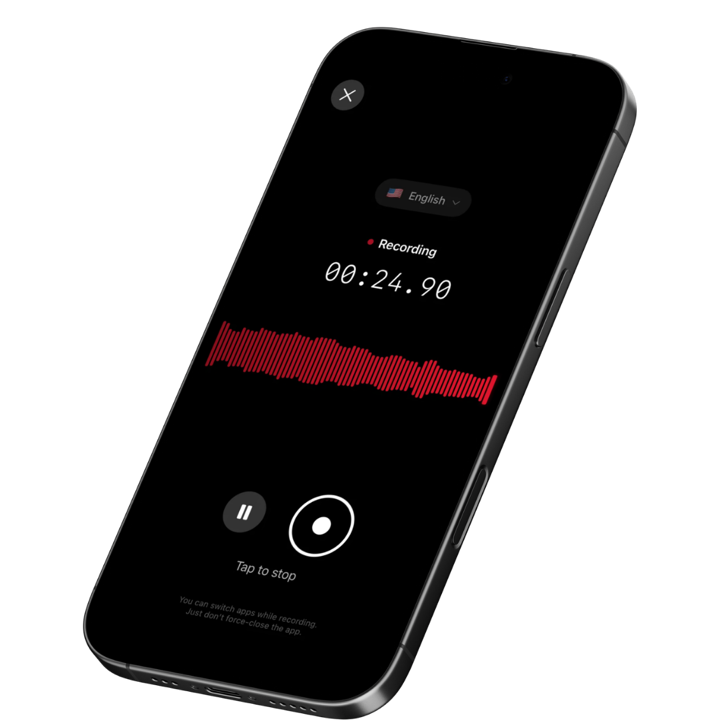
Speakwise turns your iPhone into an AI meeting assistant. One-tap or AirPods hands-free recording captures in-person conversations, then produces summaries, accurate transcripts in 100+ languages, and automatic action item extraction. As a task-specific AI tool focused on a concrete problem (post-meeting cognitive load), Speakwise delivers the kind of clear, immediate value that research associates with positive AI experiences - the starting point for moving from anxious adopter to confident one.
Download Speakwise on the App Store and start with an AI tool that does one thing exceptionally well.
4.9-star App Store rating with thousands of installs.
Download Speakwise on the App Store

🎯 4.9★ App Store Rating | 📱 Built for iOS
