Attention Residue Statistics: 16 Findings on Task-Switching
Used by recruiters, executives, consultants, and more.
Attention Residue Statistics: 16 Findings on Task-Switching
Attention residue is the cognitive phenomenon where part of your attention remains stuck on a previous task after you have switched to a new one. Professor Sophie Leroy of the University of Washington, who named and defined the concept, found that attention residue measurably reduces performance on the new task. Workers who switch tasks frequently carry residue from multiple unfinished tasks simultaneously, compressing effective cognitive capacity. The average knowledge worker switches tasks every 3-5 minutes, generating near-constant residue. These 16 statistics define the scope of the problem, its documented performance consequences, and the structural conditions that make it worse.
The concept of attention residue sits at the intersection of two well-established research traditions: studies of task-switching costs (how long it takes to reorient after changing tasks) and studies of intrusive thinking (how unfinished tasks occupy working memory). What Sophie Leroy's research added was a direct measurement of performance degradation caused specifically by the residual attention on incomplete prior tasks - not just the switching cost, but the cognitive footprint left behind.
This post compiles 16 statistics and research findings on attention residue, task-switching frequency, performance impacts, and the workplace structures that generate or reduce residue. The data is directly relevant to professionals in any role that involves multiple simultaneous responsibilities, frequent interruptions, or rapid context changes between meetings, projects, and communication channels.
1. Attention residue measurably reduces performance on the new task
Professor Sophie Leroy's foundational research on attention residue, published in Organizational Behavior and Human Decision Processes, demonstrated through multiple experiments that switching to a new task before completing a prior one left measurable cognitive residue. Participants who switched tasks with unfinished prior work performed significantly worse on the new task than those who had completed their prior work. The residue was not just a feeling of distraction - it produced quantifiable reductions in accuracy, response quality, and cognitive depth. Leroy coined the term "attention residue" to describe this persistent cognitive state, which she defined as continuing to think about the previous task while ostensibly working on the new one.
2. The Zeigarnik Effect explains why incomplete tasks generate residue
The psychological mechanism behind attention residue was identified decades before Leroy named it. In 1927, Soviet psychologist Bluma Zeigarnik found that people remember interrupted and incomplete tasks far better than completed ones. Known as the Zeigarnik Effect, this phenomenon reflects the brain's use of working memory to maintain an active "open loop" on unfinished work, continuously allocating processing resources to monitor the unresolved task. When workers switch to new tasks without finishing prior ones, the Zeigarnik Effect ensures that cognitive resources remain divided. Multiple incomplete tasks generate multiple open loops, each consuming working memory that the new task cannot fully access.
Source: Zeigarnik, B. - On Finished and Unfinished Tasks (1927), Psychologische Forschung
3. Workers switch tasks every 3-5 minutes on average
Research by RescueTime, which analyzed over 225 million hours of computer activity from 50,000 workers, found that the average knowledge worker switches tasks every 3-5 minutes. At this frequency, attention residue is essentially continuous. Workers never complete one cognitive context before entering the next, generating compounding residue that degrades every task in the sequence. Our analysis of context-switching statistics found that this 3-5 minute switching frequency is consistent across multiple large-scale productivity tracking datasets and has worsened as communication tool adoption has increased.
Source: RescueTime - Screen Time and Productivity in the Digital Age
4. Task-switching cuts performance by up to 40%
Cognitive psychology research by Dr. David Meyer and colleagues at the University of Michigan found that even brief mental blocks created by task-switching can cost as much as 40% of productive time. This figure, widely cited in organizational psychology, reflects the accumulated cost of switching across a full workday - the time lost in reorientation, the attention residue carried between tasks, and the reduction in depth achieved in each task when the prior task's mental model is still partially active. The 40% figure is not a single-event cost; it is the daily aggregate of rapid switching across dozens or hundreds of task shifts.
5. Leroy found that "finishing strong" before switching reduces residue substantially
A key practical finding from Sophie Leroy's research is that the magnitude of attention residue depends heavily on whether the prior task felt complete. Participants who were interrupted at a meaningful stopping point - one that felt like a natural pause or partial resolution - showed significantly less residue than those interrupted mid-task. Leroy's research suggests that the brain's open-loop monitoring system, which drives the Zeigarnik Effect, can be partially closed by reaching a micro-completion rather than a full task completion. This finding supports strategies like "parking lot" notes at the end of work sessions, which explicitly capture the current state so the brain can release its hold.
6. Open-plan offices increase task-switching frequency by 49%
Research comparing workers in open-plan versus private office environments found that open-plan workers switched tasks 49% more frequently than their private-office counterparts, driven primarily by higher rates of ambient interruption. Each interruption-generated task switch produces attention residue. Workers in open-plan environments therefore carry higher cumulative residue loads throughout the day, partially explaining the 28% reduction in focused work output documented in open-plan studies. Environmental design is not peripheral to attention residue management - it is one of its primary structural drivers. Our review of workplace distraction statistics covers the environmental factors that drive involuntary task-switching in detail.
7. Interruptions cause workers to resume interrupted tasks in only 82% of cases
Research by Dr. Gloria Mark at the University of California, Irvine, found that after an interruption, workers resume the interrupted task within the same working session only 82% of the time. In the remaining 18% of cases, the interrupted task is either deferred to a later session or abandoned. This abandonment rate means that interruption-driven task-switching generates residue not only for the current session but across days, as workers carry open loops from tasks they did not return to. The cognitive load of these multi-day open loops is a form of chronic attention residue.
8. Email checking generates significant attention residue between primary tasks
Research by Kostadin Kushlev and Elizabeth Dunn at the University of British Columbia found that limiting email checking to three designated times per day significantly reduced self-reported stress and increased focus, compared to checking email as frequently as notifications arrived. The mechanism is attention residue: each email check, even brief, initiates a partial cognitive context switch. The brain begins processing the email's topic, urgency, and implications, generating residue that partially persists when returning to the prior task. Workers who check email constantly maintain a near-continuous layer of communication residue over their primary work.
9. Workers with high residue loads report significantly lower confidence in their work quality
Leroy's subsequent research explored the subjective experience of working under high attention-residue conditions. Workers who frequently switched between incomplete tasks reported substantially lower confidence in the quality of the work they were producing. This confidence deficit was not merely subjective: in blind evaluation conditions, the work produced under high-residue conditions was independently rated as lower quality than the same workers' output under low-residue conditions. Attention residue does not just feel like impairment - it produces impairment that others can observe in the resulting work product.
10. Meetings are one of the highest-residue task transitions in the knowledge work day
Research by Leroy and colleagues identified meetings as a particularly high-residue transition point in the knowledge work day. When workers are pulled from active, incomplete tasks into meetings, they carry residue from the interrupted task into the meeting. This residue reduces their presence and contribution in the meeting. When the meeting ends, they carry residue from the meeting discussion back into the original task. The back-and-forth nature of meeting transitions creates double residue: workers are partially present in the meeting and partially present in their original task simultaneously, achieving full depth in neither.
11. Cognitive load from residue compounds across the workday
Research on working memory capacity and attention management found that cognitive load from open task loops accumulates across the workday. Workers who begin a day with multiple in-progress tasks, and who add new ones without completing prior ones, face progressively higher residue loads as the day advances. By late afternoon, workers carrying high residue loads show performance profiles similar to those of sleep-deprived individuals on tests of cognitive flexibility and attention management. The compounding nature of residue explains why cognitive performance often deteriorates sharply in the second half of heavily fragmented workdays.
Source: Baddeley, A. - Working Memory, Thought, and Action (2007), Oxford University Press
12. Async communication norms reduce residue-generating interruptions by up to 60%
Research on communication design in software development teams found that teams adopting asynchronous communication norms - where messages do not carry an expectation of immediate response - showed up to 60% fewer self-reported task interruptions compared to teams with synchronous chat cultures. Fewer interruptions meant fewer involuntary task switches, which meant lower cumulative attention residue throughout the day. The teams with async norms reported higher flow frequency, better concentration, and higher satisfaction with the quality of their work output. The structural change was simple; the performance benefit was substantial.
13. Planning the next task before switching reduces residue significantly
A controlled experiment by Leroy and Hafner found that workers who took 60-90 seconds before a task switch to plan their approach to the upcoming task showed significantly less attention residue than those who switched without planning. The planning process serves as an intentional context shift: by actively engaging the cognitive schema for the new task, the worker's attention partially releases its hold on the prior task. This technique - sometimes called "transition planning" - is one of the most evidence-supported individual strategies for reducing residue without changing work structure.
14. Single-tasking improves work accuracy by up to 20% compared to multitasking conditions
Research by the American Psychological Association's cognitive science division, summarizing multiple studies on task performance under multitasking versus single-task conditions, found that single-tasking produced accuracy improvements of up to 20% compared to multitasking conditions across analytical and cognitive tasks. The accuracy gain reflects both the absence of attention residue and the absence of switching costs. Workers who complete one task before beginning the next do not just feel more focused - their output is measurably more accurate, a finding with direct implications for any knowledge work role where quality matters.
Source: American Psychological Association - Multitasking: Switching Costs
15. The half-life of attention residue varies by task type and interruption depth
Research by Leroy and colleagues found that attention residue does not decay at a constant rate. Residue from highly engaging, emotionally significant, or cognitively demanding prior tasks persists longer than residue from routine or low-engagement tasks. Similarly, residue from tasks interrupted mid-flow is stronger and more persistent than residue from tasks interrupted at natural pause points. This variability matters for workplace design: not all task switches are equally costly. Interrupting a worker mid-analysis generates substantially more residue than interrupting them at the end of a discrete deliverable - a distinction that managers and meeting schedulers rarely consider.
16. Workers underestimate the performance cost of their own attention residue
A consistent finding across Leroy's research program is that workers systematically underestimate the degree to which their performance is impaired by attention residue. When asked to self-assess the quality of work completed under high-residue conditions, workers rate themselves similarly to their low-residue performance assessments. But blind external evaluation of the actual work products reveals the performance gap clearly. This metacognitive blind spot means that workers who feel like they are managing their task-switching effectively may be producing lower-quality output than they realize - and are unlikely to take corrective action because they do not perceive the problem.
What These Statistics Reveal About Attention Residue at Work
The research on attention residue is unusually consistent for a relatively young area of study. Sophie Leroy's original findings from 2009 have been replicated and extended, and the underlying mechanisms connecting residue to performance impairment are now well-supported by adjacent research in cognitive load, working memory, and the Zeigarnik Effect. The core finding is stable: switching to a new task without completing the prior one leaves cognitive residue that measurably degrades performance on the new task, and workers cannot reliably perceive or compensate for this impairment.
The structural analysis is equally clear. Workers do not choose to carry high residue loads. They are placed in environments where task-switching is not a personal habit but an organizational norm. Open-plan offices generate interruptions every few minutes. Synchronous communication tools create expectations of immediate response that override task completion. Meeting invites land mid-morning, mid-analysis, mid-deep-work session. Each structural feature of the modern workplace produces the very conditions that Leroy's research identifies as most damaging: task switches at incomplete, mid-stream points that generate maximum residue.
The forward trajectory suggests that residue management will become an increasingly explicit focus of organizational productivity strategy. The research on async communication, meeting-light cultures, and focus-block policies all point in the same direction: the teams and organizations that structurally reduce involuntary task-switching will show measurably better output quality and worker experience. The individual techniques, like transition planning and parking-lot notes, are useful. But the biggest gains require structural change, not individual willpower.
Attention residue is not a concentration failure - it is a predictable cognitive consequence of workplace structures that force task-switching before completion, and it is reducible through structural rather than personal intervention.
How Speakwise Reduces the Note-Taking Loop That Generates Residue
One of the most common residue-generating patterns in knowledge work is the incomplete note-taking loop. A meeting ends. The worker has partial notes, half-remembered action items, and a list of things they need to write down before they forget. They switch back to their primary work, but part of their attention remains stuck on the note-capture task they have not completed. That uncaptured meeting information is an open loop - a classic Zeigarnik Effect trigger maintaining an active attention residue that degrades whatever work comes next.
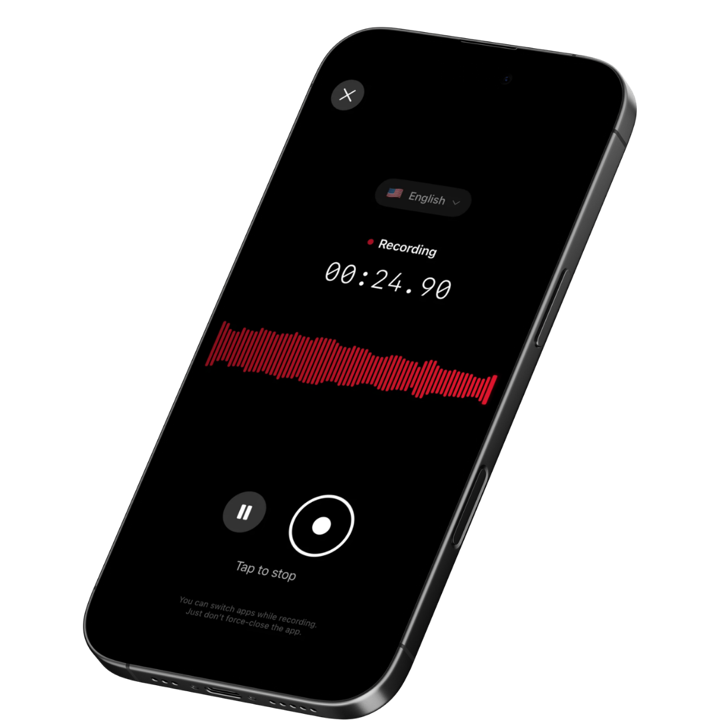
Speakwise closes that loop automatically. By recording conversations and producing accurate transcripts, summaries, and extracted action items, Speakwise ensures the meeting record is complete before the worker even opens their laptop to resume primary work. There is no uncaptured information creating residue. The cognitive open loop closes the moment the recording ends. Workers who use Speakwise for their meetings report cleaner transitions back to focused work because the note-taking obligation that normally generates persistent residue has already been handled.
Download Speakwise on the App Store and eliminate one of the most persistent attention residue loops in the knowledge work day.
Speakwise holds a 4.9-star App Store rating with thousands of installs from professionals who need clean transitions between meetings and focused work.
Download Speakwise on the App Store

🎯 4.9★ App Store Rating | 📱 Built for iOS
