Best AI Voice Journaling App in 2026
Used by recruiters, executives, consultants, and more.
Best AI Voice Journaling App in 2026
Sitting down to write in a journal takes activation energy most people do not have at 10 PM. Voice journaling lowers that barrier: you talk for two minutes, the app captures it, and you have a record of the day. Add AI and you get a summary, a pattern over time, and a searchable archive of your reflections. We compared six apps to find the best AI voice journaling tools in 2026.
The best AI voice journaling apps in 2026 are: 1) Speakwise for structured voice capture with AI summaries, 2) Day One for the established journaling habit with audio entries, 3) AudioPen for voice-to-essay journaling, 4) Voicenotes.com for personal voice notes with AI, 5) Reflect for daily networked Markdown notes, and 6) Otter.ai for voice capture with searchable transcripts. Voice journaling tools fall into two groups: apps built for journaling with voice as a feature, and voice capture apps that work well for journaling. Both paths work - the right choice depends on whether the journaling structure or the voice quality matters more to you.
1. Speakwise - Best for Daily Review and Structured Voice Capture
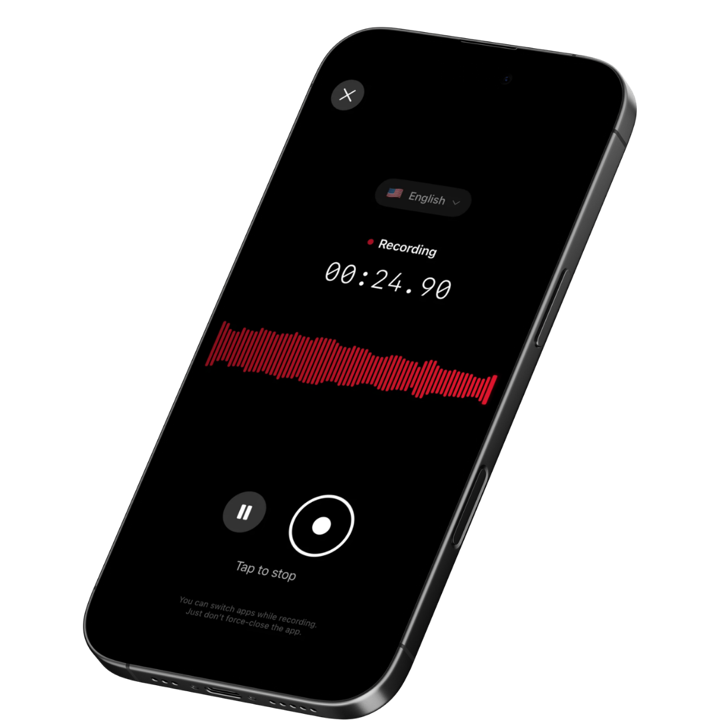
Speakwise is an iOS-native AI voice capture app built primarily for meetings and conversations. For voice journaling, it brings a specific strength: it turns your end-of-day spoken review into a structured, searchable AI summary. Record your daily debrief, team reflection, or project retrospective by voice, and Speakwise produces a clean summary with key points and follow-ups. It carries a 4.9-star App Store rating and supports 100+ languages with dialect recognition.
Why Speakwise Stands Out
Voice journaling for professionals often blurs into meeting reflection. You finish a difficult client session and want to capture what happened, what you felt, and what you should do differently. That is both a journal entry and a meeting debrief. Speakwise handles that dual-purpose capture better than dedicated journaling apps, because it is built for conversation-shaped input - multiple threads, action-oriented thinking, and outcome-focused reflection.
The AI output transforms a spoken ramble into a usable record. A five-minute voice debrief becomes a structured summary with headers, key points, and any follow-up items you mentioned. That summary is more scannable and searchable six weeks later than an audio file you never play again. For users who do daily reviews, end-of-week retrospectives, or project post-mortems by voice, Speakwise produces the cleanest AI output in this group.
Speakwise also covers journaling contexts that app-based journals miss. Long voice reflections without a time cap. Offline recording for journaling on a flight or a hike without cell service. Multi-language journaling for users who think in multiple languages. For more on voice capture as a personal practice, see our best AI voice notes app roundup.
Key Features
- Instant AI Summaries: Spoken daily reviews become structured summaries with key points, decisions, and follow-up items. The output is scannable and searchable.
- Action Items in Seconds: If your journal entry includes things you need to do, they are pulled out automatically into a bulleted list. Useful for evening daily-review practices.
- Action Button Recording: On iPhone 15 Pro and later, set the Action Button to Speakwise so you can start an entry the moment a thought lands - one press, no unlocking, no app to find, whether you are on a walk or winding down at night.
- Long Recording Support: Extended voice journaling sessions - full weekly reviews, end-of-project retrospectives, travel logs - are captured without time limits.
- Works Offline: Journal on a flight, on a hike, or in any location without WiFi. Processing and sync happen when you reconnect.
- 100+ Languages: Record journal entries in your native language, switch mid-entry, or reflect in multiple languages. Auto-detection handles the rest.
- 95%+ Transcription Accuracy: In optimal audio conditions, transcripts are readable text, not audio you have to replay to understand.
- Speaker Diarization: When a reflection turns into a recorded conversation - a debrief with a colleague or a team retrospective - Speakwise applies speaker diarization to keep each voice separate in the transcript, so a two-person exchange never collapses into one undifferentiated block.
- Native Notion Integration: Daily reflections can route directly to a Notion journal database, organized by date, project, or theme.
- AirPods Hands-Free Control: Start, pause, and stop journaling hands-free while walking, cooking, or winding down for the night.
- Private by Design: Your reflections stay yours - Speakwise never sells or shares your recordings and transcripts and never uses them to train its AI, and any entry can be deleted whenever you like.
Pricing
- Free Trial: Full access to all features
- Premium: $59.99/year - unlimited transcription, AI summaries, Notion sync, 100+ languages
Best For
- Professionals doing daily reviews and end-of-day debriefs by voice
- Anyone using Notion as their personal knowledge base or journal
- Voice journalers who want AI to structure their spoken reflections
- Users who journal in multiple languages or on the go
Limitations
- iOS only, no Android or desktop apps
- Not designed as a dedicated journaling app - no prompts, streaks, or mood tracking
- Less wellness-focused than Day One or dedicated journaling apps
Speakwise gets your hours back.
- ✓Built for in-person meetings, interviews, and site visits.
- ✓Trusted by recruiters, consultants, agents, and field pros.
- ✓One tap to record. Notion-ready summary in minutes.

2. Day One - Best for the Traditional Journaling Habit with Audio
Day One is the most established personal journaling app on iOS and Mac. It supports text, photo, audio, and video entries in a chronological journal format. You can record an audio entry, and Day One stores it alongside your other entries with a date, location, and weather stamp. There is no AI transcription or summary built in - the audio is stored as-is. For users who want a polished journal experience with audio as one of several entry types, Day One is the classic choice.
Key Features
- Audio, text, photo, and video journal entries in one timeline
- Location and weather auto-stamped on each entry
- End-to-end encryption on Day One's servers for private entries
- Streak tracking, reminders, and journaling prompts
Pricing
- Free: Limited entries per month
- Premium: ~$34.99/year
- Platinum: ~$49.99/year with advanced features
Best For
- Users who want a structured journaling practice with multiple entry types
- Anyone who values a beautiful, polished journal with streak tracking and prompts
Limitations
- No AI transcription or summary of audio entries
- Audio stored as a file, not searchable text
- AI features in the premium plan are limited compared to dedicated AI tools
3. AudioPen - Best for Voice-to-Essay Journaling
AudioPen converts spoken voice into polished, readable prose. You talk for a few minutes about your day, a reflection, or an idea, and AudioPen writes a structured essay or note from it. The output style is configurable: essays, bullet summaries, structured reflections. For users who journal by talking through their thinking and want clean written output, AudioPen is the most purpose-built tool for that use case.
Key Features
- Voice-in, structured-prose-out with customizable output style
- Essay, bullet point, and reflection output modes
- Short and medium recording sessions
- Web app with iOS access and share options
Pricing
- Free: Limited recordings per month
- Pro: ~$99/year
Best For
- Voice journalers who want their spoken reflections turned into polished written prose
- Writers who use voice as a first draft and want AI to structure it
Limitations
- No journaling prompts, streaks, or wellness features
- Better for structured thinking than emotional or wellness journaling
- No multi-speaker or meeting-context capture
4. Voicenotes.com - Best for Minimal Personal Voice Notes with AI
Voicenotes is a clean, minimal voice note app with AI transcription and summary built in. You record a voice note, and the app transcribes it and generates a short AI summary. The interface is fast and low-friction: tap, talk, done. Voice search across all your notes makes older entries findable. For daily voice journalers who want a dedicated, simple app - not a multipurpose tool - Voicenotes is the most focused option.
Key Features
- Voice capture with automatic AI transcription and summary
- Voice search across all past notes
- Minimal interface optimized for daily voice habits
- Personal knowledge base built from your voice notes over time
Pricing
- Free: Limited notes per month
- Pro: ~$10/month
Best For
- Daily voice journalers who want a dedicated minimal app for the habit
- Users who want to search past voice reflections by voice
Limitations
- Personal focus - not designed for meeting or conversation capture
- Smaller feature set than multipurpose tools
- AI summaries are shorter and less structured than Speakwise output
5. Reflect - Best for Daily Notes with Voice as One Input
Reflect is a Markdown-native daily note app with AI writing features and networked notes. Each day gets a new note, and Reflect builds backlinks between related entries automatically over time. Voice input is supported as one way to add content to your daily note. E2E encryption is marketed as a core Reflect feature on its own infrastructure. For journalers who already run a daily notes system and want voice as an input option, Reflect fits naturally. See our best AI meeting notes with Markdown export roundup for more on Reflect in knowledge workflows.
Key Features
- Daily Markdown notes with automatic networked backlinks
- AI writing and summarization for note content
- Voice input support for daily journaling
- Strong privacy positioning with E2E encryption on Reflect's servers
Pricing
- Pro: ~$10/month
Best For
- Daily note practitioners who want voice as one of several input methods
- Users building a networked knowledge base from daily reflections
Limitations
- Not a standalone voice journaling app - best as part of a broader note system
- Smaller integration ecosystem than journaling-specific apps
- Requires some setup for optimal daily note workflow
6. Otter.ai - Best for Searchable Voice Journaling Transcripts
Otter.ai is primarily a meeting notes tool, but its voice capture works for personal journaling too. You record a voice entry through the Otter mobile app, and it transcribes and summarizes it. The result is stored in your Otter account alongside meeting recordings, making it searchable. For users who already use Otter for meetings and want to add personal voice journaling to the same app, it is a convenient single-tool approach.
Key Features
- Voice recording with AI transcription and summary
- Searchable transcript archive across all recordings
- Speaker label feature turned toward single-speaker journaling entries
- Mobile app for quick recording anywhere
Pricing
- Free: 300 minutes/month, 30-minute cap per conversation
- Pro: $16.99/month
- Business: $30/user/month
Best For
- Existing Otter users who want to add voice journaling to their current workflow
- Users who want meeting notes and personal journaling in one searchable archive
Limitations
- Free plan caps recordings at 30 minutes - sufficient for journaling
- Not designed for journaling: no prompts, streaks, or mood tracking
- Meeting-focused UI is less natural for personal journaling
How to Choose the Best AI Voice Journaling App
Voice journaling tools serve different needs: emotional processing, daily review, idea capture, and habit tracking. The right tool depends on what role journaling plays in your life.
- Structure vs flow: If you want your spoken reflection to become a well-organized note with headers and bullets, Speakwise and AudioPen do that best. If you want to store the audio with minimal friction and search it later, Day One or Voicenotes is the simpler path.
- AI depth: Day One stores audio but does not summarize or transcribe it. Voicenotes gives a short summary. AudioPen gives polished prose. Speakwise gives a structured summary with extracted follow-ups. Match the AI depth to how much you want the app to do for you.
- Journaling features vs capture quality: Day One has streaks, prompts, and a beautiful timeline. Speakwise has none of those. If the journaling habit itself needs support, Day One is the better motivator. If you already have the habit and want better output, Speakwise or AudioPen adds more value.
- Integration with work tools: Daily reviews that connect to Notion, task managers, or project tracking need a tool with integrations. Speakwise routes to Notion natively. Reflect builds an internal linked knowledge base. Day One is a personal archive, not a connected workspace tool.
- Cost: Day One Platinum is ~$49.99/year. Speakwise Premium is $59.99/year. AudioPen Pro is ~$99/year. Voicenotes Pro is ~$10/month. Reflect is ~$10/month. Day One and Speakwise are the best value for annual subscribers.
Frequently Asked Questions
What is the best AI voice journaling app in 2026?
The best AI voice journaling app depends on what you want from journaling. For professionals who want structured daily reviews with AI summaries and action item extraction, Speakwise is the strongest pick in 2026. For users who want a traditional journaling experience with audio entries alongside photos and text, Day One is the most polished option. For voice-to-essay journaling where you want your spoken reflection turned into readable prose, AudioPen is the best fit. All three have free trials or tiers available before committing to a subscription.
Can Speakwise be used as a voice journal?
Yes. Speakwise captures any voice input and produces a structured AI summary. For daily reviews, end-of-day debriefs, or weekly retrospectives, the structured output is often more useful than a traditional journal entry. You speak naturally about your day, decisions, or reflections, and Speakwise produces a summary with key points and any follow-up items you mentioned. What it does not offer is journaling-specific features: no prompts, no streak tracking, no mood tags. If those matter to you, pair Speakwise with Day One for the best of both approaches.
Does Day One have AI transcription for voice journaling?
Day One supports audio entries but does not currently offer AI transcription or summary of those entries. Audio is stored as a file alongside your journal text and photos. You can play it back, but the content is not transcribed into searchable text or summarized by AI. For users who want to find and search past voice journal entries by content, a tool like Voicenotes or Speakwise - which produce searchable text transcripts - is more practical than Day One for voice-heavy journaling workflows.
What should I look for in an AI voice journaling app?
Four things matter. First, transcription quality: the more accurate the transcript, the more useful the searchable record. Second, AI output structure: does the summary actually capture the important things you said, or is it a generic paraphrase. Third, friction: the fewer steps between deciding to journal and finishing the entry, the more consistently you will do it. Fourth, long-term usefulness: can you search past entries, see patterns over time, and reference specific reflections when you need them. Speakwise and Voicenotes score well on friction and transcript quality. Day One wins on long-term archiving and journaling habit support.
Is voice journaling actually effective compared to writing?
Research on expressive writing suggests that the act of processing thoughts and feelings in language - spoken or written - produces similar benefits. The main advantage of voice journaling is lower friction: speaking is faster than typing, and you can journal while walking, driving, or lying in bed. The main disadvantage is that spoken content is harder to search and reference without a transcription layer. AI tools like Speakwise and Voicenotes close that gap by converting speech to searchable, summarized text. The combination of low-friction voice input with AI-structured text output gives you the benefits of both approaches.
Final Verdict
For professionals running daily reviews and end-of-week retrospectives, Speakwise is the strongest AI voice journaling tool in 2026. The AI summary output is more structured and actionable than any dedicated journaling app, and the Notion integration lets you build a searchable archive of your reflections alongside your work notes.
Day One is the right pick if the journaling habit needs support: prompts, streaks, and a beautiful timeline motivate consistency in a way that a capture-focused tool does not. AudioPen fills the specific niche of voice-to-essay for users who want polished written prose from their spoken reflections. Voicenotes is the cleanest minimal option for daily voice habit with AI.
The voice journaling category is still maturing. The tools that combine low capture friction with high-quality AI output - Speakwise and AudioPen - are ahead of the field. Day One remains the gold standard for journaling as a personal practice, regardless of how the AI layer develops.
Download Speakwise from the App Store and turn your next daily review into a structured, searchable AI summary you can actually reference later.
🎯 4.9★ App Store Rating | 📱 Built for iOS
