Best App for Field Teams to Send Status Reports From Their Phone (2026)
Used by recruiters, executives, consultants, and more.
Best App for Field Teams to Send Status Reports From Their Phone in 2026
The fastest way to get field status reports on phone is to stop asking people to type them. A crew lead standing in mud at 4:45pm will not fill out an eight-field form on a cracked screen, and the office finds out three days later that the trench was rerouted. Every field organization runs into the same wall: the report is not hard to write, it is hard to write at the exact moment the person is tired, dirty, and one step from their truck. We tested and compared the top options - here are the 6 best apps for field status reports in 2026.
Fastest Way to Get Field Status Reports on Phone at a Glance (2026)
The fastest way to get field status reports on phone in 2026 is one of these six apps:
- Speakwise - Best overall for spoken status updates (talk for 90 seconds, get a written summary and action items)
- Raken - Best structured daily report platform for construction crews
- SafetyCulture - Best template library for inspections and compliance-driven reporting
- Fieldwire - Best when reports need to attach to tasks and drawings
- CompanyCam - Best for photo-first documentation with location stamps
- Apple Voice Memos - Best free fallback for raw audio capture
The split in this category is simple. Form-based platforms produce clean, structured data but depend on someone stopping to fill fields. Voice-first capture produces the report in the time it takes to say it.
1. Speakwise - Best Overall for Spoken Field Status Reports
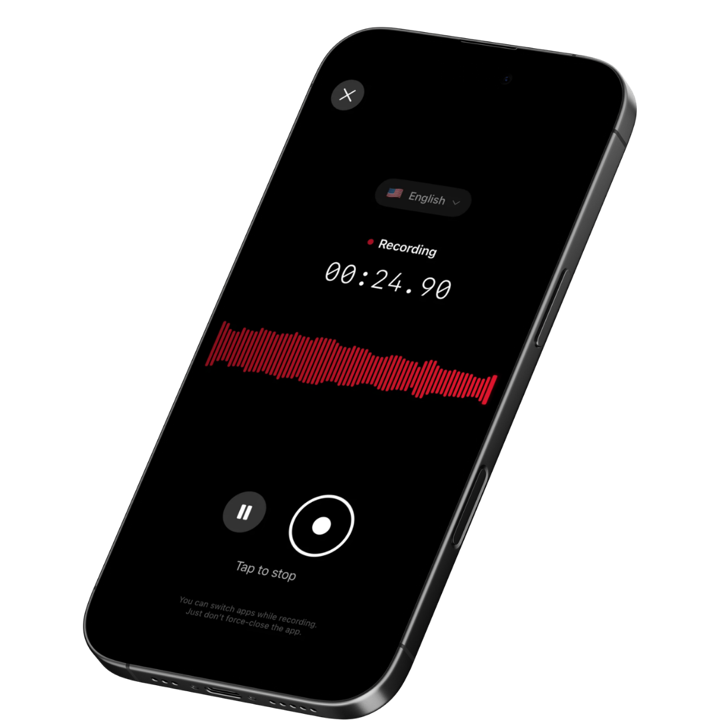
Speakwise is an iOS app that records through the iPhone microphone and returns a transcript, an AI summary, and an extracted action item list. For field status reporting, the workflow is one step: a tech or crew lead holds the phone, talks through what happened, and stops. What comes back is not a raw recording but a written summary with the follow-ups already pulled out.
Why Speakwise Stands Out
Field reporting fails at the input stage, not the output stage. Managers usually blame the template when the real problem is that typing is the wrong interface for someone wearing gloves at the end of a shift. Speaking a status update takes about a fifth of the time and produces more detail, because people describe a job the way they would to a colleague rather than compressing it into whatever the form allows.
Speakwise is also useful in the other direction. Field teams routinely need to capture what a client, inspector, or subcontractor said on site, not just what the tech did. Recording that conversation gives you a defensible record and a summary of the commitments made, which a self-authored status form never captures. Our roundup of the best apps for foreman daily field reports covers the construction-specific version of this workflow.
Offline behavior matters more here than in almost any other category. Substations, basements, tunnels, and rural service areas have no coverage, and a reporting tool that requires a live connection just to capture the input will fail at the exact moments that matter. Speakwise records regardless of signal and finishes transcription and summarization once the phone reconnects.
Key Features
-
Talk-and-Go Status Capture: One tap, then speak. A full status update takes under two minutes and produces a written summary, so nothing has to be typed on a phone keyboard.
-
Action Items Pulled Automatically: Speakwise extracts the follow-ups from the spoken update. Parts to order, permits to chase, callbacks to schedule. The dispatcher gets a task list instead of a paragraph.
-
On-Site Conversation Capture: Record the walkthrough with the client, inspector, or sub. Speaker labels separate who committed to what, which a self-reported status form cannot do.
-
Records Offline: Capture the update anywhere, including sites with zero coverage. Transcription and summary generate when the device is back in range.
-
Long Recording Support: A full site walk or a shift-end debrief with three people can run 45 minutes without being split into fragments.
-
100+ Languages: Crews are frequently multilingual. Speakwise transcribes in over 100 languages with automatic detection, so a Spanish-language update comes back accurately rather than half-guessed.
-
Share and Export: Copy the summary into your daily report tool, paste it into an email to the PM, or share a note by link. The output is plain text that goes wherever your team already works.
Pricing
- Subscription: Paid subscription via the App Store. No free tier.
- Included: Unlimited recording length, transcription in 100+ languages, AI summaries, action items, and speaker labels.
Best For
- Service techs and crew leads who need to report without stopping to type
- Teams whose reporting compliance is poor because the form is too slow
- Multilingual crews where written English is a barrier
- Field work in low-signal locations
Limitations
- iOS only, so Android field crews cannot use it
- No native integration with Procore, Raken, or any field service platform; you copy or share the text
- Produces narrative summaries, not structured database fields for reporting dashboards
- Loud equipment on site degrades audio quality
Speakwise gets your hours back.
- ✓Built for in-person meetings, interviews, and site visits.
- ✓Trusted by recruiters, consultants, agents, and field pros.
- ✓One tap to record. Notion-ready summary in minutes.

2. Raken - Best Structured Daily Report Platform
Raken is a construction field management platform built specifically around the daily report. Crews log hours, production quantities, weather, safety observations, and toolbox talks on mobile, and Raken compiles everything into a formatted daily report that the office receives automatically. For general contractors and subs who need consistent, auditable daily documentation across many crews, it is purpose-built for exactly that.
The tradeoff is entry effort. Raken produces excellent structured output because someone completed structured input, and adoption depends entirely on whether crews actually do it.
Key Features
- Daily reports with production tracking, hours, and weather
- Safety observations and toolbox talk logging
- Photo and video attachment with time stamps
- Automatic compilation and distribution of formatted reports
Pricing
- Quote-based; Raken does not publish public plan pricing
Best For
- Construction contractors who need standardized daily reports across crews
- Teams with audit or owner-reporting obligations
Limitations
- No public pricing, so evaluation requires a sales conversation
- Still fundamentally a form-filling workflow
- Construction-specific; a poor fit for service, utility, or agricultural field teams
3. SafetyCulture - Best Template Library for Inspections
SafetyCulture, formerly iAuditor, is a mobile inspection and audit platform with an enormous library of ready-made templates. Field teams complete a checklist, attach photos, flag failures, and the platform generates a report and routes corrective actions. For compliance-driven reporting where the same checks recur across many sites, it removes the work of designing forms from scratch.
It is a checklist engine first. Freeform narrative - what actually went wrong, what the client said, what the tech thinks should happen next - fits awkwardly into a template built around pass/fail fields.
Key Features
- Large library of prebuilt inspection and audit templates
- Custom form builder with conditional logic
- Photo capture, failed-item flagging, and corrective action assignment
- Offline completion with sync when reconnected
Pricing
- Free plan for individuals and small teams
- Premium: from ~$24/seat/month billed annually
Best For
- Compliance, safety, and quality inspections that repeat across sites
- Organizations that need auditable pass/fail records
Limitations
- Structured fields suit inspections better than open-ended status updates
- Seat costs add up quickly across a large field workforce
- Template design and maintenance is an ongoing admin job
4. Fieldwire - Best When Reports Attach to Tasks and Drawings
Fieldwire, now part of Hilti, is a construction field management app built around plans and tasks. Field crews view drawings on a phone or tablet, pin issues to a location on the sheet, assign them, and attach photos. Status reporting in Fieldwire is a byproduct of task activity rather than a separate document, which is a genuinely good model when the work is drawing-driven.
For field teams that do not work from drawings - service, utility, landscape, agriculture - most of the value does not apply.
Key Features
- Plan viewing and markup with issue pinning to sheet locations
- Task assignment with photos, due dates, and status
- Offline access to drawings and tasks
- Automated reports generated from task activity
Pricing
- Basic: free for up to 5 users and 3 projects
- Pro: from ~$39/user/month billed annually
- Business: from ~$59/user/month billed annually
Best For
- Construction crews whose reporting is tied to punch lists and drawings
- Teams already coordinating from a shared plan set
Limitations
- Only useful when work is organized around drawings
- Per-user pricing gets expensive for large field headcounts
- Not designed for narrative status updates
5. CompanyCam - Best for Photo-First Documentation
CompanyCam is a photo documentation platform for contractors. Every photo is stamped with time and location and filed automatically to the correct project, so the status record builds itself as the crew shoots. For trades where the picture is the proof - roofing, restoration, exteriors - it is the strongest option in this list.
Photos carry a lot but not everything. Why a decision was made, what the homeowner agreed to, and what the crew recommends next all need words, and CompanyCam's annotation tools are not built to carry that load.
Key Features
- Automatic time-stamped and location-stamped photos filed to projects
- Unlimited photo storage with project-based organization
- Photo annotation, checklists, and shareable project galleries
- Integrations with common contractor platforms
Pricing
- Pro: from ~$29/user/month billed annually, with a 3-user minimum on most plans
- 14-day free trial; no permanent free plan
Best For
- Trades where visual documentation is the primary evidence
- Teams that need automatic photo organization by job
Limitations
- Photo-centric; weak for narrative reporting
- Three-user minimum makes it costly for very small teams
- No transcription or summarization of spoken updates
6. Apple Voice Memos - Best Free Fallback
Apple Voice Memos is already on every iPhone and records with one tap. A crew lead can capture a spoken status update at zero cost, and recent iOS versions transcribe memos on device so you can read them without a connection.
What is missing is everything that makes a recording useful to somebody else. No summary, no action items, no speaker separation, and no organization beyond a flat list of files. Twenty crew members producing daily memos creates an archive nobody will ever open. Our comparison of recording apps for field technicians covers where that ceiling gets hit.
Key Features
- Preinstalled and free on every iPhone
- One-tap recording with no account or setup
- On-device transcription on recent iOS versions
- iCloud sync across Apple devices
Pricing
- Free, included with iOS
Best For
- The cheapest possible way to capture a spoken field update
- A backup recorder alongside a primary reporting tool
Limitations
- No summaries, action items, or speaker labels
- No routing to a manager or project record
- Unusable at scale across a field team
How to Choose a Field Status Reporting App
The mistake most operations leaders make is optimizing the report format when the real constraint is the twenty seconds of attention a tired tech has at the end of a shift.
-
Measure the input cost, not the output quality: A perfect structured report that gets filed 40% of the time is worse than a good narrative summary filed every day. Time how long your current form takes to complete on a phone, in gloves, outdoors.
-
Test it with no signal: Confirm the app can capture input offline and sync later. SafetyCulture, Fieldwire, and Speakwise all keep working without a connection; anything that requires a live upload to accept input will fail on your hardest sites.
-
Decide whether you need fields or narrative: If the office needs quantities, hours, and pass/fail data for dashboards, you need structured entry from Raken or SafetyCulture. If the office needs to know what actually happened and what to do next, narrative capture wins.
-
Account for language: Multilingual crews report far more detail in their first language. Speakwise transcribes over 100 languages, which turns a reporting gap into a non-issue.
-
Recording other people: If your workflow includes recording a client, inspector, or subcontractor conversation, recording consent laws vary by state and country and several US states require all-party consent. Say clearly that you are recording, get agreement before you start, and stop if anyone objects. Check your local rules and your company policy first.
Frequently Asked Questions
What is the fastest way to get field status reports on phone?
Speaking the update instead of typing it. With Speakwise, a tech records a 90-second spoken update on iPhone and gets back a written summary with action items already extracted. That beats form entry because nobody has to type on a phone in the field. Structured platforms like Raken produce cleaner data but require someone to fill fields.
What is the best app for field teams to send status reports from their phone?
Speakwise is the best choice when the bottleneck is getting crews to report at all, because a spoken update takes under two minutes. Raken is stronger if you need standardized construction daily reports with hours and quantities. SafetyCulture wins for compliance checklists, and Fieldwire fits teams whose reporting attaches to drawings.
Can field crews submit reports without typing?
Yes. Voice capture removes typing entirely. A crew lead records a spoken update, and an app like Speakwise converts it into a transcript, a summary, and a follow-up list. The summary can then be copied or shared into whatever reporting system the office uses. This works well for crews wearing gloves or working outdoors.
Do field reporting apps work without cell signal?
Some do. Speakwise records offline and processes the transcript once the phone reconnects. SafetyCulture and Fieldwire also allow offline completion with later sync. Cloud-only transcription services stall without a connection. Always test your chosen app in the worst-coverage location your crews actually visit before rolling it out.
How long should a field status report take to file?
Under two minutes if you want consistent compliance. Long forms get skipped at the end of a shift, which is when reports matter most. A spoken update recorded through Speakwise typically takes 60 to 120 seconds and still captures more detail than a filled-in template, because people describe work naturally rather than compressing it.
Final Verdict
Field status reporting is an adoption problem wearing a software problem's clothes. The template is rarely the issue. The issue is that filing it requires typing at the worst possible moment in a tech's day.
Speakwise is the strongest pick for teams whose reports are late, thin, or missing. Talking takes seconds, it works offline, and the AI summary plus action items turn a rambling update into something a dispatcher can act on. It does not replace a structured reporting platform if you need quantities and hours in a database, and it does not integrate natively with one, so you copy or share the output.
Raken and SafetyCulture remain the right answer when the office needs auditable structured data. Fieldwire fits drawing-driven construction work, and CompanyCam is unbeatable when photos are the proof. For most field teams, the practical setup is a structured platform for the numbers and a voice recorder for everything the numbers leave out.
Download Speakwise from the App Store and let your crews file tomorrow's status report by talking for ninety seconds.
🎯 4.9★ App Store Rating | 📱 Built for iOS
