Best App for Nonprofit Program Managers to Record Site Visit Notes (2027)
TL;DR
The best app for nonprofit program managers to record site visit notes in 2027 is Speakwise. The iPhone app works offline and captures the field conversation a checklist misses, with a 7-day free trial. KoBoToolbox suits free structured data collection, and Fulcrum suits inspection-style visits.
Used by recruiters, executives, consultants, and more.
Best App for Nonprofit Program Managers to Record Site Visit Notes in 2027
A monitoring trip can run four hours at a partner site, and the structured form captures the easy parts: attendance counts, stock levels, whether the register is current. What usually gets lost is the forty-minute conversation that explains why something is actually happening. By report time, that conversation flattens into one vague line. Six field-tested tools compared below.
Best App for Nonprofit Program Managers to Record Site Visit Notes at a Glance (2027)
The best app for nonprofit program managers to record site visit notes in 2026 depends on whether you are capturing structured indicators or the conversation around them:
- Speakwise - Best for capturing site conversations and spoken field observations on your iPhone
- KoBoToolbox - Best free-tier structured data collection for humanitarian and NGO work
- CommCare - Best mobile case management for ongoing beneficiary follow-up
- Fulcrum - Best for inspection-style site visits with GPS and photo evidence
- Bonterra Apricot - Best case management and outcomes reporting for US social service nonprofits
- Apple Voice Memos - Best free built-in fallback when connectivity and budget are both zero
Most program teams end up with two tools, not one: a form-based collector for indicators, and something that captures the conversation. Speakwise covers the second job, which is the one usually left to memory.
1. Speakwise - Best for Capturing Site Visit Conversations
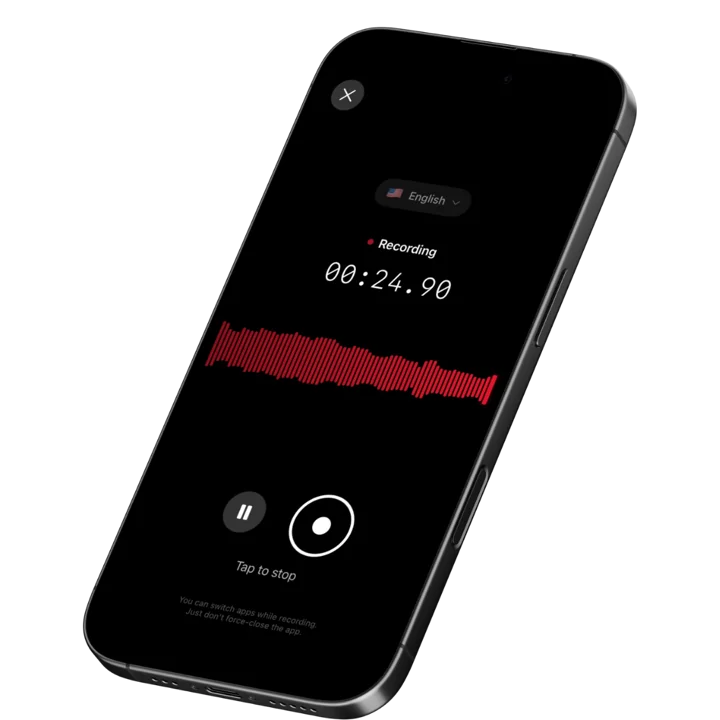
Speakwise is an iOS recording and AI notes app. It records through the iPhone microphone, transcribes in over 100 languages, applies speaker labels, and returns a structured summary with action items extracted. For a program manager, the job it does is the one no data collection form can do: capturing what people at the site actually said, in their own words, and turning it into something you can put in a report.
Why Speakwise Stands Out
Monitoring visits produce two kinds of information, and most nonprofit tooling only handles one. Indicators, counts, and compliance checks belong in a structured form, and tools like KoBoToolbox and CommCare do that well. The second kind is qualitative: a partner explaining why a process fails, a beneficiary describing what changed, a site coordinator listing the three things they need. That information arrives as conversation, and a form has no place to put it.
The default fallback is to scribble a few lines and reconstruct the rest later. That reconstruction is where nuance dies. A recorded conversation preserves the exact phrasing, and exact phrasing is what makes a qualitative finding credible to a donor rather than an assertion. If your report quotes what the site coordinator said, that quote carries weight. If it paraphrases what you remember them saying, it reads as your opinion.
Speakwise also fits the physical reality of a site visit. You are walking, standing, sitting on a plastic chair in a courtyard. There is no desk and often no reliable connection. You record from the phone already in your hand, no laptop involved, and the summary and action items come back structured. The same pattern shows up across field roles: our guide to recording driver debriefs in the field covers a near-identical capture problem in a different sector, and recording meetings outdoors covers what changes acoustically once you leave a room.
Multilingual work is the other reason it fits. Site conversations frequently happen in a language other than your reporting language, often through a translator or with a colleague interpreting. Speakwise auto-detects and transcribes across 100+ languages, so a conversation in Kiswahili, Spanish, or Bangla comes back as text rather than as a memory of what someone told you it meant.
Key Features
- One-tap capture in the field: Record the conversation with a site coordinator or a community group directly from your iPhone. No laptop, no form to navigate, no interruption to the conversation.
- AI summaries: A forty minute site conversation becomes a structured summary you can read before the drive back, and paste into your trip report.
- Action item extraction: Commitments made during the visit, on both sides, come back as an explicit list rather than something you hope you remember.
- Speaker labels: Group conversations with several participants read as a dialogue, so a finding can be attributed to the right person or role.
- 100+ languages: Automatic language detection for multilingual field work and interpreter-assisted conversations.
- Long recordings: Handles multi-hour partner meetings, community consultations, and full-day monitoring visits.
- Export and share: Copy or export the transcript and summary into your report template, or share notes by link with colleagues.
Pricing
- Paid subscription via the App Store. Speakwise is a paid iOS app with no free tier. Check the current price on the App Store listing before subscribing.
Best For
- Qualitative capture during monitoring and partner site visits
- Community consultations and focus group conversations
- Multilingual field work where accurate phrasing matters
- Program managers writing trip reports days after the trip
Limitations
- iOS only, with no Android version, which is a real constraint for field teams standardized on Android
- Not a data collection platform: no forms, no indicators, no GPS-tagged submissions, no dashboards
- Not a case management or beneficiary record system
- Paid subscription with no free tier
Consent and Recording
Recording people at a site visit requires their informed agreement, and this is more sensitive in nonprofit work than in most sectors because of the power imbalance between a funder or monitoring body and the people being visited. Explain plainly what you are recording, why, who will hear it, and how long it will be kept, then get an explicit yes. Follow your organization's safeguarding, data protection, and research ethics policies, and recognize that consent laws differ by country. Where recording is not appropriate, record only your own spoken observations after the conversation ends.
Speakwise gets your hours back.
- ✓Built for in-person meetings, interviews, and site visits.
- ✓Trusted by recruiters, consultants, agents, and field pros.
- ✓One tap to record. Notion-ready summary in minutes.

2. KoBoToolbox - Best Free Structured Data Collection
KoBoToolbox is the default form-based data collection tool across humanitarian and international development work, and for good reason: it is open source, works fully offline on mobile, syncs when connectivity returns, and offers a free tier for nonprofits, UN agencies, governments, and educational institutions. If your site visits produce indicators, KoBo is almost certainly part of your stack.
Key Features
- Offline-first mobile data collection with automatic sync
- Complex form logic, skip patterns, and validation
- Free tier for eligible nonprofit and humanitarian organizations
- Open source with a large community and template library
Pricing
- Free for eligible nonprofits, UN agencies, governments, and educational institutions
- Paid plans from ~$25 per month for higher usage
Best For
- Structured indicator collection during monitoring visits
- Low-connectivity environments where offline capture is mandatory
Limitations
- Form-based by design, so long open-ended conversation does not fit the model
- Form design requires real skill and time to get right
- Analysis of qualitative free-text answers is still manual
3. CommCare - Best Mobile Case Management
CommCare from Dimagi is a mobile case management platform rather than a survey tool, which is the important distinction. It tracks individuals and households over time, supports frontline worker workflows, works offline, and handles longitudinal follow-up. For programs where the site visit is one touchpoint in an ongoing relationship with a beneficiary, it is a stronger fit than a pure form collector.
Key Features
- Longitudinal case management, not just one-off surveys
- Offline mobile workflows for frontline workers
- Decision support and guided workflows for field staff
- Reporting and dashboards over case data
Pricing
- From ~$250 per month, rising with features and scale
Best For
- Programs following the same beneficiaries or sites over time
- Frontline worker deployments needing guided workflows
Limitations
- Substantially more expensive than KoBoToolbox
- Real implementation effort and technical capacity required
- Overkill for occasional monitoring visits
4. Fulcrum - Best for Inspection-Style Site Visits
Fulcrum is a field data collection and inspection platform with strong GPS, mapping, and photo evidence handling. It suits site visits that look more like inspections than interviews: facility condition assessments, infrastructure checks, safeguarding audits, and anything where the location and photographic record are part of the finding.
Key Features
- GPS-tagged records with mapping and spatial analysis
- Photo and video evidence attached to records
- Offline capture with sync on reconnection
- Custom inspection workflows and app builder
Pricing
- From ~$43 per user per month
Best For
- Facility and infrastructure assessments during site visits
- Programs where geographic and photographic evidence is central
Limitations
- Per-user pricing adds up quickly for large field teams
- Inspection-oriented, so open conversation is not the design target
- More tool than needed for simple partner check-ins
5. Bonterra Apricot - Best US Social Service Case Management
Bonterra Apricot is a case management and outcomes platform widely used by US social service nonprofits, covering intake forms, service tracking, participant records, and the reporting that funders ask for. Site visit notes typically live inside the participant or program record rather than as standalone documents, which is an advantage when your reporting obligation is outcomes-based.
Key Features
- Configurable intake forms, assessments, and service records
- Outcomes tracking and funder-ready reporting
- Participant records that persist across staff turnover
- Role-based access controls for sensitive data
Pricing
- Quote-based, priced by number of users. Bonterra does not publish list pricing.
Best For
- US social service nonprofits with grant reporting requirements
- Organizations that need one durable participant record
Limitations
- Quote-based pricing makes budgeting hard before a sales conversation
- Configuration and implementation time is significant
- Not designed for offline-first international field work
6. Apple Voice Memos - Best Free Built-In Fallback
Voice Memos is on every iPhone and costs nothing, which matters when program budgets do not stretch to software licenses. Record the conversation, keep the audio. On iPhone 12 and later it produces a transcript in supported languages. There are no summaries, no action items, no speaker labels, and no organization, so a busy monitoring season leaves you with dozens of unlabeled files.
Key Features
- Free and pre-installed on every iPhone
- Fully offline recording with iCloud sync when available
- Transcripts on iPhone 12 and later in supported languages
- No account or setup
Pricing
- Free, included with iOS
Best For
- Zero-budget capture of site conversations
- Testing whether recorded field notes improve your reports
Limitations
- No summaries, action items, or speaker labels
- Transcript language coverage is limited compared with dedicated apps
- No structure for finding one visit among a season of recordings
How to Choose a Site Visit Notes App
- Separate structured indicators from qualitative capture. These are different jobs and almost no single tool does both well. A form tool for numbers, a recorder for conversation. Trying to force interviews into a form is why so much qualitative insight disappears.
- Check what works with no connectivity. Rural sites, basements, border areas, and field offices with intermittent power all break cloud-dependent tools. Confirm that recording and form capture both work fully offline and sync later.
- Confirm your device standard first. Many international field teams issue Android handsets. An iOS-only app is not an option for those teams regardless of how good it is, so check hardware before you evaluate features.
- Take safeguarding and consent seriously. Recording beneficiaries carries an ethical weight beyond legal consent requirements. Follow your organization's safeguarding and data protection policies, explain how recordings are stored and deleted, and accept no as an answer.
- Ask whether it survives staff turnover. Program manager tenure is short. Notes that live only on one person's phone leave with that person. Prefer tools that export cleanly into your organization's shared systems.
Frequently Asked Questions
What is the best app for nonprofit program managers to record site visit notes?
For capturing conversations and spoken observations, Speakwise is the strongest pick: it records through your iPhone, transcribes over 100 languages, and returns a summary with action items. For structured indicators, KoBoToolbox is the humanitarian sector standard and free for eligible organizations. Most teams use both.
Can I record site visit notes without an internet connection?
Yes. Speakwise and Apple Voice Memos both record locally on the device, and KoBoToolbox and CommCare are built for offline form capture with sync on reconnection. Verify offline behavior before a trip, since some cloud-first tools silently fail to save when connectivity drops mid-visit.
Do I need consent to record people during a monitoring visit?
Yes, and the bar is higher than legal minimums in nonprofit work. Explain what you are recording, why, who will hear it, and how long it is kept, then get an explicit yes. Follow your safeguarding and data protection policies. Consent rules also vary by country, so check local law.
What is the difference between KoBoToolbox and a recording app?
KoBoToolbox collects structured data through forms: counts, indicators, checkboxes, and validated fields. A recording app captures open conversation and turns it into text. Forms answer how many, recorders answer why. Most monitoring visits generate both kinds of information, which is why program teams commonly carry both tools.
How do program managers write better trip reports?
Reduce the delay between the visit and the write-up, and stop relying on memory for qualitative findings. A recorded conversation gives you the participant's actual phrasing, which is far more credible to a donor than a paraphrase. Pair that with structured indicators from a form tool for the quantitative half.
Final Verdict
Nonprofit monitoring stacks are usually strong on numbers and weak on words. Indicators get collected carefully through purpose-built form tools, while the conversations that explain those numbers get compressed into a few lines of handwriting and then into a vague sentence in a trip report.
Speakwise is the best pick for fixing that half of the problem. Record the conversation with the site coordinator or the community group, get a speaker-labeled transcript and a structured summary with action items, and write your report from what people actually said. It does not replace your data collection platform and does not try to.
KoBoToolbox remains the right structured collector for most international programs, especially given the free tier for eligible organizations. CommCare is the stronger choice when the site visit is part of ongoing case follow-up, Fulcrum wins for inspection-style visits with photo and GPS evidence, and Bonterra Apricot fits US social service nonprofits with outcomes reporting obligations. Pair one of those with a recorder and both halves of the visit get documented.
Download Speakwise from the App Store and bring back the conversation from your next site visit, not just the checklist.
🎯 4.9★ App Store Rating | 📱 Built for iOS
