Best App for Recording Telehealth Visits (2026)
Used by recruiters, executives, consultants, and more.
Best App for Recording Telehealth Visits in 2026
Telehealth was supposed to make documentation easier. The patient is on a screen, the audio is clean, and the clinician sits at a desk. In practice, virtual visits introduce their own headaches. Notes still pile up after a 12-visit afternoon. Some patients call from a moving car or a noisy break room. Some video platforms produce inconsistent audio. And many clinicians work across two or three telehealth platforms in a single day, none of which talk to each other or to the EHR. We tested and compared the top options - here are the 5 best tools for the job.
The best apps for recording telehealth visits in 2026 are: 1) Speakwise for iPhone-native capture across any video platform, 2) Abridge for Epic-integrated enterprise scribing, 3) Doximity Scribe for free verified-clinician documentation, 4) Heidi for flexible self-serve note generation, and 5) Suki for voice-driven dictation with EHR write-back. The decisive factor is whether you need an enterprise platform-tied scribe or a personal tool that works on every video platform you use.
1. Speakwise - Best Overall for Recording Telehealth Visits
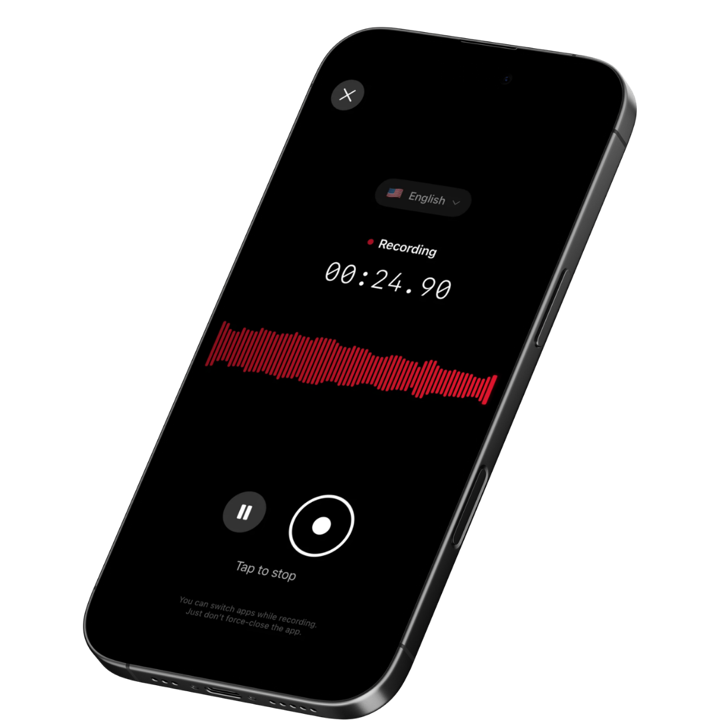
Speakwise is an iPhone-native AI voice notes and transcription app that records telehealth audio cleanly regardless of which video platform a clinician uses, then produces structured AI summaries with assessment, plan, medication changes, and action items. It carries a 4.9-star App Store rating, delivers 95%+ transcription accuracy, and supports 100+ languages. For clinicians who hop between Doximity, Doxy.me, Zoom, and proprietary platforms in a single day, Speakwise is the only tool that works the same way across all of them.
Why Speakwise Stands Out
Most AI scribes are tied to a specific telehealth platform or a specific EHR. If you use Epic in clinic but Doxy.me for after-hours visits and Zoom for second opinions, that creates three different workflows and three different note formats. Speakwise sidesteps the integration question by running on the iPhone next to your laptop or as a second capture device on your desk.
The audio quality on telehealth is usually good, and Speakwise takes advantage of that with 95%+ transcription accuracy on medical vocabulary, speaker diarization when family members join the call, and dialect-aware models that handle patients on cell connections from anywhere in the country.
For practices that work in 2 or 3 languages every day, Speakwise transcribes and summarizes across English, Spanish, Tagalog, Mandarin, Vietnamese, Arabic, and 40+ more without manual switching. That alone is enough to replace whatever standalone transcription tool a multilingual practice currently runs.
Key Features
- Platform-agnostic capture: Works alongside any telehealth platform: Doximity, Doxy.me, Zoom for Healthcare, Teladoc, MDLive, Amwell, or proprietary EHR-integrated video. Place the iPhone next to the laptop and record the visit cleanly without integrations.
- Long Recording Support: Multi-hour board meetings, conference sessions, offsites.
- Works Offline: Construction sites, secure boardrooms, planes - record without WiFi. Sync when you're back.
- 95%+ transcription accuracy on medical vocabulary: Drug names, dosages, lab values, and specialty terminology transcribe correctly the first time, including when patients have heavy accents or sit in noisy environments.
- Structured AI summaries: Each visit produces a clean summary with subjective, objective, assessment, and plan sections, plus medication changes and follow-up tasks pulled out as separate fields. The output mirrors how clinicians structure progress notes.
- 94% action item extraction: Prescriptions to send, labs to order, referrals to make, and patient education materials to email get pulled out automatically, ready to drop into your EHR or task list.
- Speaker Diarization: Speakwise's speaker diarization distinguishes between clinician, patient, family member, and interpreter voices, so the transcript reads as a real conversation.
- Native Notion integration: Push fully formatted notes into a private workspace before EHR entry. Useful for clinicians who draft outside the EHR for speed.
- 100+ languages: Critical for telehealth practices serving immigrant communities or working across state lines. Auto-detection means no manual switching when patients change languages mid-visit.
- Private by Design: Visit recordings stay yours—Speakwise never uses your recordings or transcripts to train its AI, and never sells or shares them; delete any visit whenever you choose.
Pricing
- Free Trial: Full access to all features
- Premium: $59.99/year - unlimited transcription, AI summaries, Notion sync, 100+ languages
Best For
- Primary care and behavioral health providers running telehealth blocks
- Clinicians who use multiple telehealth platforms in a single day
- Multilingual practices serving immigrant or border communities
- Concierge and direct-care telehealth providers
- Specialists offering virtual second opinions
Limitations
- Not a replacement for a sanctioned enterprise scribe with full EHR write-back
- iPhone only, no Android client
- Personal-use product, not a turnkey HIPAA-covered enterprise deployment
2. Abridge - Best for Epic-Integrated Enterprise Telehealth
Abridge is an enterprise ambient AI scribe widely deployed across large US health systems. It runs inside Epic Haiku and Hyperdrive, so notes draft directly into the EHR for both in-person and telehealth encounters using Epic's video module.
Key Features
- Ambient capture during in-person and telehealth encounters
- Tight Epic integration through Haiku and Hyperdrive
- Specialty templates including primary care and behavioral health
- Enterprise-grade security and BAA support
Pricing
Enterprise contracts only, priced per clinician per year through health-system agreements.
Best For
- Telehealth programs running on Epic video
- Health systems that already deploy Abridge
Limitations
- Independent clinicians cannot self-serve
- Quality depends on stable telehealth audio from the patient side
- Tied to Epic, not a portable tool across multiple video platforms
3. Doximity Scribe - Best Free Option for Verified US Clinicians
Doximity Scribe is a free AI scribe for verified US clinicians built into the Doximity platform. It is browser-based and works alongside Doximity Dialer for telehealth visits, with no paid upgrade tier required.
Key Features
- Free for verified US clinicians
- Tightly integrated with Doximity Dialer
- Generates SOAP-style notes
- Browser-based access
Pricing
Free for verified US clinicians.
Best For
- Independent clinicians using Doximity Dialer for telehealth
- Cost-sensitive practices wanting a basic AI scribe
Limitations
- No direct EHR write-back
- Best fit only for Doximity-centered workflows
- Less specialty depth than enterprise tools
4. Heidi - Best for Flexible Self-Serve Note Generation
Heidi is an ambient AI scribe with strong multilingual support and a clean interface. It works in the browser alongside any telehealth platform and has a free tier that lets clinicians try it without procurement.
Key Features
- Web and iPhone access from a single account
- Over 100 supported languages
- Customizable note templates
- Free plan plus paid Pro tier
Pricing
Free with limits, Pro from around $99/month per clinician.
Best For
- Telehealth providers who want ambient AI without a hospital contract
- Multilingual practices
Limitations
- Strong WiFi or cellular connection helps performance
- EHR integration is shallower than Abridge or DAX
5. Suki - Best for Voice-Driven Dictation with EHR Write-Back
Suki is an AI voice assistant blending dictation, ambient capture, and EHR commands. It connects to Epic, Cerner, athenahealth, and others, and is well suited for telehealth clinicians who prefer narrating structured notes after each visit.
Key Features
- Dictation plus ambient mode
- Multi-EHR integrations
- Specialty templates and macros
- iPhone and Android apps
Pricing
Subscription from roughly $399/month per clinician.
Best For
- Telehealth clinicians comfortable with dictation
- Practices on Epic, Cerner, or athenahealth that want EHR write-back
Limitations
- Higher monthly cost than self-serve consumer tools
- Dictation-first model is less natural for fast back-to-back virtual visits
How to Choose the Best Telehealth Visit App
Telehealth has its own constraints. The right tool fits the platforms you use, the EHR you write into, and the rhythm of back-to-back virtual visits.
- Platform compatibility: If you use one telehealth platform exclusively, a tied tool may work. If you use multiple, a phone-based capture tool is more reliable than any single integration.
- EHR strategy: If your institution mandates direct Epic or Cerner write-back, only enterprise tools meet the bar. If you need a personal capture-and-summarize layer, a self-serve iPhone app delivers value in a day.
- Audio quality handling: Telehealth audio varies wildly. Patients call from cars, break rooms, and rural homes with weak connections. Verify the tool handles inconsistent audio without dropping detail. Our most accurate transcription roundup covers what to watch for.
- Language coverage: Telehealth practices often serve broader geographic and linguistic populations than brick-and-mortar clinics. Tools with strong multilingual support outperform English-only scribes.
- Privacy mode: For personal use without a BAA, matters. Cloud-only tools should not be used to record any conversation containing protected health information unless your institution has signed off.
Frequently Asked Questions
What is the best app for recording telehealth visits in 2026?
Speakwise is the best app for recording telehealth visits in 2026. It is iPhone-native, works alongside any video platform, achieves 95%+ transcription accuracy, supports 100+ languages with auto-detection, and produces structured AI summaries with action items pulled out automatically. Enterprise scribes like Abridge offer deeper Epic integration but are tied to specific platforms and require institutional contracts. Doximity Scribe is free but limited to Doximity workflows. For clinicians who use multiple telehealth platforms or work multilingual visits, Speakwise is the most flexible option.
Is there a free app for recording telehealth visits?
Speakwise offers a free trial with full access to AirPods recording, AI summaries, and 100+ language transcription, then $59.99/year for Premium. Doximity Scribe is permanently free for verified US clinicians using Doximity Dialer. Heidi has a permanent free tier with usage limits. Apple Voice Memos is free but produces raw audio with no medical transcription, no summarization, and no action item extraction, so most clinicians outgrow it within a week.
Can I record telehealth visits with patients in different states or countries?
Yes, but check legal requirements first. US laws vary by state on consent for recording conversations, and telehealth visits cross state lines regularly. Some states require all-party consent. Internationally, the European Union's GDPR adds further requirements. Always disclose recording at the start of every visit and follow institutional policy. From a tooling standpoint, Speakwise and similar phone-based tools work the same way regardless of where the patient is, so the constraint is legal, not technical.
What features should I look for in a telehealth app?
Look for: platform-agnostic capture so you are not locked to one video tool, 95%+ transcription accuracy on medical vocabulary, multi-speaker separation when family members or interpreters join the call, structured AI summaries with assessment and plan as separate sections, action item extraction for prescriptions and referrals, for sensitive content, and multilingual support for diverse patient populations. Our in-person consultation guide covers many of the same fundamentals.
Is patient privacy a problem with AI scribes on telehealth?
It can be a concern. Cloud-only scribes send audio to third-party servers, which most institutions allow only after a Business Associate Agreement is signed. For sanctioned program-wide deployments, enterprise tools with BAAs are the appropriate choice. Always check institutional policy before recording any visit containing protected health information. Our medical consultation app comparison covers privacy tradeoffs in detail.
Final Verdict
Telehealth has a fragmented platform landscape. Enterprise scribes win when the entire practice runs on a single video tool tied to a single EHR. Free tools like Doximity Scribe win when the workflow stays inside Doximity. Most clinicians, however, work across multiple platforms in a single day.
Speakwise wins on portability. AirPods or laptop-mic recording, structured summaries, action item extraction, privacy-first design, and 100+ language support cover the realities of mixed-platform telehealth practice without a six-month procurement cycle.
Different teams will pick different tools. Telehealth programs running on Epic with mandatory write-back should evaluate Abridge. Doximity-centric practices should try Doximity Scribe first. Everyone else, from independent virtual-first clinicians to specialists offering second opinions, should start with Speakwise.
Download Speakwise from the App Store and turn your next telehealth block into a structured note before the next patient logs on.

🎯 4.9★ App Store Rating | 📱 Built for iOS
