Best note-taking app for occupational therapists in 2026
Used by recruiters, executives, consultants, and more.
Best Note-Taking App for Occupational Therapists in 2026
You just completed a 60-minute ADL assessment in a patient's home. There are no colleagues nearby, the Wi-Fi is the patient's personal hotspot, and your next visit is in 25 minutes across town. You need to document observed functional deficits, safety concerns, adaptive equipment recommendations, and the patient's self-report - all before the next appointment.
Occupational therapists work across hospitals, outpatient clinics, home health agencies, and schools. Each setting has different connectivity, noise levels, and documentation demands. The right note-taking app has to be mobile-first, handle long or interrupted sessions, and produce output that reduces post-visit editing. We reviewed the top options to find the five that actually fit OT workflows.
The best note-taking apps for occupational therapists in 2026 are: 1) Speakwise for offline-capable AI voice capture and structured session summaries, 2) Notta for multilingual support across diverse patient populations, 3) Otter.ai for searchable transcript archives and telehealth note capture, 4) AudioPen for turning post-visit verbal brain dumps into clean prose, and 5) Apple Voice Memos with Whisper Memos as a no-cost fallback for basic recording. Speakwise is the strongest all-around fit because it records hands-free, works without internet, and produces structured summaries ready to paste into your documentation system.
1. Speakwise - Best Overall for Occupational Therapists
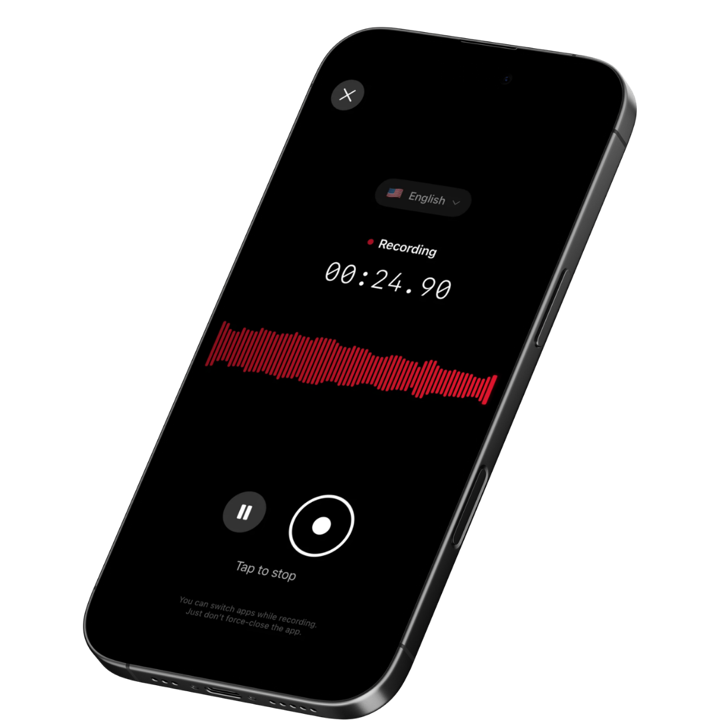
Speakwise is an iOS-native AI voice notes and transcription app that records in-person conversations with one tap or hands-free via AirPods. It generates AI summaries, full transcripts in 100+ languages, and automatic action item extraction. Occupational therapists use it to capture ADL assessments, home environment observations, school-based session notes, and caregiver training conversations without typing during patient contact time. Speakwise holds a 4.9-star App Store rating and achieves 95%+ transcription accuracy in good audio conditions.
Why Speakwise Stands Out
OT documentation is uniquely challenging because the setting changes constantly. A home health OT visits a patient's kitchen to observe meal prep, then moves to the bedroom to assess dressing, then sits with a caregiver in the living room to explain adaptive strategies. None of those moments are conducive to typing on a phone. Speakwise handles this by letting you record continuously - through room transitions, background TV noise, and caregiver interruptions - while keeping your hands available for the task at hand.
The AI summary Speakwise generates reads like a structured note rather than a raw transcript dump. For an ADL assessment, you get a clear account of what was observed and what the patient reported. For a school-based session, you get a summary of the activity, the child's performance, and any follow-up items discussed with the teacher. That output requires far less editing than a raw transcript before it is ready to paste into your EMR or documentation template.
For OTs who use Notion to manage caseload notes, evaluation templates, or goal banks, the native Notion sync means processed notes arrive in your workspace automatically - no copy-paste from a separate app. If you want to understand how this compares to other AI note-taking workflows, our AI note-taking app roundup for 2026 covers the full landscape. For settings with no Wi-Fi at all - home visits in rural areas, school basements, or secure inpatient units - Speakwise records offline and syncs the moment you reconnect, similar to workflows described in our offline meeting recorder roundup.
Key Features
-
One-Tap or Hands-Free Recording: Start capturing the moment you walk into a patient's home or a therapy room by tapping your iPhone screen or pressing an AirPods control. You can set your phone down and move through a home environment assessment with both hands free while the recording continues in your pocket.
-
Action Button Recording: On iPhone 15 Pro and later, map the Action Button to Speakwise and one press starts recording as you step into a patient's home — no unlocking, no app to open.
-
Long Recording Support: Full-day school-based OT schedules include back-to-back sessions with multiple students. Speakwise handles multi-hour recordings without cutting off or requiring you to split files manually. Record an entire clinic day and process each session's summary after hours.
-
Works Offline: Home health visits happen in residences with limited or no Wi-Fi. School basements and rural clinic annexes often have dead zones. Speakwise records to the device and syncs when you reconnect. You never lose a session note because the internet was unavailable.
-
Action Items in Seconds: After any session, Speakwise automatically extracts follow-up items from the conversation - equipment referrals, caregiver education tasks, goal updates, teacher recommendations. These appear immediately in the summary without manual highlighting or re-reading the transcript.
-
95%+ Transcription Accuracy: In good audio conditions, Speakwise achieves 95%+ word-level accuracy. For OTs, this matters because confusing "dominant hand" and "non-dominant hand" or misidentifying a safety concern creates a real documentation error. You can always verify by reading the full transcript alongside the summary.
-
100+ Language Support: OT caseloads in urban home health and school settings frequently include patients and families who speak languages other than English. Speakwise supports 100+ languages with automatic detection and dialect recognition, so it handles sessions conducted in Spanish, Cantonese, or Arabic without any setup change.
-
Speaker Diarization: A caregiver-training visit or a school session can include the patient, a family member, and a teacher. Speakwise applies speaker diarization to separate those voices and label who said what, so each person's input stays distinct in your notes.
-
Native Notion Sync: OTs who manage their caseload notes, evaluation templates, or goal banks in Notion get direct sync - not a PDF export or a third-party integration. Notes land in Notion automatically after processing and are immediately searchable and editable.
-
Private by Design: Session recordings and transcripts stay yours — Speakwise never uses them to train its AI and never sells or shares your data, and you can delete anything anytime.
-
AirPods Hands-Free Control: Start, pause, and stop recordings without touching your iPhone. For OTs facilitating kitchen tasks, dressing practice, or fine motor activities, keeping hands free during the session is essential. AirPods integration makes that possible.
Pricing
- Free Trial: Full access to all features
- Premium: $59.99/year - unlimited transcription, AI summaries, Notion sync, 100+ languages
Best For
- Home health OTs documenting in residences with unreliable Wi-Fi
- School-based OTs capturing multiple back-to-back session notes throughout the day
- OTs treating multilingual patients and families who communicate in non-English languages
- Clinicians who use Notion for caseload management or documentation templates
Limitations
- iOS only - Android users cannot access Speakwise
- No direct EMR integration; notes require copy-paste into WebPT, Casamba, or other systems
- Background noise in some home environments may reduce transcription accuracy
Speakwise gets your hours back.
- ✓Built for in-person meetings, interviews, and site visits.
- ✓Trusted by recruiters, consultants, agents, and field pros.
- ✓One tap to record. Notion-ready summary in minutes.

2. Notta - Best for Multilingual OT Clinics and Cross-Platform Teams
Notta is a cross-platform transcription app available on iOS, Android, and web that supports over 50 languages for real-time and uploaded audio transcription. For OT practices serving diverse urban populations - where sessions may involve patients or family members who speak Spanish, Vietnamese, Tagalog, or Cantonese - Notta's multilingual auto-detection significantly reduces reliance on formal interpreter calls for basic history-taking and instruction. The free tier includes 120 minutes per month with a 3-minute cap per file. Paid plans are approximately $13.99 per user per month.
Notta transcripts are searchable, exportable to Word and PDF, and shareable with team members. For OT teams where notes must be reviewed by a supervisor or shared across disciplines, the shared workspace feature is useful. The main limitation for OTs is that Notta requires an internet connection to function - it does not offer offline recording. Home health OTs and school-based OTs in low-connectivity environments will hit that wall quickly.
Key Features
- 50+ language transcription with automatic language detection
- Searchable, shareable transcript archive across team members
- Real-time transcription with speaker labels
- Export to Word, PDF, and SRT formats
Pricing
- Free: 120 minutes/month, 3-minute cap per recording
- Pro: ~$13.99/user/month
Best For
- OT clinics with multilingual patient populations using mixed iOS and Android devices
- Interdisciplinary teams that share session transcripts across providers
Limitations
- No offline recording - not suitable for home health or low-connectivity school settings
- Free tier's 3-minute cap per file is impractical for full ADL assessments
3. Otter.ai - Best for Building a Searchable Session Archive
Otter.ai creates timestamped, speaker-labeled transcripts and stores them in a searchable archive. For OTs who want to track what was said across multiple sessions with the same patient, or search for all sessions where a specific piece of adaptive equipment was discussed, Otter's archive and keyword search are genuinely useful features. The free tier includes 300 minutes per month with a 30-minute cap per recording. Paid plans start at approximately $8.33 per user per month billed annually.
Otter's OtterPilot feature auto-joins Zoom and Teams calls, which is a meaningful advantage for OTs who conduct telehealth sessions alongside in-person visits. The in-person recording quality holds up in quiet rooms but degrades in noisier environments like pediatric gyms or open home settings with background TV. Otter does not produce the kind of structured clinical summary that Speakwise does - the output is primarily a verbatim transcript, which requires more post-session editing.
Key Features
- Timestamped, speaker-labeled transcripts with keyword search
- OtterPilot auto-joins Zoom and Teams for telehealth documentation
- Shared team workspace for multi-clinician review
- iOS and Android apps with desktop access
Pricing
- Free: 300 minutes/month, 30-minute recording cap
- Pro: ~$8.33/user/month billed annually
Best For
- OTs conducting telehealth sessions who want automatic Zoom transcript capture
- Clinicians who need to search across a long history of session transcripts by topic or patient
Limitations
- Transcription accuracy drops in noisy pediatric and home environments
- Output is verbatim transcript rather than structured clinical summary
4. AudioPen - Best for Post-Visit Verbal Note Drafts
AudioPen takes unstructured verbal input and converts it into clean, readable prose. After a home visit, you tap the microphone and talk through what you observed - functional deficits, safety hazards, patient self-report, adaptive strategies trialed - in whatever order comes to mind. AudioPen reorganizes and rewrites the content into clear paragraphs. Pro pricing is approximately $99 per year.
AudioPen is not a transcript tool and does not produce speaker-labeled records. For OTs, it works best as a post-visit drafting aid rather than a live session capture tool. You can build the narrative and assessment sections of your documentation from a 90-second verbal summary and then paste the result into your EMR template. Our AI voice notes app roundup covers AudioPen alongside Speakwise and Whisper Memos in more depth.
Key Features
- Converts rambling verbal input into structured prose automatically
- Adjustable output style and length
- iOS app and web browser access
- Cloud processing with offline recording capability
Pricing
- Free: Limited recordings per month
- Pro: ~$99/year
Best For
- OTs who think verbally and want to draft narrative note sections after visits
- Clinicians building subjective and assessment sections of SOAP or DAP notes quickly
Limitations
- No verbatim transcript, speaker labels, or clinical terminology optimization
- Not suitable for capturing live multi-person conversations or caregiver training discussions
5. Whisper Memos - Best Free Baseline for Basic Session Notes
Whisper Memos is an iOS app that transcribes voice recordings using OpenAI's Whisper model and delivers the result as a clean text note. It is a good zero-cost option for OTs who primarily need to dictate brief post-visit memos rather than capture full sessions. Whisper Memos is typically available as a paid one-time purchase under $10, with transcription credits or a subscription for heavy use.
The app transcribes accurately for clear, direct dictation in a quiet environment. It does not produce AI summaries, action item lists, or speaker-labeled transcripts. For OTs who need more than basic transcription, it quickly hits its ceiling. But for a clinician who wants to record a 2-minute verbal note immediately after leaving a patient's home and have it converted to text by the time they reach the car, Whisper Memos does that job reliably.
Key Features
- Whisper-model transcription on iPhone for clear dictation
- Delivers text note to email or clipboard after processing
- Simple one-screen interface with no account required
- Works for short verbal memos in quiet environments
Pricing
- One-time purchase, typically under $10; some versions offer subscription for extended use
Best For
- OTs wanting a free or near-free baseline for short post-visit dictation
- Clinicians who do not need AI summaries and primarily dictate structured notes verbally
Limitations
- No AI summaries, action item extraction, or speaker-label support
- Accuracy drops with background noise or overlapping voices
- No archive, search, or team sharing features
How to Choose the Best Note-Taking App for Occupational Therapy
OT documentation differs from most professional note-taking because the work environment changes constantly and patient interactions involve variable noise levels and mobility. These are the five factors that determine which app fits your practice.
-
Offline recording: Home health OTs cannot depend on patient Wi-Fi. School-based OTs face dead zones in basements and older buildings. Any app that requires a live internet connection is a liability in these settings. Speakwise and AudioPen both record offline and process when connectivity returns. Otter.ai and Notta require internet and will fail silently in dead zones.
-
Session length without interruption: ADL assessments and school-based evaluations can run 60-90 minutes. Apps with recording time caps force you to split files, restart manually, or lose content. Confirm that any app you choose handles your longest sessions in a single uninterrupted recording.
-
Output format and editing burden: A raw verbatim transcript requires substantially more editing than a structured AI summary before it is ready to paste into your EMR. If post-visit documentation eats 90 minutes of your evening, the issue is often output quality, not transcription accuracy. Speakwise produces the most documentation-ready output of the apps tested here.
-
Multilingual patient and family communication: OT caseloads in urban and home health settings regularly include patients and caregivers who speak languages other than English. If your practice treats non-English-speaking patients, choose an app with strong multilingual support. Speakwise handles 100+ languages with auto-detection. Notta supports 50+ languages and may be more accessible to Android-using clinicians.
-
Integration with your documentation workflow: None of the apps in this list connect directly to major OT EMRs. You will copy-paste from the app to your documentation system. The question is how many steps that takes. Notion users get the most seamless experience with Speakwise's native sync. For everyone else, structured AI summaries in plain text minimize the editing time between the app output and a finished chart entry.
Frequently Asked Questions
What is the best note-taking app for occupational therapists in 2026?
Speakwise is the best note-taking app for occupational therapists in 2026. It records in-person sessions hands-free via AirPods, works offline for home health and school-based settings, and produces structured AI summaries that significantly reduce post-visit documentation time. The 95%+ transcription accuracy in good audio conditions and automatic action item extraction make it the most complete mobile documentation tool for OTs. At $59.99 per year after a free trial, it costs less than most professional dictation subscriptions and requires no desktop software.
Is there a free note-taking app for occupational therapists?
Yes. Speakwise offers a full-featured free trial covering all Premium capabilities before any payment is required. Otter.ai provides 300 minutes per month free with a 30-minute cap per session. Notta gives 120 minutes per month free with a 3-minute cap per file. Whisper Memos is available for a small one-time purchase and provides basic dictation transcription at no ongoing cost. Apple Voice Memos is completely free and records unlimited audio, but it does not produce AI summaries. For most OT workloads, starting with the Speakwise free trial is the most practical option before committing to any paid plan.
Can I use a voice recording app to document home health OT visits without Wi-Fi?
Yes, but only with apps that support offline recording. Speakwise records directly to your iPhone without any internet connection and syncs the audio for AI processing when you reconnect to Wi-Fi or cellular data. AudioPen also captures offline recordings and processes them later. Otter.ai and Notta both require an active internet connection, so they will fail in homes with no usable network. For home health OTs, offline capability is not optional - it is a baseline requirement that immediately rules out several otherwise capable apps.
What features should I look for in a note-taking app for OT documentation?
Start with offline recording for home health and school-based settings. Then check session length limits to ensure the app handles your longest evaluations without cutting off. Look for AI summaries rather than raw transcripts to minimize post-session editing. Multilingual support matters if your caseload includes non-English speakers. Finally, consider output format - apps that produce plain text summaries paste more cleanly into EMR fields than formatted documents with headers and bullet styling. Action item extraction is a useful bonus that surfaces follow-up tasks automatically from session conversations.
Does using a voice recording app during OT sessions create consent or privacy issues?
Recording in a clinical setting does raise considerations around patient consent and privacy. Most OTs who use voice documentation tools address this in one of two ways. Some record only their own verbal dictation after the patient leaves, avoiding capture of the patient entirely. Others inform patients at the start of care that they use voice technology to assist with documentation and obtain verbal or written acknowledgment. Your state practice act, your employer's policies, and your professional association's guidelines may have specific requirements. The apps on this list are not marketed as HIPAA-compliant clinical documentation platforms. They are productivity tools and should be used alongside, not as a replacement for, your practice's official record-keeping system.
Final Verdict
Occupational therapy documentation is demanding because the work happens in constantly changing environments with variable technology access. The five tools above cover the range of OT documentation needs in 2026, from full AI-powered session capture to basic post-visit dictation.
Speakwise earns the top spot for its combination of offline recording, hands-free AirPods control, long session support, and structured AI summaries. For OTs moving between home visits, clinic sessions, and school settings in a single day, it removes more documentation friction than any alternative.
Notta is the best fit for multilingual clinics or mixed-platform teams. Otter.ai serves telehealth-heavy OT practices well. AudioPen works as a secondary tool for drafting narrative note sections quickly. Whisper Memos provides a reliable zero-cost fallback for short post-visit dictation.
Download Speakwise from the App Store and start capturing OT session notes hands-free from your very first visit.
🎯 4.9★ App Store Rating | 📱 Built for iOS
