Mind Wandering Statistics 2026: How Often Focus Drifts
TL;DR
Mind wandering statistics for 2026 show attention drifts off task often, at work and during lectures. A 2010 Harvard study of 2,250 volunteers found minds wander about 46.9% of waking life. This post collects 16 statistics on mind wandering. Speakwise records the conversation and turns it into a transcript and summary afterward, so you can see what you missed.


Used by recruiters, executives, consultants, and more.
Mind Wandering Statistics 2026: How Often Focus Drifts
Mind wandering statistics show that attention drifts off task often, both in daily life and at work. A 2010 Harvard study of 2,250 volunteers found that minds wander about 46.9% of waking hours, and a wandering mind explained more of a person's happiness than the activity they were doing. Potential Project's own 2021 study of 225,000 data points from employees using its Mindgrow tool found people report their minds wander about 37% of the time on the job. In Klaxoon's own 2017 survey, 38% of employees say they daydream in meetings. In one 21-minute online lecture, mind wandering fell from 41% to 19% of checks once short quizzes were added. Mind wandering is also linked to driving safety and creativity: drivers responsible for a crash were almost twice as likely to say they had intense mind wandering just before it, while a simple, undemanding task that let the mind drift led to better scores on a creativity test, but only on problems people had already tried.
Phones, open-plan offices and video calls all compete for the same attention that a task needs to hold. Meetings run longer, lectures move online, and commutes still demand full focus behind the wheel. Mind wandering is not new, but the settings where it happens, and the cost of it happening there, keep changing.
This post collects 16 statistics on mind wandering from peer-reviewed studies and workplace surveys. It covers how often attention drifts in daily life, at work, while reading, in lectures and meetings, and behind the wheel, along with what the drifting costs and when it actually helps.
Key Mind Wandering Statistics (2026)
- Mind wandering happens during about 46.9% of waking hours, based on a 2010 Harvard study of 2,250 volunteers (Harvard Gazette).
- Employees using Potential Project's Mindgrow tool report that their minds wander about 37% of the time on the job, in the firm's own 2021 study covering 225,000 data points (Potential Project).
- 38% of employees in Klaxoon's own 2017 survey say daydreaming is something they do during meetings (HR Dive).
- Mind wandering during an online lecture fell from 41% to 19% of checks once short quizzes were added (Szpunar et al., PNAS 2013).
- Drivers responsible for a crash were almost twice as likely as other drivers to say, hours later, that they had intense mind wandering just before it, 17% versus 9% (Galera et al., BMJ 2012).
- An undemanding task that encouraged mind wandering led to significantly greater gains on creativity problems people had already tried before the break than a demanding task, rest or no break (Baird et al., Psychological Science 2012).
- In a small randomized study of 48 students, two weeks of mindfulness classes cut mind wandering and raised scores on a GRE reading test by an amount analogous to 16 percentile points (Mrazek et al., Psychological Science 2013).
1. Minds wander about 46.9% of waking hours
46.9% is the average share of waking hours that people's minds spend thinking about something other than what they are doing, based on a 2010 study by Harvard psychologists Matthew Killingsworth and Daniel Gilbert. The researchers built an iPhone app that contacted 2,250 volunteers at random times during the day. Each time, it asked what they were doing, whether their mind was on something else, and how happy they felt. The study collected 250,000 reports in total.
Instead, the researchers found that minds wander almost as often as they stay on the task at hand. The number comes from self-reported data in a volunteer sample, so it reflects what people noticed and reported, not a lab measurement of attention.
Source: Harvard Gazette: Wandering mind not a happy mind
2. Minds wander at least 30% of the time during almost every activity
Killingsworth and Gilbert's 2010 study found that minds wandered no less than 30% of the time during every one of the 22 activities they tracked, except one: making love. People chose their current activity from a list that included working, walking, eating, shopping and watching television, among others. Only one activity, making love, fell below 30%.
This matters because it shows mind wandering is not tied to boring tasks alone. Even activities people enjoy and choose freely still come with a wandering mind close to a third of the time or more. The study does not say why that one activity is different.
Source: Harvard Gazette: Wandering mind not a happy mind
3. A wandering mind explains more of a person's happiness than the activity itself
10.8% of the variation in how happy people felt in a given moment was explained by whether their mind was wandering, versus only 4.6% explained by the activity they were doing, in the Killingsworth and Gilbert study. People were typically less happy when their minds wandered. A time lag analysis suggested the wandering came first and the drop in mood followed, not the other way around.
This flips a common assumption. Many people expect a boring task to explain their mood more than a stray thought does. The data says the opposite: what you are thinking about matters more than what you are doing.
Source: Harvard Gazette: Wandering mind not a happy mind
4. Workers' minds wander about 37% of the time on the job
37% is the average share of work time that employees' minds spend wandering, according to Potential Project's own 2021 study, in which employees using its Mindgrow tool reported their mental state through the work week. The consulting firm pulled together 225,000 data points on focus, resilience and engagement from workers in 44 countries and 15 industries. Mind wandering was not steady through the week either: it peaked at 41% on Mondays and dropped to its lowest point on Wednesdays.
A stressed, agitated mind wandered two to three times more than a calm one in the same study. For work built on sustained attention, from client calls to detailed paperwork, more than a third of the time spent somewhere else adds up fast across a single day.
Source: Potential Project: Mind Wandering at Work; sample size via HR Reporter: When are people the most focused at work?
5. Speckled, hard-to-read text raised mind wandering from 15.82% to 21.53%
15.82% of thought checks caught participants' minds wandering while they read a story in quiet conditions, in a 2023 study of 175 people. When the same text was shown with gray visual noise added to the background, making it harder to read, that rate rose to 21.53%. The researchers, led by Lena Steindorf, checked in on participants' thoughts at 18 points while they read or listened to a novella.
Comprehension suffered alongside the wandering. Readers in the noisy condition answered fewer fact-based questions correctly afterward, 8.65 out of 12 on average, compared with 9.98 out of 12 in quiet conditions. Harder listening and reading conditions did not just annoy readers. They pulled attention away from the page and left measurably less of the text behind.
Source: Steindorf et al., Cognitive Research 2023: When there is noise on Sherlock Holmes
6. Mind wandering during an online lecture fell from 41% to 19% with short tests
41% of thought probes caught students mind wandering during a 21-minute online statistics lecture when they were not tested along the way, in a 2013 Harvard study by Karl Szpunar, Novall Khan and Daniel Schacter. When the lecture was broken into segments with a short quiz after each one, that rate dropped to 19%.
The quizzes took only two minutes and covered material the students had just seen. Actually taking a short quiz after each segment cut the amount of time students spent thinking about something else by more than half. Students who only saw the answers instead stayed at 39%. The researchers concluded that interpolated testing keeps students anchored to the material instead of letting attention drift by default.
7. Quizzed students took notes on 24% of slides, versus 7% for students who were not tested
24% of lecture slides had extra student notes written on them when short quizzes were built into an online lecture, compared with just 7% of slides for students who received no quizzes, in the same Szpunar study. The note-taking gap showed up alongside the drop in mind wandering, not instead of it.
Taking notes is a sign that attention is pointed at the lecture content rather than somewhere else. The quizzes did not just test memory after the fact. They changed what students did with their attention while the lecture was still playing, encouraging them to capture material as it went by instead of listening passively.
8. Quizzed students scored 90% on a final test, versus 68% for students who were never tested
90% is the average score students earned on a final cumulative test after being quizzed throughout an online lecture, in the Szpunar study. Students who were never quizzed during the lecture scored only 68% on the same final test. A third group, who saw the quiz answers without having to produce them, scored 76%, landing between the other two groups.
Seeing the right answers helped a little, but having to produce the answer during the lecture helped far more. The gap between 90% and 68% comes from the quizzes: the quizzed students answered the same questions during the lecture, paid more attention and took more notes, and all of that fed into their final score.
9. 38% of employees in Klaxoon's own 2017 survey say they daydream during meetings
38% of employees named daydreaming as something they do during meetings, the single most common answer in Klaxoon's own 2017 survey of 2,000 American adults, fielded with the research firm Propeller Insights. Other common meeting habits included working on unrelated projects, named by 30% of respondents, and checking social media, named by 21%.
Daydreaming was the most common habit HR Dive reported, ahead of working on other projects (30%), browsing the web (24%), checking social media (21%) and thinking about vacation (18%). The survey counts how many people do each one, not how much attention a meeting loses.
Source: HR Dive: Study: 22% of employees think meetings waste their time
10. Drivers responsible for a crash were almost twice as likely to report intense mind wandering
17% of drivers judged responsible for a traffic crash reported intense mind wandering just before it happened, compared with 9% of drivers judged not responsible, in a 2012 responsibility case-control study published in the BMJ. The study, led by Cédric Galéra, examined 955 drivers treated at a French hospital emergency department after a crash.
After adjusting for age, sex, time of day, alcohol, drug use, lack of sleep, other distractions and negative mood, intense mind wandering more than doubled the odds of being found at fault, with an adjusted odds ratio of 2.12. The researchers said a wandering mind can impair how well a driver takes in what is happening on the road around them.
Source: Galera et al., BMJ 2012: Mind wandering and driving: responsibility case-control study
11. In a driving simulator, drivers' minds wandered for about 39% of a 30-minute session
39% of a 30-minute driving session was spent mind wandering, on average, among 17 drivers who followed a pace car in a 2014 study by Matthew Yanko and Thomas Spalek, published in the journal Human Factors. Drivers were prompted at intervals to say whether their mind had been on something else.
When drivers reported mind wandering, their vehicle's speed and the time it took them to start braking once the car ahead slowed down both increased. A wandering mind did not just sit quietly in the background. It showed up in how quickly drivers reacted to a sudden braking event in the simulator.
Source: Association for Psychological Science: Daydreaming: The Other Kind of Distracted Driving
12. A second driving study found minds wandering 42% of the time, with closer following distances
42% of the session was spent mind wandering among 32 drivers in a second experiment from the same 2014 Yanko and Spalek study, this one measuring how closely people followed the car ahead. Reaction times to sudden braking and to spotting a pedestrian both slowed during the stretches when drivers reported mind wandering.
Drivers also followed the car in front more closely during those stretches, cutting their own margin for error at the exact moments their attention was least available to use it. The two experiments point the same way: a wandering mind changes how people drive in the simulator, not just what they are thinking about.
Source: Association for Psychological Science: Daydreaming: The Other Kind of Distracted Driving
13. An undemanding task that encouraged mind wandering boosted creative problem solving
145 college students took part in a 2012 incubation study by Benjamin Baird and colleagues that tested whether a break helps people solve creative problems. Before a break, everyone attempted a classic creativity test, listing unusual uses for everyday objects. During the break, one group did an undemanding task, one did a demanding task, one rested, and one got no break at all.
People given the undemanding task reported more mind wandering during the break, rating it 2.47 on a 5-point scale versus 2.15 for the demanding-task group, and went on to show significantly greater improvement on creativity problems they had already tried once the break ended. Rest and no break produced no such gain. The authors say this suggests that simple tasks that let the mind wander may help creative problem solving. Our workplace creativity statistics cover more on where original ideas come from at work.
14. Two weeks of mindfulness training cut mind wandering and lifted reading scores
48 college students were split between a two-week mindfulness class and a nutrition class in a randomized study by Michael Mrazek and colleagues. Both classes met for 45 minutes, four times a week. Afterward, the mindfulness group showed less mind wandering during a reading test and a working memory task than the nutrition group did.
The mindfulness group's reading comprehension score rose by an amount the researchers calculated as equal to 16 percentile points on a GRE reading test. Working memory capacity rose too. Among students who were prone to mind wandering at the start, the gains were statistically linked to the drop in mind wandering, which suggests the training helped attention stay in place.
15. Workers who practice mindfulness report mind wandering 28% of the time, versus 52%
28% is how often workers who practice mindfulness said their minds wandered on the job, compared with 52% for their counterparts with less mindfulness practice, in the same Potential Project 2021 study. That is close to half as much wandering for people with a mindfulness habit.
The gap lines up with controlled research on mindfulness training and attention, even though this number comes from a workplace study rather than a lab experiment. Across a work week full of meetings, emails and tasks, a gap this large fits the idea that a daily mind-training habit helps, though it is one company's own comparison of two groups, not an experiment.
Source: Potential Project: Mind Wandering at Work
16. Not all mind wandering is the same: some of it is on purpose
113 university students took part in a 2016 study by Paul Seli, Evan Risko and Daniel Smilek that split mind wandering into two kinds: intentional and unintentional. Half the group did an easy, repetitive attention task, and half did a harder version with no fixed pattern to rely on.
On the easy, boring task, students reported more intentional mind wandering: they said they let their minds drift on purpose, which the researchers suspect is because the task did not need their full attention. On the harder task, students reported more unintentional mind wandering, where attention slipped away despite the extra effort the task demanded. The distinction matters because the two kinds may have different causes, so treating all mind wandering as one problem can miss the difference. The overall rate of mind wandering was the same in both groups.
Source: Association for Psychological Science: Not All Mind Wandering Is Created Equal
What the Mind Wandering Data Adds Up To
Taken together, these numbers describe a mind that drifts often, not just by accident. In these studies, minds wandered from about 16% to 47% of the time, depending on the setting and conditions, and the rate moved a lot with things like quizzes, noise and task difficulty. The one activity that reliably held attention, in the Killingsworth and Gilbert data, was physical, not mental.
What changes is not whether minds wander, but what that costs. In a driving simulator, drivers reacted more slowly when they reported mind wandering, and drivers who said they had intense mind wandering before a crash were more likely to be the ones responsible. In a lecture or while reading, more mind wandering went with lower comprehension and lower test scores. In a meeting, it means a plan or a commitment can pass by unheard. Our attention residue statistics show a related cost: attention that lingers on a past task instead of moving fully onto the next one.
The same research shows mind wandering is not purely a flaw to engineer away. Short tests during a lecture, and two weeks of mindfulness classes, both cut the rate measurably, so the drifting is not fixed in place. At the same time, an undemanding task that let the mind wander during a break improved scores on creativity problems people had already tried. The goal is not zero mind wandering. It is catching the moments when a wandering mind quietly costs you information you will want later.
Mind wandering is common, even at work, and the real question is not how to stop it, but how to stop losing what happens while it drifts.
Speakwise Catches What You Miss While Your Mind Wanders
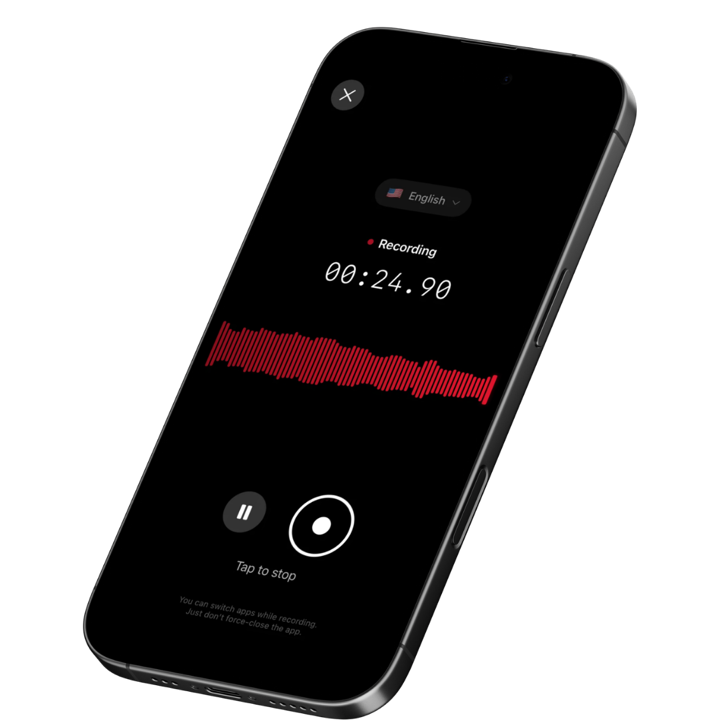
A meeting or a lecture does not pause just because your attention does. The statistics above show that minds wander often in both settings, so it is easy to miss part of what was said. Speakwise is an iPhone app that records in-person conversations, meetings, lectures and interviews with one tap, then turns the recording into a transcript and an AI summary with action items.
Instead of trying to write down every word while also staying present, you can let Speakwise keep the full record. The transcript shows who said what, so if your mind drifts during a client meeting or a lecture, you can go back and see what you missed instead of guessing later. Speaker identification is not included in every plan. When you start your free trial, pick the plan that includes it. For the lecture-attention problem the numbers above describe, our guide to the best app for recording lectures goes deeper on how to set this up.
Try Speakwise free for 7 days ($0.00). After that, it starts at $69.99 per year, which is about $5.83 a month, billed yearly. Prices shown are for the US and can differ by country.Download Speakwise from the App Store and keep a full, accurate record even when your attention is somewhere else.
Try Speakwise free for 7 days
Available on the App Store | iOS Optimized

🎯 4.9★ App Store Rating | 📱 Built for iOS
