Average Typing Speed Statistics 2026: WPM by Age and Device
TL;DR
Average typing speed statistics for 2026 show 51.56 words per minute on a keyboard and 36.2 on a phone, in 2018 and 2019 studies. A 2006 study found people talk at about 196 words per minute, much faster than typing. Speakwise lets you talk instead of typing: it records your voice and writes the transcript and summary for you.
Used by recruiters, executives, consultants, and more.
Average Typing Speed Statistics 2026: WPM by Age and Device
A 2018 study of 168,000 online volunteers found the average typing speed on a computer keyboard was 51.56 words per minute (WPM), according to Aalto University and the University of Cambridge. A 2019 study of 37,370 volunteers found a lower average of 36.2 WPM on a phone. Younger people were faster on phones: people aged 10 to 19 averaged 39.6 WPM, while people aged 50 to 59 averaged 26.3. Talking is faster than both. A 2006 study of recorded phone calls found people spoke at about 196 words per minute.
A typing test gives you a number, but the number means little without something to compare it to. Big studies fix that. They show what "normal" looks like for a keyboard, for a phone, and for different ages.
This post covers 17 average typing speed statistics from peer-reviewed research and professional bodies. It shows how fast people type, how often they make mistakes, how the best typists and court reporters compare, and how typing stacks up against talking. It is for anyone who wants a clear, sourced answer to "what is a good typing speed?"
Key Average Typing Speed Statistics (2026)
- Average typing speed on a computer keyboard was 51.56 WPM, based on 168,000 volunteers in a 2018 study (Dhakal et al., CHI 2018).
- The average phone typing speed was 36.2 WPM, based on 37,370 volunteers in a 2019 study (Palin et al., MobileHCI 2019).
- Typists aged 10 to 19 averaged 39.6 WPM on phones, while typists aged 50 to 59 averaged 26.3 WPM (Palin et al., MobileHCI 2019).
- The top 10% of keyboard typists averaged 89.56 WPM, and the slowest 10% averaged 20.91 WPM (Dhakal et al., CHI 2018).
- Keyboard typists left 1.167% of their text with uncorrected errors (Dhakal et al., CHI 2018).
- Registered Professional Reporters (RPR) have passed tests at up to 225 WPM with 95% accuracy on a stenographic machine, not a regular keyboard (NCRA).
- In a 2006 study of phone calls, people talked at about 196 WPM, and speech was 2.93x faster than phone typing in a 2017 Stanford study (Yuan et al., 2006, Ruan et al., 2017).
1. In a 2018 study of 168,000 volunteers, the average keyboard typing speed was 51.56 WPM
51.56 words per minute is the average typing speed of the 168,000 volunteers in a 2018 keyboard study. When it came out, the University of Cambridge called it the largest-ever dataset on typing. Researchers at Aalto University and the University of Cambridge asked people to copy sentences in an online test. Each person typed 15 sentences, and the team recorded every keystroke. The standard deviation was 20.2 WPM, so scores vary a lot from person to person.
The volunteers were mostly young and mostly from the US. Their average age was 24.5, and 68.05% were from the US. Most also cared about typing: 72% had taken a typing course. That makes 51.56 a fair guide for young English-speaking typists, not a hard rule for everyone.
Source: Dhakal et al., "Observations on Typing from 136 Million Keystrokes" (CHI 2018) and University of Cambridge: What makes a faster typist?
2. The fastest typists in the study reached 120 WPM or more
120 WPM is the speed the fastest typists in the Aalto and Cambridge study reached. One of the researchers said, "The fastest users in our study typed 120 words per minute, which is amazing given that this is a controlled study with randomised phrases." That is more than double the study's average of 51.56 WPM.
The gap shows how wide the range is. A small group of typists sat far above the average.
Source: University of Cambridge: What makes a faster typist? and Dhakal et al., CHI 2018
3. The top 10% of typists average 89.56 WPM, and the bottom 10% average 20.91
89.56 WPM is the average speed of the fastest 10% of keyboard typists in the Aalto and Cambridge study. The researchers defined "fast" as faster than 90% of participants, which was above about 78 WPM in their data. The slowest 10% typed below about 26 WPM, and their group average was 20.91 WPM.
So the fastest group typed more than four times faster than the slowest group. If you type 78 WPM or more, you are in the top tenth of this sample. If you type 26 WPM or less, you are in the bottom tenth.
Source: Dhakal et al., CHI 2018
4. Typists who took a typing course were only about 5 WPM faster
5 WPM is how much faster trained typists were than untrained typists in the keyboard study. People who reported typing training averaged 54.35 WPM. People with no training averaged 49.00 WPM. In the study, 72% of participants said they had taken a typing course.
The difference is small compared with the spread of 20 WPM within each group. Typists who said they had taken a course were a little faster on average, but many untrained typists are fast and many trained typists are slow.
Source: Dhakal et al., CHI 2018
5. Nearly half of typists use 9 or 10 fingers, and fast typists use more
47.6% of participants said they type with 9 or 10 fingers. Across all participants, the average was 6.95 fingers. Fast typists reported using 8.4 fingers on average, while slow typists reported 5.3. The link between finger count and speed was positive (r = 0.38).
More fingers do not guarantee more speed, and the link is not a straight line. But the pattern is clear. Typists who spread the work across more fingers tend to move faster.
Source: Dhakal et al., CHI 2018
6. Most fast typists press the next key before letting go of the last one for 40% to 70% of their keystrokes
40% to 70% is how often most fast typists used "rollover," which means pressing the next key before releasing the previous one. The study's authors said keyboard makers and e-sports players knew this trick well, but typing research had not studied it before.
Rollover had a strong link with speed (r = 0.73). Rollover is one of the clearest marks of a fast typist.
Source: University of Cambridge: What makes a faster typist? and Dhakal et al., CHI 2018
7. Keyboard typists leave 1.167% of their text with uncorrected errors
1.167% is the average uncorrected error rate in the Aalto and Cambridge keyboard study. About 90% of participants left less than 2.66% errors in their final text. Most people fix most of their own mistakes.
Speed and accuracy go together. Fast typists left an average of 0.71% uncorrected errors, while slow typists left 1.78%. Faster typists made fewer mistakes, not more. The researchers said slow typists leave more errors uncorrected, which could mean they are less able to spot their mistakes.
Source: Dhakal et al., CHI 2018
8. Substitution errors (1.65%) are the most common typing mistake
1.65% is the rate of substitution errors, where a person types the wrong letter, in a sample of 783 typists from the keyboard study. Omissions, where a letter is missing, came in at 0.8%. Insertions, where an extra letter appears, came in at 0.67%.
People also fixed their work a lot. The average was 2.29 error corrections per sentence, which was 6.3% of keystrokes. Slower typists made far more wrong-letter mistakes than faster typists. The researchers think slow typists have a weaker mental map of where their fingers are.
Source: Dhakal et al., CHI 2018
9. Professionally trained typists in the 1970s and 1980s typically reached 60 to 90 WPM
60 to 90 WPM is the range that professionally trained typists typically reached in the 1970s and 1980s, according to the Cambridge team. They compared it with the 52 WPM average of their own volunteers. They called their own volunteers' average "much slower." That average was 51.56 WPM.
In other words, the average volunteer types slower than a professionally trained typist did decades ago.
Source: University of Cambridge: What makes a faster typist? and Dhakal et al., CHI 2018
10. Registered Professional Reporters pass tests at up to 225 WPM with 95% accuracy on a steno machine
225 words per minute is the top test speed that Registered Professional Reporters (RPR) have passed, with a 95% accuracy rate, according to the National Court Reporters Association (NCRA). Reporters use a stenographic machine, not a normal keyboard.
The next level up is even faster. Registered Merit Reporters have shown speeds of up to 260 words per minute at 95% accuracy. Both numbers are far above the 51.56 WPM average, and they show what a special tool and years of training can do.
Source: NCRA: Celebrate Certification Month
11. In a 2019 study of 37,370 volunteers, the average phone typing speed was 36.2 WPM
36.2 WPM is the average phone typing speed in a study of 37,370 volunteers by researchers at Aalto University, the University of Cambridge and ETH Zurich. The standard deviation was 13.22 WPM. Three quarters of participants typed below 43.98 WPM, and the fastest typists reached over 80 WPM.
Earlier small studies had reported about 31 to 32 WPM. The larger study suggests people type on phones a bit faster than those small studies reported.
Source: Palin et al., "How do people type on mobile devices?" (MobileHCI 2019)
12. In two matching studies, phone typing was about 15 WPM slower than keyboard typing, with twice the uncorrected errors
15 WPM is roughly how much slower people type on a phone than on a computer keyboard, based on two studies that used the same method. The phone study also found more mistakes left in the text: 2.34% uncorrected errors on phones, versus about 1.17% on keyboards.
The researchers think mistakes are harder to fix on a small touchscreen, so people leave more of them. Phone typists also press backspace less: 1.89 times per sentence, compared with 2.29 on a keyboard.
Source: Palin et al., MobileHCI 2019
13. Two-thumb typists averaged 38.0 WPM, and about 74% of the volunteers typed that way
74% of participants in the phone study typed with both thumbs, and they averaged 38.0 WPM. Typists who used only the right thumb averaged 30.2 WPM, and left-thumb typists averaged 30.8 WPM.
Co-author Anna Feit of ETH Zurich said two-thumb typists were "only about 25% slower" than the typists in the big keyboard study. The advice from the data is simple: use both thumbs. Word prediction did not help, though. Its use had a negative link with speed, while autocorrect had a positive one.
Source: Palin et al., MobileHCI 2019 and Aalto University: Smartphone typing speeds catching up with keyboards
14. Younger people type faster on phones: 39.6 WPM at 10 to 19, 26.3 WPM at 50 to 59
39.6 WPM is the average phone typing speed for people aged 10 to 19, the fastest group in the study. Speed fell in every older group: 36.5 WPM for ages 20 to 29, 32.2 for 30 to 39, 28.9 for 40 to 49, and 26.3 for 50 to 59. Children under 10 were the slowest, at 24.3 WPM.
Teens typed about 10 WPM faster than people in their 40s. Interestingly, the teens did not report the most time spent typing. These age numbers are for phones.
Source: Palin et al., MobileHCI 2019
15. In a 2006 study of recorded phone calls, people talked at about 196 WPM
196 words per minute is the average speaking rate across 2,438 recorded English phone conversations in the Switchboard research corpus. Researchers at the University of Pennsylvania counted all words from both speakers and divided by the total conversation time. Individual conversations ranged from 111 to 291 WPM.
Counting only speech, without pauses and noises, gave 236 WPM. Counting by speaker turns, which overlap, gave 164 WPM. Even the lowest of these three rates, 164 WPM, is over three times the 51.56 WPM keyboard average. But the two numbers come from different groups of people and different tasks.
16. Speech input on a phone was 2.93x faster than typing: 152.86 vs 52.24 WPM
2.93x is how much faster speech was than typing on an iPhone keyboard for English in a 2017 study by Stanford, the University of Washington and Baidu. People copied short messages by speech at 152.86 WPM. On the keyboard, they typed them at 52.24 WPM. The 24 English speakers were university students. All 48 people in the study, English and Mandarin speakers together, were aged 19 to 32, and they worked in a quiet room.
The result is a talking vs typing gap of about 100 words per minute. The study is small, was run in a quiet room with a fast network, and used Baidu's Deep Speech 2 engine, described in a 2015 paper. Speed in a noisy place may be lower, and newer tools may do better.
17. Speech made 16.7% fewer errors than typing along the way
16.7% is how much lower the English error rate was with speech during entry in the same Stanford study. Errors made and fixed while entering text were 3.93% with speech and 4.72% with the keyboard. For Mandarin Chinese, the rate was 62.4% lower with speech.
The finished text was close. Speech left 0.55% errors in the final English text, and the keyboard left 0.35%. So speech was much faster and made fewer mistakes along the way, and both methods ended with very few errors. You can read more speech-to-text numbers in our speech to text statistics roundup.
What These Typing Numbers Reveal
Three things stand out. First, "average" hides a huge range. The keyboard average is 51.56 WPM, but the top 10% average 89.56 WPM and the bottom 10% average 20.91. Second, the device seems to matter. In two matching studies of different volunteers, phone typing was about 15 WPM slower than keyboard typing and left twice as many uncorrected errors. Third, younger people typed faster on phones. The 10 to 19 group averaged roughly 13 WPM faster than the 50 to 59 group.
A good typing speed depends on the job. Professionally trained typists in the 1970s and 1980s typically reached 60 to 90 WPM, and Registered Professional Reporters pass tests at up to 225 WPM on special machines. Accuracy counts as much as speed. The fastest typists were also the most accurate.
The biggest lesson comes from the talking vs typing numbers. In a 2006 study of recorded phone calls, people talked at about 196 WPM. That number comes from a different group of people doing a different task than the typing studies, so it is a rough comparison. In a 2017 Stanford study, the same people used both speech and a phone keyboard, and speech was 2.93 times faster. Typing sets a low speed limit for most people. Talking sets a much higher one.
In these studies, volunteers typed 51.56 WPM on a keyboard and 36.2 WPM on a phone, and people on recorded phone calls talked at about 196 WPM.
Talk First, Then Get Your Notes With Speakwise
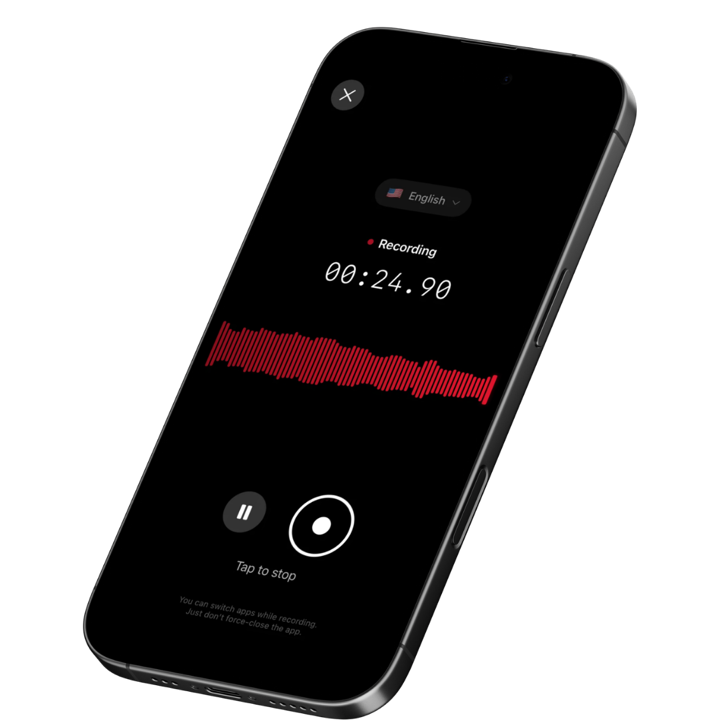
If talking is faster than typing, the best way to capture a meeting, a lecture or an idea is to say it out loud. Speakwise is an iPhone app that records in-person conversations, meetings, lectures and interviews with one tap. You then get a transcript, an AI summary and action items, so you can talk instead of typing your notes. It works in 100+ languages, records up to 5 hours in one recording, and reaches 95%+ accuracy in optimal audio and 92%+ in noisy rooms with several speakers.
You can start from the iPhone Action Button or Control Center, and the Apple Watch app lets you start from your wrist. Speakwise users report saving about 73% of their post-meeting follow-up time (Speakwise user surveys). The transcript shows who said what, and you can rename each speaker. Speaker identification is not included in every plan. When you start your free trial, pick the plan that includes it.
For more on why people capture ideas by voice, see our voice notes statistics and AI transcription statistics.
Try Speakwise free for 7 days ($0.00). After that, it starts at $69.99 per year, which is about $5.83 a month, billed yearly. Prices shown are for the US and can differ by country.Download Speakwise from the App Store and turn what you say into a transcript, summary and action items.
Try Speakwise free for 7 days
Available on the App Store | iOS Optimized

🎯 4.9★ App Store Rating | 📱 Built for iOS
