Words Spoken Per Day Statistics 2026: How Much We Talk
TL;DR
Words spoken per day statistics show a 2007 study found about 16,000 words a day. A 2025 study found the number fell to about 13,000 by 2018 (University of Arizona). Speakwise turns words into a transcript and summary on iPhone, with a 7-day free trial.
Used by recruiters, executives, consultants, and more.
Words Spoken Per Day Statistics 2026: How Much We Talk
Words spoken per day statistics have changed over time, and the old myth that women talk far more than men does not hold up. Researchers have tracked daily word counts for decades using real recordings, not guesses, and the picture that emerges is more complicated than any single number suggests. This post looks at 16 findings on who talks the most, how much, and why.
Key Words Spoken Per Day Statistics (2026)
- Words spoken per day were about 16,000 in a 2007 study of 396 college students, though a 2025 study of recordings collected from 2005 to 2018 found the figure had fallen to about 13,000 by the end of that span (NPR; University of Arizona).
- The gap between the quietest and the chattiest person is enormous: daily totals range from under 100 words to more than 120,000 (University of Arizona).
- A 2025 study found a clear gap only between ages 25 and 64, with women averaging 21,845 words a day against men's 18,570 (University of Arizona).
- The popular claim that women speak 20,000 words a day and men speak only 7,000 is a myth with no support in the data (NPR).
- A 2019 study could not confirm Hart and Risley's famous 30 million word gap in children's early language (Sperry et al., Child Development).
- The average 20-year-old native English speaker knows about 42,000 words, and researchers estimate they could use roughly half of them in speech or writing (Brysbaert et al., 2016).
- Vocabulary keeps growing with age: the average adult learns about 6,000 new words between ages 20 and 60, roughly one every two days (Brysbaert et al., 2016).
1. A 2007 study found college students speak about 16,000 words a day
About 16,000 words a day is the long-standing average from a 2007 study published in the journal Science. Researchers led by Matthias Mehl gave 396 college students, 345 Americans and 51 Mexicans, a small voice recorder that captured about 30 seconds of sound every 12.5 minutes. From those samples, the team estimated how many words each person spoke in total.
The result became one of the most cited numbers in psychology: both women and men averaged about 16,000 words a day. The study was not trying to find a nice round number. It set out to test a much bigger and more public claim, that women are far more talkative than men, and 16,000 is what came out when the researchers actually counted.
That number has since become the standard answer to "how many words does a person speak a day." As the statistics below show, it still holds up as a starting point, even though a newer, larger study puts the current figure a bit lower.
Source: NPR: Men Talk Just As Much As Women
2. The gap between people is enormous: 700 to 47,000 words a day
The range around that 16,000-word average is huge. In the same 2007 study, the quietest participant spoke only about 700 words in an average day, while the most talkative person spoke up to 47,000. That is a difference of more than 65 times between the lowest and highest talkers.
The three biggest talkers in the whole study were men, which already undercuts the idea that women are the more talkative sex. The real driver of how many words someone speaks in a day is not gender. It is the person.
An average is useful for comparing studies, but it hides this kind of spread completely. Two people who each speak a very different number of words can both be completely normal. The 16,000 figure describes a crowd, not any one person in it.
Source: NPR: Men Talk Just As Much As Women
3. The "20,000 vs 7,000" gender myth has no real data behind it
20,000 words a day for women and 7,000 for men is one of the most repeated claims about talking, and no study actually backs it up. The claim got prominent attention with Louann Brizendine's 2006 book The Female Brain, and other sources have claimed an even bigger gap.
When the 2007 Science study actually measured word counts, it found no statistically significant difference between women and men. Both groups landed close to the same 16,000-word average. The authors of that study directly addressed the popular claim and found it did not hold up against real recordings.
The myth persists because it fits a stereotype, not because anyone replicated it. Later research, covered next, found a real difference does exist, but it is far smaller than 20,000 versus 7,000, and it only shows up at certain ages.
Source: NPR: Men Talk Just As Much As Women
4. A 2025 study of 2,197 people estimated a small gap between men and women
13,349 words a day is the average for women and 11,950 for men, according to a 2025 registered report that pooled 2,197 people across 22 studies and 631,030 ambient audio recordings. That sample is more than five times the size of the original 2007 study.
The study's model put the gap at about 1,073 words a day, with women talking more on average, though the true number could be anywhere from 316 to 1,824. The study's authors say this estimate is about twice the size of the one found in the original 2007 study, but it is still far smaller than the 20,000-versus-7,000 myth.
A registered report is a study design where researchers publish their analysis plan before they analyze the data. Here the recordings had already been collected from 2005 to 2018, but the authors set their analysis plan in advance, which makes the results harder to bend toward a favored outcome.
Source: Tidwell et al., 2025: Are Women Really (Not) More Talkative Than Men?
5. The gap is biggest between ages 25 and 64
21,845 words a day is the average for women aged 25 to 64 in the 2025 study, compared with 18,570 for men in the same age range, a gap of about 3,275 words. This was the only age group where the difference was large and consistent enough to call a real pattern.
The researchers are not certain why this age range stands out. They point to parenting and caregiving responsibilities as one possible factor, since these years overlap with when many people are raising young children and managing a household's communication.
This finding also means the 16,000-words-a-day figure may undersell how much both women and men aged 25 to 64 talk in this study, at 21,845 and 18,570 words a day. Both numbers are well above the study's overall averages of 13,349 and 11,950 words a day, so read them with care. An average across all ages can hide a gap that is large and real for one specific stage of life.
Source: University of Arizona: Do Women Talk More Than Men? It Might Depend on Their Age
6. Outside ages 25 to 64, the gap is small and unclear
513 words a day is the estimated gap for teenagers, and 841 for young adults in their late teens and early twenties, both too small for the 2025 study to call a clear, reliable difference. For adults over 65, the estimate points the other way: men spoke about 788 more words a day than women, but the study could not say this is a real difference.
Across adolescence, the early twenties, and the years after 65, the study could not confidently say men and women speak different amounts. Only the 25-to-64 range showed a gap too large to be explained by chance alone.
This is the opposite of a simple story. The common idea is that women are more talkative at every age. The data instead shows a clear difference for about 40 years of adult life, and no clear answer outside that window.
Source: Tidwell et al., 2025: Are Women Really (Not) More Talkative Than Men?
7. Average daily word counts have fallen from 16,000 to 13,000
13,000 words a day is about where the average stood by 2018, the most recent year in the data, down from about 16,000 in 2005, the earliest year the 2025 study analyzed. The study did not measure a current, present-day figure. It pooled recordings collected between 2005 and 2018 and found the drop was steady enough to calculate a yearly rate. The University of Arizona gives 16,000 and 13,000 as rounded figures for the start and end of that span. The study's own pooled average across all the recordings is lower: 13,349 words a day for women and 11,950 for men.
The researchers found that, on average, people spoke about 300 fewer words every year across that period. More research is needed to find the reason. Study author Matthias Mehl said a rise in digital tools, including texting and social media, is likely part of the answer.
This looks like a trend rather than a one-time blip, though there is no newer public data past 2018 to confirm it continued. The university's own figures are rounded: 300 fewer words a year over 13 years works out closer to 3,900 than 3,000. Either way, a similar drop since 2018 could push today's real number even lower, as more daily communication moves to a screen.
Source: University of Arizona: Do Women Talk More Than Men? It Might Depend on Their Age
8. The most extreme talkers in the newer data: under 100 to over 120,000
100 words a day is about what the quietest person in the 2025 study spoke, on average, a number so low it could fit in a single short paragraph. The most talkative person in the same study spoke more than 120,000 words a day, over 1,200 times as many.
Both the quietest and the most talkative participants were men, echoing the 2007 study, where the heaviest talkers were also male. The spread is even wider than the 700-to-47,000 range the original study found, likely because the newer analysis pooled a much larger and more varied group of people across four countries.
However the average moves over time, individual variation will always be the bigger story. Knowing someone's age or gender tells you very little about how many words they will actually speak today.
Source: University of Arizona: Do Women Talk More Than Men? It Might Depend on Their Age
9. The famous "30 million word gap" came from just 42 families
42 families is the entire sample behind one of the most quoted statistics in early education: the claim that children in professional families hear tens of millions more words by age 4 than children in families on welfare. Researchers Betty Hart and Todd Risley recorded an hour of language in each home once a month for two and a half years.
They found welfare children heard about 616 words an hour, working-class children heard about 1,251, and professional-family children heard about 2,153. Stretched out to age 4, that works out to an estimated 13 million cumulative words for a welfare child, 26 million for a working-class child, and almost 45 million for a professional-family child.
The researchers themselves called this a "first approximation," built by extrapolating one small sample's hourly rate across thousands of hours. That extrapolated word gap is a disputed claim, not a settled fact, as the next statistic shows directly.
Source: American Educator: The Early Catastrophe, The 30 Million Word Gap by Age 3
10. A 2019 study of 42 children in five communities could not confirm the 30 million word gap
42 children is also the sample size of the 2019 study that put Hart and Risley's famous gap to a direct test, a coincidence in sample size with a very different result. Researchers Douglas Sperry, Linda Sperry and Peggy Miller combined ethnographic fieldwork with long-term home observations of children aged 18 to 48 months.
Published in the journal Child Development, their conclusion was direct: "Results do not support Hart and Risley's claim." Instead, they found substantial variation in how many words children heard within each income group, not just between the groups. Counting speech from multiple caregivers and people nearby, which the original study had excluded, changed the picture further.
The lesson is not that word exposure stops mattering for children. It is that a dramatic, specific number from one small study needs to be tested in more homes and places before it gets repeated as settled fact.
Source: Sperry et al., Child Development 2019: Reexamining the Verbal Environments of Children
11. The average 20-year-old knows about 42,000 words
42,000 is the estimated number of lemmas, or base dictionary words, that an average 20-year-old native English speaker knows, according to a 2016 study that combined a literature review with a crowdsourced vocabulary test. Those 42,000 lemmas are drawn from a smaller set of about 11,100 word families, since one base word can take many forms.
The researchers built an online test with about 62,000 words and had it taken by hundreds of thousands of people to calibrate how vocabulary size relates to test performance. The 42,000 figure is their median estimate for a 20-year-old.
The 16,000 figure counts every word spoken in a day, repeats included, while the 42,000 figure counts different words a person knows. The two numbers measure different things, so they cannot be compared directly.
Source: Brysbaert et al., 2016: How Many Words Do We Know?
12. Americans now spend just 35 minutes a day socializing and communicating
35 minutes a day is the average amount of time Americans spent "socializing and communicating" in 2025, according to the government's American Time Use Survey. That is down from 41 minutes in 2015, a drop of about 15% in a decade.
The share of people who did any socializing or communicating on a typical day fell too, from 38% in 2015 to 30% in 2025. The survey asks thousands of people to report everything they did the day before. BLS counts face-to-face socializing and hosting or attending social events in this category, and counts phone calls separately.
This points the same way as the drop in words spoken per day covered earlier in this post, but the two surveys cover different years and measure different things, so one does not prove the other.
Source: U.S. Bureau of Labor Statistics: American Time Use Survey, 2025 Results
13. Vocabulary keeps growing: 6,000 more words between ages 20 and 60
6,000 additional lemmas is roughly how many words the average person picks up between ages 20 and 60, according to the Brysbaert vocabulary study. Spread evenly, that works out to about one new word every two days for four decades.
This runs against the common assumption that vocabulary growth mostly stops once school ends. The study instead found a slow, steady climb through adulthood. The paper does not say what drives it.
Combined with the earlier finding that the average 20-year-old already knows about 42,000 words, this means a 60-year-old's vocabulary, by this measure, runs closer to 48,000 words, even as their daily spoken word count may be falling along with everyone else's.
Source: Brysbaert et al., 2016: How Many Words Do We Know?
14. About half of Americans spend under 15 minutes a day on calls with friends and family
35% of Americans spend between 1 and 15 minutes a day on phone calls with friends and family, the largest single group in a 2024 YouGov survey of 1,510 US adults. Only 7% spend more than an hour a day on these calls, and 17% spend less than a minute.
Work calls look different. In the same survey, 22% of people said they spend less than a minute a day on work-related voice calls, 8% spend 46 minutes or more, and 36% say they do not answer voice calls for work.
Phone calls are only one slice of a day's talking, alongside in-person conversations and video calls. This survey counts minutes spent on calls per day, not how long any single call lasts.
Source: YouGov: How Long Do Americans Talk On Calls In A Day?
15. The words you can use are about half the words you know
Roughly half of a person's receptive vocabulary, the words they recognize and understand, is thought to make up their productive vocabulary, the words they actually use when speaking or writing. Applied to the 42,000-word estimate for an average 20-year-old, that puts the number of words a person could use at somewhere around 21,000, not the number they actually speak in a day.
The Brysbaert research team notes this productive-to-receptive ratio is an estimate, not an exact figure, since it is harder to measure which words someone actively uses than which ones they merely recognize on a test.
Everyday speech repeats many familiar words, which is a separate reason conversation can sound repetitive even though a person's overall vocabulary is large. The 16,000 words someone speaks in a day and the 42,000 words they know are counted in different ways, so the two numbers should not be set against each other.
Source: Brysbaert et al., 2016: How Many Words Do We Know?
16. Even young children show the same gap in vocabulary size
1,116 words is the recorded vocabulary of the average child from a professional family at 33 to 36 months old in the original Hart and Risley study, compared with 749 for a working-class child and 525 for a child from a welfare family at the same age.
These are not estimates of words heard, like the earlier Hart and Risley statistic above. They are words the children themselves were recorded using, counted directly from the same monthly home recordings.
Remember that the broader word gap claim built on these numbers did not hold up in the 2019 study above. A gap in recorded vocabulary at one point in early childhood is a real, measured data point. A cumulative gap of tens of millions of words, extrapolated from just 42 families, is a much bigger claim, and it is the one a bigger study could not confirm.
Source: American Educator: The Early Catastrophe, The 30 Million Word Gap by Age 3
What These Word Counts Reveal About a Talking Day
Put these numbers together and a clear pattern appears. The 16,000-word average from 2007 was never a fixed law. It was a snapshot of one group of college students, and a bigger, more careful look at recordings collected through 2018, published in 2025, found the number had been sliding for years, down to about 13,000 by the end of that span. The most recent measured year is 2018, so nobody can say for certain where the real number sits today. People are not necessarily falling silent. Texting, chat apps and other typed messages may have taken over some of the talking that used to happen out loud, though researchers say more work is needed to know why.
The gender and age data tell a similar story of a popular myth losing to better evidence. The 20,000-versus-7,000 claim about women and men never had real data behind it, and the honest picture is more interesting: a clear gap shows up only in midlife, and the estimates for other ages are too uncertain to call. Hart and Risley's word gap followed the same arc. A dramatic number from a small study spread for two decades before a 2019 study in five communities could not reproduce it. Big claims about word counts deserve the same scrutiny whether they are about adults or children.
Vocabulary adds one more layer. A person might recognize 42,000 words, yet be able to use only about half of them, in speech or in writing. Even a short meeting adds up to thousands of spoken words, and our time spent in meetings statistics roundup shows how much of a workweek that can take up. Almost none of those spoken words get written down in full.
The average person speaks somewhere between 13,000 and 16,000 words in a day, depending on the study, and almost none of those words will be written down anywhere.
Where All Those Spoken Words Go
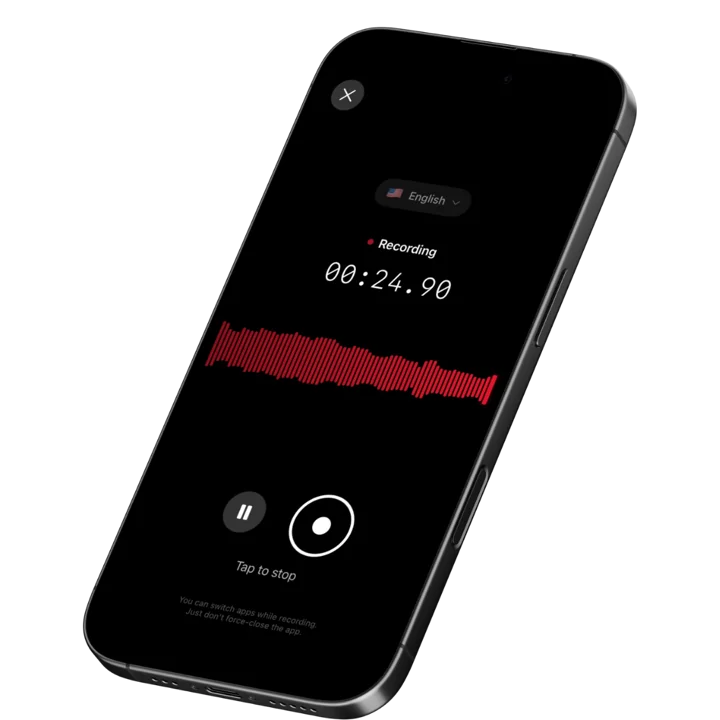
Whether the real number is closer to 13,000 or 16,000, most of the words a person speaks in a day disappear the moment they are said. A conversation ends, a meeting wraps up, a lecture finishes, and the words that filled it are gone unless someone wrote them down by hand, which almost nobody does in full. Speakwise is built around that gap. It is an iPhone app that records in-person conversations, meetings, lectures and interviews with one tap, and turns the recording into a transcript and an AI summary with action items.
The transcript shows who said what, works in 100+ languages, and can run for up to 5 hours in a single recording, even with no internet connection. Speaker identification is not included in every plan. When you start your free trial, pick the plan that includes it. For more on how spoken words get turned into text at scale, see our AI transcription statistics.
Start with a 7-day free trial ($0.00). After that, Speakwise costs from $69.99 per year, which is about $5.83 a month, billed yearly. Prices shown are for the US and can differ by country.Download Speakwise from the App Store and turn today's conversations into a transcript, summary and action items before the words are gone.
Try Speakwise free for 7 days
Available on the App Store | iOS Optimized

🎯 4.9★ App Store Rating | 📱 Built for iOS
