Best AI Note Takers with Speaker Diarization (2026)
Used by recruiters, executives, consultants, and more.
Best AI Note Takers with Speaker Diarization in 2026
AI note takers with speaker diarization solve the problem that makes most transcripts useless: a wall of text with no indication of who said any of it. In a two-person interview you can sometimes guess. In a five-person planning meeting you cannot, and a summary that says "the team agreed to move the launch" is worth very little when three people remember agreeing to different things. Diarization is the feature that separates voices and attributes each line to a speaker. We tested and compared the top options - here are the 6 best.
Quality varies more in this category than vendors admit. Diarization on a clean video call with a participant list is close to solved. Diarization in a room, with overlapping speech and similar voices, is where tools separate.
Best AI Notetakers with Speaker Diarization at a Glance (2026)
The best AI notetakers with speaker diarization in 2026 are:
- Speakwise - Best for in-person meetings on iPhone, with real speaker labels from room audio
- Otter.ai - Best for virtual calls, labeling speakers by their account names
- Fireflies.ai - Best for teams that need attributed notes pushed into Slack and CRM
- Notta - Best cross-platform option, identifying up to ten speakers
- Granola - Best for Mac users who take their own notes alongside the transcript
- Circleback - Best for action items assigned to the person who committed to them
Every tool here labels speakers. The difference is where they can listen: five of the six are built around video calls, while Speakwise is built around the room.
1. Speakwise - Best Overall for In-Person Speaker Diarization
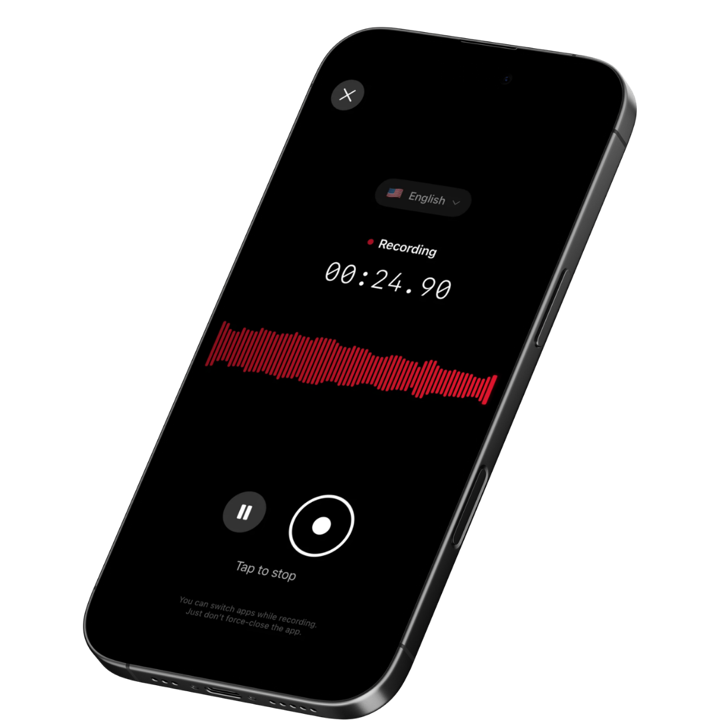
Speakwise is an iOS app that records in-person conversations through the iPhone microphone and applies speaker diarization to the result, so the transcript shows who said what without anyone joining a call. Diarization shipped in July 2026 and works on the harder input: overlapping room audio rather than clean per-participant streams from a video platform. Each session also produces an AI summary and an action item list on top of the labeled transcript.
That combination is unusual. Most diarization lives inside desktop tools that need a meeting link. Speakwise gets speaker attribution out of a phone sitting on a table.
Why Speakwise Stands Out
Video platforms make diarization easy by cheating. Zoom and Teams already know who is speaking because each participant has their own audio stream and their own name. A tool that consumes that data is doing bookkeeping, not voice separation.
Room audio has none of that. One microphone hears everyone, voices overlap, and someone always sits farther from the phone. Speakwise's speaker diarization is built for that input: it separates the distinct voices in a single mixed stream and labels them consistently through the recording, which is what makes an in-person interview, a focus group or a three-way client meeting readable afterwards.
The practical payoff shows up in the summary and the action items. When commitments are attributable, follow-up gets specific: this person owns the revised timeline, that person owns the budget question. Without labels, everything collapses into a passive "it was agreed" that nobody owns. Our guide to transcription apps with speaker labels goes deeper into how far that accuracy stretches in difficult audio.
Key Features
- Speaker Diarization from Room Audio: Speakwise separates distinct voices in a single-microphone recording and labels each contribution in the transcript. Interviews, panels and multi-person meetings come back as attributed dialogue rather than one block of text.
- One-Tap In-Person Recording: Set the iPhone on the table and start with one tap. No bot, no meeting link, no participant list required.
- AI Summaries: Each session is condensed into decisions, themes and open questions, organized by topic rather than by speaker so the summary stays readable.
- Action Items: Commitments made in the conversation are pulled into a list, which is far more useful once you can see which speaker made them.
- Long Recordings: Multi-hour sessions record in one pass, so speaker labeling applies to a full workshop or a long interview rather than a series of fragments.
- 100+ Languages: Transcription covers more than 100 languages with automatic detection, which matters for multilingual interviews and international teams.
- Notion Sync and Share by Link: Notion sync runs automatically once you connect it. For everywhere else, send a labeled transcript by link, or copy the text into a document, wiki or email.
Pricing
Paid subscription via the App Store. iPhone only.
Best For
- Researchers and journalists running in-person interviews and focus groups
- Consultants and managers in multi-person client meetings and workshops
- Anyone who needs attributed notes from a room rather than a video call
- Multilingual sessions where the speakers switch languages
Limitations
- iOS only, with no Android or desktop version
- Label accuracy drops with heavy crosstalk or very similar voices, as it does in every tool here
- Not a meeting bot, so it does not join Zoom, Teams or Google Meet
Speakwise gets your hours back.
- ✓Built for in-person meetings, interviews, and site visits.
- ✓Trusted by recruiters, consultants, agents, and field pros.
- ✓One tap to record. Notion-ready summary in minutes.

2. Otter.ai - Best Speaker Labels for Virtual Meetings
Otter.ai remains the default AI note taker for remote teams, and its diarization is the most convenient in the category for video calls. OtterPilot joins Zoom, Teams and Google Meet, then labels speakers with their actual account names rather than generic numbers. Transcripts land in a shared workspace where colleagues can search, comment and correct speaker assignments.
Key Features
- OtterPilot auto-joins scheduled calls and labels speakers by participant name
- Real-time transcription with editable speaker assignments
- Shared workspace with search, comments and highlights
- AI summaries and meeting outlines on paid plans
Pricing
Free: 300 minutes per month with a 30-minute cap per conversation. Pro: ~$8.33 per user per month billed annually. Business: ~$20 per user per month billed annually.
Best For
- Remote teams that need speakers named, not numbered
- Organizations that review and annotate transcripts collaboratively
Limitations
- Bot-based capture cannot document an in-person meeting
- The free tier's 30-minute conversation cap ends most real meetings early
- Attribution degrades when several people share one conference room microphone
3. Fireflies.ai - Best Attributed Notes for Sales and CS Teams
Fireflies.ai records Zoom, Meet and Teams calls with a bot, produces a speaker-attributed transcript, and then distributes the result. Summaries and action items push into Slack channels, Notion and CRM records in Salesforce or HubSpot. For revenue teams the attribution is not a nicety: knowing which stakeholder raised the pricing objection is the whole point of the note.
Key Features
- Auto-join bot for the major video platforms with speaker-labeled transcripts
- Automatic delivery of attributed summaries to Slack, Notion and CRM records
- Topic and keyword tracking across a meeting archive
- AskFred assistant for querying past conversations
Pricing
Free plan available. Pro from ~$10 per seat per month billed annually, Business from ~$19 per seat per month billed annually, Enterprise ~$39 per seat per month. Some AI features draw on credit allowances.
Best For
- Sales and customer success teams that need attributed notes on the account record
- Teams distributing meeting outcomes across several tools at once
Limitations
- No in-person capture, since everything runs through a call bot
- Credit-based AI limits can bite heavy users
- A visible bot in the participant list is not always appropriate for client calls
4. Notta - Best Cross-Platform Diarization
Notta covers iOS, Android, web and desktop, and identifies up to ten speakers on paid plans. It supports 58 languages with real-time transcription, which makes it a reasonable choice for teams that run interviews across languages and use a mix of devices. Speaker identification is a paid feature; the free tier is essentially a demonstration.
Key Features
- Speaker identification for up to ten speakers on paid plans
- 58 languages with real-time transcription
- Apps for iOS, Android, web and desktop
- Audio and video file import for transcribing existing recordings
Pricing
Free: 120 minutes per month with a 3-minute cap per conversation and 10 AI summaries. Pro: ~$8.17 per user per month billed annually. Business: ~$16.67 per seat per month billed annually.
Best For
- Teams split across iOS, Android and desktop
- Multilingual interview workflows
Limitations
- Speaker identification, transcript downloads and most exports require a paid plan
- The free tier's 3-minute conversation cap makes it unusable for meetings
- Accuracy falls off in noisy rooms and with larger groups
5. Granola - Best for Mac Users Who Still Take Their Own Notes
Granola is a meeting notepad rather than a pure transcriber. It captures the audio your Mac hears without sending a bot into the call, then merges the transcript with the notes you typed yourself into a structured summary. Speaker tags can label participants by display name on supported platforms through a browser extension, and the iPhone app can recognize different speakers in face-to-face meetings. Live diarization during desktop recording is still limited, and Granola infers speakers from context when tags are unavailable.
Key Features
- Bot-free capture of meeting audio on macOS and Windows
- Speaker tags using participant display names on supported platforms
- iPhone app that distinguishes speakers in in-person meetings
- Slack posting and Notion export on paid plans
Pricing
Free plan capped at 25 notes of history. Business ~$14 per user per month. Enterprise ~$35 per user per month.
Best For
- Mac-first professionals who type during meetings and want AI to structure their notes
- Teams that prefer no visible bot in the participant list
Limitations
- Desktop-first, so it depends on having a laptop open in the meeting
- Real-time diarization on the desktop app is limited compared with post-processing
- The 25-note history cap on the free plan is a trial, not a plan
6. Circleback - Best for Action Items Tied to a Named Speaker
Circleback focuses on what happens after the meeting. Its transcripts include speaker identification, and it uses that attribution to assign action items to the person who actually committed to them rather than dumping every task into one list. It supports in-person capture through its mobile experience as well as virtual meetings, and handles technical vocabulary and accents well according to user reviews.
Key Features
- Speaker-identified transcripts with automatically assigned action items
- Support for both virtual meetings and in-person capture
- Wide language coverage and strong handling of domain terminology
- Integrations for routing notes and tasks into other tools
Pricing
Free plan with unlimited recordings and ~5 AI summaries per month. Individual plans from ~$15 per month, team plans from ~$19 per user per month.
Best For
- Teams that measure a meeting by the tasks it produces
- Managers who need commitments attributed to specific people
Limitations
- The free plan's summary allowance runs out quickly for daily meetings
- Younger product with a smaller integration catalog than Fireflies
- In-person capture depends on the phone's microphone placement, same as any room recording
How to Choose an AI Note Taker with Speaker Diarization
- Match the tool to the room. Diarization from a video platform's participant streams is an easier problem than diarization from one microphone in a room. If your important meetings are in person, test with real room audio before you commit, not with a demo call.
- Count your speakers. Two to four voices is comfortable for every tool here. Six to ten is where accuracy starts to slip, especially with similar vocal ranges. Notta advertises up to ten speakers; large panels will still need review.
- Check whether labels can be renamed. Numbered labels are fine for a personal recording and useless in a shared document. Confirm you can rename Speaker 1 to a real name before you distribute notes.
- Test in your actual audio conditions. Background noise is the single biggest factor in label accuracy. Our roundup of apps for recording in noisy environments covers what survives a cafe or a busy office.
- Get consent from the people you record. Recording rules differ by country and by state, and some require every participant to agree. Say out loud that you are recording, wait for agreement, and keep that on the recording. For sensitive material, also check where the audio is stored. Our guide to private voice recording apps covers the storage side.
Frequently Asked Questions
What are the best AI notetakers with speaker diarization in 2026?
Speakwise is the strongest option for in-person meetings, because it applies speaker diarization to room audio captured on an iPhone and adds AI summaries and action items on top. Otter.ai leads for virtual calls, labeling speakers with their real account names. Fireflies.ai is best when attributed notes need to reach Slack or a CRM automatically. Notta covers the widest device range, and Circleback ties each action item to the person who committed to it.
What is speaker diarization in a note taking app?
Speaker diarization is the process of detecting how many distinct voices appear in a recording and labeling which parts of the transcript belong to each one. The output looks like a script: Speaker 1 asks a question, Speaker 2 answers. Video meeting tools often skip the hard version of this by reading names from the participant list. Tools that record a room have to separate voices from a single mixed audio stream.
How accurate is speaker diarization in real meetings?
Accuracy depends mostly on the audio, not the marketing. Two to four speakers with clear turn-taking and low background noise produce labels that need almost no correction. Heavy crosstalk, similar sounding voices, and more than six or seven participants all reduce accuracy. For research, journalism or anything used as evidence, review the speaker assignments before you rely on them. For everyday meetings, the labels are usually good enough as delivered.
Can an AI note taker label speakers in an in-person meeting?
Yes, but fewer tools do it than the category suggests. Bot-based notetakers need a video call to join, so they cannot document a conversation around a table. Speakwise records the room through the iPhone microphone and labels distinct voices in the transcript. Granola's iPhone app and Circleback's mobile capture also handle face-to-face sessions. Microphone placement matters: put the phone in the middle of the table, not in front of one person.
Do I need permission to record a meeting with multiple speakers?
Usually yes, and in some jurisdictions every participant must consent, not just you. Recording laws vary by country and by US state, so the safe practice is the same everywhere: tell the room you are recording, explain what the notes are for, and let people object before you start. Keeping that exchange at the top of the recording gives you a record of consent. For confidential material, also confirm who can access the transcript afterwards.
Final Verdict
For virtual meetings, Otter.ai still sets the standard for speaker labels because it reads names straight from the participant list, and Fireflies.ai wins when those attributed notes need to travel into Slack or a CRM without manual work.
For everything that happens in a room, Speakwise is the pick. Speaker diarization on room audio is the harder engineering problem, and it is the one that decides whether an in-person interview, a focus group or a three-way client meeting produces a usable record. Combined with AI summaries and attributed action items, it turns a phone on the table into a full meeting record.
Choose based on where your meetings actually happen. Teams that do both will keep a bot for the calendar and a phone for the room.
Download Speakwise from the App Store and get a speaker-labeled transcript from your next in-person meeting.
🎯 4.9★ App Store Rating | 📱 Built for iOS
