Best App to Extract Insights from 1:1 Meetings (2026)
Used by recruiters, executives, consultants, and more.
Best App to Extract Insights from 1:1 Meetings in 2026
A tool to extract insights from 1:1 meetings has exactly one job: make sure the thing your report said in week three still exists in week eleven. A manager with eight direct reports runs somewhere north of thirty 1:1s a month. Inside those conversations is the most valuable unstructured data any organization produces - the blocker that has been mentioned three times, the quiet flight risk, the process that everyone works around, the promise you made about scope and forgot by Thursday. Almost none of it survives, because the manager is either taking notes and not listening, or listening and not taking notes. We tested and compared the top options - here are the 6 best tools for extracting insights from 1:1 meetings.
Best Tool to Extract Insights from 1:1 Meetings at a Glance (2026)
The best tool to extract insights from 1:1 meetings in 2026 is Speakwise for in-person and walking 1:1s, and Fellow for teams whose 1:1s live on video calls with agendas. The full ranking:
- Speakwise - Best overall for in-person 1:1s, walking 1:1s, and desk-side conversations (iPhone, no bot needed)
- Fellow - Best for the full 1:1 lifecycle: shared agendas, talking points, and AI notes
- Fathom - Best free option for video-call 1:1s
- Granola - Best bot-free capture on a laptop
- Fireflies - Best searchable knowledge base across an organization's conversations
- Otter.ai - Best conversational search over past transcripts
The split is simple. If your 1:1s happen on a video call, the meeting assistants win. If they happen over coffee, on a walk, or across a desk, none of them can join, and a phone-based recorder is the only thing that works.
1. Speakwise - Best Overall for In-Person 1:1 Meetings
Speakwise is an iOS app that records in-person conversations through the iPhone microphone and returns a transcript, an AI summary, and an extracted list of action items. For 1:1s that happen face to face, it is the only category of tool that functions at all, because every AI meeting assistant on the market is built to join a meeting link that an in-person conversation does not have.
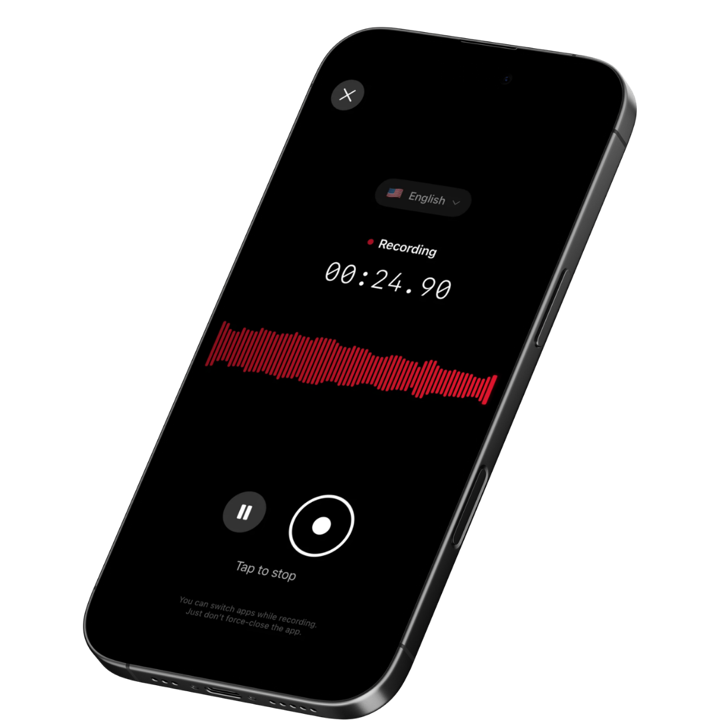
Speakwise runs on a paid subscription through the App Store. The workflow is one tap at the start, phone face down on the table, and a structured summary waiting when the conversation ends.
Why Speakwise Stands Out
The best 1:1s are the ones that do not look like meetings. Walking 1:1s, coffee 1:1s, the twenty minutes after a site visit - these produce more honest signal than any calendar-blocked video call, and they produce zero documentation. Managers accept that trade because the alternative is opening a laptop and killing the dynamic. Speakwise removes the trade: a phone on the table between two people is not a device anyone performs for.
The insight extraction is what makes this more than a recorder. A forty-minute 1:1 becomes a summary of what was actually discussed plus a separate list of commitments, and the commitments are the part that decays fastest. When your report says "I still don't have access to the staging environment" in week two and again in week five, you notice the pattern because both notes exist in searchable text rather than in two different notebooks. Managers who track that consistently find the same thing one-on-one meeting research keeps confirming: the value is in the follow-through, not the conversation.
Speaker labels separate your voice from your report's in the transcript, which matters more than it sounds. When you review a quarter of 1:1s before a performance conversation, you need to know which commitments they made and which you made. Diarization gives you that split automatically instead of forcing you to reconstruct it from context.
For remote 1:1s, the honest answer is that Speakwise does not join video calls. What managers do instead is dictate a sixty-second recap immediately after the call ends, which produces the same structured summary and the same extracted action items from their own account of the conversation. It is less complete than a full transcript and considerably better than nothing, which is what most remote 1:1s currently generate.
Key Features
- One-tap in-person recording: Start with a single tap and put the phone down. Nothing about the setup changes how the conversation feels.
- AI summaries: Every 1:1 returns an organized summary rather than a transcript wall, so a forty-minute conversation is reviewable in ninety seconds.
- Action item extraction: Commitments from both sides are pulled out as a separate list, which is the part that determines whether the next 1:1 starts from a real place.
- Speaker labels: Diarization distinguishes manager from report, so accountability is unambiguous when you review a quarter of conversations at once.
- Long recordings: Handles skip-levels, career conversations, and extended sessions in one file.
- Share and export: Send a summary link so both people leave with the same record, or copy the text into your own notes and performance documents.
- 100+ languages: Covers distributed teams where a 1:1 happens in a shared second language.
Pricing
- Paid subscription purchased through the App Store. Current pricing is shown on the Speakwise App Store listing.
Best For
- Managers whose 1:1s happen in person, on walks, or at a desk
- Skip-level conversations and career development discussions
- Field and site-based managers with no laptop in the conversation
- Anyone who wants both sides to leave with the same written record
Limitations
- iOS only, with no Android or desktop version
- No meeting bot, so it does not join Zoom, Teams, or Meet calls
- No agenda templates, shared talking points, or 1:1 scheduling features
- No integration with performance management or HR platforms
Speakwise gets your hours back.
- ✓Built for in-person meetings, interviews, and site visits.
- ✓Trusted by recruiters, consultants, agents, and field pros.
- ✓One tap to record. Notion-ready summary in minutes.

2. Fellow - Best for the Full 1:1 Lifecycle
Fellow is the most complete 1:1 product on the market because it covers the parts that happen before and after the conversation, not just during it. Shared agendas let both people add talking points ahead of time, AI notes capture the meeting itself, and open action items carry forward to the next 1:1 automatically. It was Wirecutter's pick for transcribing and summarizing meetings, and its 1:1 templates are the reason management teams standardize on it.
Key Features
- Shared, collaborative 1:1 agendas that both people can edit before the meeting
- AI transcription and notes with carry-forward action items
- 1:1 templates and prompts for career, feedback, and growth conversations
- Ask Fellow, an AI agent that answers questions across your meeting history
Pricing
- Team: ~$7 per user per month billed annually
- Business: ~$15 per user per month billed annually
- Enterprise: from ~$25 per user per month annually, 10 user minimum
Best For
- Management teams standardizing how 1:1s are run across an organization
- Managers who want structure before the meeting, not just notes after it
Limitations
- Built around scheduled video calls, so in-person 1:1s fall outside the workflow
- The agenda discipline it depends on is the thing most managers struggle with
- Per-seat cost adds up across a large management layer
3. Fathom - Best Free Option for Video 1:1s
Fathom offers unlimited free recording of video meetings with summaries generated within about 30 seconds of a call ending, and it holds the highest G2 rating in the AI notetaker category. For a manager who wants their remote 1:1s captured without a budget conversation, it is the shortest path. The 2026 catch is that advanced summary templates are limited to the first five meetings per month on the free plan, after which you get the general template only.
Key Features
- Unlimited free recording and transcription of video meetings
- Summaries ready roughly 30 seconds after the meeting ends
- Highlight clips you can share with specific moments marked
- CRM logging on paid tiers
Pricing
- Free: unlimited recordings, advanced summaries capped at 5 per month
- Premium: from ~$16 per user per month billed annually
- Team Edition: from ~$15 per user per month billed annually
- Business: from ~$25 per user per month billed annually
Best For
- Managers with fully remote reports and no tooling budget
- Teams that want fast summaries with minimal configuration
Limitations
- Requires a bot to join the call, which some reports find intrusive in a 1:1
- Advanced summary cap on the free plan arrives quickly for a full management load
- No in-person capture
4. Granola - Best Bot-Free Laptop Capture
Granola takes a different approach: instead of sending a bot into the meeting, it captures audio from your laptop directly and merges it with the notes you type yourself. For 1:1s, the bot-free design is genuinely relevant, because a visible recording bot changes what a direct report is willing to say. It runs about $18 per month for an individual, with 25 free meetings lifetime to evaluate it.
Key Features
- Bot-free capture from laptop audio, so nothing joins the meeting
- Merges your typed notes with the transcript into one enhanced document
- Fast, keyboard-driven note interface built for taking notes live
- Works across meeting platforms without integration setup
Pricing
- Free: 25 meetings lifetime
- Individual: ~$18 per month
Best For
- Managers who want capture without a bot appearing in the participant list
- People who already take notes during 1:1s and want them enhanced rather than replaced
Limitations
- Desktop-first, so it does not help with in-person or walking 1:1s
- Still requires you to be at your laptop with the meeting audio playing
- Individual pricing is higher than team plans elsewhere
5. Fireflies - Best Organization-Wide Knowledge Base
Fireflies is strongest not at the individual 1:1 but at the aggregate. It records across an organization's meetings and builds a searchable archive with topic tracking, so you can search a theme across months of conversations rather than reading one transcript at a time. Its free plan includes unlimited transcription with 800 minutes of storage, and paid plans start around $10 per user per month billed annually.
Key Features
- Searchable archive across all recorded meetings with topic tracking
- Unlimited transcription on the free plan with capped storage
- Field-level CRM sync and custom note templates on paid tiers
- Conversation analytics across teams
Pricing
- Free: unlimited transcription, 800 minutes of storage
- Paid: from ~$10 per user per month billed annually
Best For
- Organizations that want cross-meeting themes, not just per-meeting notes
- Teams already using Fireflies for customer calls who want 1:1s in the same archive
Limitations
- Recording 1:1s into an org-wide searchable archive raises real trust questions
- Bot-based, so it does not cover in-person conversations
- Storage limits on the free plan fill quickly
6. Otter.ai - Best Conversational Search Over Transcripts
Otter's differentiator in 2026 is that you interrogate the transcript rather than read it. Ask what your report said about workload over the last quarter and it answers from the archive. For a manager preparing a promotion case or a performance conversation, that is a faster path than scrolling six transcripts. The free tier is 300 minutes per month with a 30-minute cap per conversation.
Key Features
- Conversational search that answers questions from your transcript history
- Real-time transcription with automatic speaker identification
- Shared workspace with keyword search
- Meeting bot for Zoom, Meet, and Teams
Pricing
- Free: 300 minutes per month, 30 minutes per conversation
- Pro: from ~$8.33 per user per month billed annually
- Business: from ~$19.99 per user per month billed annually
Best For
- Managers preparing performance or promotion cases from months of conversations
- Anyone who wants to query meeting history rather than reread it
Limitations
- The 30-minute free tier cap is shorter than a typical 1:1
- Bot-based, with no in-person capture
- Summary quality is inconsistent on unstructured conversations
How to Choose a Tool to Extract Insights from 1:1 Meetings
1. Start with where your 1:1s physically happen. This single question eliminates most of the list. Bot-based assistants require a meeting link. If a meaningful share of your 1:1s are walks, coffees, or desk-side conversations, those tools capture nothing and your best 1:1s stay undocumented. Count your last month honestly before choosing.
2. Judge it on the follow-up list, not the summary. Summaries are commodity output at this point; every tool produces a readable one. The difference is whether commitments come out as a distinct, trackable list that carries into the next conversation. A 1:1 tool that does not surface open items from last time is a transcription tool with extra steps.
3. Consider what recording does to candor. A 1:1 has a power asymmetry built into it. A bot joining the call, or an org-wide searchable archive holding the transcript, changes what a direct report will tell you about their manager, their team, or their job search. Bot-free and phone-based capture are less intrusive, but the real fix is asking permission and being clear about who can see the record.
4. Check whether both people get the record. The strongest use of a 1:1 tool is shared: the report leaves with the same summary and the same action items you do. That removes the recurring argument about what was agreed and turns the next 1:1 into a review rather than a reconstruction. Tools that keep the record manager-only preserve the asymmetry that causes the problem.
5. Test it across a quarter, not a meeting. Insight extraction is a longitudinal claim. Any tool looks fine on one conversation. The question is whether, twelve weeks in, you can find every time a report raised workload, or trace when a blocker first appeared. That requires searchable text across the archive, which is why the storage and retention limits on free tiers matter more than they look.
A Note on Recording and Consent
Recording a 1:1 with a direct report is not the same as recording a customer meeting. Recording law varies by jurisdiction, and several US states and many countries require the consent of every party to a recorded conversation. Beyond the legal requirement, the power dynamic makes disclosure a matter of basic good practice: tell your report you would like to record, explain why, say exactly who will be able to see the summary, and accept no as an answer without consequence. Many managers get better results by sharing the summary with the report every time, which converts the recording from surveillance into a shared record. Check your own organization's HR policy as well, since some employers restrict recording of employee conversations regardless of what state law allows. For more on the mechanics, see our guide to recording one-on-one meetings with your manager and our roundup of AI apps for one-on-one meetings.
Frequently Asked Questions
What is the best tool to extract insights from 1:1 meetings?
Speakwise is the best tool to extract insights from 1:1 meetings held in person, since it records through an iPhone with no bot required and returns a summary plus extracted commitments. For 1:1s on video calls, Fellow is the strongest option because it links agendas, AI notes, and carry-forward action items into one workflow.
Can I record a 1:1 meeting with my direct report?
Only with their knowledge and agreement. Several US states and many countries require every party to consent to a recording, and most HR policies add their own rules. Disclose it, explain who will see the summary, and share that summary with the report afterward so the record belongs to both of you.
How do managers capture insights from in-person 1:1s?
Bot-based meeting assistants cannot join an in-person conversation, so managers use a phone-based recorder placed on the table, or dictate a sixty-second recap immediately after the conversation ends. Both approaches produce a structured summary and an action item list without a laptop sitting between two people.
What should a 1:1 summary actually contain?
Three things: the topics discussed, the commitments each person made, and the open items carried over from last time. Narrative transcripts are rarely reread. The commitments list is what makes the next 1:1 start from a real place instead of from whatever both people happen to remember.
Final Verdict
The insight problem in 1:1s is not a capture problem for one meeting. It is a memory problem across thirty of them. Any single conversation is easy to remember on the day. What disappears is the pattern: the third mention of the same blocker, the slow shift in how someone talks about their work, the commitment made in May that shaped an expectation in September.
Speakwise is the best pick for managers whose 1:1s happen in the physical world, which is most managers outside fully remote companies. It captures the walking 1:1 and the coffee 1:1 that no bot can reach, extracts commitments as a separate list, and separates your voice from your report's so accountability stays clear across a quarter of conversations.
Fellow is the better answer for organizations standardizing 1:1 practice around scheduled video calls, and its carry-forward action items are the single best-designed feature in the category. Fathom is the right free starting point, and Granola is the right choice for managers who want capture without a bot in the participant list. Pick based on where your conversations actually happen, then judge the tool on whether anything from week three is still visible in week eleven.
Download Speakwise from the App Store and leave your next in-person 1:1 with the commitments already written down.
🎯 4.9★ App Store Rating | 📱 Built for iOS
