Cognitive Offloading Statistics 2026: Memory and AI
TL;DR
Cognitive offloading statistics show how people hand off memory and thinking to phones, search engines and AI tools. A 2015 Kaspersky survey found that 90% of 6,000 people surveyed across six European countries could not recall their children's school phone number from memory. This post has 16 statistics on cognitive offloading. Speakwise records conversations and makes a transcript and summary.
Used by recruiters, executives, consultants, and more.
Cognitive Offloading Statistics 2026: Memory and AI
Cognitive offloading statistics show how much memory and thinking people now hand over to phones, search engines, notes and AI tools. In a landmark 2011 study, people recalled where a fact was stored, a computer folder, 49% of the time, but the fact itself only 23% of the time. A 2015 Kaspersky survey of 6,000 consumers in six European countries found that 90% could not recall their children's school phone number from memory. More recently, a 2025 self-report survey of 666 people in the UK found a strong negative link (-0.68) between AI tool use and critical thinking scores, and a Pew survey run in fall 2025 found that 54% of US teens had used AI chatbots for help with schoolwork. The research is mixed: offloading can free up mental effort, and in several studies heavier reliance on tools went along with weaker memory or weaker critical thinking.
People have offloaded memory for as long as they have had calendars, address books and sticky notes. Phones, search engines and AI tools just make offloading faster and easier than before. We have covered the related problem of too much incoming information in our cognitive overload statistics; this post looks at the other side of the same coin, what happens when people hand the remembering itself to a tool.
This post covers 16 statistics on cognitive offloading, running from the original 2011 Google effect study to 2025 research on AI tools and critical thinking. It looks at both sides of the trade-off: how offloading can free up mental capacity, much like good note-taking always has, and how it can weaken memory and independent thinking when people lean on a tool instead of their own mind. It is for anyone who wants a clear, sourced answer about what handing over our memory really does to us.
Key Cognitive Offloading Statistics (2026)
- Cognitive offloading statistics show that people can remember where a fact is stored better than the fact itself: in a 2011 experiment, participants recalled a storage folder 49% of the time versus 23% for the fact (Sparrow, Liu and Wegner).
- A 2015 Kaspersky survey of 6,000 consumers in six European countries found 90% could not recall their children's school phone number from memory (Kaspersky).
- People who lean on gut instinct over analysis were more likely to search their phones instead of reasoning a question out, in three Waterloo studies with 660 people in total, reported in 2015 (University of Waterloo).
- In a study reported in December 2014, saving one list of words helped college students remember a second list better, which suggests offloading can free up mental effort instead of only costing it (Association for Psychological Science).
- 54% of US teens say they have used an AI chatbot for help with schoolwork, according to a Pew Research Center survey run in fall 2025 (Pew Research Center).
- Knowledge workers' confidence in AI was linked to less critical thinking, a model coefficient of -0.69, while confidence in their own skill was linked to more, in a 2025 survey of 319 workers (Lee et al.).
- AI tool use showed a strong link to cognitive offloading (0.72) and a strong negative link to critical thinking scores (-0.68) in a 2025 self-report survey of 666 people in the UK (Gerlich).
1. People recall where a fact is stored (49%) better than the fact itself (23%)
49% versus 23%. That is how often participants in a landmark 2011 memory study recalled the computer folder where a trivia fact was saved, compared with how often they recalled the fact itself. Betsy Sparrow, Jenny Liu and Daniel Wegner ran the study at Columbia, Wisconsin-Madison and Harvard. Volunteers read and typed short trivia statements, each one assigned to a folder on a computer. Afterward, researchers tested whether people remembered the statement, the folder it was saved in, or both.
People recalled the storage location more than twice as often as the stored information itself, though the authors note the folder question came with a hint, a word from the statement, that the fact question did not have. Researchers called this the Google effect: once people expect a fact to stay available somewhere else, their mind seems to favor remembering how to find it over remembering it directly. The finding was published in the journal Science in 2011.
Source: Sparrow, Liu and Wegner: Google Effects on Memory (Science, 2011)
2. People remembered 31% of facts they expected to lose, but only 22% they expected to keep
31% compared with 22%. In the same 2011 study, participants typed 40 memorable trivia statements into a computer. Half were told their entries would be erased, and half were told the computer would save them. Afterward, everyone tried to write down as many statements as they could remember.
People who believed their answers would be erased recalled about 31% of them. People who believed the computer had saved their answers recalled only about 22%. This was one of the four experiments in the study. The researchers compared it to a long-known memory pattern: when people do not expect to need information later, they do not put in the same effort to hold onto it. Expecting a search engine, a notes app or an AI tool to keep the information produces a similar effect. A reliable backup seems to give the brain a reason to let go.
Source: Sparrow, Liu and Wegner: Google Effects on Memory (Science, 2011)
3. 90% of consumers in a six-country European survey could not recall their children's school phone number
90% is the share of people surveyed across Europe who could not recall their children's school phone number from memory, according to a 2015 Kaspersky survey. Kaspersky, a cybersecurity company, surveyed 6,000 consumers aged 16 and older in six European countries. The same survey found that 53% could not recall their children's own phone numbers and 51% could not recall their workplace number, all without checking a device.
Kaspersky named this pattern Digital Amnesia: forgetting information because you trust a device to remember it for you. This is a company survey, not a peer-reviewed study, but the scale, 6,000 people, and the consistent pattern across several kinds of phone numbers make it a widely cited data point on cognitive offloading. The numbers describe people who no longer memorize many of the phone numbers that matter to them.
Source: Kaspersky: Kaspersky Lab Diagnoses Digital Amnesia
4. 43% of young adults say their phone holds almost everything they need to recall
43% of 16 to 24 year-olds said their smartphone holds almost everything they need to know or recall, in the same 2015 Kaspersky Digital Amnesia survey. That is the youngest group in the study.
The figure suggests offloading is not just a habit people slip into. For many young adults, the phone is where most of what they need to know is kept. Whether that is a problem depends on what happens if the phone is lost, or the information is needed in a moment without one nearby.
Source: Kaspersky: Kaspersky Lab Diagnoses Digital Amnesia
5. 86% say they have too many numbers and handles to remember even if they tried
86% of people in the Kaspersky Digital Amnesia survey agreed that, in an increasingly connected world, they simply have too many numbers, addresses and online handles to remember even if they wanted to. This statistic points at a cause rather than an effect: offloading may not be a pure choice so much as a response to volume.
A generation ago, a person needed to remember a handful of phone numbers and addresses. Today the same person manages dozens of logins, contacts and accounts. Kaspersky's own security researcher said connected devices enrich daily life but have also produced what the company calls Digital Amnesia. The company surveyed this partly to sell security software, so the numbers deserve a critical eye, but the underlying claim, that modern life asks for more memory than one mind can reasonably hold, is hard to dispute.
Source: Kaspersky: Kaspersky Lab Diagnoses Digital Amnesia
6. 660 people linked gut-instinct thinking to leaning on a smartphone for answers
660 is the total number of participants in three University of Waterloo studies, reported in 2015, that looked at how thinking style relates to smartphone use. Researchers led by Gordon Pennycook measured how much people leaned on quick intuition versus slower, more effortful reasoning, then asked about smartphone habits.
People who leaned more on gut instinct were also more likely to search their phones for answers instead of working a problem out themselves. People who scored as more analytical relied on their phones less for this kind of lookup. The researchers were careful not to overstate the finding: whether smartphones actually lower intelligence over time is still an open question, only that the two habits travel together. The result fits a broader pattern. When a quick answer is one search away, there is less pressure to reason it out alone.
Source: University of Waterloo: Heavy Smartphone Use Linked to Lower Intelligence
7. Photographing museum objects made people remember fewer of them
28 undergraduates took a guided tour of 30 objects at an art museum, and a camera changed what they remembered. Psychologist Linda Henkel had each student observe 15 objects and photograph the other 15, then tested their memory the next day. The study was published in the journal Psychological Science.
Students remembered fewer of the objects they had photographed, and fewer details about them, than the ones they had simply looked at. Henkel called this the photo-taking-impairment effect. Her explanation was not about the camera itself but about attention: once a photo is taken, the brain seems to treat the job as done and stops processing the object as closely. When students zoomed in on one part of an object before photographing it, the impairment disappeared, and memory for that object was as strong as for one they had only observed.
Source: NBC News: Want to Remember Your Museum Visit? Don't Take Pictures
8. Saving one list of words helped people remember a second list better
20 college students took part in an experiment that found a surprising benefit of offloading: saving old information can make room to learn new information. Each student studied two computer files, each containing 10 common nouns, then either saved the first file or simply closed it before studying the second.
Students remembered more words from the second file in the trials where they saved the first file than in the trials where they simply closed it. Psychologists Benjamin Storm and Sean Stone, who ran the study at UC Santa Cruz, called the effect saving-enhanced memory, and a second study with 48 undergraduates confirmed it. Their explanation is that saving frees up a limited amount of mental effort, which the brain then spends on the next task. The effect disappeared when saving was unreliable or when there was too little information for offloading to be worthwhile. This is one of the clearest pieces of evidence that offloading is not only a loss.
Source: Association for Psychological Science: Saving Old Information Can Boost Memory for New Information
9. ChatGPT use for schoolwork doubled among US teens: 26%, up from 13%
26% of US teens said they used ChatGPT for schoolwork help in 2024, according to Pew Research Center, double the 13% who said the same in 2023. Pew surveyed 1,391 US teens between September 18 and October 10, 2024, through Ipsos.
Most teens, 73%, still had not used ChatGPT this way, so widespread homework offloading was not yet the norm at that point. But the direction was clear, and attitudes varied by task. 54% of teens said it is acceptable to use ChatGPT to research a new topic, while only 18% said the same about using it to write an essay outright. That gap suggests many teens already draw a line between offloading the search for information and offloading the thinking itself, even without data showing whether that line holds up in practice.
Source: Pew Research Center: About a Quarter of U.S. Teens Have Used ChatGPT for Schoolwork
10. 54% of US teens have used AI chatbots for schoolwork help
54% of US teens say they have used an AI chatbot, such as ChatGPT, Copilot or Character.ai, for help with schoolwork, according to a Pew Research Center survey published in February 2026. Pew surveyed 1,458 US teens and their parents between September 25 and October 9, 2025, a broader and more recent count than the single-chatbot numbers from the year before.
About 1 in 10 teens said they do all or most of their schoolwork with a chatbot's help, while 45% said they do not use chatbots for schoolwork at all. The 54% counts any chatbot, so it cannot be compared directly with the ChatGPT-only numbers from the year before. It does show that more than half of teens had used a chatbot for schoolwork by fall 2025.
Source: Pew Research Center: How Teens Use and View AI
11. Knowledge workers reported thinking critically in only 59% of their AI tasks
59% is how often knowledge workers said they used critical thinking while doing a task with generative AI, in a 2025 survey of 319 knowledge workers by Microsoft Research and Carnegie Mellon University. Participants shared 936 real examples of using tools like ChatGPT at work, and researchers asked whether critical thinking played a role in each one.
Participants reported enacting critical thinking in 555 of the 936 examples, about 59%. That means in roughly 4 out of 10 real tasks, people did not report thinking critically while using AI, often because the task felt low stakes or routine. The researchers found that critical thinking shifted in nature rather than disappearing: instead of producing the work from scratch, people spent more effort verifying, combining and overseeing what the AI produced.
Source: Lee et al.: The Impact of Generative AI on Critical Thinking (CHI 2025)
12. Workers who were more confident that AI could do a task reported less critical thinking (a model coefficient of -0.69)
-0.69 is a model coefficient, not a correlation, from the same Microsoft Research and Carnegie Mellon study of 319 workers. Confidence in AI doing a task was measured on a 5-point scale, and for each one-point rise, the odds of a worker reporting critical thinking about that task went down (p below 0.001).
The more confident workers were that AI could do a task well, the lower their odds of also thinking critically about its output. The opposite showed up for confidence in their own skills: workers who felt more confident in doing the task themselves showed a positive link with critical thinking (0.26), and so did workers who felt more confident in evaluating the AI's answers (0.31). This is a model built from survey answers, not an experiment, so it cannot prove that trusting AI causes weaker critical thinking. It shows that, in this sample, workers who were more confident in AI doing a task also reported less critical thinking while using it.
Source: Lee et al.: The Impact of Generative AI on Critical Thinking (CHI 2025)
13. AI tool use and cognitive offloading moved together closely (a link of 0.72)
0.72 was the strength of the link between how often people used AI tools and how much they said they offloaded thinking to those tools, in a 2025 self-report survey of 666 people in the UK by researcher Michael Gerlich, published in the journal Societies. The survey also included 50 follow-up interviews.
A link of 0.72, on a scale where 1 is a perfect match, counts as strong. In plain terms, people who used AI tools more often also leaned on them more heavily to do their thinking for them, such as checking facts, writing summaries or working through a decision. The study was correlational, so it cannot prove that AI use causes more offloading. It is also possible that people who are already inclined to offload reach for AI tools more often.
Source: Gerlich: AI Tools in Society: Impacts on Cognitive Offloading and the Future of Critical Thinking
14. Frequent AI tool use was linked to lower critical thinking scores (-0.68)
-0.68 was the strength of the negative link between how often someone used AI tools and their score on a critical thinking measure, in the same 666-person study. Younger participants, aged 17 to 25, showed both higher AI use and lower critical thinking scores than participants aged 46 and older.
Education mattered too: people with more formal education scored higher on critical thinking regardless of how much they used AI. The study's author calls the AI-use link strongly negative and points to cognitive offloading, letting the tool do the thinking, as the likely path between the two. As with any correlational study, this cannot show that AI use itself causes weaker critical thinking, only that the two track together closely in this sample.
Source: Gerlich: AI Tools in Society: Impacts on Cognitive Offloading and the Future of Critical Thinking
15. Cognitive offloading had the strongest link with weaker critical thinking (-0.75)
-0.75 was the strength of the link between how much people said they offloaded thinking to a tool and their critical thinking score, the strongest of the three links the study measured. It was stronger than the link for AI use alone.
The study's authors also ran a statistical test called a mediation analysis and reported that offloading accounts for much of the link between AI use and critical thinking scores. But all three numbers come from one survey, not an experiment, so none of them can show that using AI tools causes weaker critical thinking. They show only that, in this sample, people who used AI tools more also said they offloaded more thinking to those tools, and scored lower on the critical thinking measure.
Source: Gerlich: AI Tools in Society: Impacts on Cognitive Offloading and the Future of Critical Thinking
16. 15 of 18 people in a ChatGPT group could not quote a sentence from the essay they had just written (first session)
83.3% (15 of 18 people) in the ChatGPT group of a small 2025 study could not correctly quote a single sentence from an essay they had written only minutes earlier with the AI's help, in the study's first session. This is a preprint from the MIT Media Lab, not yet peer reviewed, and the sample is small: 54 people split into three groups of 18, writing essays over three sessions, with 18 of them coming back for a fourth, spread across four months.
One group wrote with ChatGPT, one with a search engine, and one with no tools at all. Sensors on the head (EEG) showed that brain connectivity dropped as external help increased: the no-tools group showed the strongest brain activity, the search-engine group fell in the middle, and the ChatGPT group showed the least. By the third session, 6 of the 18 ChatGPT users still could not quote their own work correctly. The authors have cautioned against reading too much into one small, early study, but the quoting result is a vivid example of offloading without review.
Source: Kosmyna et al.: Your Brain on ChatGPT (MIT Media Lab preprint, 2025)
What These Cognitive Offloading Statistics Add Up To
Two threads run through this research. The first is that offloading can work as intended: Storm and Stone found that saving old information helped people remember new information, which they take to mean saving frees up mental effort, and Lee and colleagues found that when knowledge workers did think critically about AI output, the work shifted toward checking and combining it, though they reported no critical thinking in about 4 of 10 tasks. Offloading is not automatically a loss.
The second thread is a cost that shows up in several of these studies. Sparrow's original Google effect study found that people remember where to find a fact better than the fact itself. The newer Gerlich survey finds that heavier AI use goes with lower critical thinking scores, and the small Kosmyna preprint found that people who wrote with ChatGPT were worse at quoting their own essay. None of this is entirely new, but an AI tool can now offload judgment, not only facts, which raises the stakes. Our attention span statistics cover a related problem: how phones and constant interruptions make it harder to stay focused.
For most people, a reasonable approach is not to stop offloading, but to review what gets offloaded instead of filing it away and forgetting it exists. A saved note, transcript or AI summary can only help if someone reads it again.
Cognitive offloading can free up mental effort, and in several studies heavier reliance on tools went along with weaker memory or weaker critical thinking.
Offload the Note-Taking, Not the Conversation
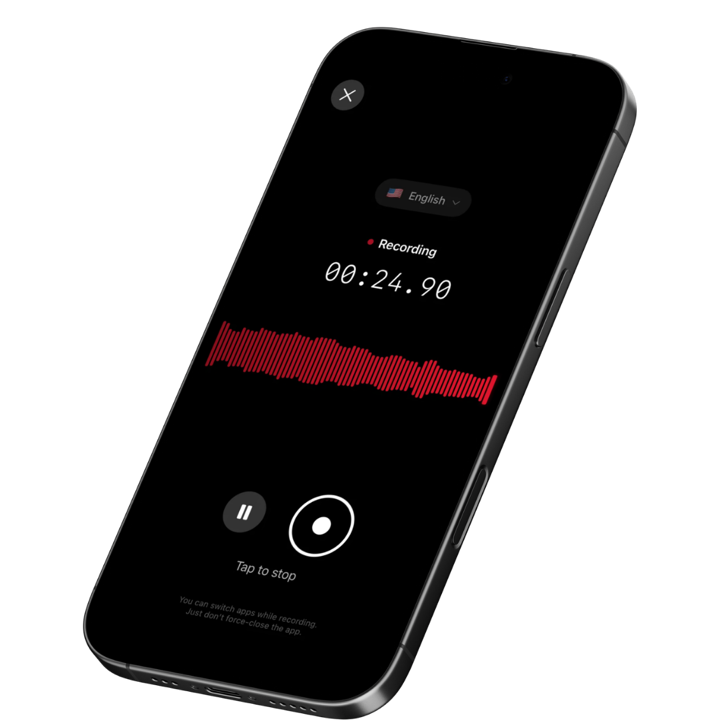
The research above points at a simple idea: offloading can free up mental effort, but in several studies heavier reliance on tools went along with weaker memory or weaker critical thinking. Speakwise records meetings, lectures and interviews on your iPhone with one tap, so there is a full record to look back on.
Afterward, you get a transcript and an AI summary with action items, and you can read that summary again whenever you need it. Speakwise also shows who said what with speaker identification, so a summary of a multi-person conversation is easier to make sense of later. Speaker identification is not included in every plan. When you start your free trial, pick the plan that includes it.
Speakwise works offline, covers 100+ languages with automatic detection, and records up to 5 hours in a single recording. Speakwise users report saving about 73% of their post-meeting follow-up time (Speakwise user surveys).
Try Speakwise free for 7 days ($0.00). After that, it starts at $69.99 per year, which is about $5.83 a month, billed yearly. Prices shown are for the US and can differ by country.Download Speakwise from the App Store and offload the note-taking, not the conversation.
Try Speakwise free for 7 days
Available on the App Store | iOS Optimized

🎯 4.9★ App Store Rating | 📱 Built for iOS
